Marketing Assistant Resume Examples: what gets the call
Build a Marketing Assistant Resume That Earns a First Interview
By Mustafa Tarabya, founder of CVBooster · Published · Updated
A marketing assistant resume example with sample bullets, the tools hiring teams filter on, keyword lists, and a full writing guide.
Sample resumes for a marketing assistant
The same marketing assistant content laid out in three CVBooster templates, so you can see what the finished document looks like before you write a word.
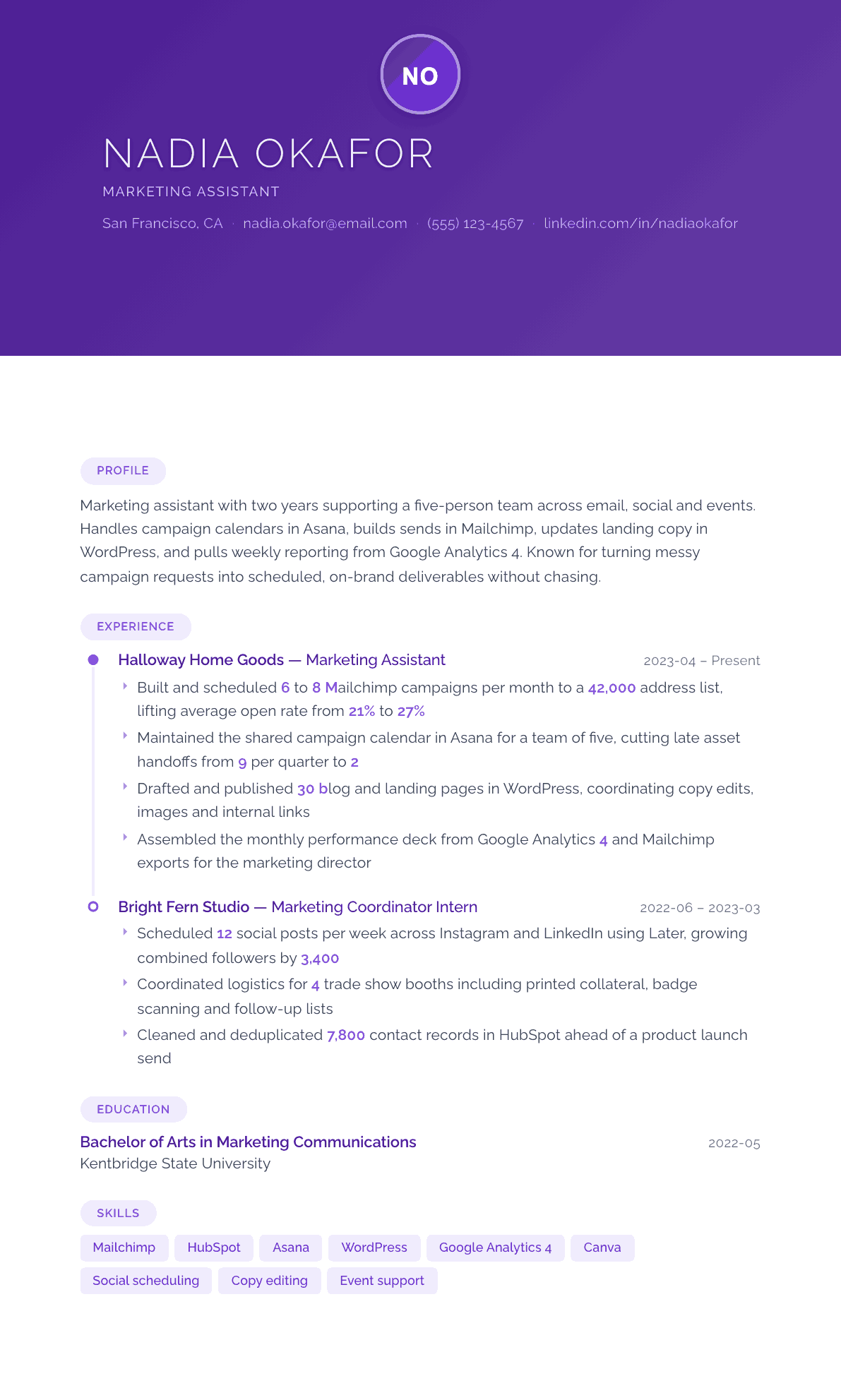
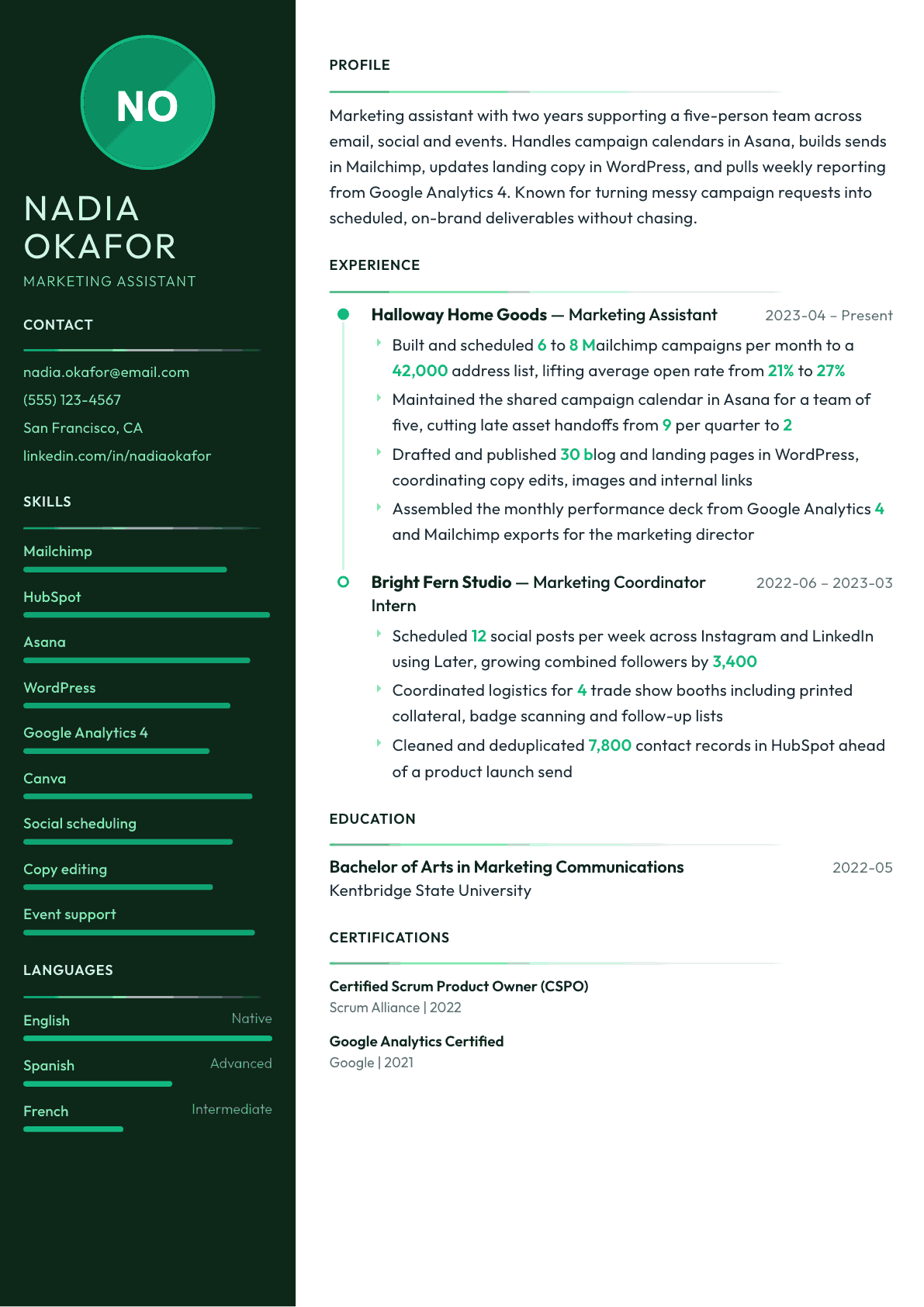
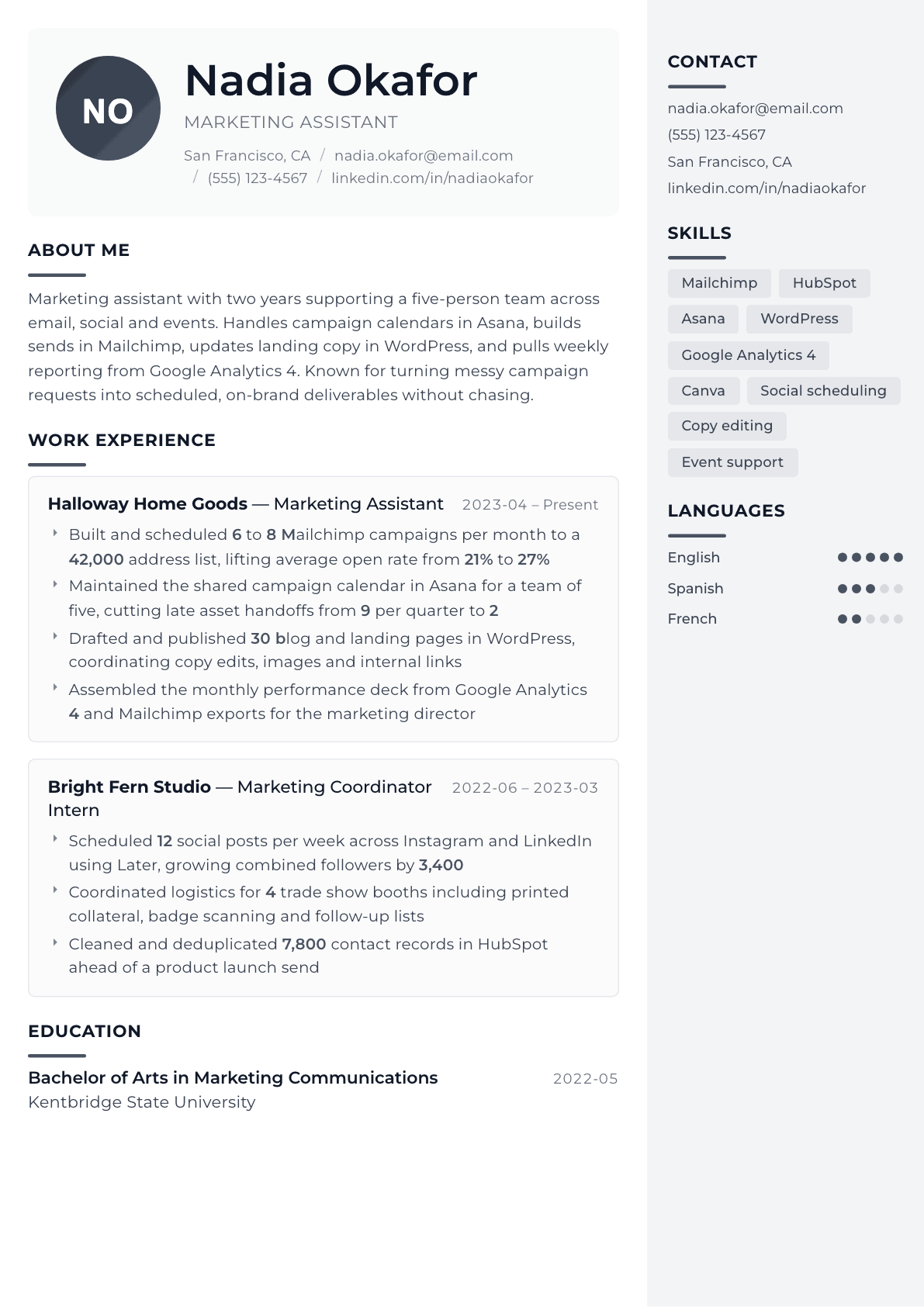
Example Marketing Assistant summary
Marketing assistant with two years supporting email, social and event programs for a consumer brand. Builds and schedules campaigns in Mailchimp, keeps a shared content calendar in Asana, and reports results from Google Analytics 4. Raised email open rate by six points through subject line testing and kept a five-person team on schedule through two product launches.
Skills to list on a Marketing Assistant resume
- Email marketing
- Mailchimp
- HubSpot
- Social media scheduling
- Content calendar management
- WordPress
- Google Analytics 4
- Canva
- Copy editing
- Campaign reporting
- Event coordination
- CRM data hygiene
- Asana
- Basic SEO
What actually gets this resume read
- Name every platform you actually touch, because marketing assistant postings filter on tool names before a human reads a word.
- Show volume rather than duty: sends per month, posts per week, records cleaned, events staffed, pages published.
- Put a short tools section near the top so the recruiter finds Mailchimp, HubSpot and Canva without scrolling to page two.
- Turn coordination work into outcomes: fewer missed deadlines, faster approvals, cleaner data, on-time launches all count.
- Include one bullet showing you read a report, not just built one, such as a subject line test you ran and what it changed.
- Keep the resume to one page and lead with the marketing work even if your title was administrative at the time.
How to write a marketing assistant resume
A marketing assistant opening attracts a very large pile, because it is one of the few marketing titles that accepts recent graduates, career changers and administrative staff who want to move into a creative team. The person reading the pile is usually the marketing manager who will supervise you, and she is scanning for one thing: evidence that handing you a task means the task comes back done, on brand, and on the day it was promised.
That evidence is almost never in the job duties. It is in the tools you have logged into, the volume of work you have moved through them, and the small process fixes you made when a calendar or a contact list was a mess. A resume that says "assisted with marketing campaigns" gives the manager nothing to test in an interview. A resume that says you built eight email sends a month in a named platform and kept a five-person calendar in a named tracker gives her three questions to ask and a reason to ask them.
This guide covers the section order for an assistant resume, how to describe support work without sounding like an intern, three example summaries at different stages, before and after bullets, and the questions people ask most when they are trying to break into a marketing team from the outside.
Format: one page, tools visible above the fold
Use a single column, reverse chronological layout. Marketing assistant postings often run through an applicant tracking system that indexes tool names, so a heavy design template with the tools trapped in a sidebar graphic works against you. Save the visual flourish for the portfolio link.
Put a compact tools line directly under the summary. Group it: email platform, customer relationship system, social scheduler, content management system, analytics, design. Six to ten names is enough. A manager reading fast wants to know within four seconds whether you have touched her stack.
- Header: name, city and state, phone, email, and a link to a portfolio, personal site or public social account you ran.
- Sections in this order: summary, tools, experience, projects if you need them, education, certifications.
- Recent graduates keep education above experience only until the first marketing job is on the resume.
Summary: the team you supported and the channels you touched
Three lines. Name the size and type of team you supported, the channels you worked in, the platforms you used, and one concrete thing you improved. A manager hiring an assistant is buying reliability and range, so both belong in the opening block.
Avoid adjective stacking. "Detail oriented, passionate and creative" is on almost every resume in the stack and survives no scrutiny. Replace it with a fact that implies the same trait: a calendar you kept, a list you cleaned, a deadline pattern you fixed.
Experience: volume, ownership and the fix you made
Each job needs the company, a one line description of what it does if the name is not obvious, and three to five bullets. Lead every bullet with the work rather than the assistance: "Built and scheduled" beats "Assisted the manager with building and scheduling", and it is just as true.
Volume is the assistant version of impact. Sends per month, posts per week, pages published, contact records cleaned, events staffed, decks assembled. These numbers are small compared to a director resume and that is fine; they tell the reader the pace you are used to.
Reserve one bullet in each job for something you noticed and fixed. A duplicate contact problem, a missing approval step, a folder structure nobody could search, a report that was rebuilt by hand every week. Those bullets are the reason assistants get promoted, and hiring managers know it.
- Give the channel: email, social, events, web, print, or paid support.
- Give the tool by name rather than the category. "Mailchimp" indexes; "email software" does not.
- Close each job with one bullet about a process, a template or a piece of data you cleaned up.
Projects: what to do when the marketing work was unpaid
If your marketing experience came from a club, a family business, a volunteer role or freelance work, put it in a projects section with the same structure as a job: name, your role, dates, two bullets with numbers. Do not bury it under an interests heading where it reads as a hobby.
One well documented project beats four vague ones. Pick the piece of work you can talk about for ten minutes: what the goal was, what you built, what happened, what you would change. That is the interview conversation, so choose the project that gives you the best version of it.
Skills and certifications the screen actually filters on
Assistant postings list tools far more often than competencies, so mirror the posting language exactly. If it says HubSpot, write HubSpot rather than customer relationship management. If it says Adobe Creative Suite, name the specific applications you use.
Free platform credentials are worth listing at this level because they are verifiable and they show initiative. The Google Analytics certification, the HubSpot email marketing certification and the Meta social media credential all carry an issuing body a recruiter recognizes. List the issuer next to the name so it reads as a credential and not a course you watched.
Marketing Assistant resume summary examples
First marketing role
Recent communications graduate moving into a marketing assistant role after running social and email for a campus organization and a local bakery. Comfortable in Mailchimp, Canva and Later, and Google Analytics certified. Grew a client Instagram account from 800 to 2,600 followers over one semester while writing every caption.
Two years in
Marketing assistant supporting a five person team across email, social and events for a home goods brand. Builds six to eight Mailchimp campaigns a month to a list of forty two thousand addresses, keeps the shared calendar in Asana, and assembles the monthly performance deck from Google Analytics 4.
Ready for coordinator
Senior marketing assistant running the campaign calendar, the email build queue and the agency asset handoff for a regional retailer. Owns the weekly reporting pack, trained two new assistants, and rebuilt the request intake form so briefs arrive complete. Ready to own campaigns as a marketing coordinator.
Work experience bullets: before and after
Before: Assisted with email marketing campaigns.
After: Built, proofed and scheduled six to eight Mailchimp campaigns a month to a list of forty two thousand addresses, raising average open rate from 21% to 27% through subject line testing.
The platform, the cadence, the audience size and a tested result turn a support line into a track record.
Before: Helped keep the marketing calendar organized.
After: Maintained the campaign calendar in Asana for a team of five, adding an asset due date to every task and cutting late handoffs from nine per quarter to two.
It names the tool, the team size, the change you made, and the number that moved because of it.
Before: Updated the website with new content.
After: Published thirty blog and landing pages in WordPress, coordinating copy edits with two writers, sourcing images, and adding internal links to the related product pages.
The reader learns the volume, the system and the editorial coordination rather than picturing a copy and paste task.
Before: Worked on trade shows and events.
After: Coordinated four trade show booths end to end: printed collateral, badge scanning setup, shipment tracking and a same week follow up list of 380 scanned contacts sent to sales.
Event support is only credible when the logistics and the follow through are spelled out.
Before: Cleaned up the contact database.
After: Deduplicated and standardized 7,800 HubSpot contact records before a product launch, correcting company names and unsubscribing bounced addresses so the send list stayed compliant.
Data hygiene sounds trivial until the volume and the reason behind it are visible.
Hard skills
- Email campaign build
- Mailchimp
- HubSpot
- Social media scheduling
- Content calendar management
- WordPress
- Google Analytics 4
- Canva
- Copy editing
- Campaign reporting
- CRM data hygiene
- Event logistics support
Soft skills
- Deadline discipline
- Written clarity
- Cross team coordination
- Attention to brand detail
- Proactive follow up
- Comfort asking for a clear brief
Certifications worth listing
- Google Analytics Certification (Google Skillshop)
- Google Ads Search Certification (Google Skillshop)
- HubSpot Email Marketing Certification (HubSpot Academy)
- Meta Certified Digital Marketing Associate (Meta)
- Hootsuite Social Marketing Certification (Hootsuite Academy)
Mistakes that cost marketing assistant candidates the interview
- Starting every bullet with "assisted with", which hides the fact that you did the work yourself.
- Listing software categories instead of product names, so the applicant tracking system never matches the posting.
- Filling the summary with adjectives about your personality rather than the channels and tools you have used.
- Leaving out volume, which makes a year of real campaign support read like two weeks of shadowing.
- Hiding club, volunteer and freelance marketing work under interests where a manager reads it as a pastime.
- Sending a heavily designed two column layout to a corporate posting where the parser drops half the tool names.
- Claiming a tool you opened once, since the first interview question for an assistant is usually a walkthrough of a build.
Marketing Assistant resume questions
How do I write a marketing assistant resume with no marketing job yet?
Use a projects section formatted exactly like a job. Give the club, freelance client or volunteer group a name, list dates and your role, then write two bullets with real numbers. Retail or service work still belongs on the resume for the customer and reliability signals.
Should a marketing assistant resume be one page?
Yes. At this level a second page almost always means padding, repeated duties or coursework that adds nothing. One page forces you to keep the strongest bullets, and every marketing manager reviewing assistant applications is reading quickly.
Which tools matter most on an assistant resume?
The email platform and the customer relationship system carry the most weight, followed by a social scheduler, a content management system, an analytics tool and a design tool. Name the exact products, and put them where the reader sees them before the first job.
Do I need a portfolio for a marketing assistant application?
A small one helps a great deal, especially without a formal marketing title. Three to five artifacts is plenty: a newsletter you wrote, a set of social posts, a landing page, a one page report. Host it anywhere public and link it in the header.
How do I show growth if my job title never changed?
Split the role into two blocks under the same employer, or use the bullets to show scope increasing: more channels, a bigger list, a report you took over, a new assistant you trained. Title changes are slow in small teams and hiring managers know it.