Marketing Specialist Resume Examples: what gets the call
Write a Marketing Specialist Resume That Shows Campaign Ownership
By Mustafa Tarabya, founder of CVBooster · Published · Updated
A marketing specialist resume example with campaign bullets, channel keywords, skills recruiters filter on, and a step by step writing guide.
Sample resumes for a marketing specialist
The same marketing specialist content laid out in three CVBooster templates, so you can see what the finished document looks like before you write a word.
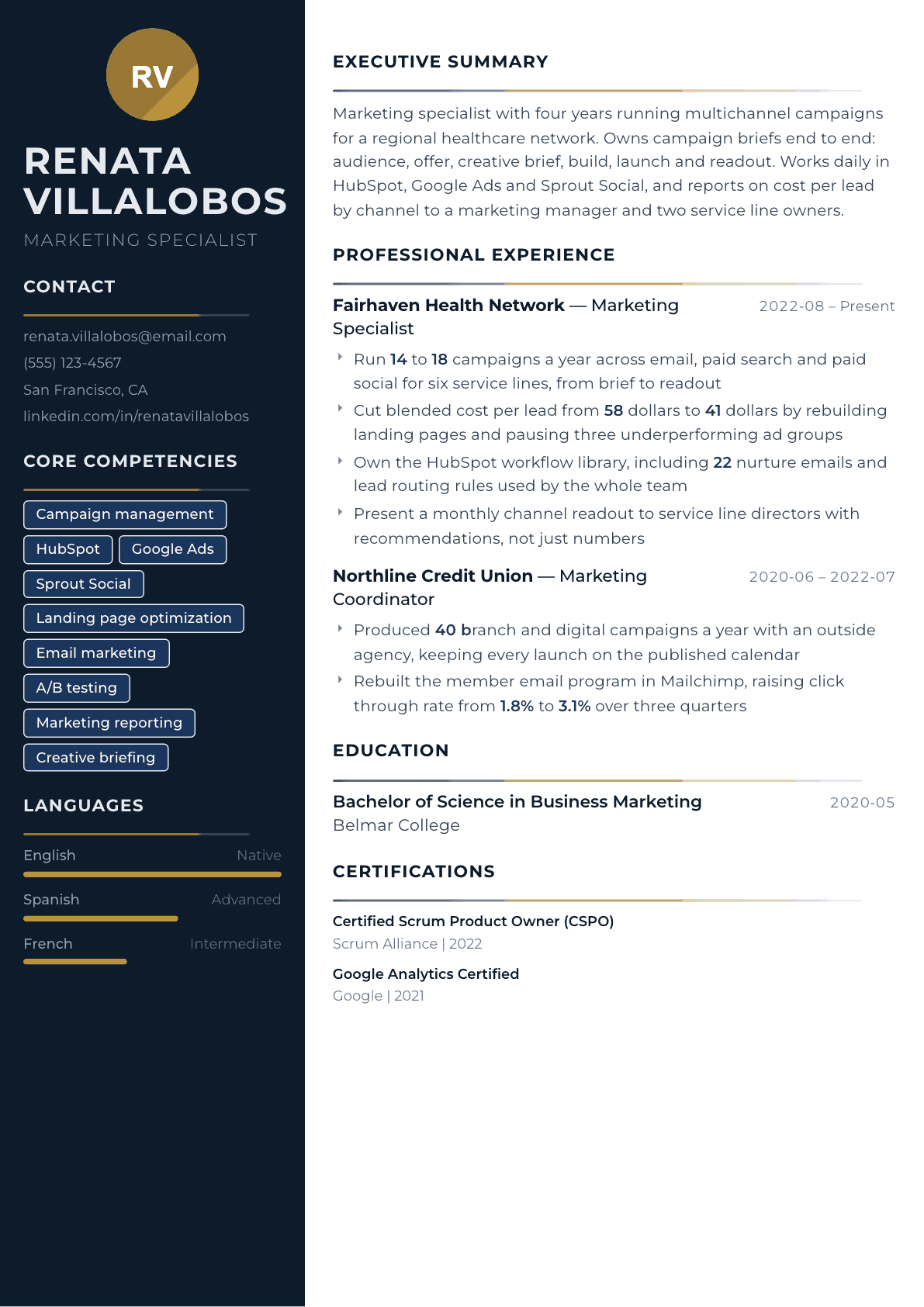
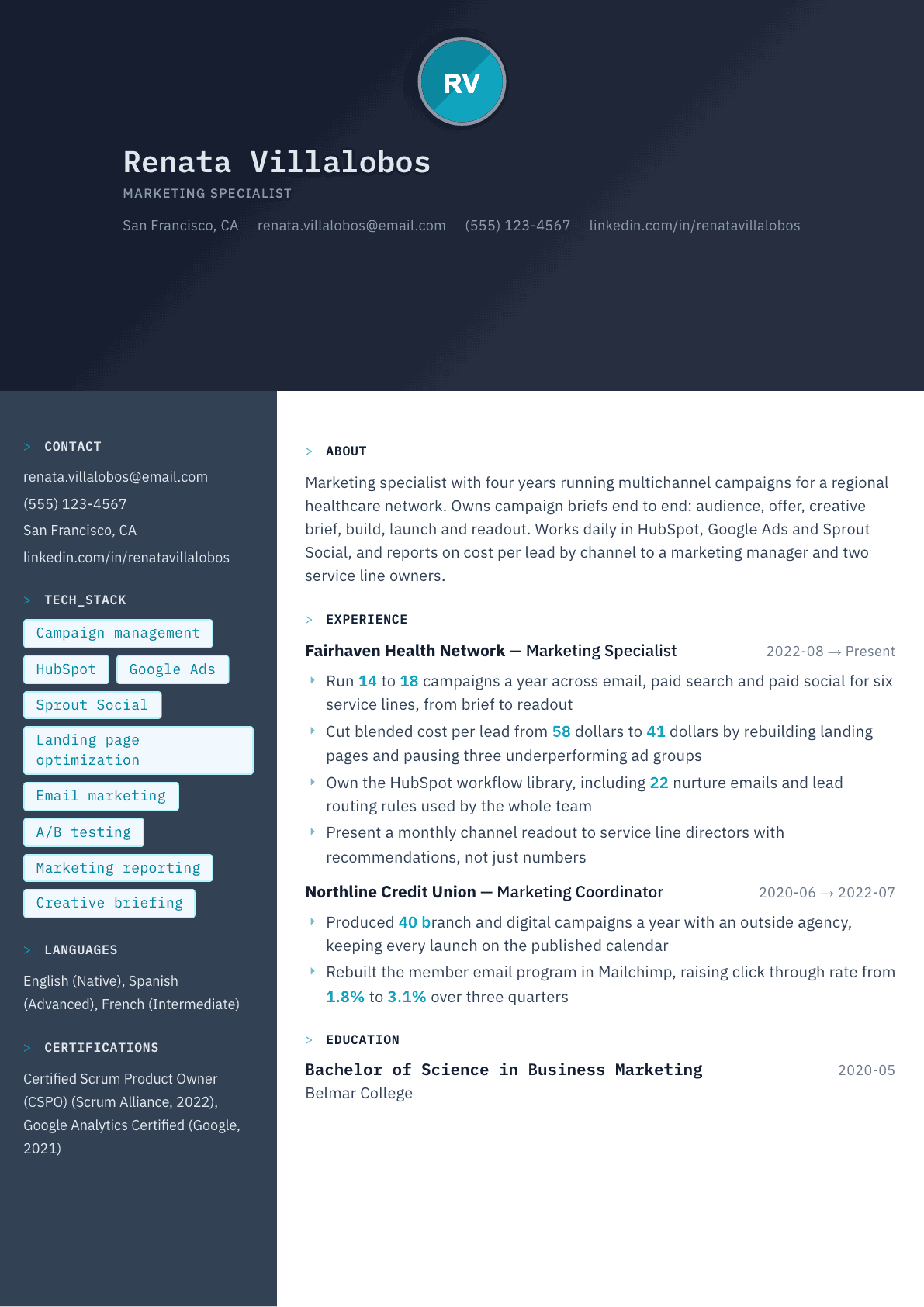
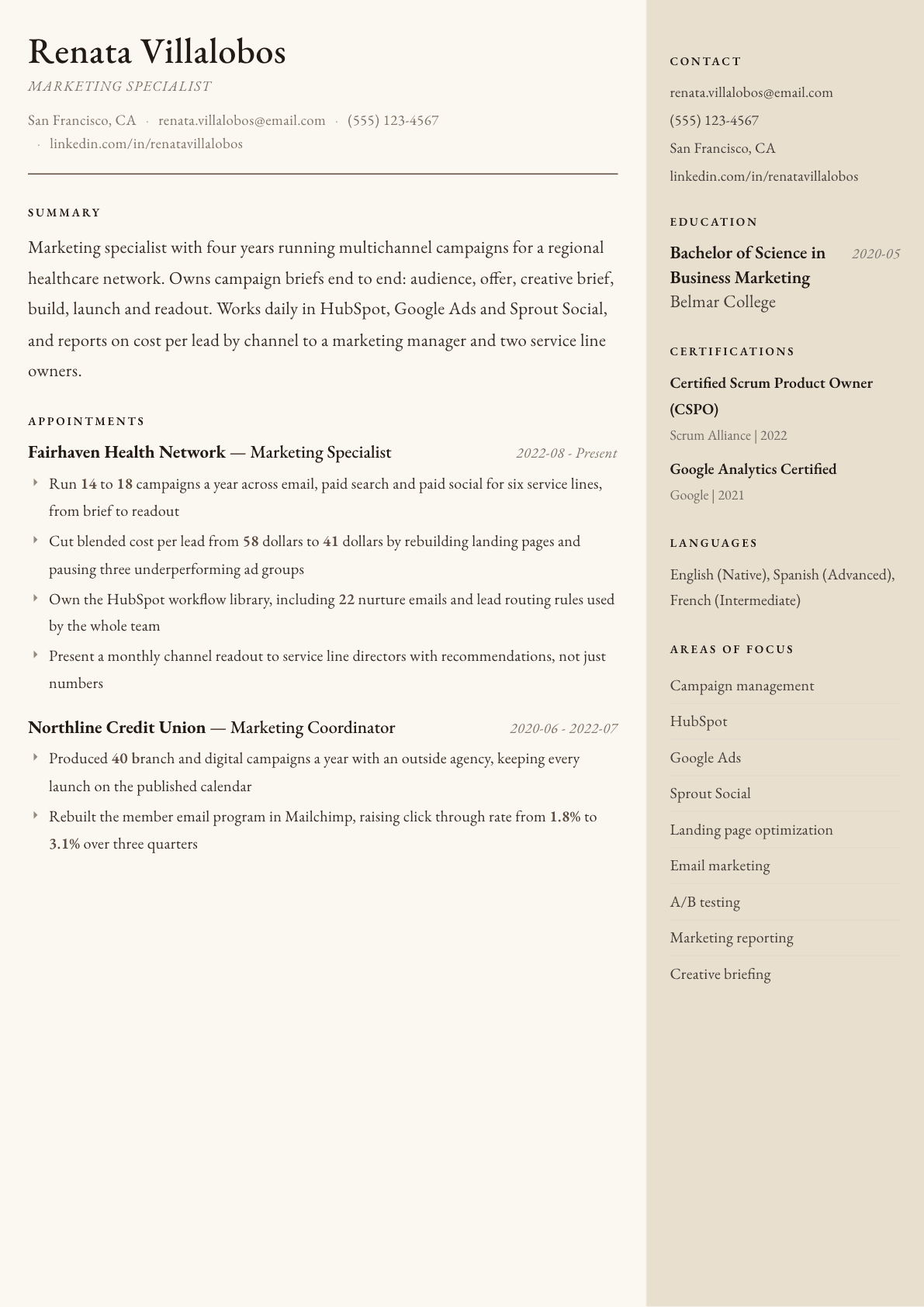
Example Marketing Specialist summary
Marketing specialist with four years running multichannel campaigns for a regional healthcare network across email, paid search and paid social. Owns each campaign from brief through readout and maintains the HubSpot workflow library the whole team uses. Cut blended cost per lead by nearly a third by rebuilding landing pages and cutting weak ad groups, and presents monthly channel recommendations to service line directors.
Skills to list on a Marketing Specialist resume
- Campaign management
- Email marketing
- Paid search
- Paid social
- HubSpot
- Google Ads
- Marketing automation
- A/B testing
- Landing page optimization
- Google Analytics 4
- Copywriting
- Creative briefing
- Marketing reporting
- Audience segmentation
What actually gets this resume read
- Frame each bullet around a campaign you owned end to end rather than a task you helped somebody else complete.
- Give the channel mix in your summary, since a specialist who runs paid search is screened differently from one who runs email.
- Report cost per lead, conversion rate or pipeline contribution, because those are the numbers a marketing manager defends.
- Show the writing side too: a creative brief, a landing page rewrite, a subject line test, an offer you helped design.
- List platform certifications you actually hold, such as the Google Ads and HubSpot credentials, with the issuing body.
- Keep the resume to one page through six years of experience and drop the summer retail job once you have two marketing roles.
How to write a marketing specialist resume
Marketing specialist is the first title where you are expected to own something end to end. An assistant supports campaigns and a manager approves them; a specialist writes the brief, builds the asset, launches it, watches the numbers and comes back with a recommendation. Hiring managers read specialist resumes looking for that full loop, and most applicants only show the middle of it.
The second thing the screen tests is channel fit. The title covers email specialists, field marketing specialists, product marketing specialists and generalists at small companies who do all of it. A posting written for one of those and a resume written for another rarely survive the first pass, even when the candidate could do the job. Your summary has to close that gap in the first two lines.
This guide sets out the section order for a specialist resume, how to write campaign bullets that show ownership, three summaries from first specialist role to senior, before and after bullet rewrites, and answers to the questions people ask when they move up from coordinator or across from an agency.
Format: one page, channels named early
One page carries a specialist comfortably through six or seven years of experience. Use reverse chronological order, a plain single column body, and a tools block under the summary. Keep any design personality in the header rather than in a layout that a parser will scramble.
Name your channel mix in the first line of the summary and repeat it in the tools block. A hiring manager filling an email focused specialist seat is scanning for lifecycle, automation and deliverability language. One filling a field seat is scanning for events, regional programs and sales alignment. Make the match visible instead of hoping it is inferred.
- Header: name, title, city and state, phone, email, professional profile link.
- Sections: summary, tools and platforms, experience, education, certifications.
- Add a short campaigns block only if you have two or three flagship programs worth naming.
Summary: channels, audience, and the number you moved
Three lines. Years in the field, the channels you run, who you market to, the platforms you live in, and the strongest efficiency or volume result you own. Business audience and consumer audience are different crafts, so say which one.
A specialist summary should also signal how independently you work. Owning campaigns from brief to readout, or building without waiting on a designer, or writing your own copy, are all statements that change how a manager pictures the first month.
Experience: one campaign loop per bullet
The strongest specialist bullets describe a complete loop in one sentence: what you were trying to move, what you built, and what happened. Anything shorter reads as a task list, and anything longer stops being scannable.
Give the annual or quarterly count of campaigns you run, because a specialist executing four campaigns a year and one executing eighteen have different tolerances for pace. Then pick two or three campaigns worth naming and describe the mechanics: the audience segment, the offer, the channels, the landing experience, the follow up.
Reserve one bullet per role for an asset the whole team uses. A workflow library, a brief template, a segment definition, a naming convention, a dashboard. Specialists who build reusable pieces are the ones who become managers, and that bullet is where the reader sees it.
- State whether the audience was business buyers, consumers, or internal stakeholders.
- Attach the platform to the work: automation platform, ad platform, content system, analytics.
- Include one bullet where a test failed and you stopped doing something because of it.
Metrics that survive scrutiny
Choose metrics you could reproduce in an interview. Cost per lead, conversion rate by stage, click through rate, list growth net of unsubscribes, pipeline contribution, event attendance to opportunity ratio. Say where the number came from, because the follow up question is always about the source.
Avoid stacking every metric you can remember. Two strong numbers per role, tied to decisions you made, land better than eight numbers that could belong to the team rather than to you.
Skills, certifications and the applicant tracking screen
Mirror the posting vocabulary. Specialist postings repeat a predictable set: campaign management, marketing automation, segmentation, A/B testing, landing page optimization, reporting, and a named customer relationship platform. Put each phrase somewhere it is proven rather than in a list of nouns.
Certifications carry real weight at this level because they are platform specific and checkable. The Google Ads and Google Analytics certifications, the HubSpot marketing software certification and the Salesforce Marketing Cloud credentials all name an issuer a recruiter recognizes. List only the ones you hold, with the issuing body beside them.
Marketing Specialist resume summary examples
First specialist role
Marketing specialist with two years supporting and now owning campaigns for a regional credit union. Runs member email in Mailchimp and paid social for branch openings, and rebuilt the welcome series that raised click through rate from 1.8% to 3.1% over three quarters. Comfortable writing copy and building assets without a designer.
Four years in
Marketing specialist running fourteen to eighteen multichannel campaigns a year for a healthcare network across email, paid search and paid social. Owns every campaign from brief to readout and maintains the automation workflow library the team shares. Cut blended cost per lead from 58 dollars to 41 dollars in one year.
Senior specialist
Senior marketing specialist owning lifecycle and demand programs for a business software company, including segmentation, automation build and quarterly readouts to two service line owners. Mentors one junior specialist, sets the testing calendar, and rebuilt the lead routing rules that ended the weekly handoff disputes with sales.
Work experience bullets: before and after
Before: Ran marketing campaigns across several channels.
After: Ran fourteen to eighteen campaigns a year across email, paid search and paid social for six service lines, owning the brief, the build, the launch and the monthly readout for each.
The volume, the channel list and the phrase covering the whole loop show ownership rather than participation.
Before: Improved cost per lead.
After: Cut blended cost per lead from 58 dollars to 41 dollars by rewriting three landing pages, pausing two underperforming ad groups and shifting that budget into branded search.
A before and after number plus the three specific actions makes the result attributable to you.
Before: Managed marketing automation workflows.
After: Built and maintained a HubSpot workflow library of 22 nurture emails, lead routing rules and re engagement triggers used by every campaign owner on the team.
Naming the count and the shared use turns maintenance into infrastructure the team depends on.
Before: Presented campaign results to stakeholders.
After: Presented a monthly channel readout to three service line directors with a recommendation attached to each chart, which led to two budget reallocations inside a quarter.
Reporting becomes influence once the reader sees a recommendation and a decision that followed it.
Before: Tested email subject lines.
After: Ran a subject line and send time test across twelve sends, found no reliable send time effect, and retired the scheduling debate so the team could focus testing on offers instead.
A negative result honestly reported is rare on resumes and reads as genuine analytical discipline.
Hard skills
- Campaign management
- Marketing automation
- Email marketing
- Paid search and paid social
- Audience segmentation
- A/B testing
- Landing page optimization
- HubSpot
- Google Ads
- Google Analytics 4
- Creative briefing
- Campaign reporting
Soft skills
- Ownership without prompting
- Clear briefing of designers and writers
- Stakeholder communication
- Analytical curiosity
- Calm under launch pressure
Certifications worth listing
- Google Ads Search Certification (Google Skillshop)
- Google Analytics Certification (Google Skillshop)
- HubSpot Marketing Software Certification (HubSpot Academy)
- Salesforce Certified Marketing Cloud Email Specialist (Salesforce)
- Professional Certified Marketer (American Marketing Association)
Mistakes that cost marketing specialist candidates the interview
- Describing the campaign the team ran instead of the part you personally owned from brief to readout.
- Leaving the channel mix out of the summary, so a hiring manager cannot tell which specialist seat you fit.
- Reporting only vanity counts such as sends and impressions with no efficiency or conversion figure beside them.
- Writing bullets that stop at launch, when the interesting half of the job is what you concluded afterward.
- Listing a customer platform without saying what you built inside it, which invites a skeptical screening question.
- Using an agency style resume full of client logos and no numbers when applying to an in house team.
Marketing Specialist resume questions
What is the difference between a marketing specialist and a marketing coordinator resume?
A coordinator resume proves reliable execution across other people's campaigns. A specialist resume proves ownership of a campaign loop, including the brief, the build, the measurement and the recommendation that followed. Rewrite coordinator bullets around decisions you made.
How many numbers should a marketing specialist resume include?
Two or three strong ones per role. Each should be reproducible in an interview and tied to something you decided. Eight scattered metrics look impressive at a glance and collapse the first time a hiring manager asks where a figure came from.
Should I list every marketing tool I have used?
No. List the ones you have built something in and could demo. A tools block of eight to twelve products with the categories grouped reads as credible; a wall of thirty logos reads as a list of software you have seen a colleague open.
How do I move from agency to an in house specialist role?
Translate client work into business outcomes rather than deliverables. Name the industries you served, the budget scale, and the results in the client's terms. Then add one line showing you understand internal stakeholder work, because that is the part agencies do not teach.
Do marketing specialist resumes need a portfolio?
It helps in content and creative heavy seats and matters less in operations or paid media. When you include one, pick three or four artifacts with a short note on the goal, your role and the outcome, rather than a gallery of finished pieces without context.