Marketing Coordinator Resume Examples: read this first
Write a Marketing Coordinator Resume That Shows Execution
By Mustafa Tarabya, founder of CVBooster · Published · Updated
Marketing coordinator resume examples with campaign, email and event bullets, plus a guide to the tools and keywords coordinator postings screen for.
Sample resumes for a marketing coordinator
The same marketing coordinator content laid out in three CVBooster templates, so you can see what the finished document looks like before you write a word.
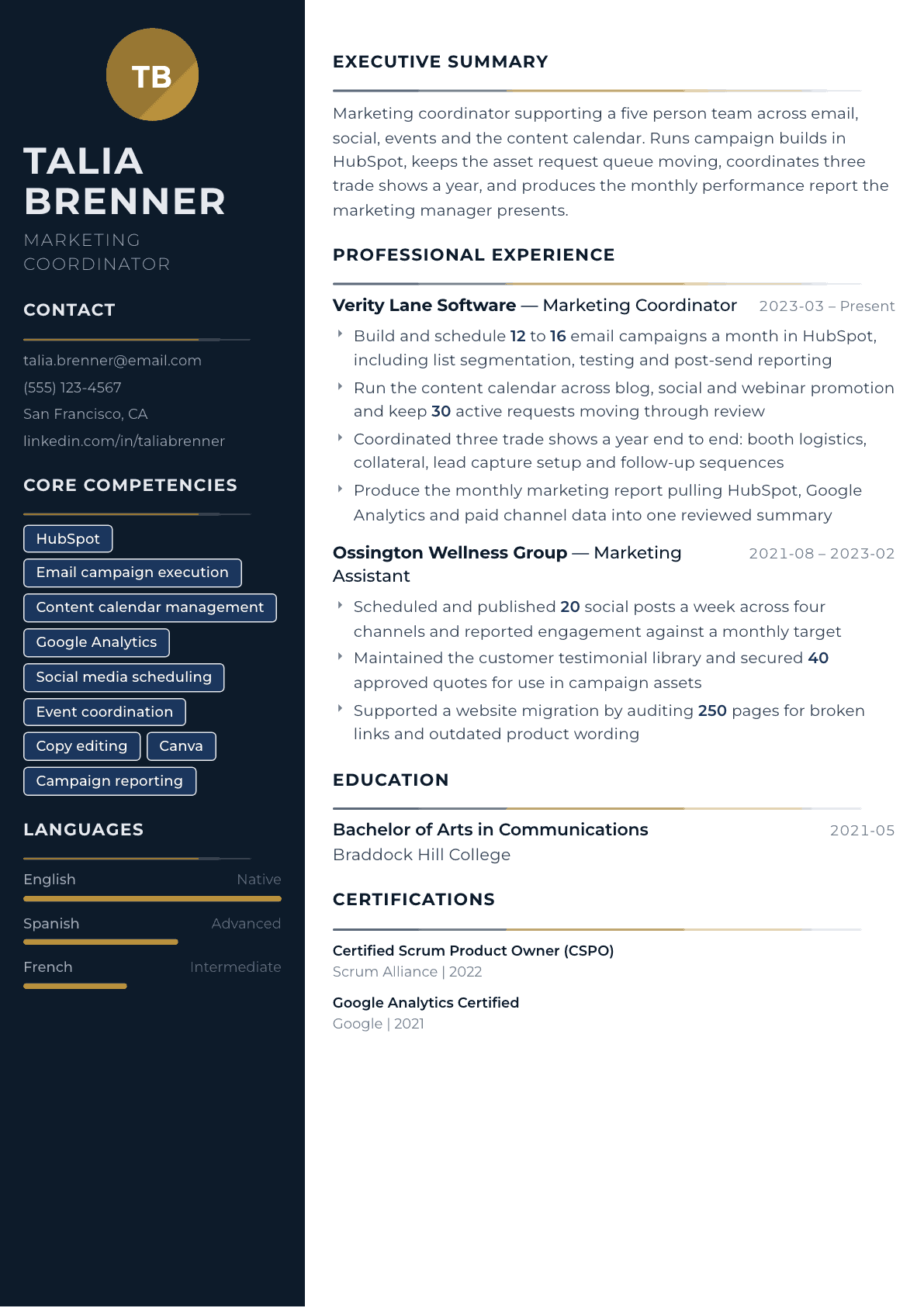
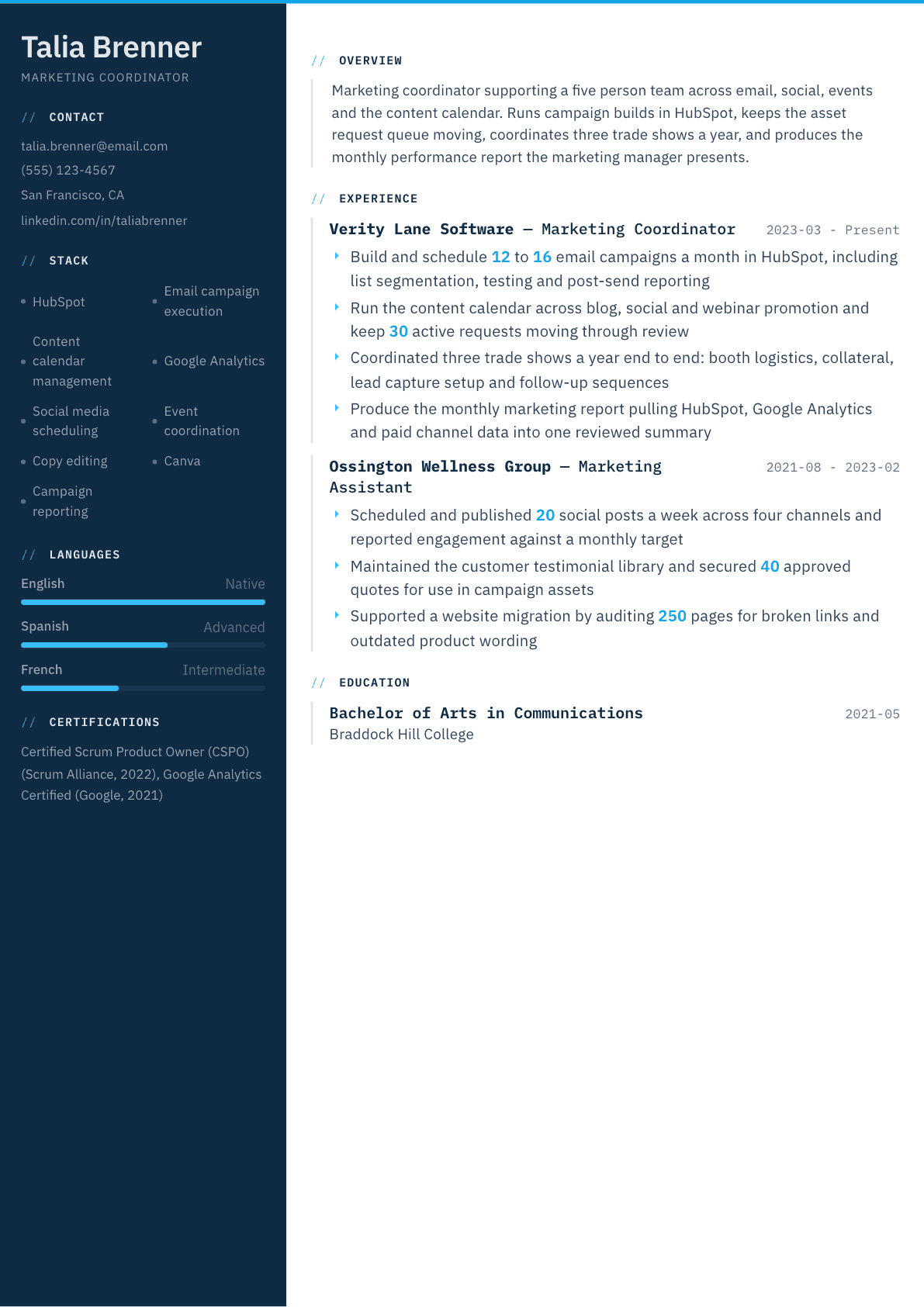
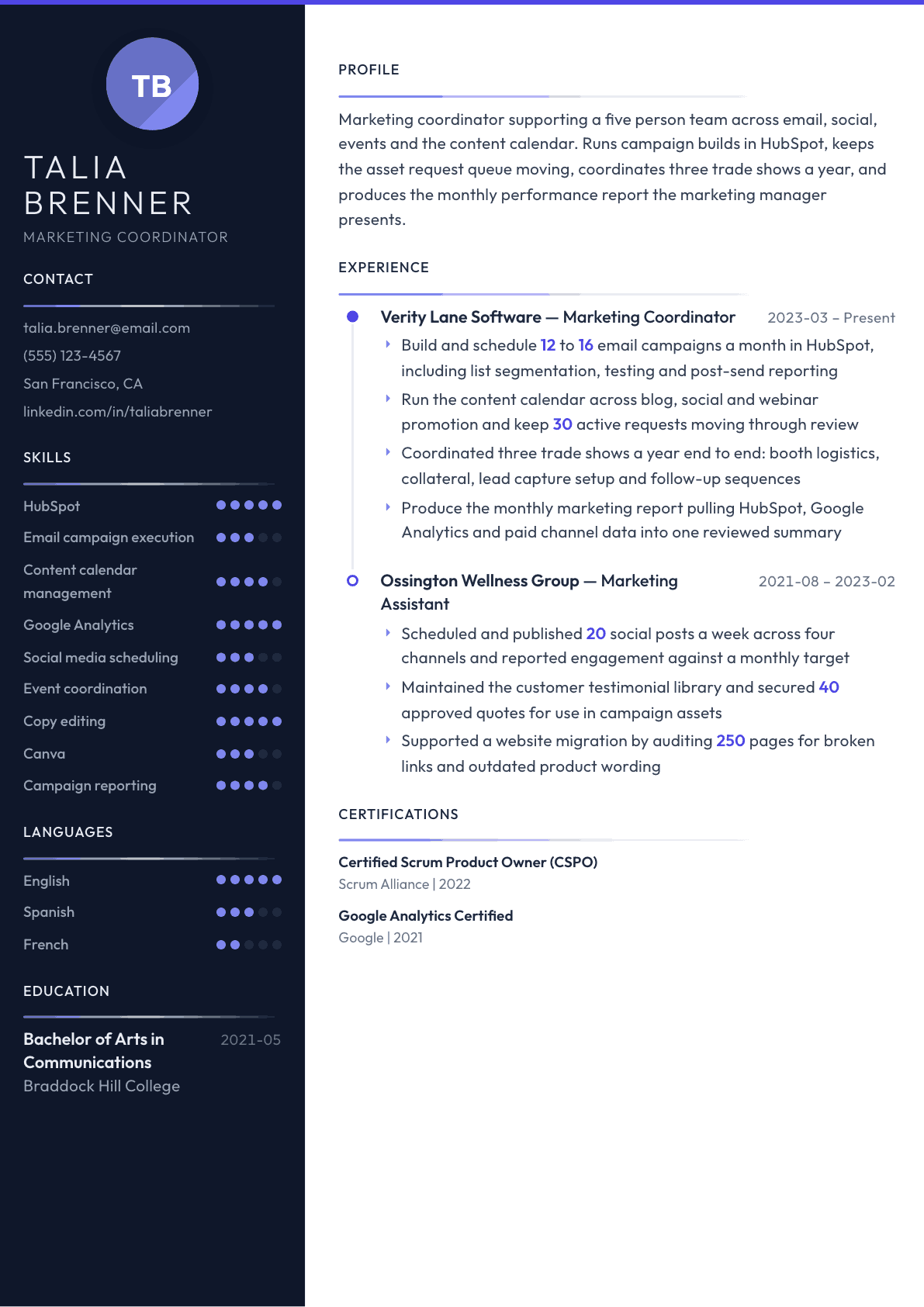
Example Marketing Coordinator summary
Marketing coordinator with four years supporting software and wellness marketing teams. Builds 12 to 16 email campaigns a month in HubSpot, runs the content calendar across blog, social and webinar promotion, and coordinates three trade shows a year end to end. Produces the monthly report that pulls HubSpot, Google Analytics and paid channel data together. Reliable on deadlines nobody has to chase.
Skills to list on a Marketing Coordinator resume
- Email campaign execution
- HubSpot
- Marketing automation
- Content calendar management
- Social media scheduling
- Google Analytics
- Campaign reporting
- Event and trade show coordination
- List segmentation
- Copy editing
- Canva
- Content management systems
- Landing page builds
- Vendor coordination
- Lead capture and routing
What actually gets this resume read
- Show cadence rather than adjectives: campaigns sent a month, posts a week, events a year, and requests moving through your queue.
- Name the marketing platform you work in, because HubSpot, Marketo, Mailchimp and Klaviyo experience are screened as separate skills.
- Prove reporting ability by naming the sources you pull together and who reads the summary you produce each month.
- Include event coordination detail such as booth logistics, lead capture and follow-up, since coordinators often own that end to end.
- Separate work you executed from work you only supported, because coordinator hiring is about reliable ownership of the small pieces.
- Add any design or content tooling you use directly, such as Canva, Figma or a content management system, with the tasks you did in it.
How to write a marketing coordinator resume
A marketing coordinator is hired to make sure things actually happen. The strategy is usually decided above you, and your value is that campaigns go out on schedule, the event booth arrives with the right collateral, the request queue keeps moving and the monthly numbers are ready before anyone asks. The hiring manager reading your resume is looking for evidence that nothing falls through when you own it.
That makes cadence the most persuasive thing you can put on the page. Emails built per month, posts published per week, events run per year, requests moving through review. Those numbers show throughput in a role where throughput is the job, and they replace the adjectives that fill most coordinator resumes.
Below is the layout marketing managers expect, three summaries covering assistant through senior coordinator, before and after bullets that turn support work into ownership, and answers to the questions coordinators ask when they are trying to move up rather than sideways.
Format: one page, platform named early
One page, single column, reverse chronological. The single most important formatting decision is putting your marketing platform where it is visible in the first third of the page, because postings screen on those product names and a hiring manager with a stack of files uses them to sort quickly.
Resist the urge to make a marketing resume visually elaborate. Portfolio work belongs in a portfolio link, and heavy graphic layouts break in the applicant tracking systems that most marketing teams still hire through.
- Header: name, city and state, phone, email, portfolio or professional profile link.
- Sections: summary, experience, tools and platforms, education, and a short certifications block if you have any.
- Name the company type. Software, agency, nonprofit and retail marketing coordination differ more than the title suggests.
Summary: team, channels, cadence, one thing you own end to end
Three lines. Who you support and how big the team is, the channels you work across, your working cadence, and one thing you own from start to finish without supervision. That last piece is the whole argument for hiring a coordinator over an assistant, so it should never be left implied.
Avoid opening with creative and detail oriented. Every coordinator resume in the pile starts that way, which means it functions as blank space. Replace it with a cadence figure and the platform, and the same three lines start doing work.
Experience: cadence, ownership, coordination, reporting
Email and campaign bullets should carry the build count per month and the parts of the process you handle: segmentation, testing, scheduling, quality checks and post-send reporting. A coordinator who owns segmentation and testing is doing more skilled work than one who schedules approved sends, and the distinction is invisible unless you write it.
Content calendar work is best expressed as a queue. Say how many active requests you keep moving, how many contributors you chase, and what the review sequence looks like. Marketing managers hire coordinators specifically to stop being the bottleneck, so evidence that you cleared one is directly persuasive.
Events deserve detail because coordinators frequently own them end to end. Booth logistics, shipment timing, collateral, staffing schedules, lead capture setup and the follow-up sequence afterward are all concrete responsibilities, and the follow-up piece is the part that connects your work to pipeline.
Reporting is the bullet that separates a coordinator ready for promotion from one who is not. Name the data sources you pull together, the cadence, and who reads the summary. Anyone who can assemble a monthly report from a marketing platform, an analytics tool and a paid channel without supervision is doing marketing operations work.
Tools: platform, analytics, content, design
Group your tools rather than listing them in a single line. Marketing automation and customer relationship platforms come first because they are the strongest screening signal. Then analytics, then the content management system and any advertising platform, then design and scheduling tools.
State the depth for the main platform. Building a workflow, setting up a landing page with form logic, and managing list hygiene are different capabilities from sending an approved template, and the interview will establish which one you have within a few questions.
- Marketing automation and customer relationship platform, with the tasks you perform in it.
- Analytics and reporting tools, plus any advertising platform you have had direct access to.
- Content management system, design and scheduling tools, and any project management tool you run the queue in.
Keywords coordinator postings screen for
The repeated terms are campaign execution, email marketing, marketing automation, content calendar, social media scheduling, event coordination, lead capture, list segmentation, landing pages, campaign reporting and marketing operations. Use the ones that are true of you, placed where a bullet proves them. Marketing hiring managers read for evidence of throughput, so a term attached to a cadence figure lands far harder than the same term in a skills strip.
Marketing Coordinator resume summary examples
Moving up from assistant
Marketing assistant ready for a coordinator seat, publishing 20 social posts a week across four channels and maintaining the testimonial library that supplies campaign assets. Supported a website migration by auditing 250 pages for broken links and outdated wording. Comfortable in a marketing platform and an analytics dashboard.
Three years coordinating
Marketing coordinator supporting a five person team across email, social, events and the content calendar. Builds 12 to 16 email campaigns a month including segmentation and testing, keeps 30 active requests moving through review, and coordinates three trade shows a year end to end.
Senior coordinator
Senior marketing coordinator running campaign operations for two business lines, owning the request intake process, the monthly performance report and the trade show calendar. Rebuilt the intake workflow so briefs arrive complete, cutting revision rounds and freeing the manager from queue triage entirely.
Work experience bullets: before and after
Before: Assisted with email marketing campaigns.
After: Build and schedule 12 to 16 email campaigns a month including list segmentation, subject line testing, link and rendering checks, and the post-send report circulated to the team.
Volume and the named process steps convert an assisting claim into ownership of an end-to-end workflow.
Before: Managed the content calendar for the team.
After: Run the content calendar across blog, social and webinar promotion, keeping 30 active requests moving through drafting, review and publication with weekly status to the marketing manager.
A live request count and the review stages show you cleared a bottleneck rather than maintained a spreadsheet.
Before: Helped organize trade shows and events.
After: Coordinated three trade shows a year end to end: booth logistics and shipment timing, collateral, staffing schedule, lead capture setup and the follow-up email sequence within 48 hours of close.
The full task list plus the follow-up timing connects event work to pipeline instead of leaving it as logistics.
Before: Created reports on marketing performance.
After: Produce the monthly marketing report pulling automation platform, web analytics and paid channel data into one reviewed summary for the leadership meeting.
Naming the sources and the audience shows independent reporting ability, which is the promotion signal in this role.
Before: Posted on social media channels regularly.
After: Scheduled and published 20 social posts a week across four channels, tracking engagement against a monthly target and adjusting posting times based on the previous month results.
Cadence, a target and an adjustment loop turn publishing into managed channel work with a feedback mechanism.
Hard skills
- Email campaign execution
- Marketing automation platforms
- List segmentation and hygiene
- Content calendar management
- Social media scheduling
- Web analytics reporting
- Landing page building
- Event and trade show coordination
- Lead capture and routing
- Content management systems
- Copy editing and proofing
- Campaign performance reporting
Soft skills
- Chasing contributors politely
- Deadline reliability
- Attention to proofing detail
- Vendor coordination
- Prioritizing competing requests
- Clear status communication
Certifications worth listing
- Google Analytics Certification (Google)
- HubSpot Marketing Software Certification (HubSpot Academy)
- Meta Certified Digital Marketing Associate (Meta)
- Google Ads Search Certification (Google)
Mistakes that cost marketing coordinator candidates the interview
- Opening with creative and detail oriented, a phrase so common in this role that it reads as blank space.
- Leaving the marketing platform buried at the bottom when postings filter on those exact product names.
- Writing assisted and supported throughout, which describes an assistant rather than a coordinator ready to own work.
- Omitting cadence figures in a role where throughput is the actual product being hired.
- Skipping the reporting bullet, the clearest evidence that you can operate without the manager checking your work.
- Using a heavily designed template that breaks parsing, when a portfolio link would carry the visual case better.
Marketing Coordinator resume questions
What is the difference between a marketing coordinator and a marketing assistant?
A coordinator owns processes end to end and is trusted to run a campaign, an event or a report without step-by-step direction. An assistant supports tasks others own. Show the difference by writing at least three bullets where you were the person accountable for delivery.
Do I need certifications to be a marketing coordinator?
They are not required, but platform and analytics certifications are cheap credibility when your experience is short. List them with the issuing body and the year is unnecessary. They matter most for candidates moving into marketing from another field entirely.
How do I show results when I do not own the strategy?
Report execution outcomes rather than business outcomes. Campaigns delivered on schedule, requests cleared, events run, engagement against target and reports produced without revision are all genuinely yours, and a marketing manager reads them as reliability evidence.
Should a marketing coordinator resume include a portfolio?
Include a link if you have written copy, built landing pages or designed assets. Keep the resume itself plain and let the portfolio carry the visual work. A single line in the header is enough, and the portfolio should open on relevant pieces rather than everything you have made.
How do I move from coordinator into a specialist or manager role?
Pick one channel and go deep enough to own its numbers, then rewrite that section of your resume around performance rather than execution. Coordinators who can show they improved a channel metric, not just ran the channel, are the ones who get promoted internally and hired externally.