Packer Resume Examples: what a hiring manager reads first
Write a Packer Resume That Proves Speed and Quality
By Mustafa Tarabya, founder of CVBooster · Published · Updated
Packer resume example with pack rate and quality bullets, warehouse keywords, station skills to list, and a guide to writing every resume section.
Sample resumes for a packer
The same packer content laid out in three CVBooster templates, so you can see what the finished document looks like before you write a word.
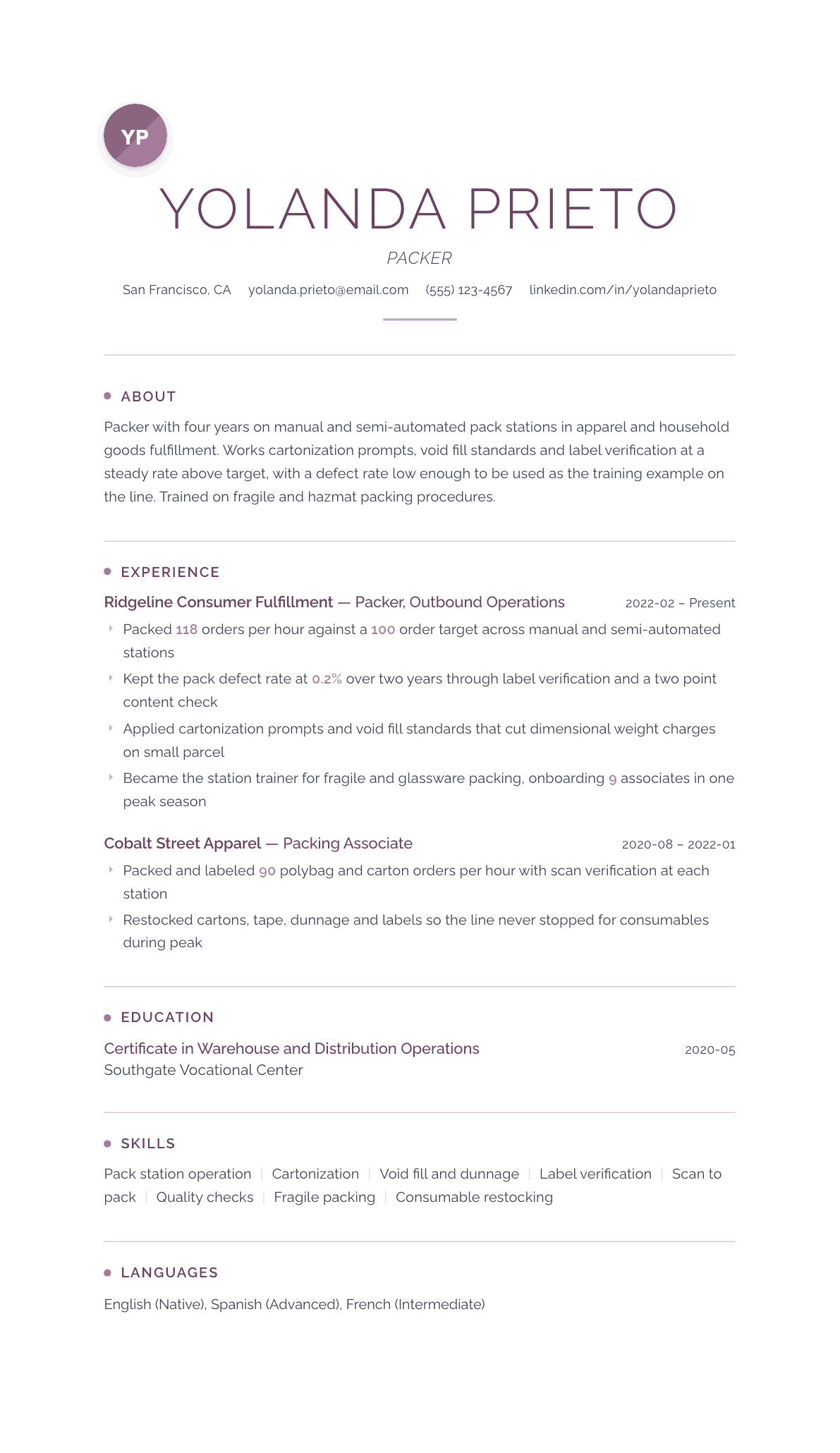
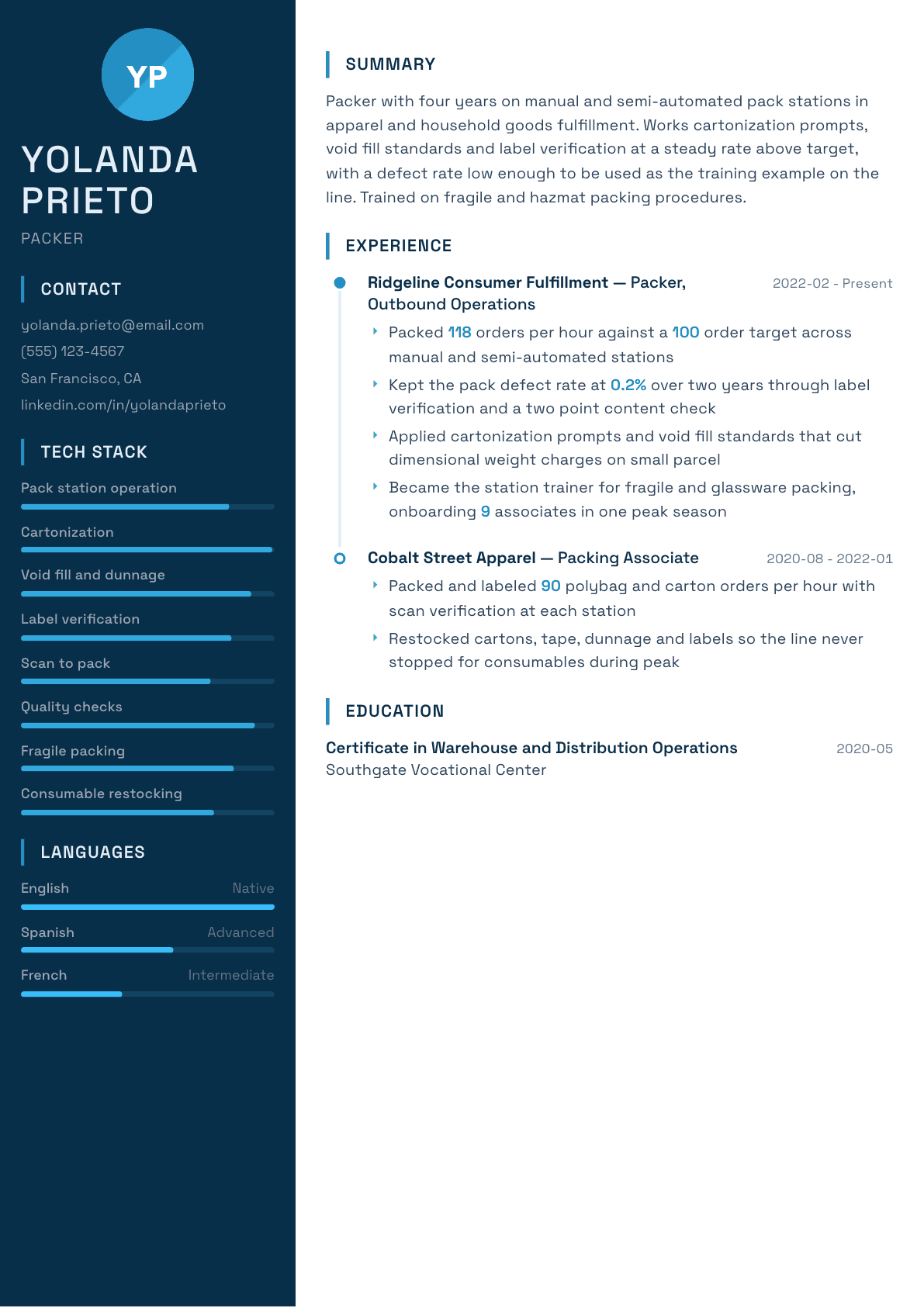
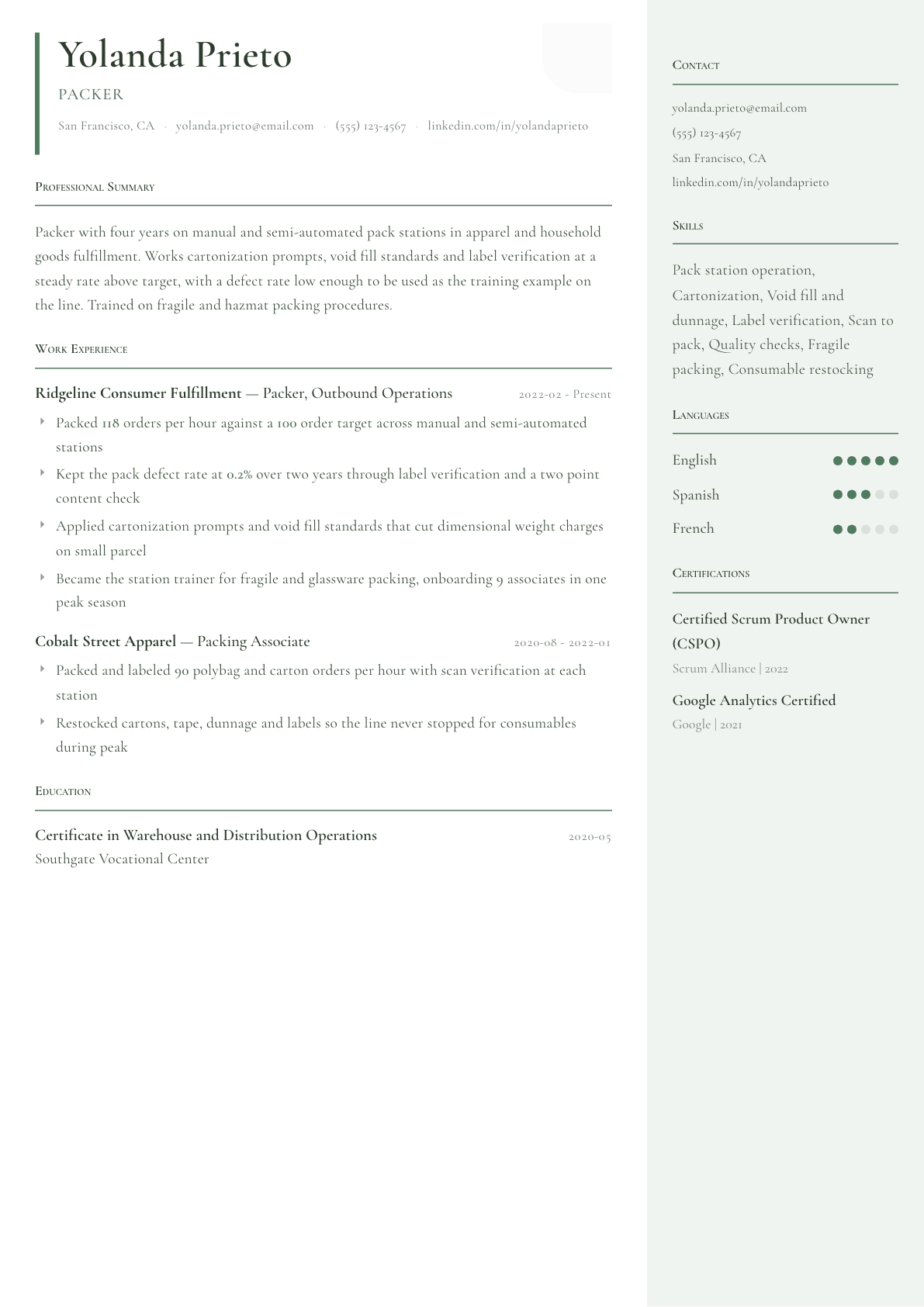
Example Packer summary
Packer with four years in apparel and household goods fulfillment, working manual and semi-automated stations at 118 orders per hour against a 100 order target. Holds a pack defect rate near 0.2% through label verification and a two point content check, and trains new associates on fragile and glassware procedures. Seeking a pack line role with a route into quality auditing.
Skills to list on a Packer resume
- Pack station operation
- Cartonization and carton selection
- Void fill and dunnage
- Scan to pack verification
- Label application and audit
- Quality and content checks
- Fragile and glassware packing
- Polybag and bagger lines
- Carton erector operation
- Dimensional weight awareness
- Consumable replenishment
- Rework and defect reduction
- Peak season throughput
- Workstation 5S
What actually gets this resume read
- Give orders packed per hour next to the station target, because pack rate is the first thing a lead checks.
- Report a defect or rework rate, since a fast packer who creates claims costs the site more than a slow one.
- Name the station type: manual bench, semi-automated, carton erector fed, polybagger or automated bagger line.
- Show that you understand carton selection and void fill, because packaging choice drives parcel cost.
- List fragile, hazmat, cold chain or high value packing training separately, as those move you to better stations.
- Mention training or auditing other packers, because it is the usual step toward a lead or quality role.
How to write a packer resume
The pack station is the last place anyone touches an order before the customer does, and that fact shapes everything a hiring supervisor looks for. A packer who is quick but sloppy generates returns, claims and customer service calls that cost far more than the minutes saved. A packer who is careful but slow holds up the whole outbound line. The resumes that get called show both sides of that balance with numbers.
The other thing a supervisor screens for is the station type. A manual bench with a tape gun, a semi-automated line fed by a carton erector, a polybagger, and an automated bagging or void fill system are different jobs with different training curves. Saying packed customer orders describes all four and identifies none of them, which is why so many packer applications never get a call.
What follows is the structure that suits a fast fulfillment screen, three summaries from a first pack line job through to a station trainer and quality auditor, before and after bullets that turn packing into evidence, and the questions packers ask when a posting asks for a rate they have to guess at.
Format: one page, output and quality side by side
One page, single column, no decoration. Fulfillment employers screen high volumes automatically, so keep headings literal and leave the design ambition out of it.
Under the header put one line with your pack rate against the station target and your defect or rework rate, then the station types you have worked. Rate on its own reads as a claim about speed, and speed is exactly what a supervisor is worried about when quality is missing beside it.
- Header: name, city, phone, email, shift availability, any equipment certification.
- Performance line: orders per hour against target, defect or rework rate, station types.
- Sections: summary, experience, training and certifications, skills, education.
Summary: rate, quality, and what you are trusted to pack
Two or three lines carrying three things: how fast you pack against the standard, how clean the output is, and which product categories you have been trusted with. Fragile, glassware, high value, hazmat, cold chain and oversize packing are all separately trained, and each one narrows the field in your favor.
If you are new to packing, use the summary to name the transfer honestly. Retail gift wrapping, food service assembly, laboratory sample handling and moving crew work all involve careful handling on a clock, and stating the connection is stronger than hoping a screener infers it.
Experience: the station, the standard, the defect rate
Head each role with the operation and the order profile: single line orders in apparel, multi line mixed cartons in household goods, subscription boxes with fixed inserts, returns processing with reconditioning. Order profile is what decides pack complexity, and a supervisor sizes your experience from it in a second.
Then the bullets. Give orders or cartons per hour against the target, the verification steps you performed, and the quality figure that came out the other end. Scan to pack verification, content counts, weight checks against expected weight, and label audits are the controls that stop wrong item and missing item claims, and naming them tells a supervisor you know why the controls exist.
Carton and material decisions belong here too. Choosing the right carton size, applying void fill correctly and using the right dunnage for the product affects both damage and parcel cost, since carriers charge on dimensional weight as well as actual weight. A packer who understands that is arguing for a better station.
Add the work between orders: restocking cartons, tape, labels and dunnage, clearing the takeaway conveyor, keeping the station to a housekeeping standard. Lines stop for consumables more often than for people, and a packer who prevents that stoppage is worth naming it.
Quality, training and the route out of the station
If you have audited other packers, corrected defects at source or trained new hires, put it above your rate. Training and auditing are the two behaviors that move a packer toward a quality or lead role, and they are far rarer on these resumes than speed.
Describe quality work concretely. A daily audit of a sample of finished cartons, a rework loop you owned, a recurring defect you traced to a carton size or a label printer, a pack standard you helped rewrite. Any of those shows you treat defects as a system problem rather than as personal carelessness.
Skills, systems and physical facts
Name the systems: the warehouse management platform, the manifesting or parcel system that produced your labels, the scale and scan setup on the station. Then the equipment: carton erector, tape machine, strapping, stretch wrapper, polybagger, void fill dispenser, label applicator.
Keep the physical description factual. Standing shifts, reach and lift ranges, repetitive hand work and the length of shift you have worked. Fulfillment supervisors have learned that vague enthusiasm predicts nothing about who is still at the station in week three, while a plain statement of what you have already sustained predicts quite a lot.
Packer resume summary examples
First pack line role
Detail focused worker with two years in retail stockroom and gift wrapping, moving into fulfillment packing. Comfortable on a standing shift, quick with tape guns and label applicators, and used to checking contents against a list. Available for evenings and weekends including peak season.
Two years on the line
Packer with two years on manual and polybag stations in apparel fulfillment, packing 90 orders an hour with scan verification at every station. Keeps rework under 1% by checking content counts and label matches before sealing, and restocks consumables so the line does not stop.
Station trainer and auditor
Senior packer with five years across manual and semi-automated stations, running 118 orders an hour against a 100 order target with a defect rate near 0.2%. Trains new associates on fragile and glassware procedures and audits finished cartons daily for content and label accuracy.
Work experience bullets: before and after
Before: Packed orders for customers.
After: Packed 118 orders an hour against a 100 order target across manual benches and semi-automated stations, working single line and multi line orders in the same wave.
The rate beside the target and the station types show what kind of packer the supervisor is getting.
Before: Made sure orders were correct.
After: Verified every order with a scan to pack check, a content count and a weight comparison before sealing, holding the pack defect rate at 0.2% over two years.
Naming the three controls and the resulting defect rate turns care into a repeatable process.
Before: Used the right boxes and packing materials.
After: Applied cartonization prompts and void fill standards, moving fast moving items to a smaller carton size that reduced dimensional weight charges on small parcel.
Linking carton choice to parcel cost shows you understand what packaging decisions actually pay for.
Before: Trained new packers.
After: Became the station trainer for fragile and glassware packing and onboarded nine associates in one peak season, auditing their first cartons until the defect rate matched the line.
The specialty, the count and the audit loop turn a training mention into ownership of quality at the source.
Before: Kept the station stocked.
After: Restocked cartons, tape, dunnage and labels ahead of each wave and cleared the takeaway conveyor at breaks, so the line ran a full peak without a consumables stoppage.
The result you protected is what makes this bullet worth the space rather than a description of housekeeping.
Hard skills
- Manual and semi-automated pack stations
- Cartonization and carton selection
- Void fill and dunnage application
- Scan to pack verification
- Content count and weight checks
- Label application and auditing
- Fragile and glassware packing
- Polybag and bagger operation
- Carton erector and tape machine
- Stretch wrapping and strapping
- Parcel manifesting systems
- Defect and rework reduction
Soft skills
- Consistency at pace
- Care with fragile goods
- Focus through repetition
- Following pack standards exactly
- Coaching at the station
- Reliable attendance in peak
Certifications worth listing
- Certified Logistics Associate (CLA) (Manufacturing Skill Standards Council)
- OSHA 10-Hour General Industry (OSHA Outreach Training Program)
Mistakes that cost packer candidates the interview
- Reporting speed with no defect or rework figure, which reads to a supervisor as a returns problem waiting to happen.
- Leaving out the station type, so the site cannot tell whether you have ever worked a semi-automated line.
- Ignoring specialty packing training such as fragile, hazmat or cold chain, which is what gets you a better station.
- Describing packing as putting items in boxes, a sentence that removes every reason to interview you.
- Failing to mention scan to pack or weight verification, the two controls most sites audit against.
- Skipping the consumables and housekeeping work that keeps the line moving, which supervisors notice and value.
Packer resume questions
What pack rate should I put on my resume?
Whatever your station actually measured, stated next to the target you were held to. Targets vary widely by product and station type, so a number without its target cannot be interpreted and is often read as inflated.
How do I prove quality if my site did not publish a defect rate?
Use what exists: no quality write ups over a period, orders returned to your station for rework, audit results your lead shared, or a stretch where you were the trainer. Then describe the verification steps you performed on every carton.
Is packing experience from a different industry transferable?
Yes, if you frame it as careful handling on a clock. Food assembly, gift wrapping, laboratory sample preparation and moving crews all build the same habits, so describe the checks you performed rather than the industry you performed them in.
Should I mention how much I can lift?
State it plainly when the posting lists a lifting requirement, because the site has to confirm it anyway. Add how long a standing shift you have worked, which predicts retention better than a single lifting number does.
How do I move from packer to a lead or quality role?
Put training, auditing and defect investigation above your rate on the page. A packer who traces a recurring defect to a carton size or a label printer is demonstrating the exact reasoning that quality and lead roles are hired for.
Related resume examples
- Warehouse Worker Resume example
- Logistics Coordinator Resume example
- Order Picker Resume example
- Material Handler Resume example
- Warehouse Associate Resume example
- Distribution Center Manager Resume example