Phlebotomist Resume Examples: free ATS score and gap list
Phlebotomy Job Description for a Resume, With a Full Example
By Mustafa Tarabya, founder of CVBooster · Published · Updated
Phlebotomist resume example, phlebotomy resume objective samples and a phlebotomy job description turned into bullets: draw volume and lab keywords.
Sample resumes for a phlebotomist
The same phlebotomist content laid out in three CVBooster templates, so you can see what the finished document looks like before you write a word.
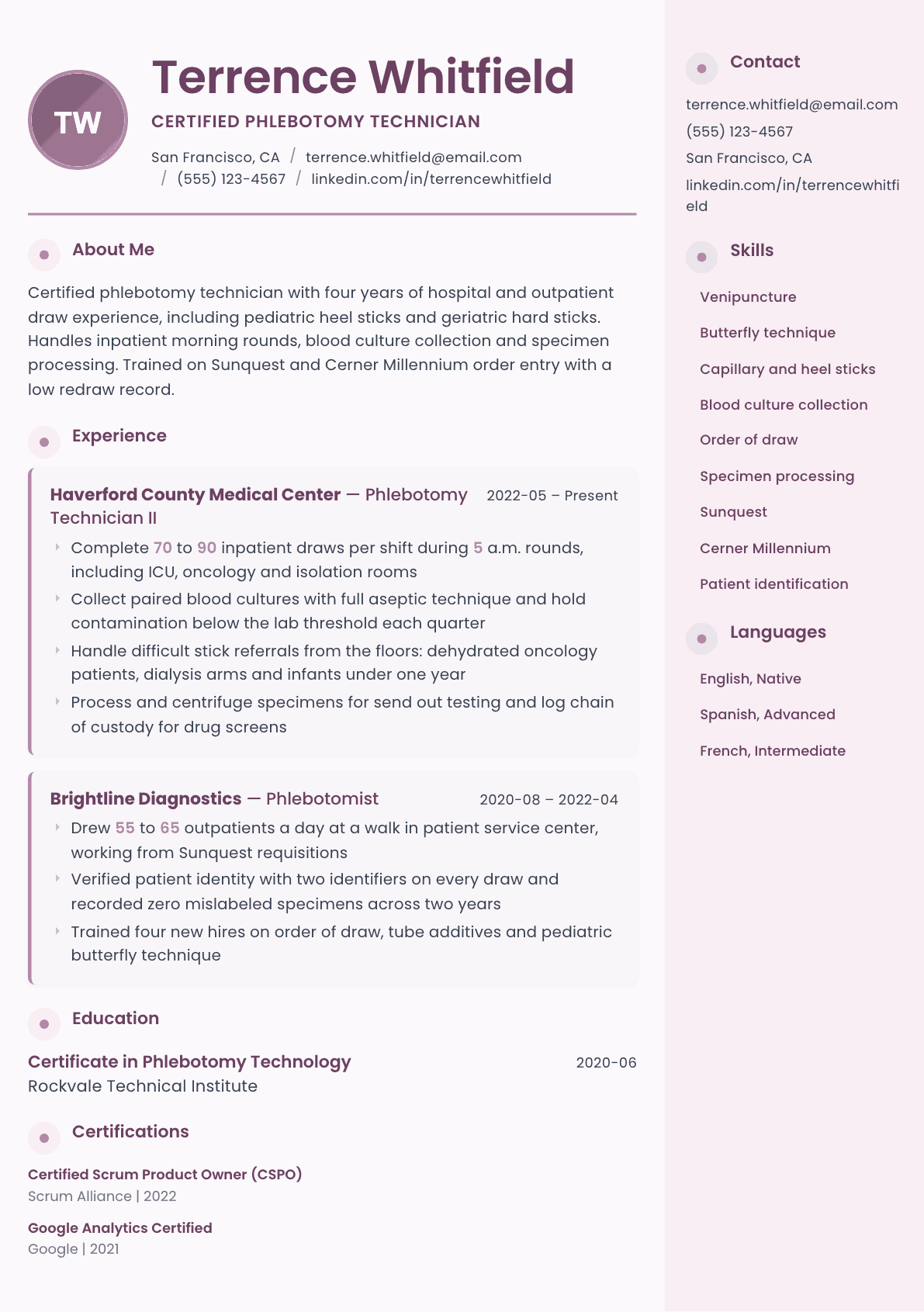
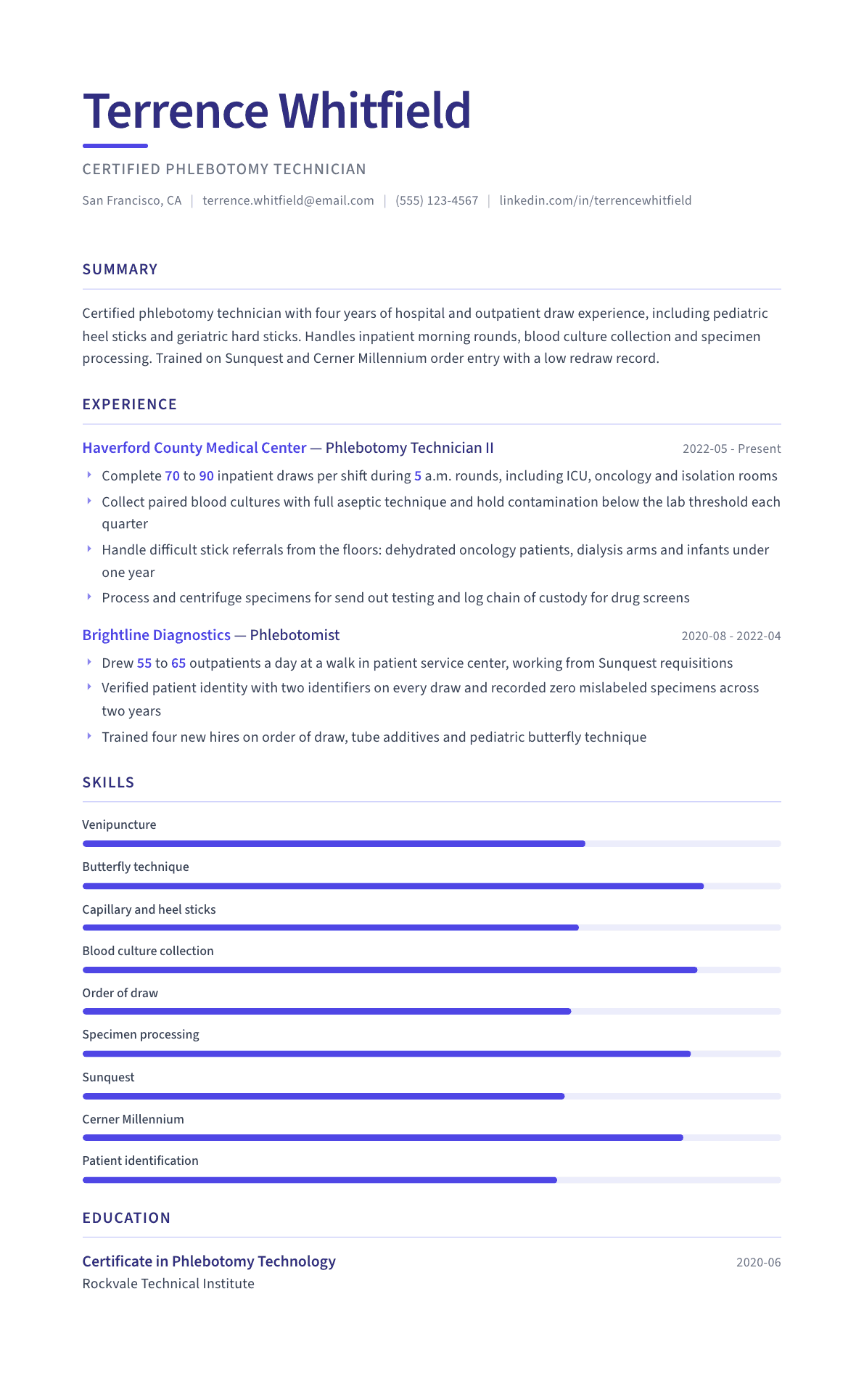
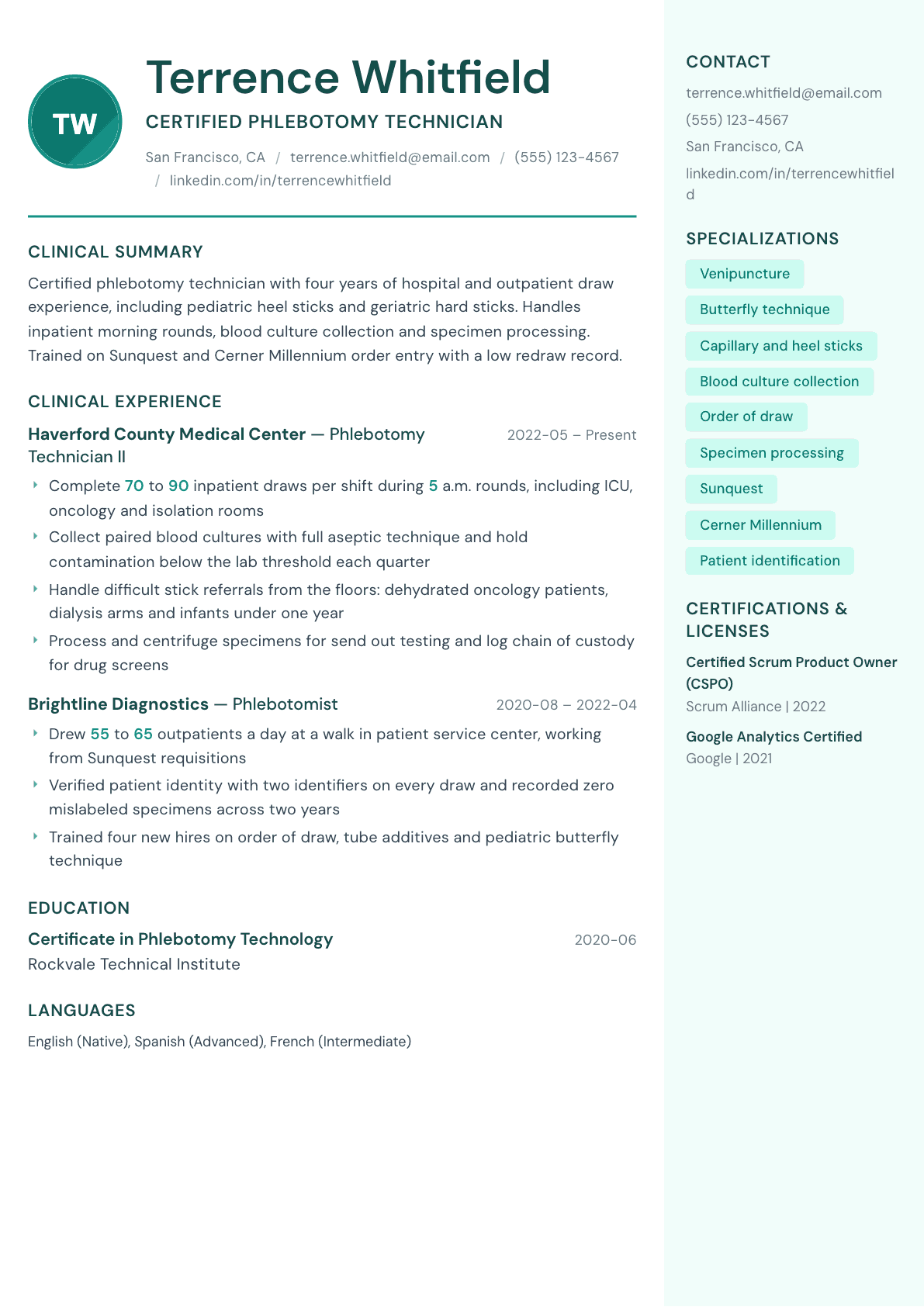
Example Phlebotomist summary
Certified phlebotomy technician with four years of hospital and outpatient collection, completing up to ninety inpatient draws per morning shift. Known on the floors as the difficult stick call for oncology and pediatric patients. Fluent in order of draw, blood culture aseptic technique and specimen processing, with a clean labeling record. Seeking a hospital laboratory position with a defined lead technician track.
Skills to list on a Phlebotomist resume
- Venipuncture
- Butterfly and syringe draws
- Capillary and heel stick collection
- Blood culture collection
- Order of draw
- Tube additive knowledge
- Specimen labeling and handling
- Centrifugation and aliquoting
- Chain of custody collection
- Point of care glucose testing
- Laboratory information systems
- Bloodborne pathogen precautions
- Patient identification protocol
- Vein assessment
- HIPAA compliance
What actually gets this resume read
- Put daily draw volume in your first bullet, because lab supervisors compare candidates on throughput before anything else.
- Name your certification and the issuing body: ASCP, NHA and AMT are read as different credentials by hospital recruiters.
- Call out difficult populations you draw well: oncology, neonates, dialysis patients, geriatric and pediatric patients.
- Mention blood culture contamination and mislabeling records, since those are the two numbers a lab actually tracks.
- List the laboratory information system by name so the posting keyword and your resume line match exactly.
- Say which shift you have worked, because early morning inpatient rounds are the hardest slot to staff in any hospital.
How to write a phlebotomist resume
Laboratory supervisors hire phlebotomists on three numbers and one habit: draws per shift, redraw rate, blood culture contamination rate, and whether you check two patient identifiers every single time. A resume that answers those before the interview goes to the top of the pile.
The second thing a supervisor looks for is population. Drawing cooperative outpatients at a walk-in center is a different craft from finding a vein in a dehydrated oncology inpatient at five in the morning, and the resume should make clear which one you have been doing.
This guide covers how to structure a phlebotomist resume, when a phlebotomy resume objective beats a summary, how to turn a phlebotomy job description into resume bullets, what to put in each bullet, how to present your certification so it is read as the credential it is, and how to write the file when you are coming straight out of a training program with no paid draws behind you.
Format: one page, credential and setting up top
One page, single column, reverse chronological. Hospital laboratory postings receive a high volume of applications and get filtered quickly, so the first third of the page has to carry the certification, the setting and the draw volume.
Put your credential after your name with the certifying body in parentheses, then your city and state and the shifts you can work. Early morning inpatient rounds and overnight coverage are the hardest slots to staff in any hospital laboratory, so stating your availability early is a real advantage.
- Header: name with credential and certifying body, contact details, shift availability.
- Section order: summary, certification, experience, technical skills, education and training hours.
- Recent graduates add a training section with supervised successful draw counts.
Summary or phlebotomy resume objective: setting, volume, and the hard sticks
Two or three lines. Name the setting, your years, the per shift draw volume and the difficult populations you handle. Hospital inpatient rounds with seventy to ninety draws before eight in the morning is a claim a supervisor can immediately size up.
Add one line on accuracy. Mislabeled specimens and blood culture contamination are the two failures that generate incident reports in every laboratory, so a candidate who mentions a clean record on both is speaking the supervisor's language.
A phlebotomy resume objective is the better opener when you have no paid draws yet or are changing careers, because it states the credential and the job you want instead of a work history you do not have. Keep it to two lines, name the certification, your supervised draw count and the setting, and drop phrases like seeking a challenging position. The three objectives below are written out so you can adapt one.
- New graduate: Certified phlebotomy technician with 120 supervised venipunctures and 30 capillary punctures from a hospital externship, seeking an outpatient draw station role with early morning availability.
- Career changer from a medical office: Medical assistant moving into full time phlebotomy, certified this year, with two years of daily venipuncture on adult and pediatric patients in a family practice.
- Moving to a hospital: Phlebotomist with three years at a high volume outpatient center, seeking inpatient morning rounds on a hospital laboratory team, comfortable with fragile veins and blood cultures.
Experience: throughput, technique, and specimen integrity
Under each job give the setting: hospital inpatient, patient service center, mobile draw team, plasma donation center, long term care or research site. Then the volume per shift, then the bullets.
The technique bullets should name what you actually do differently from a beginner: butterfly and syringe draws on fragile veins, capillary and heel stick collection on infants, blood culture collection with full aseptic prep, arterial line draws where your scope allows, and difficult stick calls taken from the floors after another collector has failed.
Then specimen handling. Order of draw, tube additive knowledge, mixing requirements, light protection, chilled specimens, centrifugation timing, aliquoting and chain of custody for drug screens. Laboratories lose more results to bad handling than to bad sticks, and supervisors know it.
Skip bullets that describe the existence of phlebotomy. Drew blood from patients tells a reader nothing that the job title has not already said.
- State whether you work from a requisition list, a phlebotomy queue in the laboratory system, or floor calls.
- Name the laboratory information system: Sunquest, Cerner Millennium, Epic Beaker, SoftLab, Meditech.
- Include training or precepting of new collectors and any competency sign-off you have held.
Certification, training hours and scope
List the credential, the certifying body and the current status. Several bodies certify phlebotomists and hospital recruiters treat them differently, so write out the issuer rather than an abbreviation alone. Include your training program hours and the number of supervised successful venipunctures and capillary collections if you are within a year or two of graduating.
Add anything that extends your scope: point of care glucose testing, EKG, specimen processing, front desk registration, or a state specific collector license where your state issues one. Every additional task you already know is a shift the laboratory does not have to cover twice.
Keywords laboratory postings repeat
Hospital and reference laboratory job descriptions reuse a narrow vocabulary: venipuncture, capillary collection, order of draw, specimen integrity, two patient identifiers, aseptic technique, bloodborne pathogen precautions, chain of custody, HIPAA and the laboratory information system name. Match those exactly once each in your summary or skills, and prove one or two of them inside a bullet.
Phlebotomy job description for a resume: duties turned into bullets
A phlebotomy job description for a resume is the list of duties you did, rewritten so each line says where, how many and to what standard. Copying the employer job description word for word gives you the right keywords and the wrong sentences, because every applicant can paste the same list.
Take each duty from the posting or your old job description and add three things: the setting, the volume, and the rule you followed. The bullets below show the usual duties of a hospital or outpatient phlebotomist rewritten that way. Use the ones you actually performed and put your own numbers in.
- Patient identification: Verified two patient identifiers and the requisition before every draw, and labeled tubes at the bedside or chair.
- Venipuncture and capillary collection: Collected blood by venipuncture, butterfly and fingerstick for an average of 40 outpatients per shift, following the order of draw.
- Pediatric and geriatric draws: Performed draws on children and older adults with fragile veins, using smaller gauge needles and calming steps agreed with the family.
- Specimen processing: Centrifuged, aliquoted and packaged specimens for the reference laboratory, and logged each one in the laboratory information system.
- Safety and infection control: Followed bloodborne pathogen precautions and sharps disposal rules, and cleaned the draw station between patients.
- Front desk and records: Checked insurance details, entered orders and kept patient information private under HIPAA.
Phlebotomist resume summary examples
Newly certified
Certified phlebotomy technician with 120 program hours and 110 supervised successful venipunctures plus 25 capillary collections across a hospital and an outpatient draw station. Trained on order of draw, tube additives and specimen processing. Available for early morning inpatient rounds and weekend coverage.
Four years in
Phlebotomy technician with four years split between a hospital inpatient team and a walk-in patient service center, completing 70 to 90 draws per morning shift. Takes difficult stick referrals for oncology, dialysis and pediatric patients. Clean labeling record across two annual laboratory inspections.
Lead phlebotomist
Lead phlebotomist with nine years in hospital collections, now scheduling a twelve-person team across three shifts and signing annual competency assessments. Rebuilt the blood culture collection procedure and cut contamination flags on the medical floors. Handles inspection preparation and corrective action documentation for the collection area.
Work experience bullets: before and after
Before: Drew blood from patients in a hospital setting.
After: Completed 70 to 90 inpatient draws per shift during 5 a.m. rounds, covering the intensive care unit, oncology floor and isolation rooms.
Volume, timing and unit type describe the hardest version of the job instead of restating the job title.
Before: Collected blood cultures following procedure.
After: Collected paired blood cultures with full chlorhexidine prep and dedicated draw sites, holding contamination flags below the laboratory threshold every quarter.
The prep detail and the tracked outcome turn a procedural claim into a measurable one.
Before: Was good with difficult patients.
After: Took difficult stick referrals from the floors after failed attempts, including dehydrated oncology patients, dialysis arms and infants under one year.
Naming the populations shows a specific skill; being good with patients is a claim nobody can check.
Before: Labeled and delivered specimens to the lab.
After: Verified two patient identifiers at the bedside before every draw and labeled at the point of collection, with zero mislabeled specimens recorded across two years.
The procedure and the outcome together address the single failure a laboratory tracks most closely.
Before: Trained new employees on the job.
After: Trained four new collectors on order of draw, tube additives and pediatric butterfly technique, and signed their initial competency checklists.
The count, the topics and the sign-off responsibility show a lead role rather than casual help.
Hard skills
- Venipuncture
- Butterfly and syringe collection
- Capillary and heel stick collection
- Blood culture aseptic collection
- Order of draw
- Tube additive selection
- Specimen labeling at point of collection
- Centrifugation and aliquoting
- Chain of custody collection
- Point of care glucose testing
- Laboratory information systems
- Bloodborne pathogen precautions
- Vein assessment and site selection
- Specimen transport and stability handling
Soft skills
- Calming needle-anxious patients
- Working quickly at shift start
- Clear communication with nursing staff
- Composure in isolation and critical care rooms
- Attention to identity verification
- Training new collectors
Certifications worth listing
- Phlebotomy Technician (PBT) (American Society for Clinical Pathology)
- Certified Phlebotomy Technician (CPT) (National Healthcareer Association)
- Registered Phlebotomy Technician (RPT) (American Medical Technologists)
- Certified Phlebotomy Technician (National Center for Competency Testing)
- Basic Life Support (BLS) (American Heart Association)
Mistakes that cost phlebotomist candidates the interview
- Leaving out draws per shift, which is the first number a laboratory supervisor looks for and the easiest one to supply.
- Writing certified phlebotomist with no issuing body, when hospital recruiters treat the different certifying organizations as different credentials.
- Describing only outpatient work while applying to an inpatient team, without saying whether you have ever drawn a critical care patient.
- Omitting specimen handling entirely, when improper handling causes more rejected samples than failed sticks.
- Claiming to be gentle and compassionate instead of naming the difficult populations you draw successfully.
- Hiding shift availability, when early morning rounds are the slot most hospital laboratories are trying to fill.
- Listing every soft skill in the language and none of the laboratory systems the posting named.
Phlebotomist resume questions
How do I write a phlebotomist resume with no work experience?
Lead with your training program. Give the total classroom and clinical hours, the number of supervised successful venipunctures and capillary collections you logged, and the settings where you practiced. Those numbers are exactly what a supervisor would otherwise have to ask you for.
Which phlebotomy certification do employers prefer?
It varies by region and by employer, and hospital systems often name an acceptable list in the posting itself. Write out the full credential and issuing body so a recruiter can check it against their list rather than guessing which organization certified you.
Should a phlebotomy resume have an objective or a summary?
Use an objective when you are newly certified or changing careers, and a summary once you have paid draws to describe. Either way keep it to two lines with the certification, the draw count or volume per shift, and the setting you want or have worked in.
How do I show accuracy without inventing statistics?
Describe the procedure you follow and any result you genuinely know: identifiers checked at the bedside, labeling at point of collection, contamination flags staying under the laboratory threshold, or a clean record through an inspection. Describe what you did, not a number you cannot support.
How do I write a phlebotomy job description for my resume?
List the duties you performed, then rewrite each one with the setting, the daily volume and the standard you followed, such as order of draw or two patient identifiers. Add specimen processing or point of care testing if you did it, because those tasks also open a path toward laboratory assistant work.