Naturopath Resume Examples: free ATS score and gap list
Write a Naturopath Resume That Survives Clinical Review
By Mustafa Tarabya, founder of CVBooster · Published · Updated
Naturopath resume example, keyword list and writing guide for licensing, case documentation, dispensary work and referral relationships.
Sample resumes for a naturopath
The same naturopath content laid out in three CVBooster templates, so you can see what the finished document looks like before you write a word.
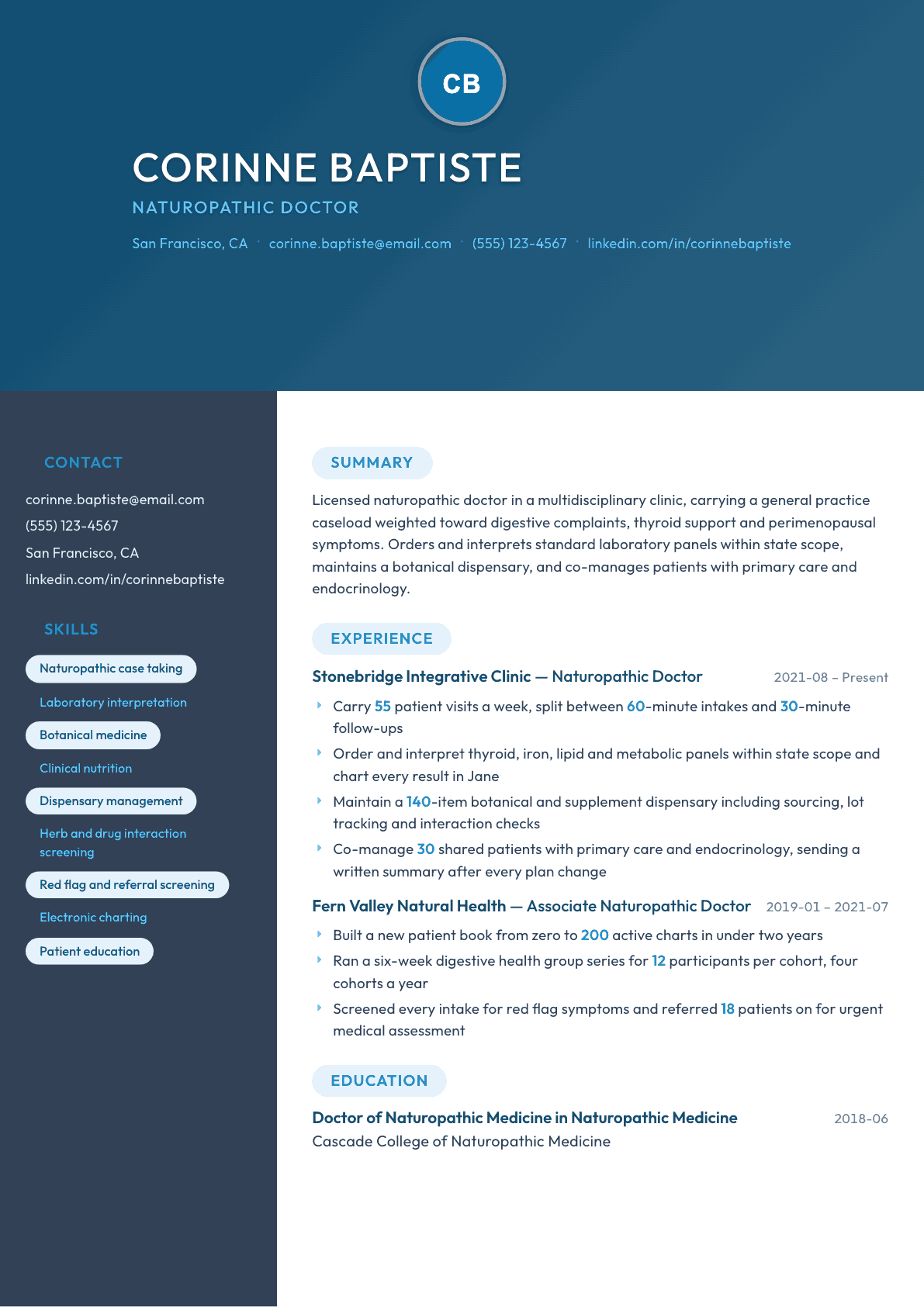
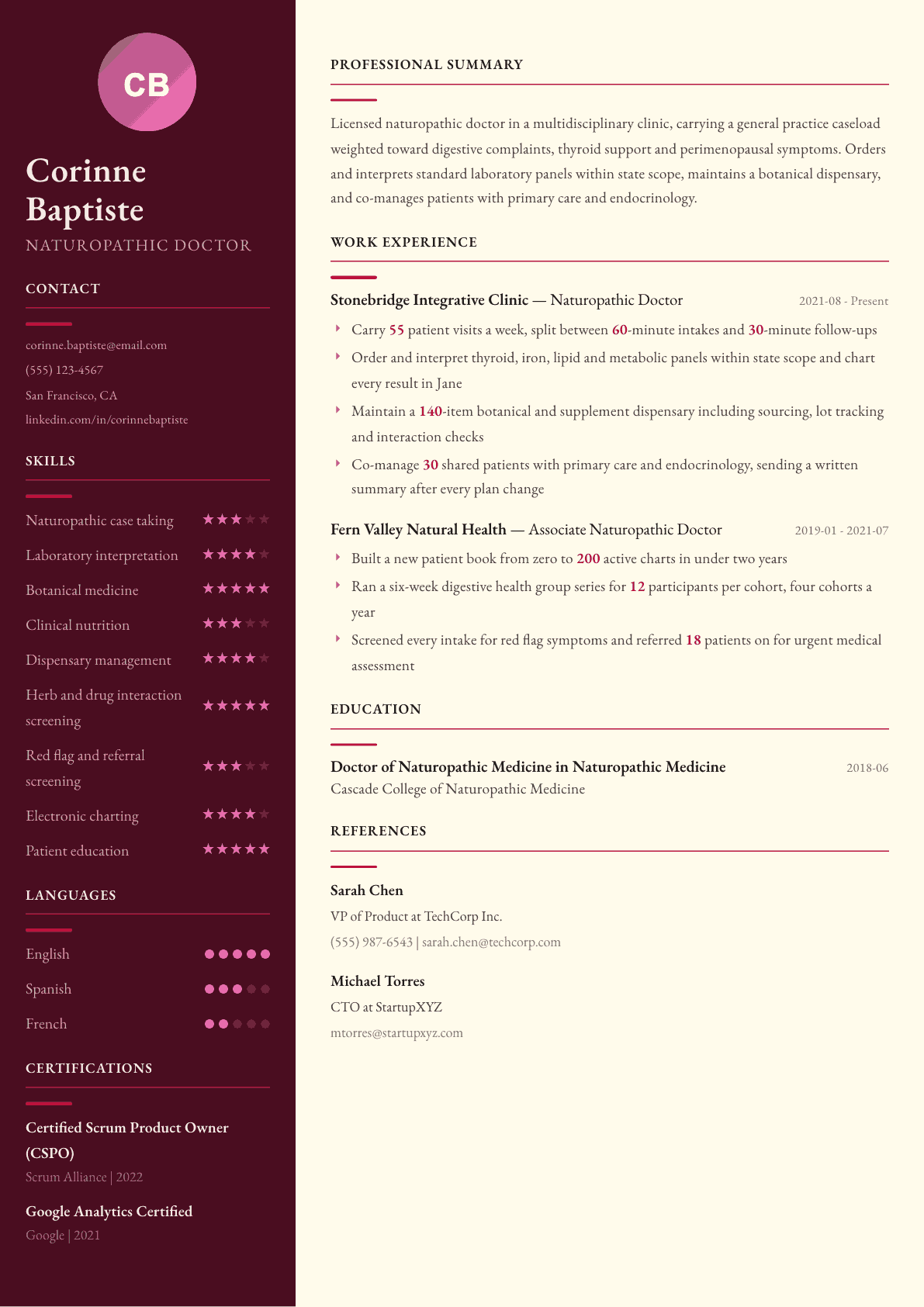
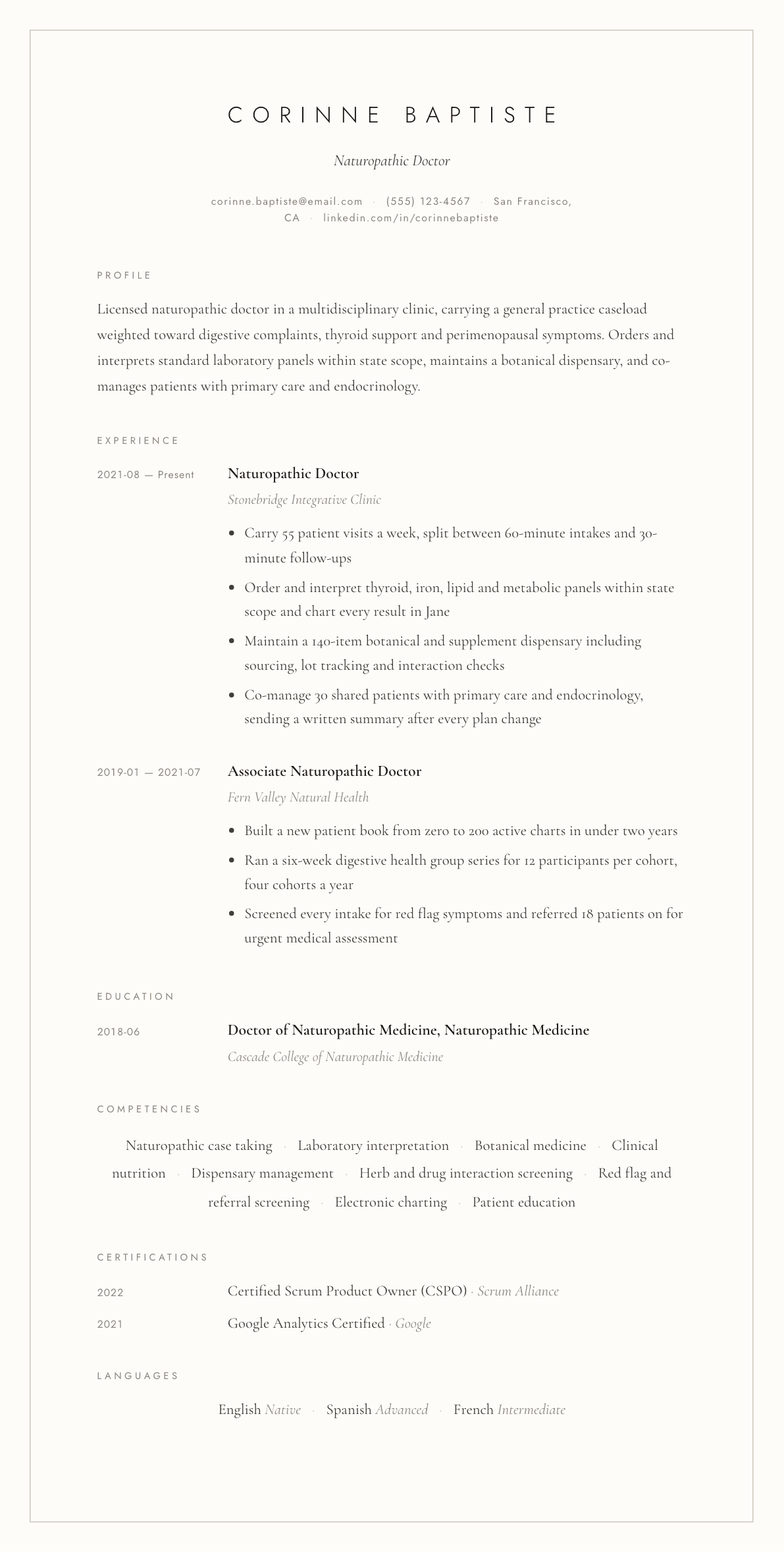
Example Naturopath summary
Licensed naturopathic doctor with a general practice caseload weighted toward digestive complaints, thyroid support and perimenopausal care inside a multidisciplinary clinic. Orders and interprets standard laboratory panels within state scope, formulates from a curated botanical dispensary with interaction screening, and co-manages shared patients with primary care and endocrinology. Carries a full weekly visit load with charting closed the same day. Seeking a clinical associate role.
Skills to list on a Naturopath resume
- Naturopathic case taking
- Physical examination
- Laboratory panel interpretation
- Botanical medicine formulation
- Clinical nutrition
- Homeopathic prescribing
- Hydrotherapy
- Herb and drug interaction screening
- Dispensary and inventory management
- Red flag screening and referral
- Treatment plan writing
- Group education series
- Electronic health records
- Informed consent documentation
What actually gets this resume read
- Lead with your license, the state that regulates it, and the exam board that credentialed you.
- State your scope plainly, because scope differs by state and a clinic will screen you on that first.
- Give visit volumes and appointment lengths so a clinic owner can model you against their schedule.
- Show your referral relationships by discipline, since co-management is what integrative clinics buy.
- Name the charting system and dispensary tools you use, including interaction checking and lot tracking.
- Describe your patient education format: handouts, group series, or written plans the patient takes home.
How to write a naturopath resume
A naturopath resume gets read by someone who is checking two things before anything else: what you are licensed or registered to do where you plan to practice, and whether the rest of the page shows clinical discipline. Regulation of this field varies widely by state and country, so a clinic owner or medical director starts with your credential and your scope and only then looks at your caseload.
The second read is about safety and documentation. Can you take a full case, order or interpret the labs your scope allows, screen for the presentations that need a physician, check a botanical formula against a prescription list, and write it all somewhere a colleague can follow? A page that answers those questions is treated as a clinical resume. A page of philosophy is treated as a brochure.
This guide covers the sections an integrative clinic reads and the order it reads them in, with summaries for a recent graduate, an established practitioner and a clinic lead, five rewritten bullets, and the questions that come up when a naturopath moves between a solo practice and a multidisciplinary team.
Format: credential first, scope stated, one clean page or two
Reverse chronological, one page early on and two once you have multiple clinical roles and teaching or supervision. Put your degree, your licensing or registration status and the jurisdiction directly under your name. A reader who has to hunt for that assumes it is missing.
State your scope in a single line rather than leaving it implied. Laboratory ordering, injection therapy, minor office procedures and prescribing rights differ by jurisdiction, and a clinic that hires you into duties your credential does not cover has a problem it would rather avoid at the resume stage.
- Credential block: doctorate or diploma, the school, board examination status and the jurisdiction you are licensed or registered in.
- Scope line: laboratory ordering and interpretation, botanical and supplement prescribing, and any additional certified therapies.
- Each role names the clinic type: multidisciplinary, solo practice, community health, teaching clinic or dispensary-based practice.
- Caseload line per role: weekly visits, the split between intakes and follow-ups, and the appointment lengths.
Summary: patient population, scope, visit volume, co-management
Three lines. Name the presentations that dominate your book, the credential and jurisdiction, your weekly visit volume, and whether you co-manage with other clinicians. A clinic owner uses those four facts to work out whether you fill a gap in her schedule or duplicate someone she already employs.
Resist the urge to claim a whole-body approach in the summary. Every practitioner in this field says it, so it carries no information. What carries information is the fact that your book runs heavy on digestive complaints, or thyroid support, or pediatric skin conditions, because that is what a referring physician remembers.
Experience: the case, the workup, the plan, the note
Write bullets that follow the clinical process. A full intake with a history and physical, a laboratory workup within your scope, a plan built from botanical, nutritional and lifestyle components, and a chart note a colleague could pick up. Give appointment lengths, because a sixty-minute intake and a fifteen-minute follow-up are different clinical products.
Bring the dispensary onto the page. Sourcing, formulation, lot tracking, storage and interaction screening are real operational responsibilities that a clinic pays for, and a practitioner who has run one is much cheaper to onboard than one who has only prescribed from a catalog.
Then show the referral traffic in both directions. Patients you sent onward for urgent assessment, and patients referred to you by primary care or specialists. A resume that shows referrals coming in is telling a clinic owner that other clinicians trusted your judgment.
Safety, interactions and informed consent
Give one section to the safety machinery. Herb and drug interaction screening, contraindications in pregnancy, cautions around anticoagulants and thyroid medication, and the point at which you stop and refer. Naming the categories shows a reader you were taught this rather than that you are cautious by temperament.
Informed consent belongs here too. Say what your patients sign, what they are told about expected timelines, and how you document a decision to decline or delay a recommendation. Clinics carry the liability for this, so a practitioner who volunteers it is doing the medical director a favor.
Keywords an integrative clinic filters on
Clinic postings repeat a recognizable set: case taking, physical examination, laboratory interpretation, botanical medicine, clinical nutrition, homeopathy, hydrotherapy, dispensary, treatment planning, patient education, co-management, informed consent and the electronic record they run. Mirror the true ones once in a skills block and once inside a clinical bullet.
Include teaching, group series and writing if you have them. Integrative clinics build patient volume through education, and a practitioner who can run a six-week group or produce patient handouts brings marketing value alongside clinical hours.
Naturopath resume summary examples
Recent graduate
Naturopathic doctor with 1200 supervised clinical hours in a teaching clinic, board examinations complete and licensure pending in one state. Case load during training ran heavy on digestive complaints and menstrual irregularity. Trained in botanical formulation, clinical nutrition and laboratory interpretation within scope.
Established practice
Licensed naturopathic doctor carrying 55 visits a week in a multidisciplinary clinic, weighted toward digestive complaints, thyroid support and perimenopausal symptoms. Orders and interprets standard panels within state scope, maintains a curated botanical dispensary, and co-manages shared patients with primary care and endocrinology.
Clinic lead
Clinic lead with twelve years in integrative practice, supervising two associates and a dispensary team while carrying a reduced caseload. Owns the intake protocol, the interaction screening standard and the referral agreements with three local practices, and teaches a clinical nutrition module for residents.
Work experience bullets: before and after
Before: Saw patients and created natural treatment plans.
After: Carried 55 patient visits a week split between 60-minute intakes and 30-minute follow-ups, building plans from botanical, nutritional and sleep components and charting each one the same day.
Visit volume, appointment lengths and same-day charting describe a working clinical practice.
Before: Ordered lab tests for patients.
After: Ordered and interpreted thyroid, iron, lipid and metabolic panels within state scope, recorded every result in the clinic record, and reviewed abnormal values with the patient at the next visit.
Naming the panels and the scope boundary makes the claim checkable instead of decorative.
Before: Managed the clinic dispensary.
After: Maintained a 140-item botanical and supplement dispensary including supplier vetting, lot tracking, storage conditions and an interaction check against each patient medication list.
The item count and the four operational tasks turn a title into a set of responsibilities.
Before: Worked with other doctors on patient care.
After: Co-managed 30 shared patients with primary care and endocrinology, sending a written summary after every plan change and adjusting recommendations around prescribed medication.
A shared patient count and a written handoff show real integration rather than proximity.
Before: Referred patients when necessary.
After: Screened every intake for red flag presentations and referred 18 patients for urgent medical assessment, documenting the finding, the referral and the outcome in the chart.
Documented referrals with outcomes are the clearest evidence of clinical safety on the page.
Hard skills
- Naturopathic case taking
- Physical examination
- Laboratory panel interpretation
- Botanical medicine formulation
- Clinical nutrition
- Homeopathic prescribing
- Hydrotherapy
- Herb and drug interaction screening
- Dispensary and inventory management
- Red flag screening and referral
- Treatment plan writing
- Group education series
- Electronic health records
- Informed consent documentation
Soft skills
- Explaining a plan a patient will actually follow
- Working alongside skeptical clinicians
- Managing expectations about timelines
- Clear written handover
- Holding a boundary on unproven requests
Certifications worth listing
- Naturopathic Physicians Licensing Examinations (NPLEX) (North American Board of Naturopathic Examiners)
- Board Certification in Naturopathic Oncology (FABNO) (American Board of Naturopathic Oncology)
- Basic Life Support (BLS) (American Heart Association)
Mistakes that cost naturopath candidates the interview
- Leaving the jurisdiction and licensing status off the header, which stalls the file before the clinical history is read.
- Writing a philosophy paragraph where the caseload, visit volume and appointment structure should be.
- Blurring the scope line by implying diagnostic or prescribing rights the credential does not carry in that jurisdiction.
- Omitting interaction screening and contraindication practice, the part a medical director checks hardest.
- Describing the dispensary as a shelf of products rather than as sourcing, lot tracking, storage and interaction checks.
- Failing to show referrals arriving from other clinicians, which is the strongest third-party evidence you have.
Naturopath resume questions
How do I handle the fact that regulation differs by state?
Name the jurisdiction you hold a credential in, the board examinations you have completed, and the states you are eligible to apply in. Then describe your duties in terms of what you actually performed, so a reader in another jurisdiction can map it to their own rules.
Should a naturopath resume list specific conditions treated?
Yes, because a clinic hires to fill a gap in its schedule. Name the presentations that dominate your book rather than a full list of everything you can see. Referring clinicians remember practitioners for two or three areas, never for a catalog.
What belongs in the education section?
The naturopathic doctorate or diploma with the school and completion, supervised clinical hours with the teaching clinic named, and any residency. Add continuing education only where it maps to a technique you use, with the provider and the hour count attached.
How do I show I work well with conventional clinicians?
Give the number of co-managed patients, the specialties involved, and the format of your written handoff after each plan change. Add any inbound referrals you received. That evidence answers the concern a medical director has before she interviews you.
Is it worth listing the dispensary and supplement work?
Very much so, because it is operational responsibility a clinic otherwise has to staff separately. Cover item count, supplier vetting, lot tracking and interaction screening, and say whether dispensary revenue and margin were part of what you managed.
Related resume examples
- Wellness Coach Resume example
- Sports Nutritionist Resume example
- Massage Therapist Resume example
- Skincare Specialist Resume example
- Medical Esthetician Resume example
- Sports Massage Therapist Resume example