Resident Assistant Resume Examples: the lines they read
Build a Resident Assistant Resume Around Duty Nights and Documentation
By Mustafa Tarabya, founder of CVBooster · Published · Updated
Resident assistant resume example with duty rotation, incident documentation, roommate mediation and hall programming keywords, plus a writing guide.
Sample resumes for a resident assistant
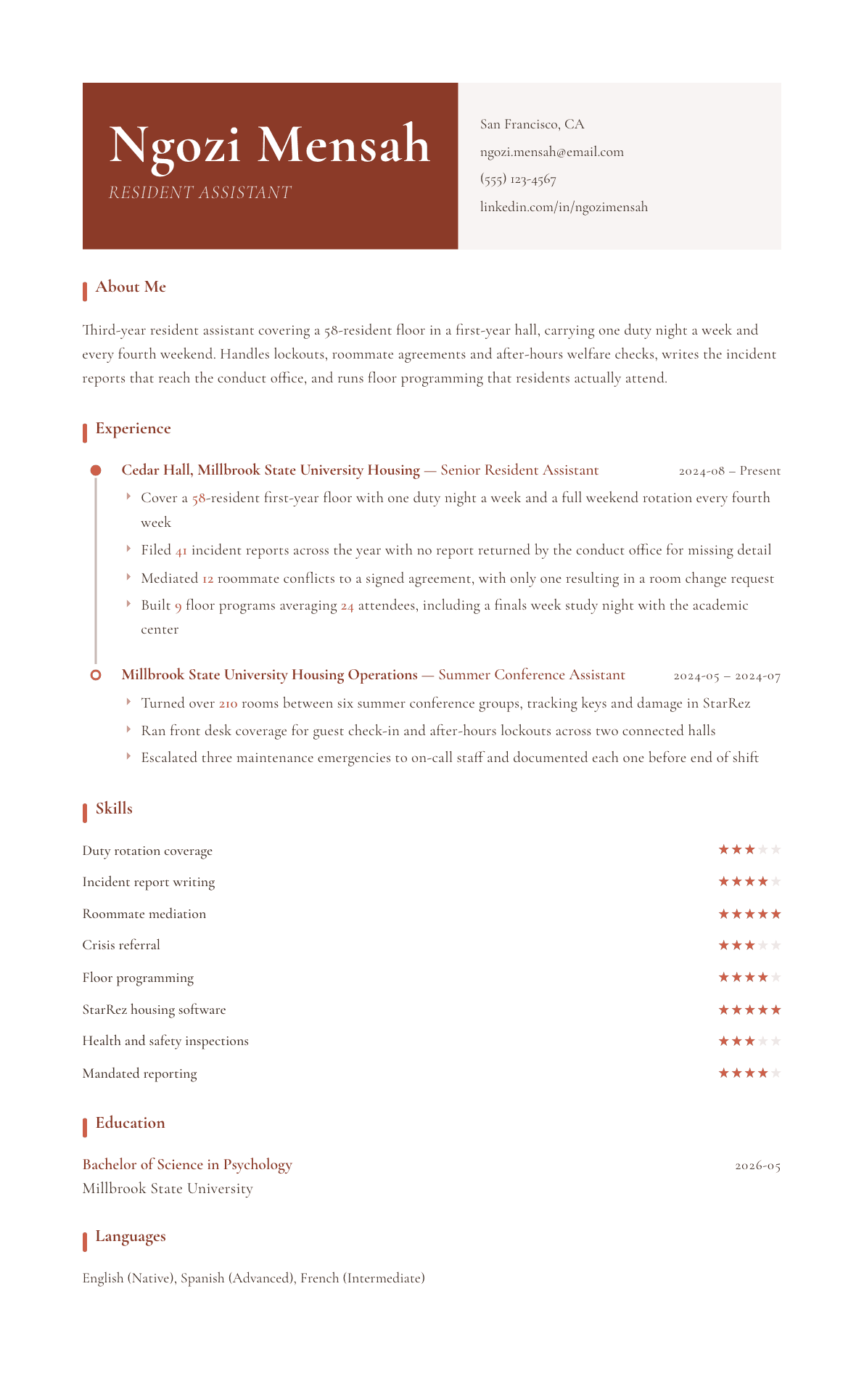
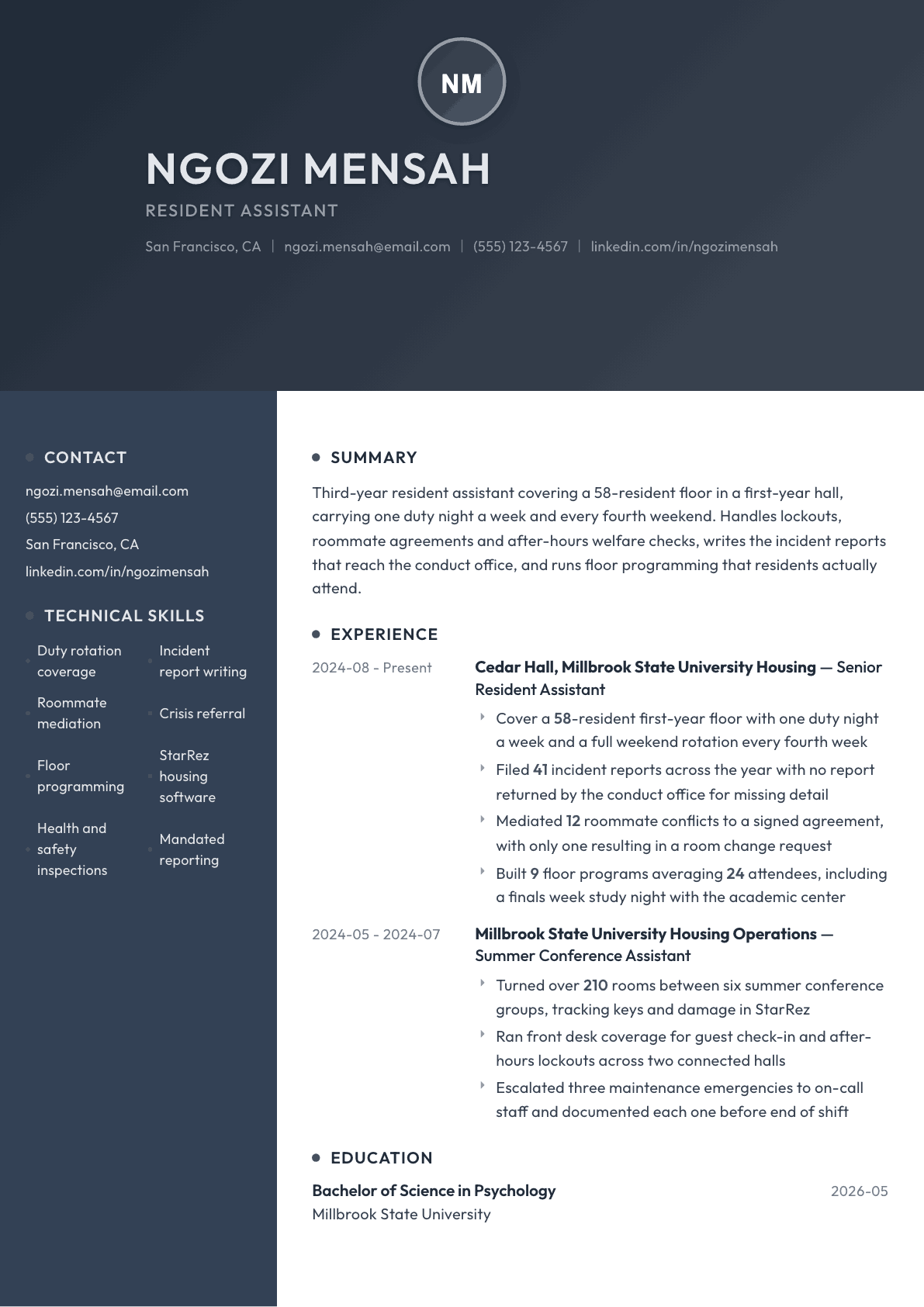
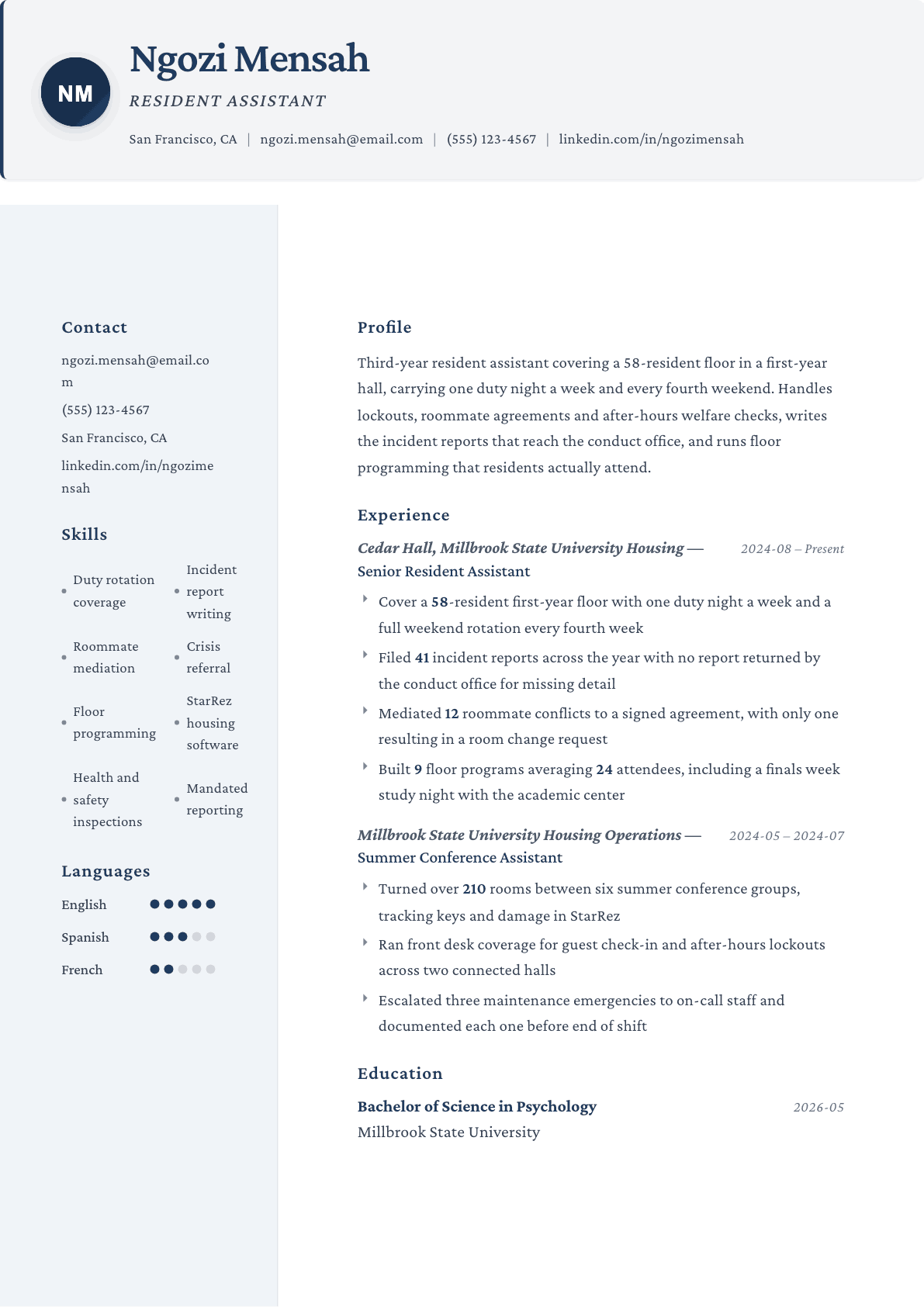
The same resident assistant content laid out in three CVBooster templates, so you can see what the finished document looks like before you write a word.
Example Resident Assistant summary
Resident assistant with two years on a first-year floor of 58 residents, carrying a weekly duty night and a weekend rotation. Writes incident reports the conduct office can act on without follow-up, mediates roommate conflicts to signed agreements, and builds floor programming with real attendance. Trained in mental health first aid and mandated reporting. Seeking a senior RA or housing operations assistant position.
Skills to list on a Resident Assistant resume
- Duty and on-call rotation
- Incident report documentation
- Roommate agreement mediation
- Crisis response and referral
- Mandated reporting procedure
- Residence hall programming
- Health and safety room inspections
- Lockout and key control
- StarRez housing records
- Community standards enforcement
- Bulletin board and floor communication
- Move-in and move-out operations
- Peer support conversations
- Staff meeting and on-call handover
What actually gets this resume read
- State your floor size and building type, because a 58-resident first-year floor is a different job from a suite.
- Give the duty rotation in plain terms: how many nights a week, and how often the weekend comes around.
- Count the incident reports you wrote, since documentation quality is what housing directors ask about first.
- Describe mediation as a process with an outcome, not as a personality trait you happen to have.
- Put program attendance next to program count, because ten posters and no attendees is not a record.
- Name the housing system you work in, whether that is StarRez, THD or a homegrown duty log.
- List your first aid, CPR and mental health training with the issuing body and the year it expires.
How to write a resident assistant resume
A residence life coordinator hiring a resident assistant is filling a duty roster, not a job title. She has buildings that need someone awake and reachable every night of the term, a conduct process that only works when reports arrive complete, and a floor of first-year students who will test every boundary in the first six weeks. Your application is read against those pressures.
The applications that stall are the ones written as a personality profile. Being approachable is table stakes. What separates a hire is whether you can write an incident report at two in the morning that the conduct office can act on without a follow-up email, whether you can sit between two roommates and get to a signed agreement instead of a room change, and whether you know the difference between a situation you handle and a situation you escalate to the professional on call.
This guide walks the sections a housing office reads in order, with summaries for a first-time applicant, a returning resident assistant and a senior staff member, before and after bullets built from real duty work, and the questions that come up in the group interview every housing department runs.
Format: one page, floor and duty facts before anything else
Reverse chronological, one page, with a short profile block that carries three facts: the building type you have worked, the number of residents you covered, and your duty rotation. A coordinator staffing a first-year hall and a coordinator staffing graduate apartments are looking for different people, and those three facts sort you immediately.
Group your training and certifications together rather than scattering them through job bullets. First aid, CPR, mental health first aid, bystander intervention and any mandated reporter training belong in one block where they can be read at a glance against the department requirement list.
- Profile block: building type, resident count, duty nights per week, weekend rotation frequency.
- Experience entries name the hall and the population, whether first-year, upper class, graduate or themed housing.
- Training block: first aid and CPR with the issuing body, plus any crisis and reporting training the department requires.
- A first-time applicant leads with peer mentoring, camp counseling, coaching, or any role that carried overnight responsibility.
Duty, on-call and what happens after midnight
Duty is the core of the job and most applicants describe it in a single vague line. Write it as a schedule and a set of tasks: how many nights a week, how often the weekend rotation returns, what rounds you walk and at what hours, what you carry, and how you hand over to the next person. A coordinator reading that knows you understand the shape of the work.
Then name what you have actually handled. Lockouts, noise, an intoxicated resident, a welfare check, a fire alarm evacuation, a maintenance emergency at an hour when nothing is staffed. Give counts where you have them and describe the escalation path: what you resolve on the floor, what goes to the professional on call, and what triggers a call to campus safety.
Documentation: the skill that decides the hire
Incident reports are the product a resident assistant makes. A conduct officer builds a case from your narrative, so timing, sequence, names, quotes and observed facts matter, and speculation ruins the record. Say how many reports you filed, in what system, and whether any came back for missing detail. A candidate who writes that no report was returned incomplete is telling a coordinator something she cannot get from a reference call.
The same discipline applies to roommate agreements, room condition forms, health and safety inspections and key logs. Each of those is a document with a deadline attached and a consequence when it is late. Name them, and name the housing system they live in, whether that is StarRez, THD, Symplicity or a departmental duty log.
- Report volume and the system you filed in, plus any note on completeness or turnaround.
- Roommate agreements written and how many held without a room change request.
- Health and safety inspection rounds, with the number of rooms and the follow-up process.
- Key control, lockout logging and room condition documentation at move-in and move-out.
Programming that people actually attended
Every applicant lists programs. Almost none list attendance. Give both, and say how you got the number up: a partnership with the academic center for a finals study night, food timed to when your floor comes back from practice, a passive program on the bulletin board that ran all month with no attendance at all. A coordinator who has watched pizza go cold in an empty lounge reads attendance figures closely.
Tie a program to a floor need where you can. A budgeting session after the first tuition deadline, a roommate reset in week four, a sleep and stress program before finals. That sequencing is what a residence life department calls intentionality, and it is the difference between a floor calendar and a set of events.
Skills, keywords and the language housing departments use
Housing postings recycle a stable vocabulary: duty rotation, on-call, incident documentation, community standards, conflict mediation, crisis response, referral, mandated reporting, occupancy management, room change process, community building. Mirror the ones that are true of you, once in the skills block and once inside a bullet where the work shows.
Two more belong on the page and rarely appear. The first is referral literacy: knowing what the counseling center takes, what the dean of students office takes, what an accessibility office handles, and how you walk a resident to a door instead of handing over a phone number. The second is the confidentiality boundary around what a resident tells you, including what you are required to pass on and how you tell them so before they say it.
Resident Assistant resume summary examples
First-time applicant
Second-year student applying for a first resident assistant position, with two summers as an overnight camp counselor responsible for a cabin of 14 and a semester as a peer mentor for first-generation students. Certified in adult and child CPR, and trained in bystander intervention through the campus wellness office.
Returning resident assistant
Resident assistant covering a 58-resident first-year floor with one duty night a week and a full weekend every fourth. Filed 41 incident reports in a year with none returned for missing detail, mediated 12 roommate conflicts to signed agreements, and ran 9 floor programs averaging 24 attendees.
Senior staff and hall lead
Senior resident assistant leading a staff of seven across two connected halls, running duty handover and the weekly staff meeting agenda. Rewrote the building emergency call tree after a fire panel fault, trained new staff on report writing, and covered summer conference turnover for 210 rooms.
Work experience bullets: before and after
Before: Served as an RA for a residence hall floor.
After: Covered a 58-resident first-year floor in a traditional double-occupancy hall, carrying one duty night a week and a full weekend rotation every fourth week across both semesters.
The population, the building type and the rotation let a coordinator match you to a specific staffing gap.
Before: Wrote incident reports when needed.
After: Filed 41 incident reports covering noise, alcohol and welfare checks, each submitted before the end of shift, with none returned by the conduct office for missing detail.
Volume, timing and a quality signal turn documentation from an assumed duty into demonstrated competence.
Before: Helped roommates resolve conflicts.
After: Mediated 12 roommate conflicts using a structured agreement covering sleep hours, guests and shared items, with 11 holding through the year and one escalating to a room change.
Naming the method and the outcome, including the one that failed, reads as honest and repeatable practice.
Before: Planned events for residents.
After: Built 9 floor programs averaging 24 attendees, including a finals study night co-hosted with the academic center and a week four roommate reset scheduled before conflicts hardened.
Attendance and timing show you plan around a floor calendar rather than filling a programming quota.
Before: Responded to emergencies in the building.
After: Responded to two overnight medical calls and a full fire alarm evacuation, cleared 4 floors with the duty partner, and escalated both medical incidents to the professional on call within minutes.
Specific incident types and a clear escalation line prove you know where your authority ends.
Hard skills
- Duty and on-call rotation coverage
- Incident report writing
- Roommate agreement mediation
- Community standards enforcement
- Crisis response and escalation
- Mandated reporting procedure
- Health and safety room inspections
- Move-in and move-out room condition forms
- Key control and lockout logging
- Residence hall programming and assessment
- Housing management software records
- Emergency evacuation procedure
Soft skills
- Holding a boundary with someone who lives next door to you
- Staying legible in writing at three in the morning
- Reading a floor before a conflict becomes a room change
- Knowing which door to walk a resident to
- Handing over cleanly to the next person on duty
Certifications worth listing
- Adult, Child and Baby First Aid/CPR/AED (American Red Cross)
- Mental Health First Aid (National Council for Mental Wellbeing)
Mistakes that cost resident assistant candidates the interview
- Describing the role as being a friend to residents, which tells a coordinator nothing about duty nights or documentation.
- Omitting the resident count and building type, the two facts that decide whether you fit the vacancy being staffed.
- Listing programs without attendance, so the reader cannot tell a full lounge from an empty one.
- Putting confidential incident details on the page instead of describing the category and the escalation.
- Scattering first aid, CPR and reporting training through job bullets where a checklist reader will miss them.
- Presenting conflict mediation as a personality trait rather than a process with an agreement at the end of it.
Resident Assistant resume questions
Can I apply to be a resident assistant with no campus job history?
Yes. Housing departments hire first-time staff every cycle. Lead with anything that carried overnight or unsupervised responsibility for other people: camp counseling, coaching, lifeguarding, caregiving, or a peer mentoring assignment through your own first-year program.
How do I write about an incident without breaking confidentiality?
Write the category, the volume and your action, never the person. Saying you responded to two overnight medical calls and escalated both to the professional on call demonstrates judgment. A recognizable story about a specific resident demonstrates the opposite.
Does resident assistant experience transfer to jobs after graduation?
It transfers better than almost any other campus role, but only if you write it as operations rather than as community building. Duty rotation becomes on-call coverage, incident reports become documentation under policy, and mediation becomes conflict resolution with a written outcome.
Should I mention that I was not rehired or that I left the position early?
Put the dates honestly and do not explain the gap on the resume itself. If the department asks in the interview, answer plainly and briefly. Housing offices talk to each other, so a date that does not match a reference will surface anyway.
What do housing departments look for in the group interview?
They watch how you behave when someone else is talking, whether you can disagree without flattening a quieter candidate, and how you reason through a scenario with incomplete information. Prepare by rehearsing your escalation logic rather than memorizing policy text.