Medical Technologist Resume Examples: what gets the call
Medical Technologist and Medical Technology Resume Examples
By Mustafa Tarabya, founder of CVBooster · Published · Updated
Medical technologist and medical technology resume examples for new graduates and experienced staff, organized by bench, with ASCP wording and ATS keywords.
Sample resumes for a medical technologist
The same medical technologist content laid out in three CVBooster templates, so you can see what the finished document looks like before you write a word.
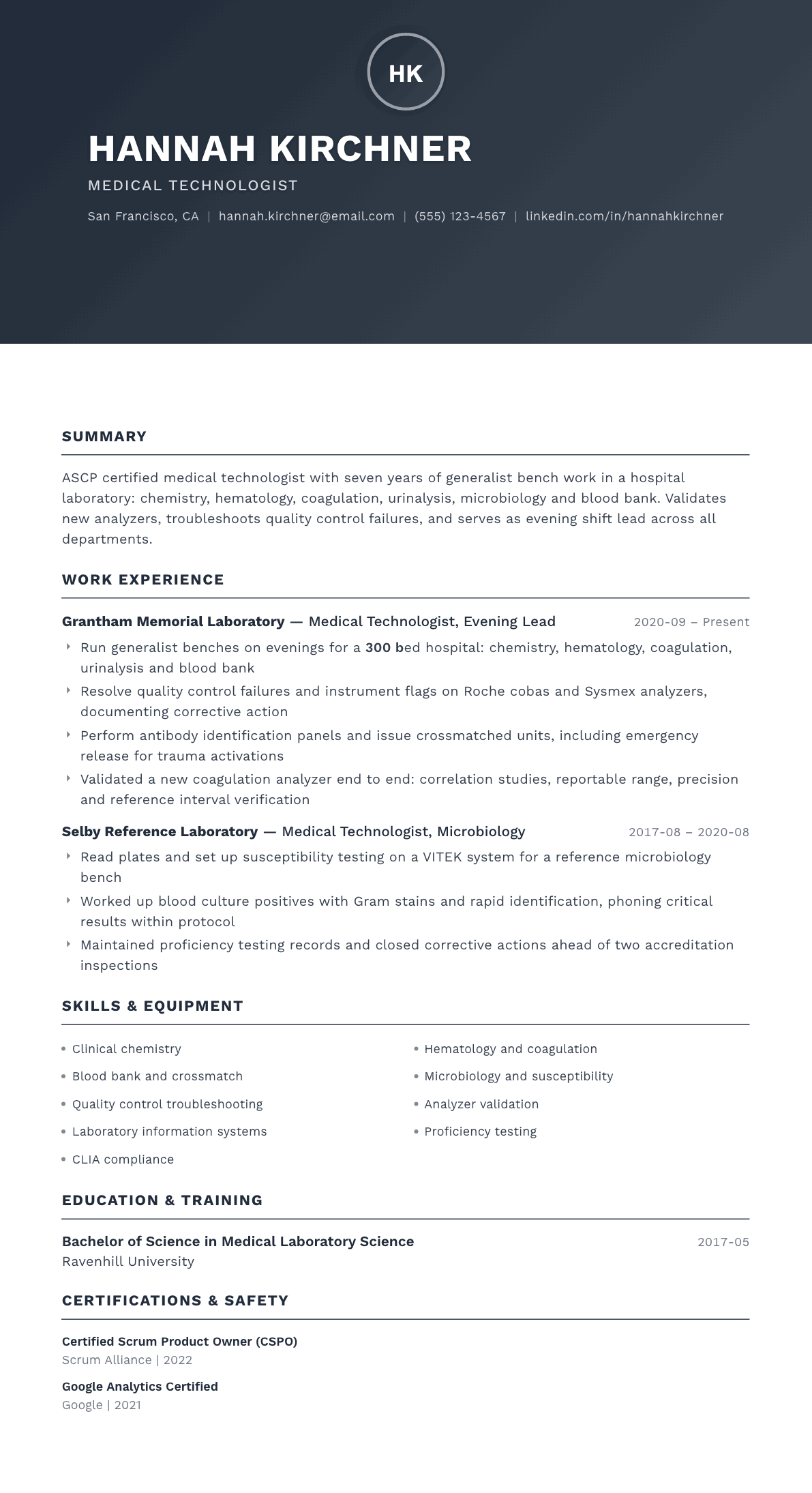
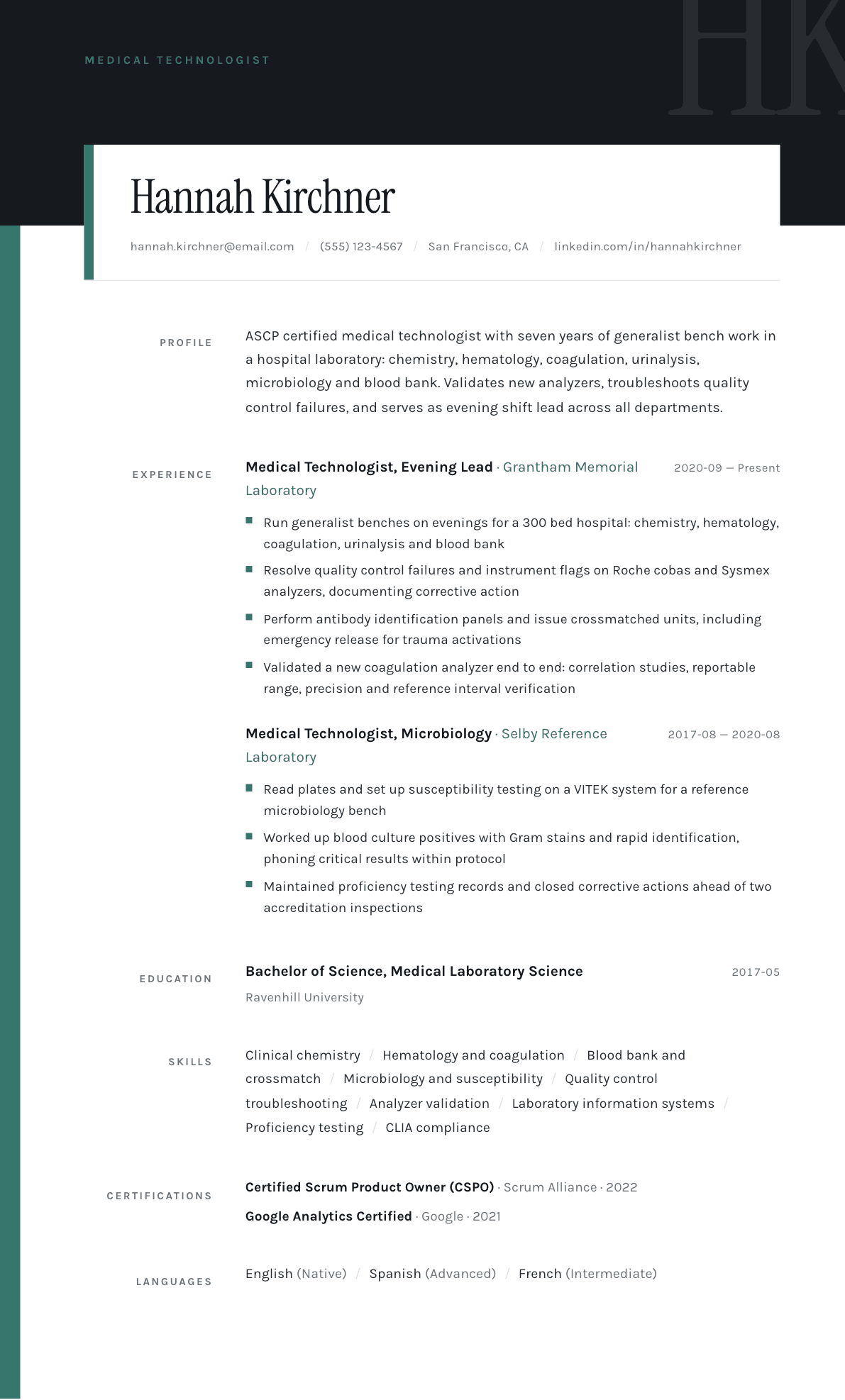
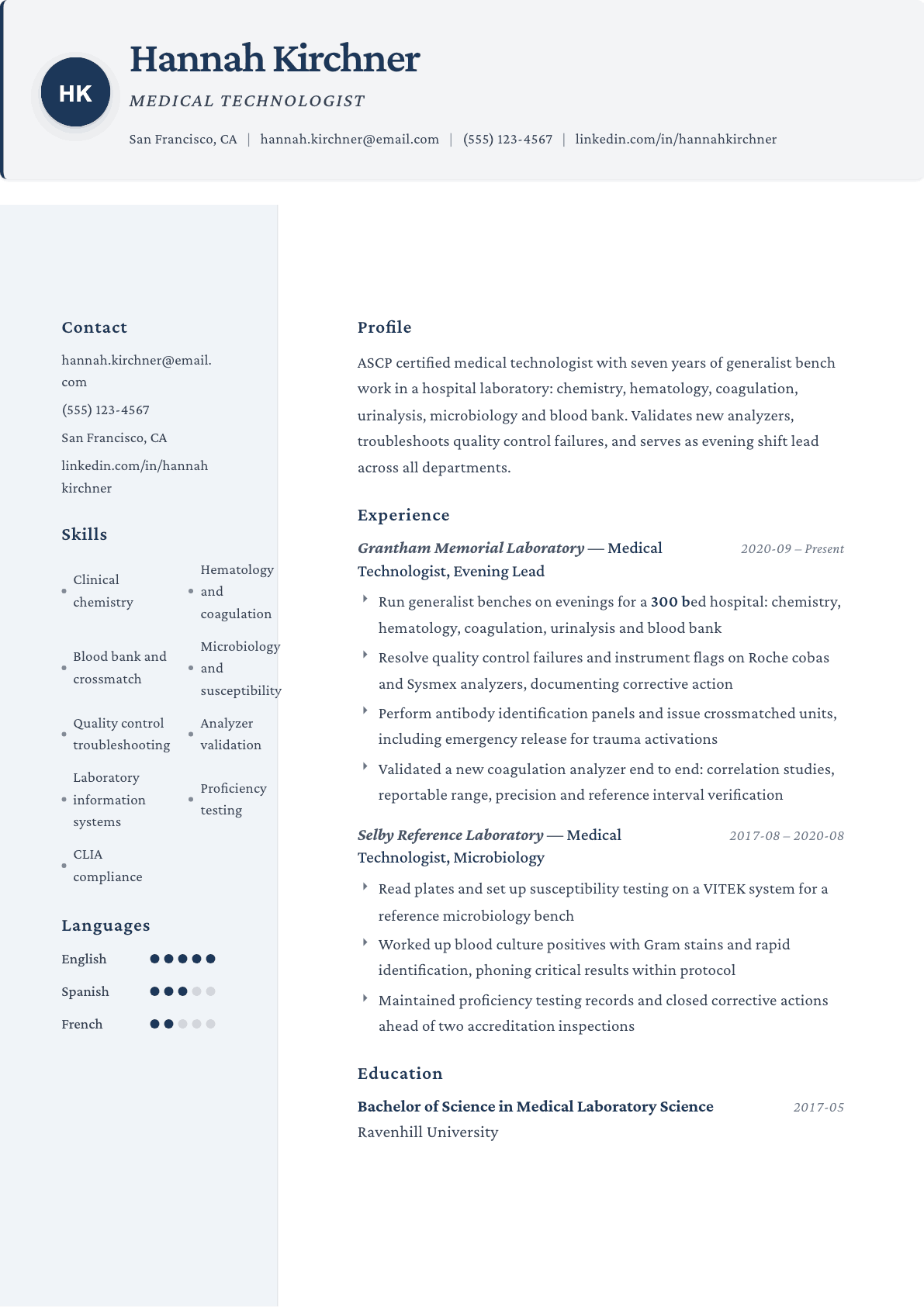
Example Medical Technologist summary
ASCP certified medical technologist with seven years of generalist hospital bench work covering chemistry, hematology, coagulation, urinalysis, microbiology and blood bank. Leads the evening shift, resolves analyzer quality control failures, and validated a coagulation platform end to end including precision and reference interval studies. Comfortable with antibody panels and emergency release. Seeking a laboratory supervisor track position.
Skills to list on a Medical Technologist resume
- Clinical chemistry
- Hematology
- Coagulation testing
- Urinalysis and body fluids
- Clinical microbiology
- Antimicrobial susceptibility testing
- Blood bank and crossmatching
- Antibody identification
- Molecular diagnostics
- Quality control and Levey-Jennings review
- Method validation and verification
- Instrument maintenance
- Proficiency testing
- Laboratory information systems
- CLIA and accreditation compliance
What actually gets this resume read
- Organize experience by bench: chemistry, hematology, coagulation, microbiology, blood bank, urinalysis and molecular.
- Name the analyzers you have run and maintained, because laboratory managers hire against the instruments already installed.
- Put ASCP certification and any state laboratory personnel license in the header, since both are checked before an interview.
- Show quality work explicitly: quality control troubleshooting, corrective actions, proficiency testing and method validation.
- Mention accreditation inspection experience and the inspecting body, which tells a manager you can survive a survey week.
- If you have blood bank depth, spell it out: antibody panels, crossmatching, emergency release and transfusion reaction workups.
How to write a medical technologist resume
A medical technologist resume is read by a laboratory manager filling a specific bench on a specific shift. She is not looking for a generalist claim. She wants to know which departments you can be scheduled in alone, which analyzers you have troubleshot at two in the morning, and whether you can carry blood bank without calling for help.
The second thing she reads for is quality discipline. Laboratories live under inspection cycles, proficiency testing deadlines and corrective action documentation, and a technologist who has been through validations and surveys costs far less to onboard than one who has only run samples.
A medical technology resume and a medical technologist resume are the same document: the term comes from the medical technology degree, now often called medical laboratory science. Imaging roles such as radiologic or MRI technologist need their own resume. This guide covers organizing the resume by bench, writing analyzer and troubleshooting bullets that a manager believes, presenting certification and any state personnel license correctly, and what to emphasize when you want to move toward a supervisor or specialist track.
Format: certification in the header, benches in the body
One page under eight years, two after that, single column. The header carries your name with the certification abbreviation and the certifying body, plus any state laboratory personnel license. Several states license laboratory staff separately from national certification and the hiring manager checks both before an interview is scheduled.
Directly under the header, a bench line naming every department you can work independently does more for you than a summary paragraph. Chemistry, hematology, coagulation, urinalysis, microbiology, blood bank, molecular and flow cytometry are the standard buckets, and the manager filling a hole reads that line first.
- Header: name with certification and issuing body, contact details, state license status, shift availability.
- Bench line: departments you cover independently, then those you cover with support.
- Section order: summary, certification and license, laboratory experience by bench, instruments, quality work, education.
Experience: bench by bench, instrument by instrument
Inside each job, group the bullets by department rather than writing one paragraph about laboratory work. Chemistry and hematology bullets should name the analyzer platforms, the daily specimen volume and the flags and deltas you resolve. Microbiology bullets should name plate reading, identification and susceptibility systems, and critical result reporting. Blood bank bullets should name antibody screening and identification, crossmatching methods, emergency release and transfusion reaction workups.
Instrument troubleshooting is the skill managers cannot train quickly. Describe what you actually do when quality control fails: reagent lot checks, calibration verification, maintenance procedures, correlation studies between analyzers, and documented corrective action. A technologist who resolves a failing control without calling the service engineer is worth naming as such.
Do not write bullets that describe laboratory testing in general. Performed laboratory tests on patient samples says nothing beyond the job title.
- Name the laboratory information system and middleware you have worked in.
- State shift and staffing level: solo evening coverage across all benches is a different job from a day shift in chemistry.
- Include specimen accessioning, send out coordination and critical value reporting if they are part of your role.
Quality work: validations, proficiency testing and surveys
Method validation is the strongest thing a staff technologist can put on a resume. Describe an analyzer or assay you brought online and what you personally did: correlation studies against the existing method, precision runs, linearity and reportable range, reference interval verification, and the written summary you handed to the technical director.
Then proficiency testing and inspections. Name the accrediting body, describe the records you maintained, the corrective actions you closed and the outcome of the survey. Managers read that as evidence you can be trusted with the parts of the job that carry regulatory weight rather than only bench throughput.
Quality control review is the daily version. Levey-Jennings chart review, Westgard rule application, shift and trend recognition, and reagent lot to lot verification are all specific practices worth naming.
Certification, license and specialist credentials
List the generalist certification with its issuing body and current status. Then list any specialist or categorical credential separately, because those map directly to different postings: blood banking, microbiology, chemistry, hematology, molecular biology and cytogenetics are all distinct qualifications with their own hiring pools.
Include your degree and the accreditation of your medical laboratory science program if it was accredited, since some employers and some state licensure routes require it. Add continuing education categories if you are applying for a specialist role, naming the subject areas rather than only the credit total.
Medical technology resume examples: new graduate and experienced
A new graduate of a medical technology or medical laboratory science program has no bench history yet, so the clinical rotations do that work. Give the hospital type, the weeks on each bench and the analyzers you ran under supervision, then your certification status. An experienced technologist leads with the benches covered alone and the quality work.
The two samples below are invented. Copy the structure, not the facts.
- New graduate header: Lauren Petrakis, MLS(ASCP) eligible, BS in Medical Technology, available for evening shift.
- New graduate rotations: 22 weeks of clinical rotations at a 350 bed teaching hospital, covering chemistry, hematology and coagulation, urinalysis, microbiology and blood bank, with sign-off on daily QC and maintenance for the chemistry analyzers.
- New graduate bullet: Performed antibody screens and crossmatches under supervision during a five week blood bank rotation, and wrote up one antibody identification as a case study for the program.
- Experienced header: Victor Mensah, MLS(ASCP), state licensed, nine years in a 24 hour hospital core lab.
- Experienced bullet: Covers chemistry, hematology and blood bank alone on nights for a 400 bed hospital, including emergency release and massive transfusion support.
- Experienced bullet: Ran the correlation study and validation for a new chemistry analyzer line and wrote the procedures used in the go live.
Keywords laboratory postings repeat
Laboratory job descriptions reuse a compact vocabulary: clinical chemistry, hematology, coagulation, microbiology, blood bank, quality control, proficiency testing, method validation, instrument maintenance, critical value reporting, regulatory compliance and laboratory information system. Mirror the true ones once, and prove two or three inside your bullets.
Where the posting names an analyzer platform, echo the exact product name. It is the single most common filter a laboratory recruiter applies, because platform familiarity shortens training by weeks.
Medical Technologist resume summary examples
New graduate
Medical laboratory science graduate with clinical rotations across chemistry, hematology, coagulation, urinalysis, microbiology and blood bank in a 400-bed hospital. Certified as a generalist and trained on Roche and Sysmex platforms. Available for evening and overnight coverage and seeking a hospital laboratory position with rotation across all benches.
Six years in
Certified medical technologist with six years of generalist hospital bench work covering chemistry, hematology, coagulation, urinalysis and blood bank. Resolves analyzer quality control failures independently on evening shift, performs antibody identification panels, and issues emergency release units during trauma activations.
Lead technologist
Lead medical technologist with eleven years in hospital and reference laboratories, now supervising evening staffing across all benches. Validated three analyzer replacements end to end, owns proficiency testing enrollment and corrective actions, and prepared the laboratory for two accreditation inspections without a deficiency.
Work experience bullets: before and after
Before: Ran patient samples on laboratory analyzers.
After: Covered chemistry, hematology, coagulation and urinalysis benches solo on evenings for a 300-bed hospital, releasing results and reporting critical values within policy.
Bench coverage, staffing level and facility size describe the responsibility rather than the activity.
Before: Troubleshot instruments when there were problems.
After: Resolved quality control failures on Roche cobas and Sysmex analyzers through reagent lot checks, calibration verification and maintenance procedures, documenting corrective action each time.
Named platforms and an actual troubleshooting sequence prove independence, which is what evening staffing needs.
Before: Worked in the blood bank.
After: Performed antibody screening and identification panels, issued crossmatched units, and handled emergency release during trauma activations under the massive transfusion protocol.
The specific blood bank tasks separate a technologist who can carry the bench from one who has visited it.
Before: Helped bring a new analyzer into the lab.
After: Validated a replacement coagulation analyzer end to end: method correlation, precision runs, linearity, reportable range and reference interval verification, then wrote the summary for the technical director.
Listing the validation components shows you can carry regulatory work, not just observe someone else doing it.
Before: Kept records for inspections.
After: Maintained proficiency testing enrollment and results, closed corrective actions on schedule, and prepared bench documentation ahead of two accreditation inspections.
Naming the specific compliance tasks and the inspections they served makes the record keeping meaningful.
Hard skills
- Clinical chemistry
- Hematology and differentials
- Coagulation testing
- Urinalysis and body fluids
- Clinical microbiology
- Antimicrobial susceptibility testing
- Blood bank and crossmatching
- Antibody screening and identification
- Molecular diagnostics
- Quality control and Levey-Jennings review
- Method validation and verification
- Instrument maintenance and troubleshooting
- Proficiency testing administration
- Laboratory information systems
Soft skills
- Solo judgment on evening and night shifts
- Critical value communication to nursing
- Documentation discipline
- Composure during trauma activations
- Training new technologists on the bench
- Working with service engineers
Certifications worth listing
- Medical Laboratory Scientist, MLS(ASCP) (American Society for Clinical Pathology)
- Specialist in Blood Banking, SBB(ASCP) (American Society for Clinical Pathology)
- Specialist in Microbiology, SM(ASCP) (American Society for Clinical Pathology)
- Medical Technologist (MT) (American Medical Technologists)
- Clinical Laboratory Scientist (CLS) (American Association of Bioanalysts Board of Registry)
Mistakes that cost medical technologist candidates the interview
- Describing yourself as a generalist without listing which benches you can actually staff alone.
- Omitting the analyzer platforms, when platform familiarity is the fastest way a manager estimates your training time.
- Leaving out method validation work, which is the single strongest differentiator on a staff technologist resume.
- Ignoring the state laboratory personnel license where your state requires one, which stalls the file at credentialing.
- Writing quality control as a phrase instead of the chart review, rule application and corrective action you perform.
- Failing to state shift and staffing level, so a reader cannot tell whether you have ever run a laboratory alone.
- Listing a specialist credential inside a general certification line, where a keyword filter for that specialty misses it.
Medical Technologist resume questions
What is the difference between a medical technologist and a medical laboratory technician?
The technologist role is built on a bachelor degree and carries broader responsibility for validation, troubleshooting and result interpretation, while the technician role generally follows an associate degree. Use the title from the posting and keep your formal certification wording accurate in the credentials section.
Should I organize my resume by bench or by employer?
By employer for the chronology, but group the bullets by bench inside each position. That way a manager hiring for microbiology finds your microbiology work immediately without reading your whole history, and your dates still parse cleanly through the applicant system.
What is a medical technology resume?
It is the resume of a medical technologist, also called a medical laboratory scientist, named after the medical technology degree. It lists your certification, the benches you can work alone, the analyzers you run and your quality work. State the shift and staffing level you covered, because that is the clearest proof of independence.
Is it worth listing every instrument I have used?
List the platforms you have run and maintained rather than every device you have touched. Managers filter on the analyzers already installed in their laboratory, so accuracy matters more than length, and an inflated list falls apart in the first technical interview question.
How do I position myself for a laboratory supervisor role?
Move validations, proficiency testing, inspection preparation, competency assessment and staff training to the front of each position. Those responsibilities are what a supervisor posting screens for, and bench throughput alone will keep you competing in the staff technologist pool.