Merchandiser Resume Examples: free ATS score and gap list
Merchandiser Resume and Merchandising Resume Examples
By Mustafa Tarabya, founder of CVBooster · Published · Updated
Merchandiser resume and four merchandising resume examples, from assistant and coordinator to field and lead merchandiser, with planogram bullets and ATS keywords.
Sample resumes for a merchandiser
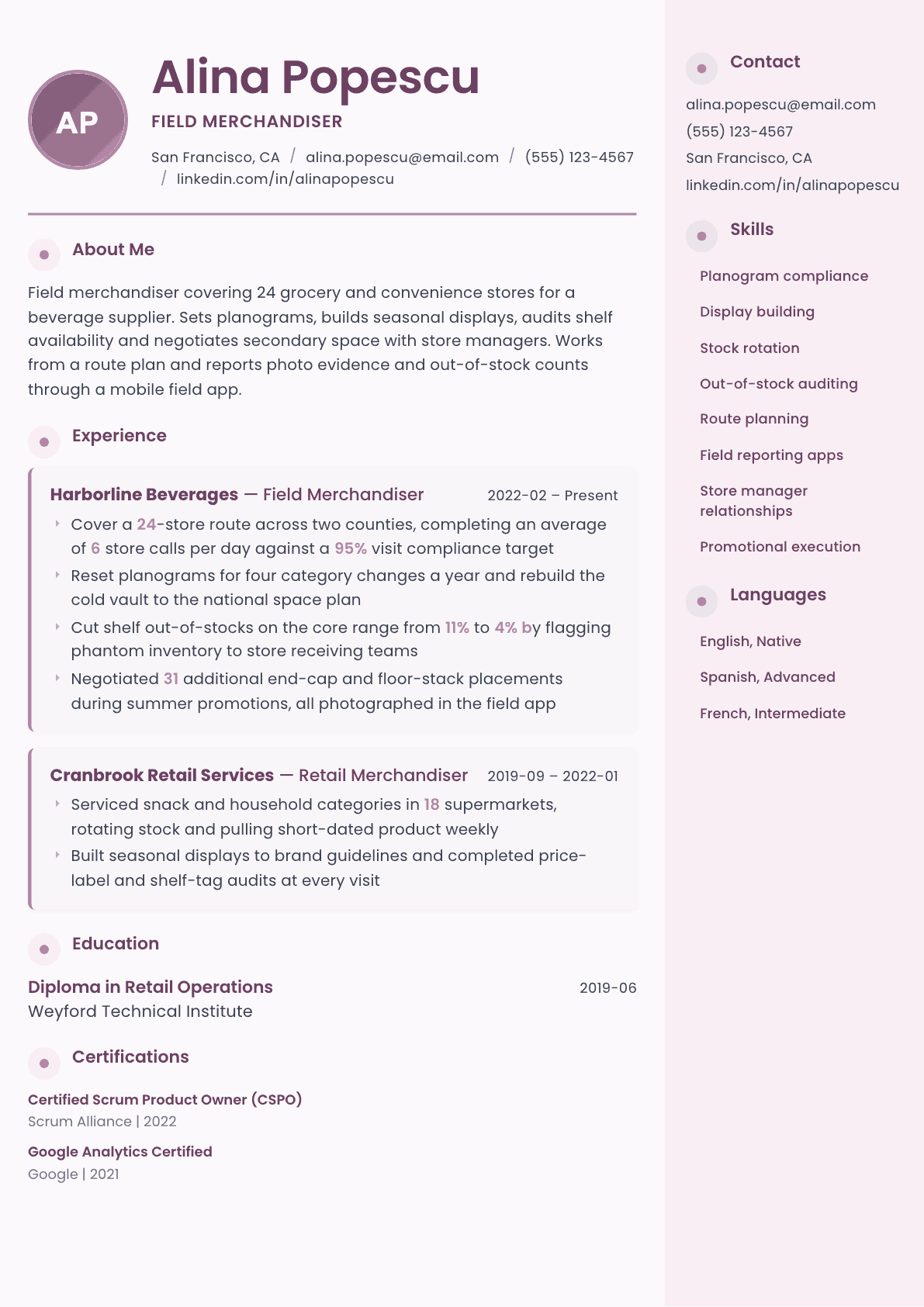
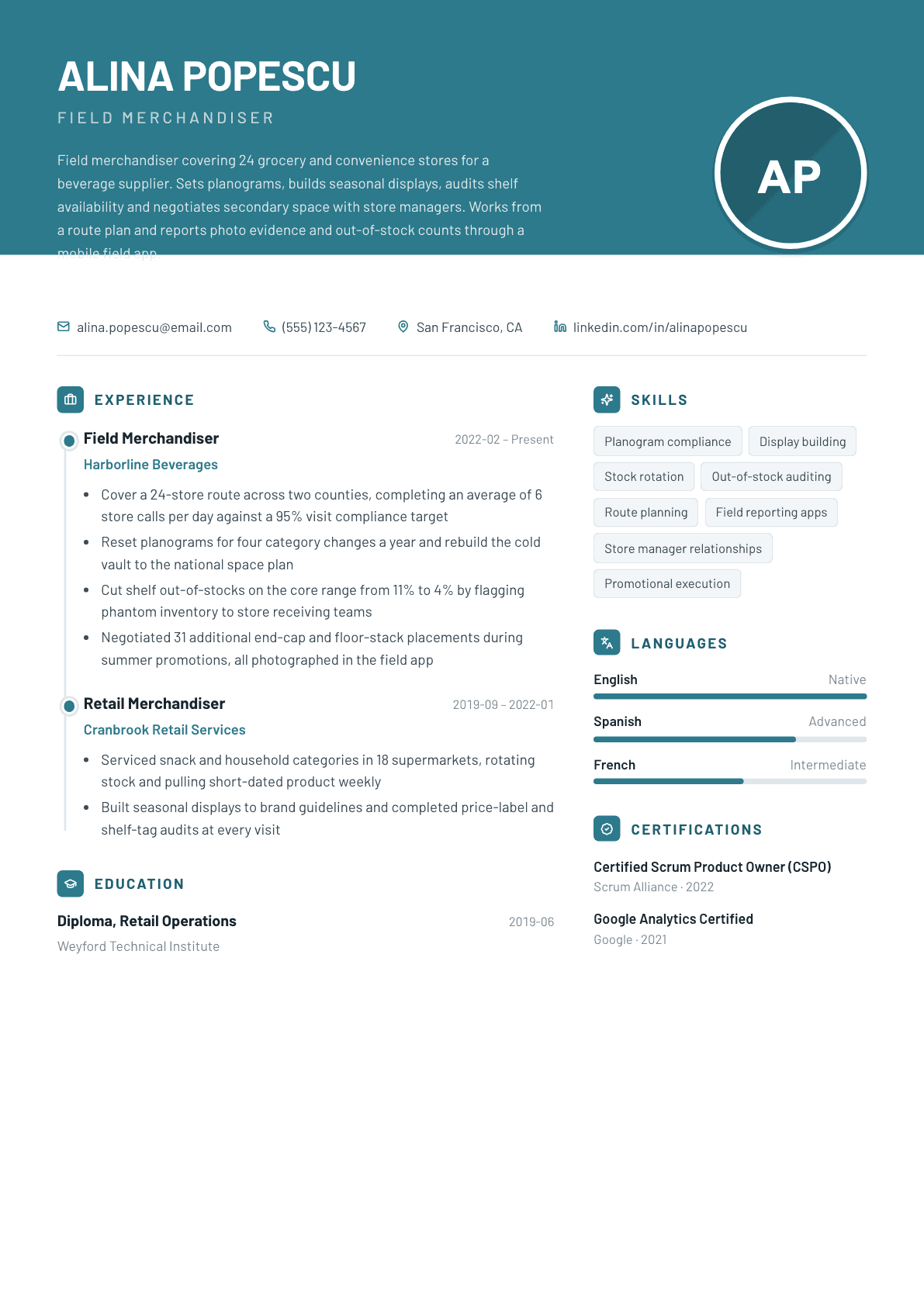
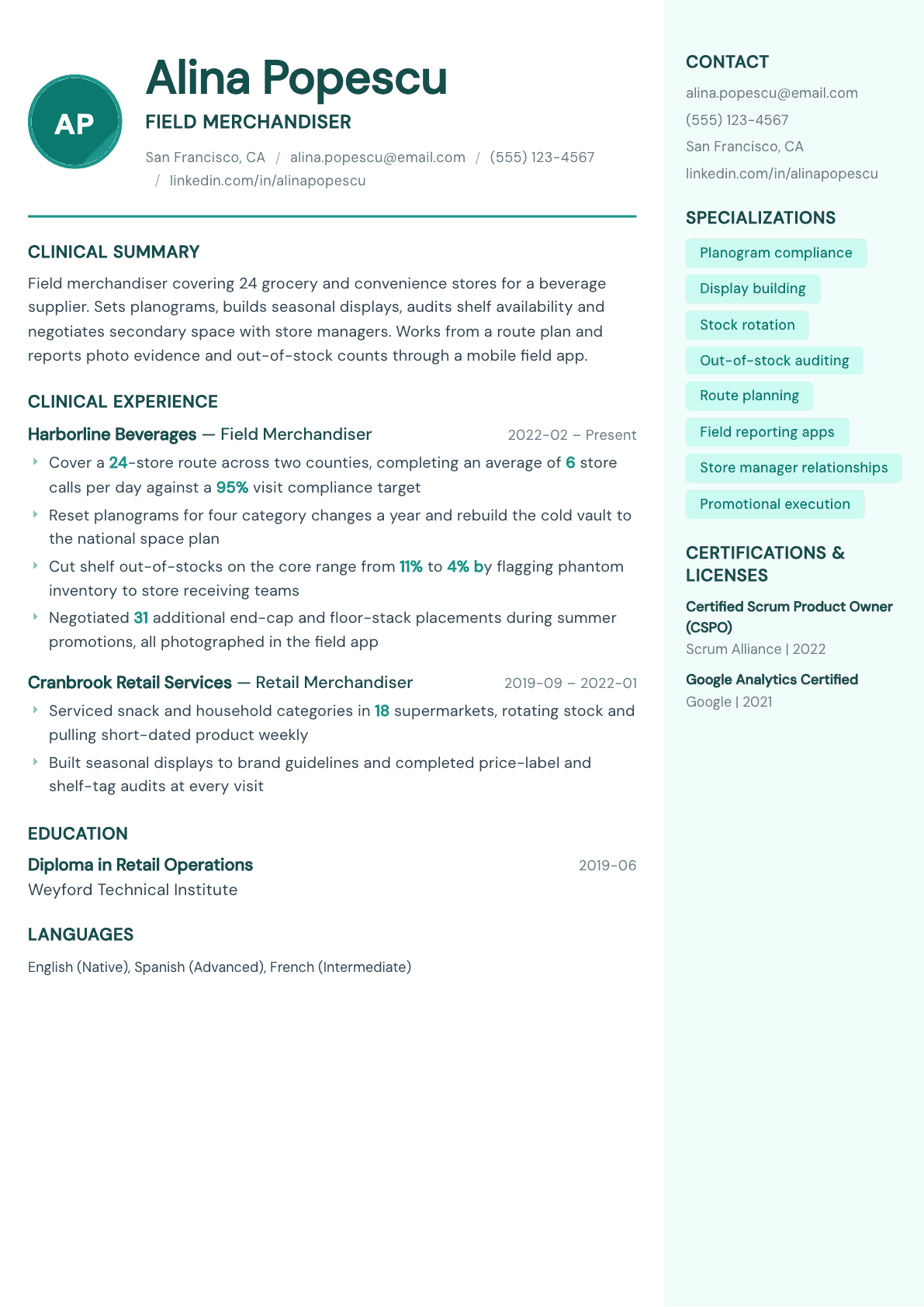
The same merchandiser content laid out in three CVBooster templates, so you can see what the finished document looks like before you write a word.
Example Merchandiser summary
Field merchandiser with five years servicing grocery and convenience accounts, currently covering a 24-store beverage route with six calls a day. Reset four category planograms a year, brought core-range out-of-stocks down from double digits to the low single digits, and won 31 incremental display placements in one promotional season. Looking for a merchandising role with a national account and a larger territory.
Skills to list on a Merchandiser resume
- Planogram compliance
- Visual display building
- Shelf availability auditing
- Stock rotation and date checks
- Route and journey planning
- Promotional execution
- Field reporting apps
- Inventory counts
- Store relationship management
- Price and label accuracy
- Category resets
- Point of sale material placement
- Health and safety in store
What actually gets this resume read
- Put the route size in your first line: number of stores, the territory, and the average calls per day.
- Give planogram work a number, such as the resets per year and the categories or fixture types involved.
- Report availability results, because out-of-stock reduction is the metric a field manager is measured on.
- Name the field reporting app and the photo or audit requirements you worked to at each employer.
- Show the selling half of the job: incremental displays, secondary space, and promotions you talked stores into.
- List a clean driving record and vehicle if the role is a driving route, since it screens candidates in or out.
How to write a merchandiser resume
A merchandiser resume is screened by a field sales manager who has a territory to cover and a national account to keep happy. They are checking three things quickly: how many stores you can service in a day, whether your planogram work holds up to an audit, and whether store managers actually give you the extra space when you ask.
The word merchandiser covers several jobs, and the first duty of your resume is to say which one you have done. Field merchandising on a driving route, in-store merchandising for a single large site, visual merchandising in fashion retail and head office merchandise planning are four different careers. A manager who cannot tell yours apart in five seconds moves on to the next application.
Some postings and searches call it a merchandise resume or a merchandise associate resume; the screen is the same. This guide sets out the format, four merchandising resume examples from assistant to lead, how to describe a route and a call file, the availability and compliance numbers that matter, three summaries across the career, before-and-after bullets, and the questions field merchandisers ask when they are applying for a bigger territory.
Format: one page, route detail before duties
One page, reverse chronological. This is a role where the concrete facts of the job do the persuading, so give them structurally. Under each employer, add a route line: number of stores, retailer names or banner types, the geography, calls per day and the visit frequency per store.
If you drove for the job, say so, with the license class and whether a vehicle was provided. Many employers screen on this before they read a single bullet, and leaving it out gets a strong application filtered.
- Header: name, city, phone, email, driving license class and vehicle availability.
- Section order: summary, route and store experience, systems and apps, education and training.
- Route line: store count, retailer type, territory, calls per day, visit cycle.
Summary: the route, the categories, the result
Three lines. Name the number of stores you cover, the retailers or channel, the categories you merchandise, and one measurable result such as availability improvement or incremental display wins. The specific product category matters because cold vault beverage work, ambient grocery and fresh produce all require different handling.
Add the reporting side. Most field merchandising jobs now run through a mobile app that requires photographs, timed check-ins and audit answers at every visit, and an employer wants to see you have worked to that standard.
A merchandise resume summary for an in-store job, written out: Merchandise associate at a home goods store, sets four planogram resets a month, works the morning truck to the floor before opening and keeps the high volume aisles full through the evening shift. It names the work, the rhythm and the standard in two lines.
Experience: compliance, availability and the selling half
Split your bullets across the three parts of the job. Compliance is planogram accuracy, shelf tags, price integrity and date rotation. Availability is out-of-stock reduction, phantom inventory flags, backstock recovery and ordering support. The selling half is the negotiation with the store manager for end caps, floor stacks, secondary sitings and promotional space.
The selling half is where most merchandiser resumes are silent, and it is where field sales managers look hardest. A merchandiser who only executes what the space plan says is doing half the job. Count the incremental placements you won in a promotional period and put the number on the page.
Availability work carries the strongest numbers available to you. Bringing core-range out-of-stocks down is measurable, valuable to the supplier and directly attributable to your visits, so give it its own bullet with a before and after figure.
- Planogram resets completed, by category and by fixture type.
- Out-of-stock rate on the core range, before and after.
- Incremental displays and secondary space won during a named promotion.
- Visit compliance: calls completed against calls scheduled.
Systems, evidence and audits
Name the field reporting app you used, the photo evidence standard, and any handheld scanning or ordering system. Suppliers audit field teams on photographic proof, so a candidate who is comfortable with timed check-ins, before-and-after photographs and structured survey answers is easier to onboard.
If you have worked with retailer systems for ordering or stock enquiry, say so. Being trusted on a retailer's own terminal is a mark of a merchandiser who has built a real relationship in store.
Merchandising resume examples: assistant, coordinator, field and lead
Merchandising job titles in the US split the same way as the work. Merchandising assistant and coordinator roles usually sit with a buying or planning team and live in spreadsheets, purchase orders and sample tracking. Field and retail merchandiser roles live in stores. Pick the sample closest to the posting and use its title word for word in your headline.
The four samples below are invented. Each shows the headline, the summary line and the strongest bullet, which is the part a hiring manager reads before deciding to read the rest.
- Merchandising assistant, apparel buying office: Headline: Merchandising Assistant, women's apparel, Excel and purchase order tracking. Summary: Supports two buyers with line sheets, sample tracking and weekly sell through reports. Best bullet: Rebuilt the weekly sell through report so buyers could see slow sellers by store cluster, which the team now uses in every markdown meeting.
- Merchandising coordinator, home goods: Headline: Merchandising Coordinator, home and seasonal, vendor and sample management. Summary: Coordinates samples, item setup and launch dates for about 300 items a season with 15 vendors. Best bullet: Cut late item setups before a holiday launch by building a shared calendar with vendors and the planning team.
- Retail merchandiser, grocery route: Headline: Retail Merchandiser, beverage and snacks, 22 store weekly route. Summary: Services grocery and drug stores across three counties, resetting shelves to planogram and building end caps. Best bullet: Raised planogram compliance on the route to the top of the district on the supplier's monthly photo audit.
- Lead merchandiser, national reset team: Headline: Lead Merchandiser, overnight resets, team of six. Summary: Leads overnight category resets in big box stores and trains new team members on fixtures and safety. Best bullet: Finished every assigned reset in a 40 store remodel program on schedule, with store sign off on the first walk.
Keywords retailers and suppliers search for
Postings reuse a tight vocabulary: planogram, space plan, retail execution, availability, out of stock, stock rotation, first in first out, gondola end, end cap, floor stack, point of sale material, call file, journey plan, visit compliance and category reset. Use the ones that match your real experience.
Add the retail environments you have worked in, since a manager filters on them: grocery multiples, convenience, discount, pharmacy, forecourt, department stores or wholesale cash and carry.
Merchandiser resume summary examples
First merchandising role
Retail assistant with two years of shop floor experience in a supermarket, including stock rotation, date checks, shelf edge labeling and building promotional displays to a brand guide. Full driving license and comfortable with a mobile audit app. Looking for a first field merchandising route.
Field merchandiser on a driving route
Field merchandiser covering 24 grocery and convenience stores across two counties at six calls a day. Resets four category planograms a year, holds visit compliance at 95%, and brought core-range out-of-stocks down from 11% to 4% by flagging phantom inventory to store receiving teams.
Senior or team merchandiser
Senior merchandiser with nine years in beverage and snack categories, currently covering a national account territory and training four new field staff a year. Leads seasonal reset crews, negotiated 31 incremental placements in one summer promotion, and audits route quality across a five-person team.
Work experience bullets: before and after
Before: Visited stores to make sure shelves looked good.
After: Cover a 24-store route across two counties at an average of six calls a day, working a fixed journey plan with a 95% visit compliance target and photo evidence logged at every call.
Route size, call rate, journey planning and the evidence standard tell a field manager exactly what you can carry.
Before: Set up displays according to the planogram.
After: Reset planograms for four category changes a year and rebuild the cold vault to the national space plan, checking facings, shelf tags and date rotation before the store manager signs the visit off.
Naming the reset frequency, the fixture and the sign-off shows the compliance discipline an audit would look for.
Before: Helped reduce out of stocks in my stores.
After: Cut core-range out-of-stocks from 11% to 4% across the route by identifying phantom inventory, walking the backstock with receiving teams and raising manual orders where the automatic system had underordered.
The before and after figure plus the three actions behind it turn availability work into a repeatable method.
Before: Built good relationships with store managers.
After: Negotiated 31 additional end-cap and floor-stack placements during the summer promotion by bringing store managers a sales rate argument for the space rather than a request.
A relationship claim becomes evidence when it produces counted space and names the approach that won it.
Before: Used the company app to report on visits.
After: Report every call in the field app with timed check-in, before-and-after photographs, an availability count and answers to the weekly survey, which the account team uses in its retailer review.
Explaining what the report contains and who consumes it shows you understand why the evidence exists.
Hard skills
- Planogram and space plan compliance
- Category resets
- Out-of-stock auditing
- Stock rotation and date code checks
- Journey and route planning
- Display and point of sale installation
- Field reporting apps
- Handheld scanning and ordering
- Price and shelf label accuracy
- Promotional execution
- Inventory counting
- Manual handling and safe working in store
Soft skills
- Store manager negotiation
- Working alone without supervision
- Time discipline across a route
- Attention to detail on a repetitive task
- Adaptability when a store is not ready
- Clear written reporting
Mistakes that cost merchandiser candidates the interview
- Not saying which kind of merchandising you do, leaving a field manager to guess between a driving route and a fashion floor.
- Leaving out the store count, the call rate and the visit cycle, which are the first facts a territory manager checks.
- Describing only planogram execution and never the space you negotiated, which is half the value of the role.
- Omitting the driving license and vehicle detail on a job that is filtered on both.
- Writing duties with no numbers when availability, compliance and display counts are all easy to measure.
- Ignoring the reporting app and photo evidence standard that suppliers audit field teams against.
Merchandiser resume questions
What is the difference between a merchandiser and a sales representative?
A merchandiser executes and protects the agreed space in store: planograms, availability, rotation and displays. A representative negotiates the range, the promotion and the order. Many field roles blend the two, so say clearly which parts you owned at each employer.
How many stores should I say I covered?
Give the real number along with the visit cycle and the calls per day, since a 24-store weekly route and a 60-store monthly route are very different jobs. If your territory changed, quote the largest route you held and the period you held it.
What should a merchandising resume example include for an office role?
For a merchandising assistant or coordinator role, lead with the planning side: the category, the number of items or vendors, the reports you built and the systems, usually Excel and a purchase order or product data tool. Add one store visit or retail job to show you understand how the range lands on the floor.
How do I get into merchandising with only shop floor experience?
Lead with the transferable work you already did: stock rotation, date checks, shelf edge labeling, backstock recovery and building promotional displays to a brand guide. Add your driving license, and apply first to territories close to home where a supplier is filling a route quickly.
Should I list the brands and retailers I have worked with?
Yes, at the level of category and banner type rather than confidential account detail. Saying you serviced beverage and snack ranges in grocery multiples, convenience and forecourt sites tells a hiring supplier whether your experience maps onto their route.