MIG Welder Resume Examples: free ATS score and gap list
Write a MIG Welder Resume That Lists Positions and Procedures
By Mustafa Tarabya, founder of CVBooster · Published · Updated
MIG welder resume example, keyword list and guide covering GMAW settings, positions, wire and gas selection, certifications and weld quality.
Sample resumes for a mig welder
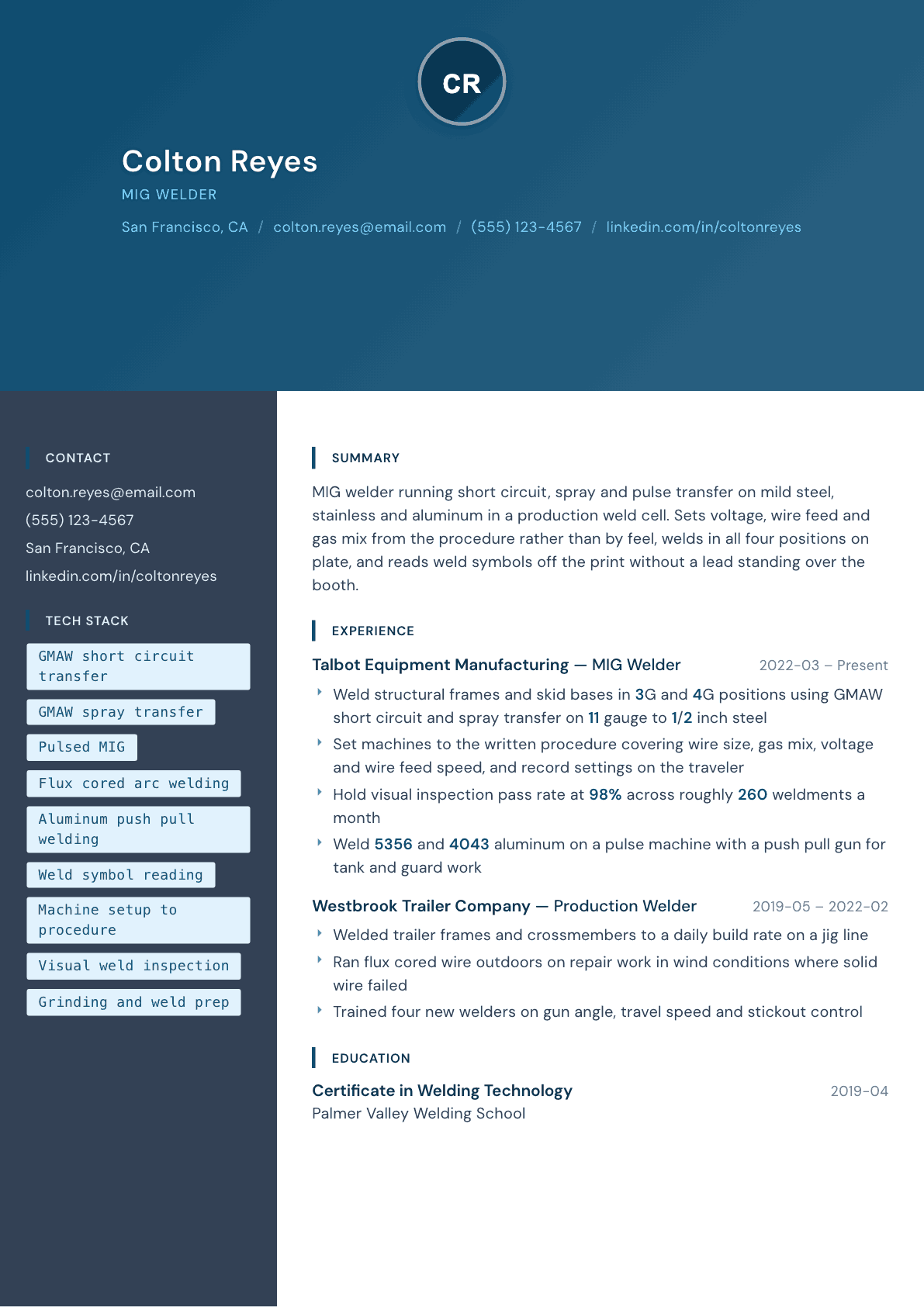
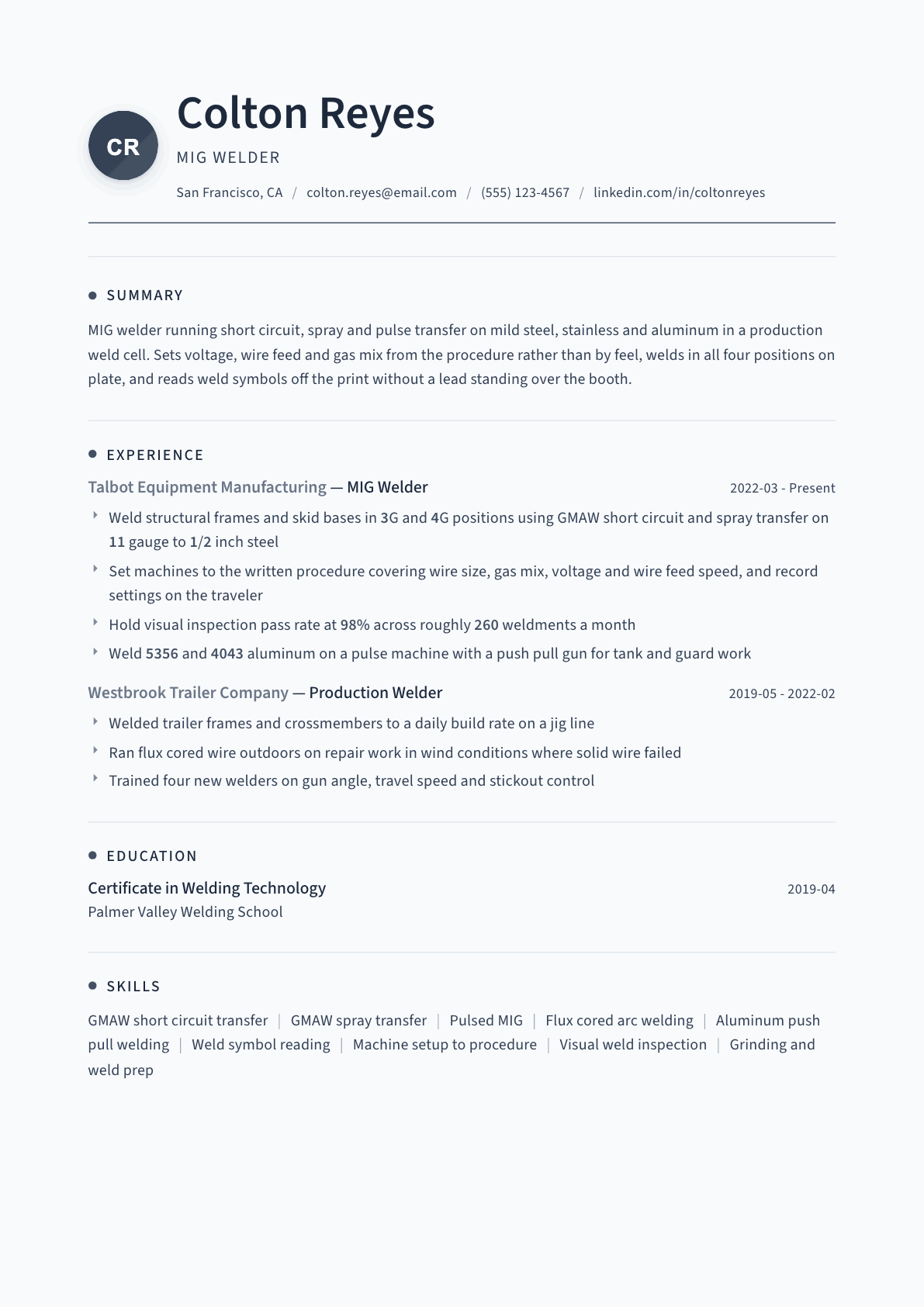
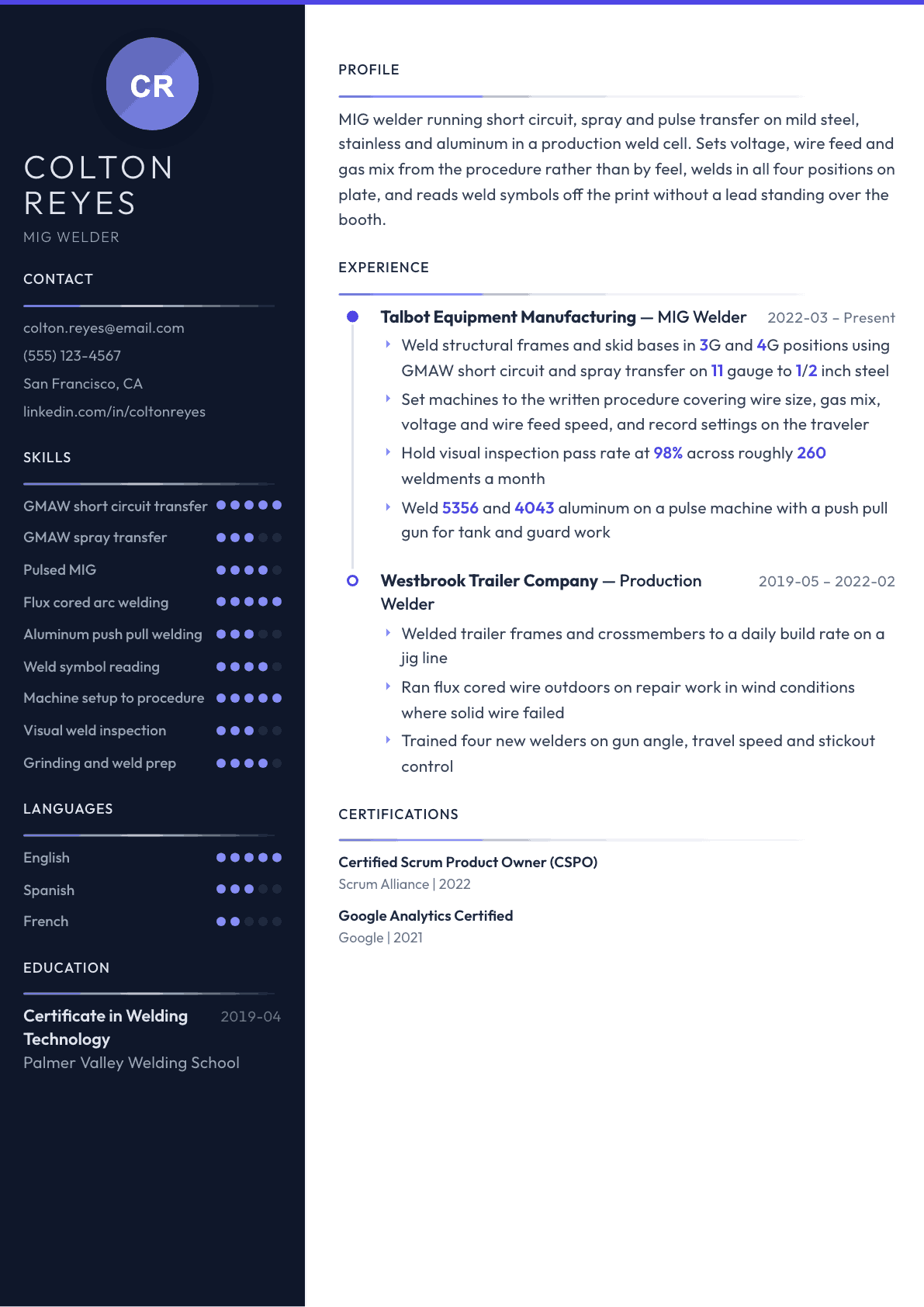
The same mig welder content laid out in three CVBooster templates, so you can see what the finished document looks like before you write a word.
Example MIG Welder summary
MIG welder running short circuit, spray and pulsed transfer on mild steel, stainless and aluminum in a production cell. Welds structural frames in 3G and 4G on 11 gauge through half inch material, sets voltage, wire feed and gas mix directly from the written procedure, and records settings on the traveler. Holds a 98% visual inspection pass rate across roughly 260 weldments a month.
Skills to list on a MIG Welder resume
- GMAW short circuit transfer
- GMAW spray and globular transfer
- Pulsed MIG welding
- Flux cored arc welding
- Push pull aluminum welding
- Welding procedure specification reading
- Voltage and wire feed speed setup
- Shielding gas mix selection
- Weld symbol and print interpretation
- Joint preparation and fit up
- All position plate welding
- Visual weld inspection
- Distortion control and tack sequencing
- Grinding, gouging and weld repair
- Robotic weld cell tending
What actually gets this resume read
- Name the transfer modes you run, because short circuit, spray and pulse are three different skills to a weld engineer.
- List the positions you have welded and tested in, using the standard codes such as 2F, 3G and 4G.
- Give the materials and thickness range, and say which wire and gas mixes you have run on each one.
- State whether you set your own machine from a written procedure, since that is what separates a welder from a button pusher.
- Put any current weld test or certification with the code, the position and the date it was taken.
- Include your visual inspection pass rate or rework figure, because weld quality is measured and your next shop will ask.
- Mention fixture and jig work, robot tending or tack sequences if you have them, since production shops value all three.
How to write a mig welder resume
A production shop hiring a MIG welder is buying arc time and consistent quality. The weld engineer or shop lead reading your resume wants to know which transfer modes you run, which positions you have been tested in, what materials and thicknesses you handle, and whether you can set a machine from a written procedure instead of turning knobs until the puddle looks familiar.
That last point separates most candidates. Plenty of people can lay a decent bead on a bench in flat position on quarter inch mild steel. Far fewer can read a welding procedure specification, dial in wire size, gas mix, voltage, wire feed speed and travel angle to match it, and record the settings where an inspector can find them. Say on the page that you do the second thing.
This guide covers what belongs on a MIG welder resume: the process block with transfer modes and positions, the machine setup evidence, the quality numbers a shop tracks on welds, and how to write certifications so a weld engineer can see immediately what you are qualified to run.
Format: processes, positions, materials, right at the top
One page. Directly under the summary, put a welding block: processes with transfer modes, positions tested and worked, base metals with thickness ranges, and filler and gas combinations. A weld engineer scans that block against his procedures and knows within seconds whether you can run his work.
Keep certifications in their own section with full detail. A certification means nothing without the process, position, base metal, thickness range and date, because that is exactly what it covers. Listing a bare certification name suggests you have never had to explain the essential variables to an inspector.
- Processes: gas metal arc welding with short circuit, globular, spray and pulsed transfer, plus flux cored and metal cored if you run them.
- Positions using standard codes: 1F, 2F, 3F, 4F for fillet, and 1G through 4G on plate.
- Base metals with thickness ranges: mild steel gauge through plate, 304 and 316 stainless, 5052 and 6061 aluminum.
- Filler and gas: wire diameters, solid versus cored, and the shielding mixes you have used with each.
- Equipment: power source types, push pull or spool guns for aluminum, and any robotic cell you tend.
Summary: transfer modes, positions and independence
Three or four sentences. What you weld, in which transfer modes, in which positions, on what material range. Then the independence statement: that you set machines from the written procedure and record the settings. A shop that has to have a lead set every machine is paying twice for the same weld.
If you weld aluminum, put it in the summary rather than the skills list. Aluminum MIG on a push pull or spool gun is a distinct skill with its own preparation, cleaning and travel speed demands, and shops that need it will pay for it. The same applies to pulsed transfer, which many welders have never run.
Experience: rate, quality and machine setup
Write the technical detail first. Which joints you weld, in which positions, on what fixtures, at what thickness, and what preparation you do beforehand. Joint preparation, cleaning, fit up gaps and tack sequence are all part of a MIG welder's work in production, and a lead reading them knows whether you understand why welds fail.
Then the numbers a shop tracks. Visual inspection pass rate, rework or repair rate, weldments completed per shift or per month, and any inspection results beyond visual. Weld quality is measured in almost every shop, so a candidate with no numbers looks either new or unmeasured, and neither helps.
Include distortion control, because it is the thing that turns a good bead into a bad part. Describe your tack pattern on a long member, when you skip weld, when you clamp and when you preheat. That paragraph tells a weld engineer more about your experience than the number of years you list.
- Name the joint types you run: fillet, lap, butt with and without backing, T joints, and open root work if you do it.
- State whether you fit and tack your own work or receive fixtured parts, since the two are different jobs.
- Give your throughput honestly: weldments per shift, or arc time as a share of the shift if the shop measured it.
- Include any repair and gouging work, since shops with repair benches need welders who can cut a bad weld out cleanly.
Certifications and procedures written properly
Write each certification as the code or standard, the process, the position, the base metal group and the thickness range covered, plus the date of the test. That is what makes it usable to an employer. If you have a continuity record showing you have welded to that procedure recently, say so, because continuity is what keeps a qualification live.
If you have welded to structural or manufacturer procedures, say which and what they covered without misrepresenting the scope. A welder who describes his qualification precisely is trusted with the next test; one who overstates gets found out on the coupon and loses the job on day one.
Test taking itself is worth mentioning. Shops often ask for a weld test before hiring, and stating that you have passed tests recently, on which materials and positions, signals that you will not freeze in the booth.
Safety, fixtures and the words postings use
Cover the safety and equipment habits that reduce a shop's risk: fume extraction use, hot work permits, respirator fit testing, flammable material control, and proper personal protective equipment for aluminum and stainless work. Then add fixture work, robotic cell tending and any programming or teach pendant exposure, since automation is spreading through production welding.
Postings use a narrow vocabulary. Gas metal arc welding, short circuit, spray transfer, pulsed, flux cored, wire feed speed, voltage, shielding gas, weld symbols, fit up, visual inspection, weld procedure specification, and the position codes themselves. Use those exact words where the work is shown rather than as a list.
MIG Welder resume summary examples
Welding school graduate
Welding technology certificate graduate running gas metal arc welding in short circuit transfer on mild steel from 16 gauge to 1/4 inch, tested in 2F and 3F. Reads weld symbols and joint prep callouts. Seeking a production welding seat with a path to spray transfer work.
Production welder
MIG welder running short circuit and spray transfer on structural frames and skid bases in 3G and 4G positions, 11 gauge through 1/2 inch steel. Sets machines from the written procedure and records settings on the traveler. Holds a 98% visual inspection pass rate across roughly 260 weldments a month.
Lead welder
Lead MIG welder across steel, stainless and aluminum, running pulsed transfer with a push pull gun and tending two robotic cells. Trains new welders on gun angle, stickout and travel speed, and writes the tack sequences the shop uses to control distortion on long frames.
Work experience bullets: before and after
Before: Welded parts using a MIG welder.
After: Welded structural frames and skid bases in 3G and 4G positions using short circuit and spray transfer on 11 gauge through 1/2 inch steel, working from weld symbols on the assembly print.
Positions, transfer modes and thickness range describe qualification instead of naming a machine type.
Before: Set up the welding machine before starting work.
After: Set voltage, wire feed speed, wire diameter and shielding gas mix directly from the written welding procedure, then recorded the settings on the traveler for the inspector to verify.
Working from a procedure and documenting it is the difference between a welder and a machine operator.
Before: Produced high quality welds with few defects.
After: Held a 98% visual inspection pass rate across roughly 260 weldments a month, with the small remainder driven by fit up gaps rather than weld defects.
A measured pass rate over a stated volume, with the failure cause named, is verifiable and honest.
Before: Welded aluminum parts as needed.
After: Welded 5356 and 4043 aluminum on a pulsed power source with a push pull gun for tank and guard work, cleaning with dedicated stainless brushes and welding within the same shift as preparation.
Filler alloys, equipment and the preparation habit prove genuine aluminum experience rather than occasional exposure.
Before: Helped train new welders on the team.
After: Trained four new welders on gun angle, travel speed and contact tip to work distance, then reviewed their first week of weldments against the visual acceptance criteria before signing them off.
Naming the specific techniques and the sign off standard turns training into a quality control activity.
Hard skills
- Gas metal arc welding in short circuit transfer
- Spray and globular transfer welding
- Pulsed MIG welding
- Flux cored and metal cored arc welding
- Aluminum welding with push pull and spool gun
- Welding procedure specification interpretation
- Voltage and wire feed speed setup
- Shielding gas selection and flow setting
- Weld symbol and assembly print reading
- Joint preparation and fit up gap control
- All position plate and fillet welding
- Visual weld inspection to acceptance criteria
- Distortion control and tack sequencing
- Arc gouging and weld repair
- Robotic welding cell tending
Soft skills
- Holding bead consistency through a full shift under a hood
- Stopping to fix fit up rather than welding over a gap
- Taking a weld test without losing technique to nerves
- Reporting a procedure that does not match the joint
- Teaching technique by hand rather than by description
Certifications worth listing
- Certified Welder (American Welding Society)
- Certified Welding Inspector (CWI) (American Welding Society)
- SENSE Level I and II Welding Program (American Welding Society)
- OSHA 10-Hour General Industry (OSHA Outreach Training Program)
Mistakes that cost mig welder candidates the interview
- Writing only that you run MIG, when short circuit, spray and pulsed transfer are separate skills to a weld engineer.
- Omitting position codes, which leaves a shop unable to tell whether you can weld anything but flat work.
- Listing a certification with no process, position, base metal or thickness range, so it cannot be evaluated.
- Claiming quality without a visual pass rate, rework figure or inspection result behind it.
- Ignoring fit up and joint preparation, which is where most production weld failures actually start.
- Treating aluminum as a footnote when it is a distinct capability shops will pay a premium for.
MIG Welder resume questions
How do I list welding certifications on a MIG welder resume?
Give the standard or code, the process, the position, the base metal group, the thickness range and the date tested. Add whether your continuity is current. An employer needs all of those to know what your qualification actually permits you to weld.
Does spray transfer experience matter if I have only run short circuit?
It matters for heavier production work, because spray deposits far more metal per hour on thicker material. Say honestly which modes you have run, and note any exposure to spray under supervision, since shops will often train a welder who is straightforward about the gap.
What should I put on a MIG welder resume with only school experience?
List your program hours, the processes and positions you were tested in, the materials and thicknesses you welded, and any shop projects you completed. Add measurement and print reading training, then state clearly that you are ready to take a weld test on request.
How do I prepare for a weld test during hiring?
Ask which process, position, material and thickness the test uses, and whether you set your own machine or take a preset one. Practice that exact combination beforehand. Bring your own hood and gloves, and take time on fit up, because most test failures start there.
Is robotic welding experience worth putting on the resume?
Yes. Even simple cell tending, load and unload, torch cleaning and reporting a drifting seam shows you can work alongside automation. If you have touched a teach pendant or adjusted weld schedules, say exactly how far that went rather than implying programming ability.
Related resume examples
- Welder Resume example
- TIG Welder Resume example
- Fabricator Resume example
- Welding Engineer Resume example
- Pipe Welder Resume example
- Metal Fabricator Resume example