TIG Welder Resume Examples: free ATS score and gap list
Write a TIG Welder Resume That Proves Precision Work
By Mustafa Tarabya, founder of CVBooster · Published · Updated
TIG welder resume example and guide covering GTAW on stainless and aluminum, purging, tungsten selection, code work and weld test results.
Sample resumes for a tig welder
The same tig welder content laid out in three CVBooster templates, so you can see what the finished document looks like before you write a word.
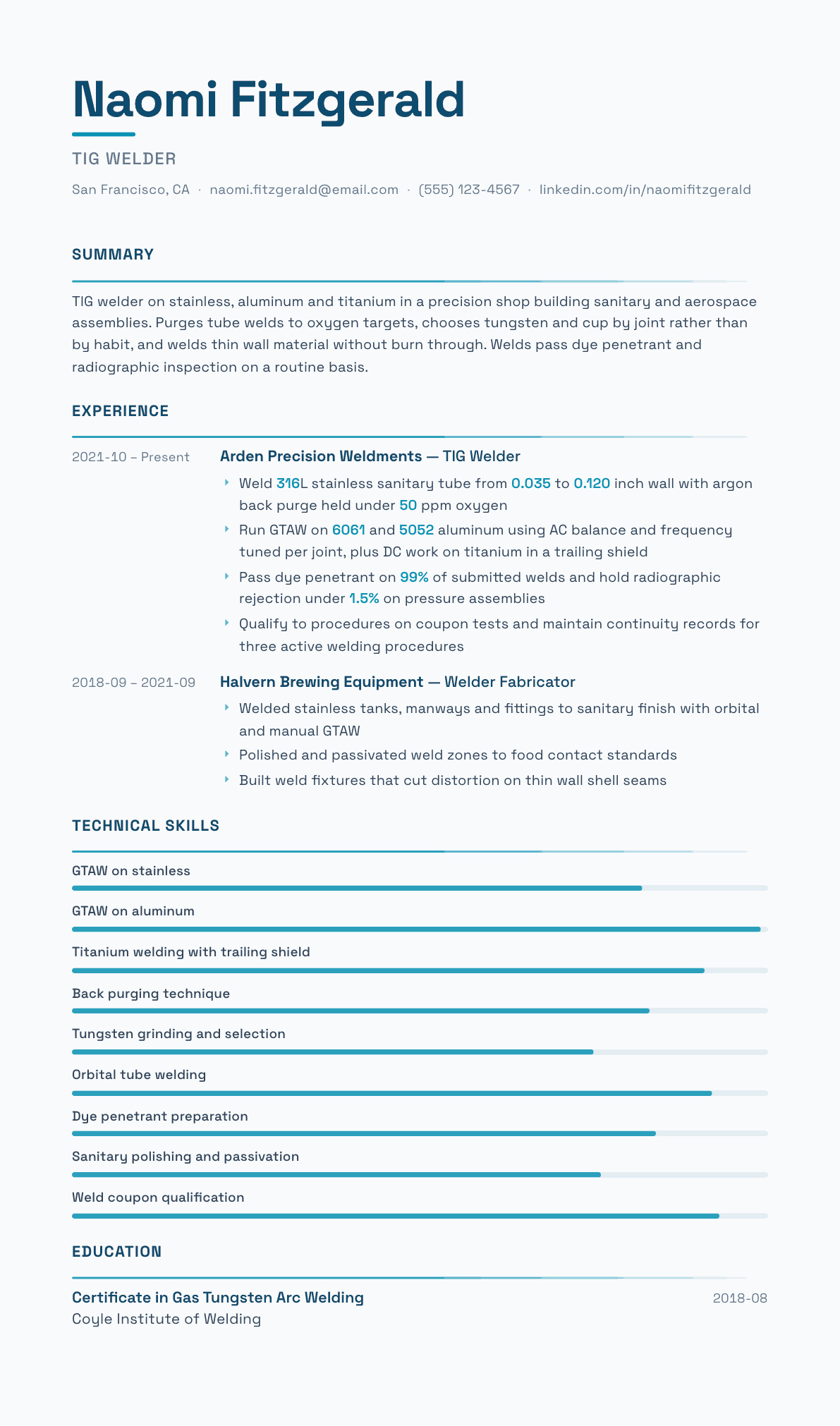
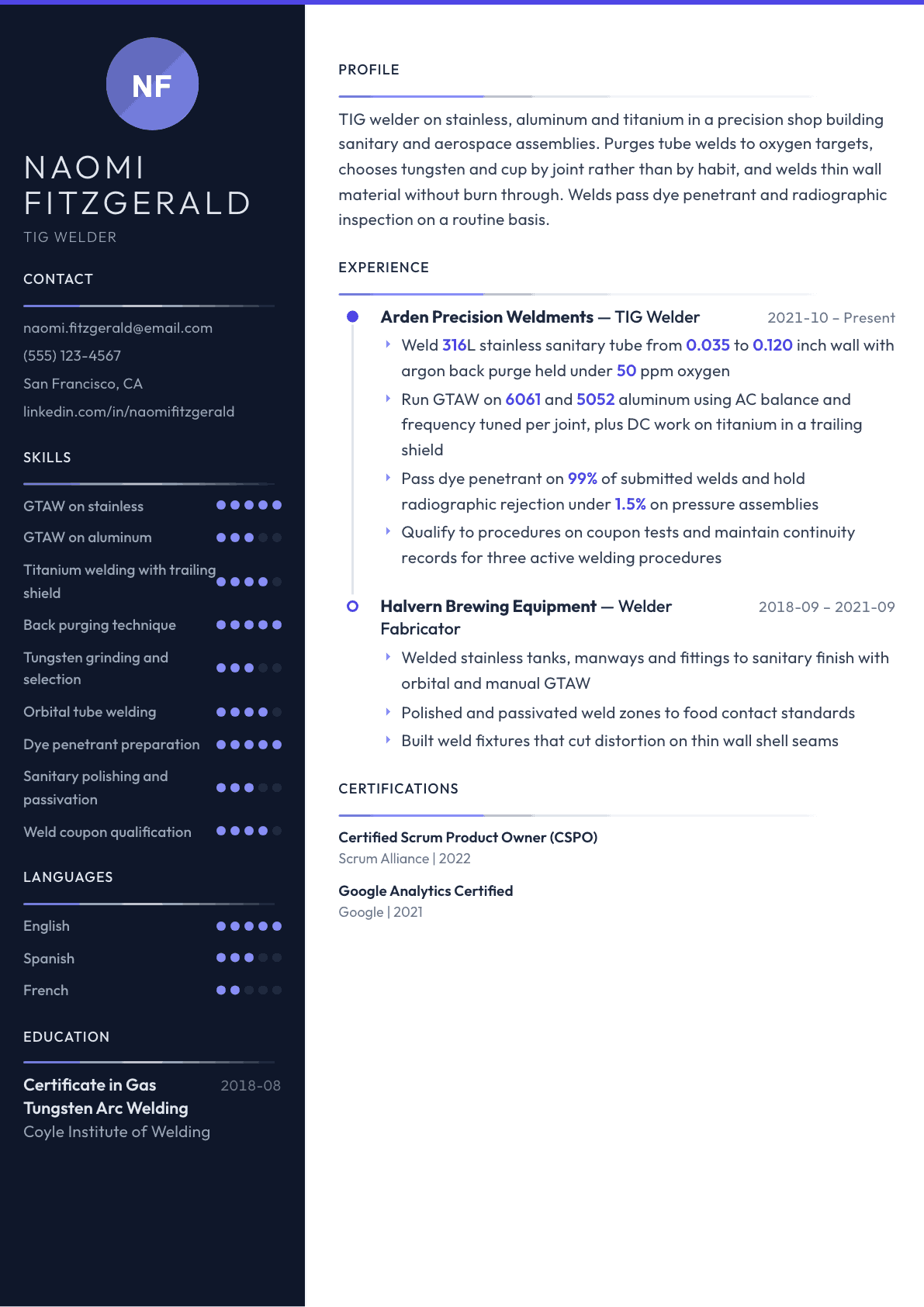
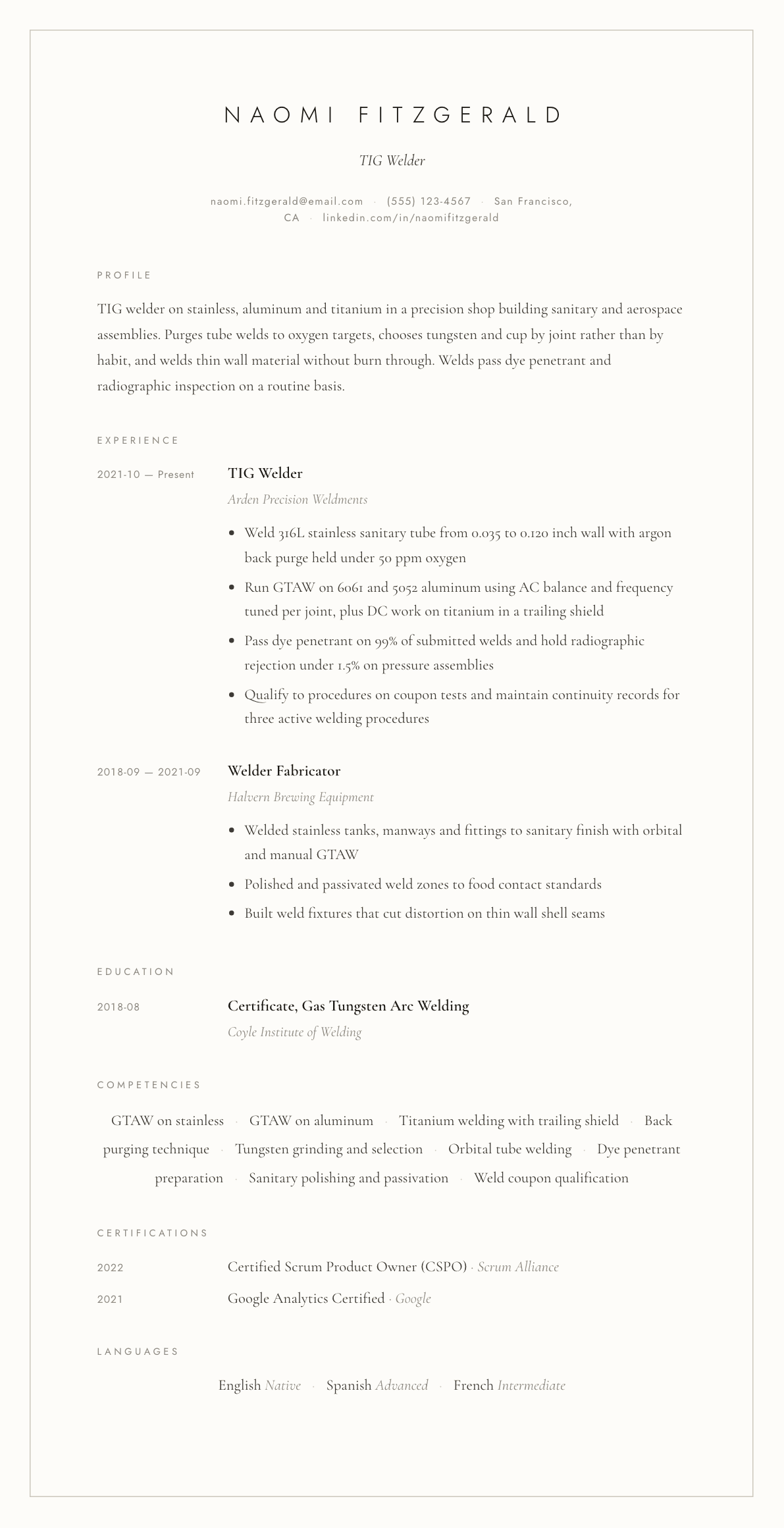
Example TIG Welder summary
TIG welder on stainless, aluminum and titanium in a precision shop building sanitary and aerospace assemblies. Welds 316L tube from 0.035 to 0.120 inch wall with an argon back purge held under 50 ppm oxygen, tunes AC balance and frequency per aluminum joint, and runs titanium under a trailing shield. Passes dye penetrant on 99% of submitted welds with radiographic rejection under 1.5%.
Skills to list on a TIG Welder resume
- GTAW on stainless steel
- GTAW on aluminum with AC balance control
- Titanium welding with trailing shield
- Thin wall tube welding
- Argon back purge and oxygen monitoring
- Tungsten selection and grinding
- Filler metal selection
- Orbital tube welding heads
- Welding procedure qualification
- Dye penetrant and visual inspection prep
- Radiographic quality weld deposition
- Weld distortion control
- Sanitary polishing and passivation
- Pressure vessel and tube fit up
What actually gets this resume read
- Name every base metal you TIG and the wall thickness range, because thin wall stainless and heavy aluminum are separate hires.
- Describe your purging method and the oxygen target you hold, since sanitary and aerospace shops screen on exactly that.
- Say how you pick tungsten type, grind and cup size, because that answer tells a weld engineer how you were trained.
- List the inspection methods your welds have passed, from visual and dye penetrant to radiographic and pressure testing.
- Record your active procedure qualifications with the position, base metal and thickness range each one covers.
- Add orbital welding separately from manual, because a shop with orbital heads pays for that specific experience.
- Mention finishing work such as polishing and passivation, since sanitary customers buy the finish as much as the weld.
How to write a tig welder resume
TIG work is bought for precision, not for deposition rate, and the resume has to reflect that. The shop owner or weld engineer reading it wants to know the base metals you weld, the wall thicknesses you can hold without burning through, how you purge, and what inspection your welds have passed. A page written like a general welding resume will lose to one that answers those four questions directly.
The reason is money. In sanitary, aerospace, pressure and instrumentation work, a rejected weld is expensive to find and worse to cut out. Shops therefore screen for welders who understand the variables around the arc: tungsten preparation, gas coverage, oxygen level in the purge, filler selection, heat input and how each of them shows up in the finished bead color and root profile.
This guide covers how to build a TIG welder resume around that evidence: the metals and thickness block, the purging detail most candidates leave off, procedure qualifications written so an inspector can read them, and how to describe finish work when the customer is buying the appearance as well as the joint.
Format: base metals, thickness, inspection, in the first block
One page. The block under your summary should name every base metal you TIG with its thickness or wall range, the positions you weld, and the inspection methods your work has passed. That is the entire technical screen for this trade, and it should be readable in ten seconds.
Give procedure qualifications their own section. Each one needs the standard, the process, the position, the base metal group and the thickness range it covers, plus whether your continuity is current. Precision shops work to written procedures constantly, so a candidate who presents qualifications properly looks like someone who has been through real qualification testing.
- Base metals with ranges: 304 and 316 stainless from thin wall through plate, 5052 and 6061 aluminum, titanium, nickel alloys, carbon steel.
- Wall thickness and diameter ranges for tube and pipe work, since thin wall skill is what shops pay for.
- Positions welded, and whether the work is fixed or rotated.
- Inspection your welds have passed: visual, dye penetrant, radiographic, ultrasonic, pressure and helium leak testing.
- Equipment: power source type, foot or torch control, pulse capability, orbital heads, purge monitoring instruments.
Summary: what you weld, how thin, to what standard
Four sentences. The metals, the thickness range, the setting and the inspection standard your welds meet. That combination places you immediately in a category, whether that is sanitary process piping, aerospace assemblies, instrumentation tubing or general precision fabrication.
Say whether you weld to code or to customer specifications, and name the inspection results plainly. A TIG welder who can state a dye penetrant pass rate or a radiographic rejection level has been measured, and that is what a precision shop is buying more than years of experience.
Purging, tungsten and the variables around the arc
Purging is the detail that identifies a real sanitary or aerospace TIG welder. Describe your method: how you dam a line, what gas you use, how long you purge before striking, whether you monitor with an oxygen analyzer and what level you weld at. A shop reading a specific oxygen target knows immediately that you have done inspected tube work.
Tungsten and torch setup deserve a line as well. How you select tungsten type and diameter for the material and current, how you grind it and why the grind direction matters, cup and gas lens choices for coverage on stainless and titanium, and when you use a trailing shield. Those choices are the technical vocabulary of the trade.
Filler selection and heat control complete the picture. Which filler you pair with which base metal, how you keep interpass temperature down on thin material, and how you read bead color on stainless as a coverage check. Write two or three of these as bullets rather than paragraphs so a weld engineer can scan them.
Inspection results and rework, written honestly
Give the numbers your work was judged on. Dye penetrant pass rate, radiographic rejection level with the weld count behind it, pressure test results, and any repair rate the shop tracked. Precision welding is one of the few trades where quality is measured on nearly every joint, so having no figures makes a hiring manager assume you were never inspected.
Be careful not to overstate. Claiming that no weld you have made was ever rejected reads as false to anyone who has run a weld shop. A realistic rejection level with the volume attached and one sentence about the most common cause is far more convincing and sets up an honest interview.
If you have had welds cut out and repaired, describe how you handled it: root cause found, procedure adjusted, repair completed and re-inspected. Weld engineers respect a welder who handles a rejection professionally, because everyone gets one eventually.
Finish work, orbital welding and keywords
In sanitary and architectural work the customer buys the surface. Say what finishing you perform: polishing to a stated grit, blending a weld into surrounding grain, passivation after fabrication, and cleaning practice that keeps carbon steel contamination away from stainless. Those are separate paid skills and shops list them separately in postings.
Orbital welding belongs in its own line if you have it. Head sizes, weld schedule development, coupon testing and the documentation packages that go with orbital work are all specific, and a shop that owns orbital equipment will pay for a welder who does not need to be taught it.
For keywords, postings use gas tungsten arc welding, TIG, back purge, tungsten, filler rod, thin wall, sanitary, orbital, dye penetrant, radiographic, procedure qualification, passivation, and the alloy names themselves. Place each where the work is shown and skip the keyword block entirely.
TIG Welder resume summary examples
Recent graduate
Gas tungsten arc welding certificate graduate welding 304 stainless and 6061 aluminum in flat, horizontal and vertical positions on plate and light tube. Trained in tungsten selection, gas lens setup and basic back purging. Seeking a first precision welding seat with coupon testing.
Four years precision work
TIG welder on 316L sanitary tube from 0.035 to 0.120 inch wall with argon back purge held under 50 ppm oxygen, plus aluminum work with AC balance tuned per joint. Passes dye penetrant on 99% of submitted welds and holds radiographic rejection under 1.5% on pressure assemblies.
Senior welder and procedure holder
Senior TIG welder qualified to three active procedures across stainless, aluminum and titanium, running manual and orbital heads on sanitary and aerospace assemblies. Develops orbital weld schedules, builds distortion fixtures for thin wall shells, and mentors welders through their first coupon tests.
Work experience bullets: before and after
Before: Welded stainless steel tubing using TIG.
After: Welded 316L sanitary tube from 0.035 to 0.120 inch wall with an argon back purge dammed and held under 50 ppm oxygen, verified on an analyzer before striking the arc.
Alloy, wall range, purge method and a measured oxygen level identify genuine inspected tube experience.
Before: Welded aluminum parts on the TIG machine.
After: Ran gas tungsten arc welding on 6061 and 5052 aluminum with AC balance and frequency tuned per joint thickness, cleaning with dedicated stainless brushes and welding within the same shift as preparation.
Machine control choices and the cleaning discipline prove aluminum knowledge rather than machine access.
Before: Produced welds that passed inspection.
After: Passed dye penetrant on 99% of submitted welds and held radiographic rejection under 1.5% on pressure assemblies, with the few rejections traced to root concavity on one joint configuration.
Two inspection methods, real rates and a named failure cause show a welder who has been measured and studied his own work.
Before: Worked to welding procedures.
After: Qualified by coupon test to three active welding procedures covering stainless, aluminum and titanium, and maintained continuity records so all three stayed live through the year.
Naming the qualification count, the metals covered and the continuity practice makes the claim checkable.
Before: Finished and polished welds after welding.
After: Polished and passivated weld zones on food contact vessels to a sanitary finish, blending the bead into the surrounding grain so no crevice remained at the toe of the weld.
Naming the finish standard and the reason behind it shows understanding of why sanitary customers pay for it.
Hard skills
- Gas tungsten arc welding on stainless steel
- Gas tungsten arc welding on aluminum with AC balance control
- Titanium welding with trailing shield and purge chamber
- Thin wall tube and instrumentation welding
- Argon back purge setup and oxygen monitoring
- Tungsten selection, grinding and gas lens setup
- Filler metal selection by base metal
- Orbital tube welding and schedule development
- Welding procedure qualification and continuity
- Dye penetrant and visual inspection preparation
- Radiographic and pressure test quality deposition
- Distortion control on thin wall assemblies
- Sanitary polishing and passivation
- Pipe and tube fit up for fixed position welding
Soft skills
- Sitting still through a long root pass without rushing
- Working to a written procedure exactly rather than by habit
- Accepting a rejected weld and finding the cause without defensiveness
- Keeping a bench clean enough to avoid contamination
- Explaining a joint problem to an engineer before welding it anyway
Certifications worth listing
- Certified Welder (American Welding Society)
- Certified Welding Inspector (CWI) (American Welding Society)
- ASME Section IX Performance Qualification (Employer qualified to ASME Boiler and Pressure Vessel Code)
- OSHA 10-Hour General Industry (OSHA Outreach Training Program)
Mistakes that cost tig welder candidates the interview
- Listing TIG as one skill without the base metals and wall thickness ranges that define what you can actually run.
- Leaving purging off the page, which tells a sanitary or aerospace shop you have never done inspected tube work.
- Claiming perfect inspection results, which reads as untrue to anyone who has managed a precision weld shop.
- Writing qualifications as bare names instead of the standard, process, position, material and thickness they cover.
- Ignoring finishing and passivation when the customer for stainless work is buying the surface as much as the joint.
- Presenting orbital and manual welding as the same skill when shops budget and hire for them separately.
TIG Welder resume questions
How thin should a TIG welder claim to weld?
State the thinnest wall or gauge you can hold consistently with acceptable root profile, not the thinnest you have ever attempted. Shops test that claim quickly, and a realistic range with a purge method attached earns more trust than an ambitious number.
What makes a TIG welder resume stand out for aerospace work?
Named alloys including titanium and nickel alloys, trailing shield and chamber experience, procedure qualification records, and inspection history covering radiography and dye penetrant. Add any traceability and documentation habits, since aerospace suppliers live on paperwork as much as on weld quality.
Should I mention welds that were rejected?
Include an honest rejection rate rather than individual failures, and one sentence about the most common cause and how you addressed it. That reads as a professional who studies his own work, while claiming a flawless record raises doubt in an experienced reader.
Is orbital welding experience worth listing separately?
Yes, because it is a distinct capability with its own equipment, weld schedules, coupon testing and documentation. A shop with orbital heads will move your resume up simply for that line, and it is easy to lose if buried inside a general welding sentence.
How do I move from production MIG work into TIG?
Build evidence before applying: take a TIG course, get tested on thin stainless in multiple positions, and practice back purging on tube. Then write the resume around the joints you can now hold rather than around your production history, and expect to take a coupon test.
Related resume examples
- Welder Resume example
- MIG Welder Resume example
- Pipe Welder Resume example
- Metal Fabricator Resume example
- Fabricator Resume example
- Boilermaker Resume example