Fabricator Resume Examples: free ATS score and gap list
Write a Fabricator Resume That Names Every Process You Run
By Mustafa Tarabya, founder of CVBooster · Published · Updated
Fabricator resume example with keywords and a guide to print reading, tolerances, weld processes, material thickness and shop equipment lists.
Sample resumes for a fabricator
The same fabricator content laid out in three CVBooster templates, so you can see what the finished document looks like before you write a word.
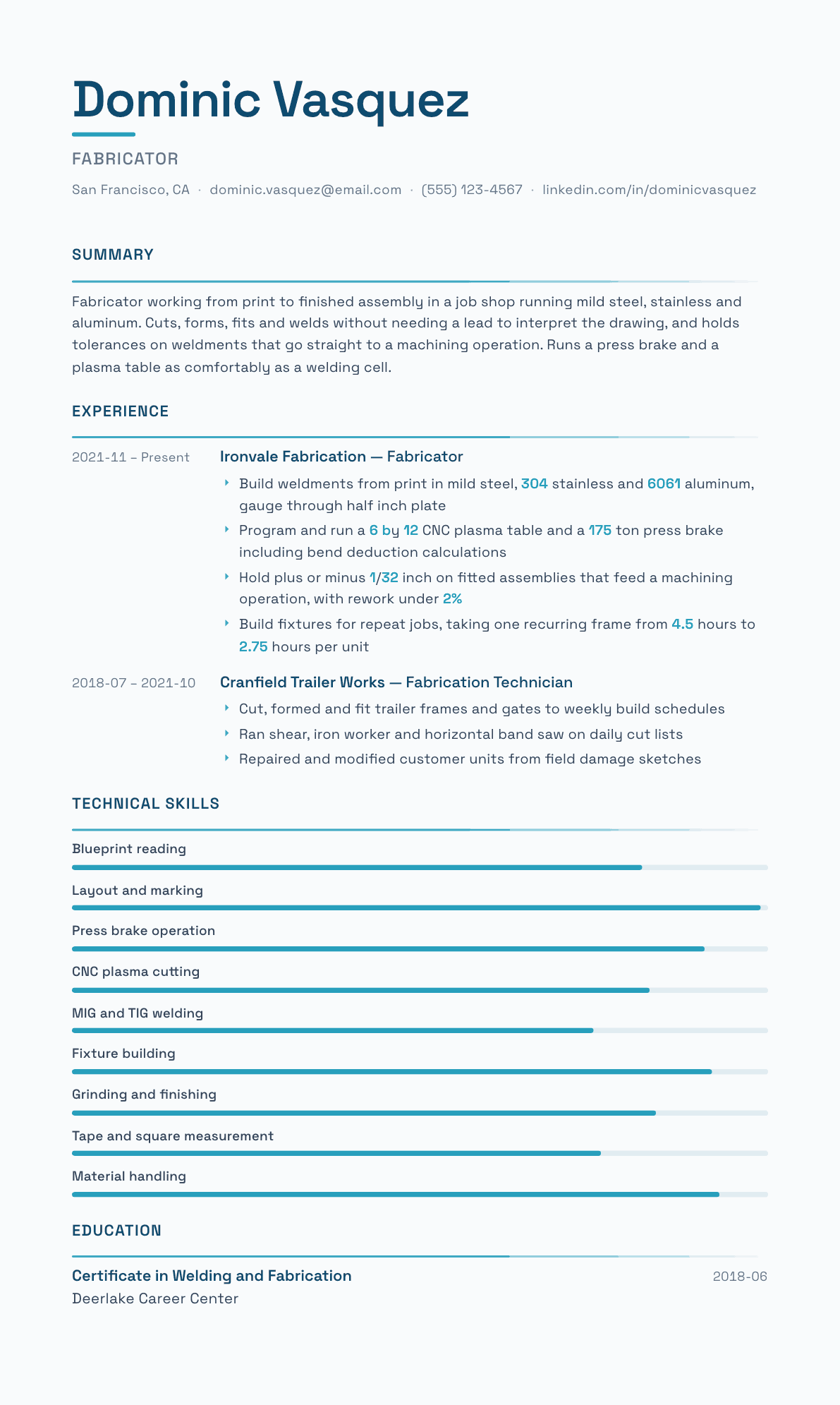
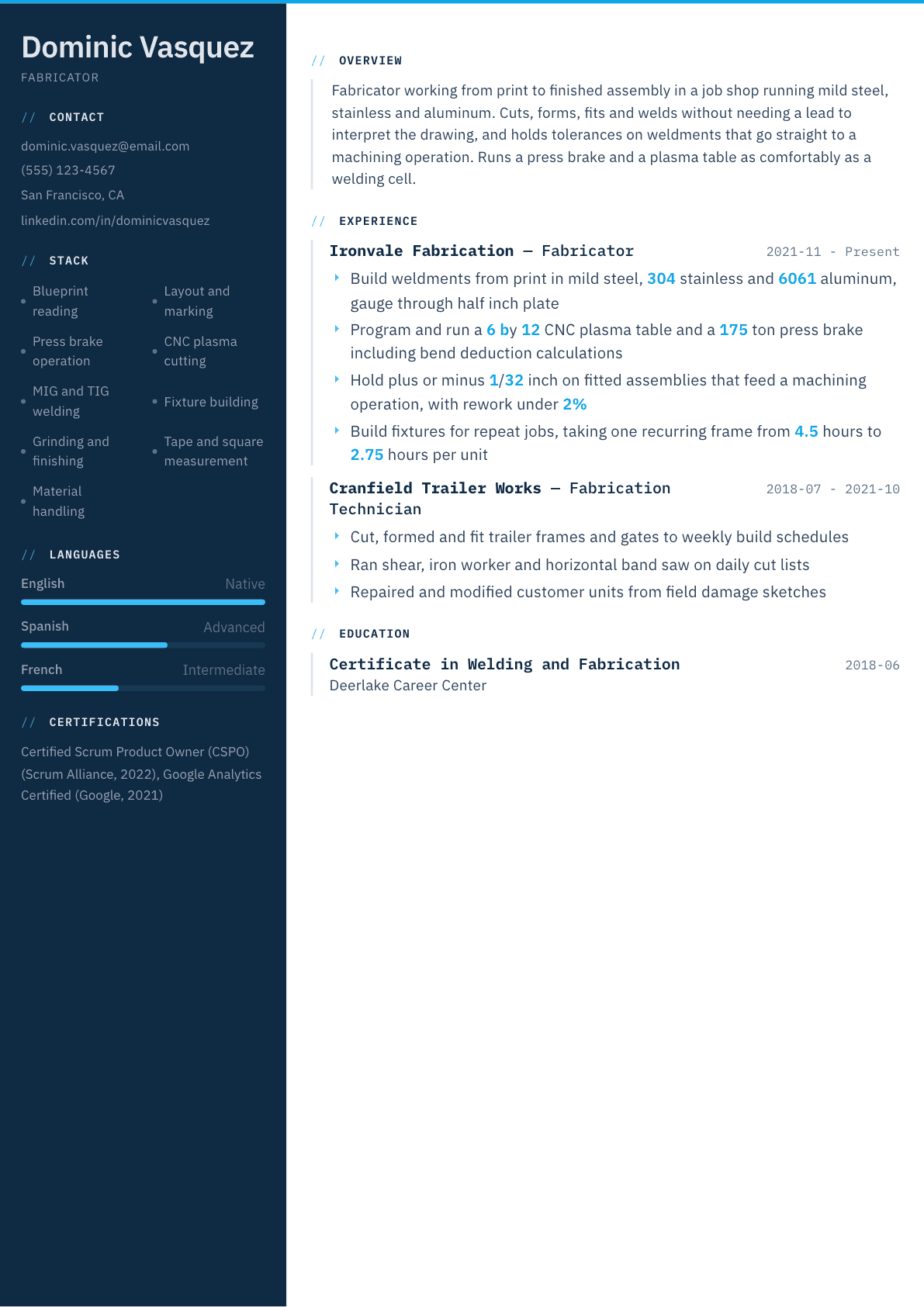
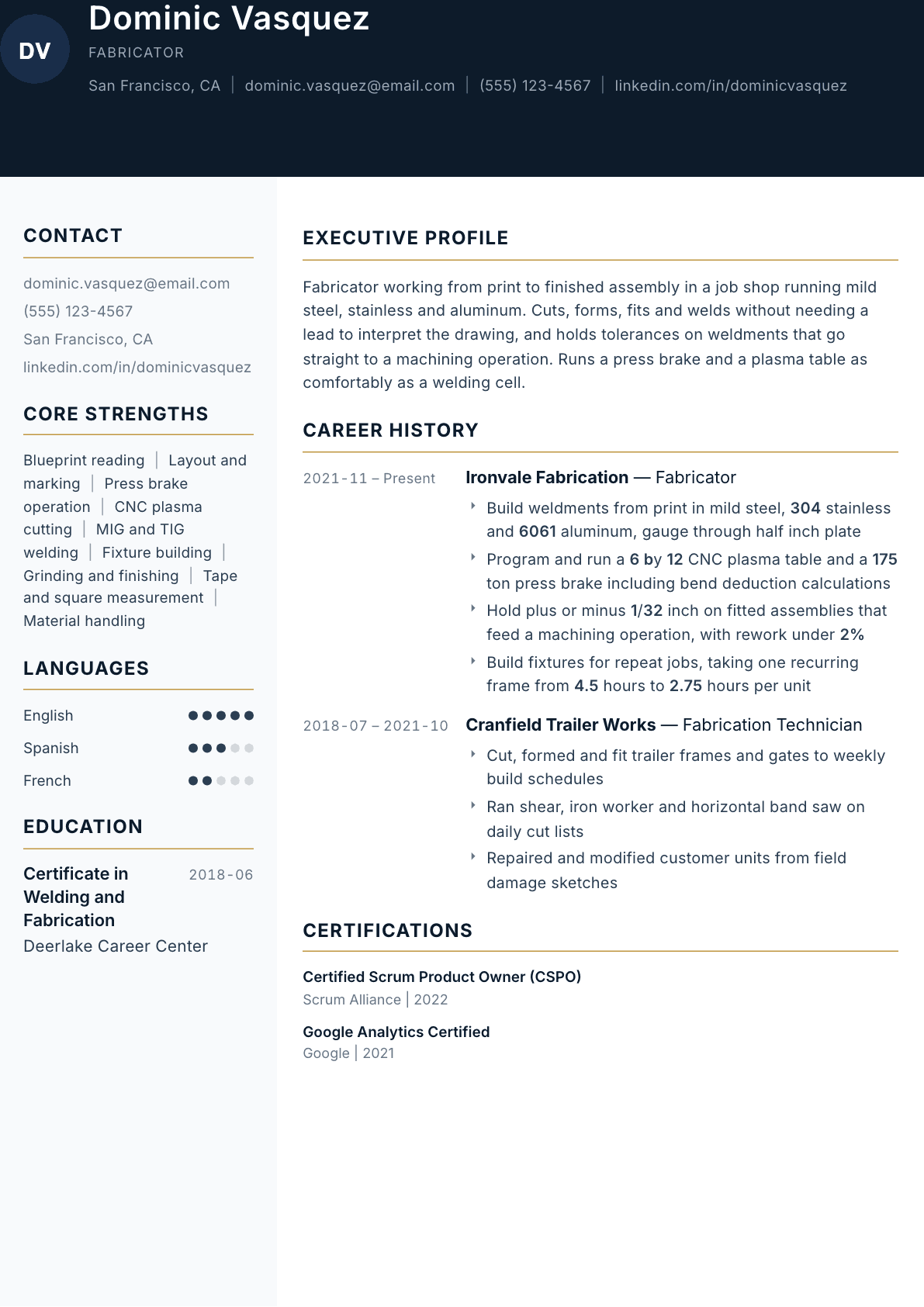
Example Fabricator summary
Fabricator taking jobs from print to finished weldment in mild steel, 304 stainless and 6061 aluminum, gauge through half inch plate. Programs a 6 by 12 CNC plasma table, sets up a 175 ton press brake with bend deductions calculated in house, and holds plus or minus 1/32 inch on assemblies that feed a machining operation. Builds fixtures that cut cycle time on repeat frames.
Skills to list on a Fabricator resume
- Blueprint and weldment print reading
- Layout, marking and squaring
- Press brake setup and bend deduction
- Shear and iron worker operation
- CNC plasma and oxy fuel cutting
- Horizontal and vertical band saw
- MIG welding
- TIG welding
- Stick welding
- Fit up and tacking
- Fixture and jig fabrication
- Grinding, deburring and finishing
- Tape, square, level and caliper measurement
- Weld symbol interpretation
- Overhead crane and rigging
What actually gets this resume read
- List every process you personally run, from shear and brake to plasma, saw, iron worker and each welding process.
- Name the materials and thickness range you work, because a stainless shop and a heavy plate shop screen differently.
- State the tolerance you hold on fitted assemblies, since that number separates a fabricator from a helper.
- Say whether you work from prints alone or need a lead to interpret them, because independence is the real hiring question.
- Include the machines by tonnage, table size and control, so a shop knows you can walk up to theirs.
- Mention fixture and jig building, which is the clearest signal that you improve a job rather than only run it.
How to write a fabricator resume
A shop foreman hiring a fabricator is answering one question: can this person take a print, a stack of material and a machine, and hand back a part that fits? Everything on the resume either supports that or wastes his time. He has probably hired three people who claimed fabrication experience and turned out to be welders who could not read a drawing, so he reads with suspicion.
The way past that suspicion is specificity. Name the processes you run yourself, the materials and thickness range you run them on, the tolerance you hold on a fitted assembly, and whether you work from the print alone. Those four facts are worth more than any summary paragraph, because they are the ones a foreman can test in the first hour of a working interview.
This guide covers how a fabricator resume should be built: the process and equipment block that opens it, the way to write independence from prints, the tolerance evidence that separates a fabricator from a helper, and the fixture work that shows you improve a job instead of only completing it.
Format: processes and equipment above everything else
One page, with a process and equipment block sitting directly under the summary. Shop foremen match your list against their machine list, so anything hidden in prose costs you. Write the machines with the detail you know: brake tonnage and bed length, plasma table size and control, saw type, shear capacity, welding machines and processes.
Material range belongs in the same block. A fabricator who runs gauge sheet all day and one who fits half inch plate are different hires, and stainless and aluminum work carry their own habits around contamination, tooling and distortion. Give the range plainly rather than writing that you work with various metals.
- Process list: layout, sawing, shearing, punching, plasma or laser cutting, forming, rolling, fitting, welding, grinding.
- Equipment named with capacity: press brake tonnage, plasma table size, shear capacity, iron worker, band saw type.
- Material and thickness range for each family: mild steel, stainless grade, aluminum alloy, from gauge through plate.
- Welding processes you personally run, with positions if you have been tested.
- Measurement tools: tape, square, protractor, calipers, height gauge, and any optical or laser layout equipment used.
Summary: print to part, in your own hands
Four lines. What you build, from what materials, using which processes, to what tolerance. Then the independence statement: that you work from the print through layout, cutting, forming, fitting and welding without a lead interpreting the drawing for you. That sentence is the single most valuable line on a fabricator resume and almost nobody writes it.
If your background is a job shop rather than a production shop, say so, because the two demand opposite strengths. Job shop fabricators handle constant variety, one off layout and repair work. Production fabricators hold rate and repeatability on the same part. A foreman knows which he needs and cannot tell from a title.
Experience: tolerance, sequence and distortion
Give the tolerance you hold and on what. Plus or minus a sixteenth on a bracket and plus or minus a thirty second on an assembly that feeds a machining operation are very different claims, and stating yours honestly tells a foreman which jobs he can put you on. Add how you verify it, whether that is a tape and square, a caliper check or a first article on a surface plate.
Show that you think in sequence. Which cuts happen first, when a hole gets drilled versus punched, when a part gets formed before welding versus after, and how you tack and stitch to keep a frame from pulling. Distortion control is where experienced fabricators separate themselves, and describing your tack sequence on a long seam says more than a decade of dates.
Cut the generic lines. Fabricated metal parts according to specifications, used various hand and power tools, and maintained a safe work environment are all invisible. Replace them with the frame you built, the material it was in, the tolerance it held and the time it took once you had a fixture for it.
Fixtures, repairs and problem jobs
Fixture and jig building is the clearest signal on a fabricator resume. A shop can teach a person to cut and weld; it cannot easily teach someone to look at a repeat job and design a way to make it faster and squarer. Write each fixture as what it held, what it fixed, and what the cycle time did afterward.
Repair and modification work deserves its own mention if you have done it. Field damage, customer units, reverse engineering a broken part with no drawing, and modifying a design that will not assemble are all situations that reveal judgment. A foreman with a repair bench in the corner of his shop will read that section carefully.
Mention the times you caught a print error. A fabricator who checks the drawing against reality before cutting expensive material is saving money and saying something about how he works. One concrete example beats a claim of attention to detail.
Safety, rigging and the words a shop searches
Rigging and crane work belongs on the page. Fabricators move heavy assemblies constantly, and a shop wants to know you can sling a weldment properly, choose the right strap and understand load angles. Add hot work permits, confined space entry and any respirator or fume training if your history includes them.
For keywords, use what postings actually contain: blueprint reading, weld symbols, layout, press brake, bend deduction, plasma cutting, fit up, tack welding, grinding, tolerance, fixture fabrication, overhead crane, rigging. Put each one where the work is shown rather than stacking them all at the bottom of the page.
- State whether you calculate your own bend deductions or work from a supplied flat pattern, since shops differ.
- Name the drawing standards you read, including weld symbols, section views and geometric callouts.
- Include rigging and crane experience with the load range you have handled.
- List any welding certification separately with the process, position and thickness range it covers.
Fabricator resume summary examples
Trade school graduate
Welding and fabrication certificate graduate with shop experience on shear, band saw and press brake, plus MIG on mild steel in flat and horizontal positions. Reads basic weldment prints and weld symbols. Seeking a first fabricator seat in a job shop with mentoring on the bench.
Five years on the bench
Fabricator building weldments from print in mild steel, 304 stainless and 6061 aluminum, gauge through half inch plate. Programs a 6 by 12 CNC plasma table, sets up a 175 ton press brake with calculated bend deductions, and holds plus or minus 1/32 inch on fitted assemblies with rework under 2%.
Lead fabricator
Lead fabricator running a four person bay in a custom job shop, taking jobs from print through layout, cutting, forming, fit up and final weld. Builds fixtures for repeat work, handles reverse engineering on damaged customer units, and trains apprentices on layout and distortion control.
Work experience bullets: before and after
Before: Fabricated metal parts according to blueprints.
After: Built weldments from print in mild steel, 304 stainless and 6061 aluminum, gauge through half inch plate, covering layout, cutting, forming, fit up and final weld without a lead interpreting the drawing.
Materials, thickness range and the full process list prove independence, which is the real hiring question.
Before: Operated the press brake and plasma cutter.
After: Programmed and ran a 6 by 12 CNC plasma table and set up a 175 ton press brake, calculating bend deductions in house and proving them on a test bend before running the job.
Machine capacity plus the bend deduction habit shows setup capability rather than button pushing.
Before: Produced accurate parts with low rework.
After: Held plus or minus 1/32 inch on fitted assemblies feeding a machining operation, verifying critical dimensions with calipers and a square before release, with rework held under 2% across the year.
A stated tolerance, a verification method and a rework figure are checkable where accuracy is not.
Before: Built jigs to help with repeat jobs.
After: Designed and built a fit up fixture for a recurring machine frame, which brought build time from 4.5 hours to 2.75 hours per unit and removed the squaring rework the job used to need.
Naming the part, the time change and the rework it eliminated turns a side task into a measurable contribution.
Before: Repaired customer equipment as needed.
After: Repaired and modified customer trailer units from field damage sketches, reverse engineering replacement gussets and crossmembers where no drawing existed and matching original material grades.
Working without a drawing and matching material grades demonstrates judgment a print reader cannot show.
Hard skills
- Weldment print and weld symbol reading
- Layout, marking and squaring
- Press brake setup and bend deduction
- Shear and iron worker operation
- CNC plasma and oxy fuel cutting
- Band saw and cold saw operation
- MIG, TIG and stick welding
- Fit up, tacking and distortion control
- Fixture and jig fabrication
- Grinding, deburring and finishing
- Caliper, square and height gauge measurement
- Material grade and thickness selection
- Overhead crane operation and rigging
- Reverse engineering from damaged parts
Soft skills
- Checking a print against reality before cutting material
- Working alone on a bay for a full shift without drift
- Explaining a drawing problem to an engineer plainly
- Teaching an apprentice layout without doing it for him
- Pacing a long job so the last joints are as clean as the first
Certifications worth listing
- Certified Welder (American Welding Society)
- SENSE Level I and II Welding Program (American Welding Society)
- OSHA 10-Hour General Industry (OSHA Outreach Training Program)
- Overhead Crane and Rigging Operator Training (OSHA compliant employer training program)
Mistakes that cost fabricator candidates the interview
- Listing welding only, which makes a foreman assume you cannot lay out, cut or form and will need a fitter beside you.
- Writing that you work with various metals instead of naming grades and the thickness range you form and fit.
- Leaving out the tolerance you hold, which is the number that decides which jobs a shop can trust you with.
- Describing machines without capacity, since a brake is meaningless to a foreman until he knows the tonnage and bed length.
- Skipping fixture and jig work, the clearest available evidence that you improve a job rather than just complete it.
- Omitting rigging and crane experience in a shop where every assembly you build has to be lifted safely.
Fabricator resume questions
What is the difference between a fabricator and a welder on a resume?
A welder joins parts; a fabricator takes a drawing and produces the parts before joining them, which means layout, cutting, forming and fit up. If you do both, lead with the fabrication half and treat welding as one of your processes, because shops pay more for the wider range.
Should I list welding certifications if I am applying as a fabricator?
Yes, in their own section with the process, position and thickness range each one covers. Many fabrication shops need certified welds on some jobs, and a current certification removes a hiring obstacle even when the posting does not require it.
How do I show print reading ability on paper?
Describe what you read rather than claiming the skill: weld symbols, section views, geometric callouts, revision blocks and bills of material. Add an example where you caught a drawing error before cutting material, which proves you read the print instead of glancing at it.
Does job shop experience transfer to a production fabrication shop?
The skills do, but the emphasis changes. Production shops want repeatability, cycle time and fixture discipline, so rewrite your bullets around the repeat jobs you ran, the fixtures you built and the time per unit rather than around the variety you handled.
What tolerance should I claim on a fabricator resume?
The tightest one you can consistently hold and prove, tied to the type of part. Claiming machining tolerances on a weldment reads as inexperience to any foreman, while a realistic assembly tolerance with a verification method reads as someone who has been measured before.
Related resume examples
- Welder Resume example
- Metal Fabricator Resume example
- CNC Machinist Resume example
- Machinist Resume example
- MIG Welder Resume example
- Boilermaker Resume example