Welding Engineer Resume Examples: the lines they read
Write a Welding Engineer Resume That Proves Code Knowledge
By Mustafa Tarabya, founder of CVBooster · Published · Updated
A welding engineer resume guide with WPS and PQR examples, code experience bullets, certification placement, keywords and a sample resume.
Sample resumes for a welding engineer
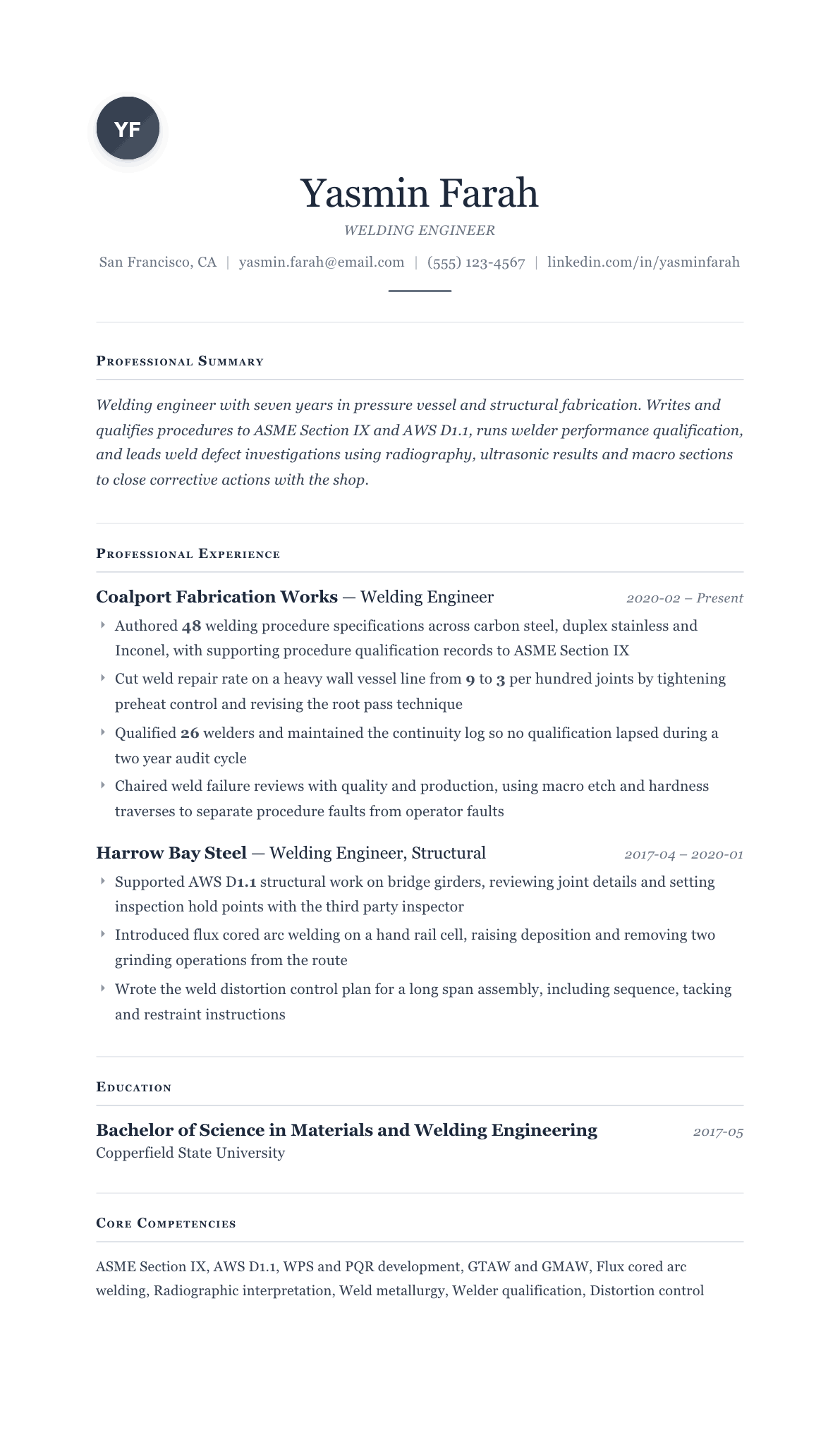
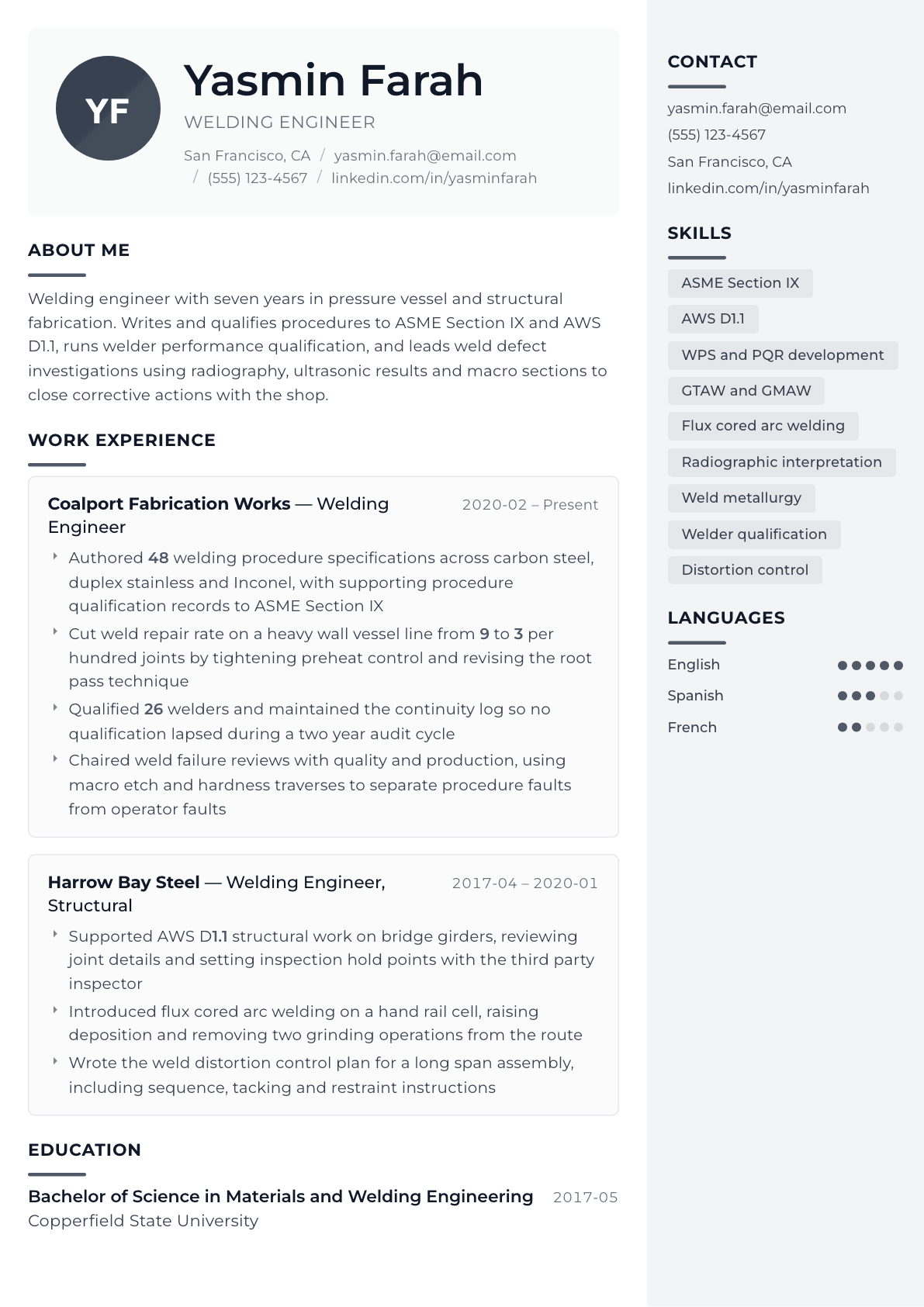
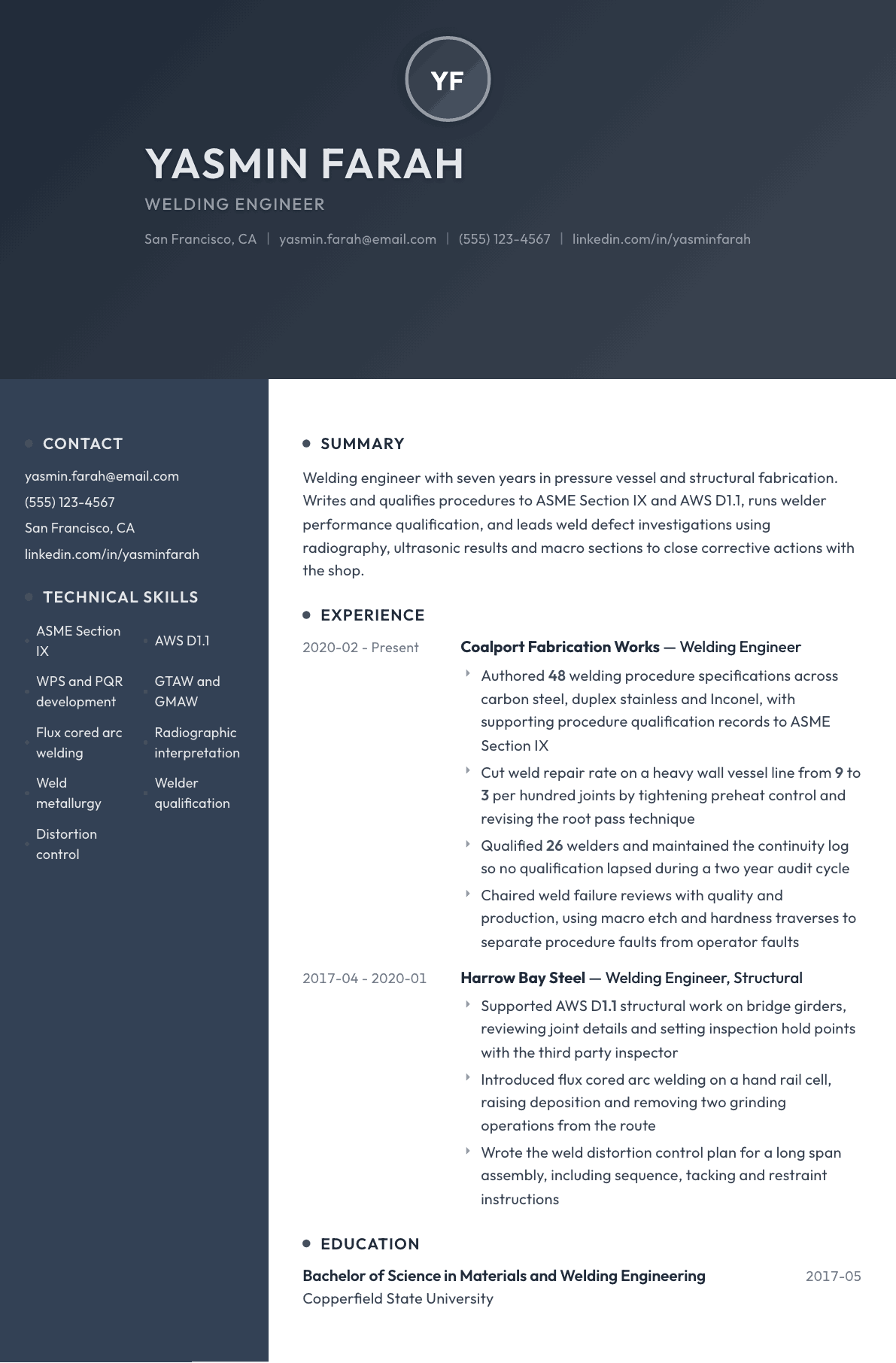
The same welding engineer content laid out in three CVBooster templates, so you can see what the finished document looks like before you write a word.
Example Welding Engineer summary
Welding engineer with seven years across pressure vessel and structural fabrication. Writes procedures to ASME Section IX and AWS D1.1, qualifies welders, and closes weld defect investigations with macro sections and hardness data rather than opinion. Brought repair rate on a heavy wall line down from nine to three per hundred joints by controlling preheat and revising the root pass. Certified Welding Inspector through the American Welding Society.
Skills to list on a Welding Engineer resume
- Welding procedure specifications
- Procedure qualification records
- ASME Section IX
- AWS D1.1
- API 1104
- Weld metallurgy
- GTAW
- GMAW
- SMAW
- Submerged arc welding
- Radiographic testing
- Ultrasonic testing
- Preheat and PWHT control
- Distortion control
- Welder qualification and continuity
- Root cause analysis
What actually gets this resume read
- List the codes you actually work to by number, since a welding engineer posting is written around ASME, AWS or API.
- Say how many procedures you have written and qualified, and in which base metal groups and thickness ranges.
- Name the processes you support at the arc: GTAW, GMAW, SMAW, FCAW, submerged arc or resistance welding.
- Show the inspection side, from radiography and ultrasonic testing to dye penetrant, macro sections and hardness checks.
- Give a repair rate or rework figure, because that number is how a fabrication manager measures the role.
- Put your CWI or IWE credential in a certifications block with the issuing body and keep the number off the public copy.
How to write a welding engineer resume
A welding engineer resume is a code document before it is a career document. The fabrication manager reading it wants to know which code you work to, whether you have written and qualified procedures under it, and whether you can stand in front of an authorized inspector or a third party auditor and defend a procedure qualification record. Everything else on the page is secondary to that.
The mistake that sinks most of these resumes is writing about welding rather than about welding engineering. Bullets about supporting production or improving weld quality could belong to a welder, a supervisor or a quality technician. The bullets that get interviews name the code by number, the base metal groups and thickness ranges, the processes, and the defect that a procedure change actually removed.
This guide walks through the sections in the order a fabrication shop reads them, how to present procedure and welder qualification volume, where the certified welding inspector credential belongs, and the questions welding engineers ask when they rewrite this document for a pressure vessel, structural or pipeline job.
Format: credentials near the top, single column, dates unbroken
Use reverse chronological order and a single column. Fabrication companies run resumes through parsers that mishandle side panels, and losing the date column on a resume built around continuity records is a bad trade for a nice layout.
Put a codes and credentials block directly under the summary. It should list the codes you work to by number and the credentials you hold with their issuing body. That block is the fastest way for a screener to decide whether your background matches a boiler shop, a bridge fabricator or a pipeline contractor, and those three rarely hire each other.
- Header: name, credentials, city and state, phone and email.
- Sections in this order: summary, codes and certifications, experience, education, technical skills.
- Add a procedures block if you have written many: base metal groups, processes, thickness ranges and positions covered.
Summary: the code, the product, and what you qualify
Four lines at most. Name the codes, the product form, the years, and the part of the job you own. Pressure vessels under ASME Section IX read differently from structural steel under AWS D1.1 and from pipeline work under API 1104, and a manager filters on that in one pass.
If you have moved between sectors, say it plainly and name what carried over. Procedure writing, welder qualification and defect investigation transfer well; the code knowledge and the joint details do not transfer automatically, and a reader respects a candidate who acknowledges that.
Experience: procedures written, welders qualified, defects closed
Start each role with a scope line: what the shop fabricates, the materials, the wall thicknesses, and the size of the welding population you supported. A welding engineer over twenty six welders and one over two hundred are doing different jobs, and the reader cannot infer it.
Then three to five bullets built on the four things a welding engineer is measured by. How many procedure specifications you authored and qualified, and across which base metal groups. How many welders you qualified and whether continuity held through an audit. What the repair or rework rate did while you owned it, and what technique or parameter change moved it. And which investigations you closed with evidence, whether that was radiography, ultrasonic results, macro etch sections or hardness traverses.
Add one bullet on process introduction if you have it. Bringing flux cored arc welding onto a cell, moving a joint from manual to submerged arc, or introducing pulsed transfer changes deposition and cost, and those are the projects a plant manager remembers.
Codes, procedures and inspection: be precise, not broad
Never write familiar with industry codes. Write the numbers. ASME Section IX for qualification, ASME Section VIII for vessel construction, AWS D1.1 for structural steel, AWS D1.6 for stainless, API 1104 for pipeline girth welds. Then say what you do under each one: author, qualify, review, or audit.
The inspection side needs the same precision. Say which nondestructive methods you interpret rather than only request, since reading a film or a scan report is a different skill from scheduling one. Preheat, interpass control and post weld heat treatment belong here too, because those are the parameters that decide whether a heavy wall job passes.
- Codes by number, with your role under each one.
- Base metal groups, filler classifications, thickness and diameter ranges, positions.
- Nondestructive methods you interpret: radiographic, ultrasonic, magnetic particle, dye penetrant.
- Metallurgical evidence you work from: macro etch, hardness traverse, ferrite measurement, impact testing.
Certifications: name the body, keep the number private
The certified welding inspector credential from the American Welding Society is the one most postings name, and it belongs in its own block with the issuing body and the endorsement level. An international welding engineer diploma carries similar weight where the employer works to European practice.
List nondestructive testing levels with the method and the written practice they were granted under. Do not print certificate numbers on a resume you post publicly; bring them to the interview instead, along with the continuity log if you have one.
Welding Engineer resume summary examples
New graduate
Welding and materials engineering graduate with a plant internship supporting structural fabrication to AWS D1.1. Prepared draft procedure specifications, witnessed welder qualification tests, and prepared macro etch sections in the metallurgy lab. Seeking an associate welding engineer position in a fabrication shop.
Seven years in
Welding engineer with seven years across pressure vessel and structural fabrication. Authored 48 procedure specifications with supporting qualification records to ASME Section IX, qualified 26 welders, and brought a heavy wall repair rate from nine to three per hundred joints through preheat control and a revised root pass.
Lead welding engineer
Lead welding engineer and certified welding inspector with fourteen years covering ASME Section IX, AWS D1.1 and API 1104 work. Owns the procedure library, the welder continuity program and third party audit readiness for two plants, and leads failure investigations using metallography and hardness data.
Work experience bullets: before and after
Before: Wrote welding procedures for the shop.
After: Authored 48 welding procedure specifications across carbon steel, duplex stainless and nickel alloys, each backed by a procedure qualification record tested to ASME Section IX.
Volume, base metal groups and the qualifying code turn a routine claim into a verifiable body of work.
Before: Improved weld quality on the production line.
After: Cut the weld repair rate on a heavy wall vessel line from nine to three per hundred joints by tightening preheat control and revising the root pass technique with the welders.
A before and after figure plus the two parameter changes shows the reader how the improvement was engineered.
Before: Certified welders as required.
After: Qualified 26 welders across four processes and maintained the continuity log so that no qualification lapsed through a two year audit cycle.
Continuity is the part auditors check, and mentioning it signals you run the program rather than just witness tests.
Before: Investigated weld failures with the quality team.
After: Chaired weld failure reviews using macro etch sections and hardness traverses to separate procedure faults from operator technique, closing each finding with either a procedure revision or targeted retraining.
Naming the metallurgical evidence proves the conclusions were measured rather than argued.
Before: Introduced a new welding process to save time.
After: Introduced flux cored arc welding on a hand rail cell, raising deposition rate and removing two grinding operations from the routing without changing the joint design.
The process, the mechanism and the operations removed give a plant manager a cost story he can check.
Hard skills
- Welding procedure specification development
- Procedure qualification records
- ASME Section IX
- ASME Section VIII
- AWS D1.1
- API 1104
- Weld metallurgy
- Gas tungsten arc welding
- Gas metal arc welding
- Shielded metal arc welding
- Submerged arc welding
- Radiographic and ultrasonic interpretation
- Preheat, interpass and post weld heat treatment control
- Distortion control and weld sequencing
- Welder qualification and continuity management
Soft skills
- Defending a procedure to an auditor
- Coaching welders on technique
- Evidence based argument in failure reviews
- Working across quality and production
- Clear written instruction for the floor
Certifications worth listing
- Certified Welding Inspector (CWI) (American Welding Society)
- Certified Welding Engineer (CWEng) (American Welding Society)
- International Welding Engineer (IWE) (International Institute of Welding)
- NDT Level II (American Society for Nondestructive Testing)
- Certified Quality Engineer (CQE) (American Society for Quality)
Mistakes that cost welding engineer candidates the interview
- Saying you know industry codes without naming a single one by number, which reads as exposure rather than ownership.
- Counting procedures without saying what they covered, so a reader cannot tell twenty carbon steel repeats from twenty across four base metal groups.
- Leaving welder continuity out, when that is the first record an auditor asks for and the part most engineers actually run.
- Claiming a quality improvement with no parameter behind it, so preheat, technique and joint detail all stay invisible.
- Burying the certified welding inspector credential in the education section instead of a block near the top.
- Mixing structural and pressure work into one undifferentiated blur, when the two hiring pools screen for different code experience.
- Printing certificate numbers on a public resume rather than saving them for the interview.
Welding Engineer resume questions
Do I need a certified welding inspector credential to be a welding engineer?
No, but it is named in a large share of postings and it removes a screening question before anyone reads your experience. If you do not hold it, make the procedure qualification and metallurgical work in your bullets carry the weight instead, and say whether you are pursuing the exam.
How do I list codes without turning the resume into a list?
Put the codes in a short block near the top with one qualifier each, such as author, qualify or audit, then let the experience bullets show them in use. The block satisfies the keyword scan and the bullets satisfy the manager who reads afterward.
Should I include the number of welding procedures I have written?
Yes, with the range they cover. A count on its own is easy to inflate, so attach base metal groups, processes and thickness ranges. That combination tells a fabrication manager whether your library would transfer to his product without requalification.
How do I move from structural fabrication to pressure vessel work?
Lead the summary with the transferable core: procedure writing, qualification testing, and defect investigation with metallurgical evidence. Then name any exposure you have to ASME work, even as a reviewer, and be clear about which code you have qualified under yourself.
Is nondestructive testing certification worth adding?
It is, particularly a Level II in radiographic or ultrasonic testing, because interpreting results yourself shortens every investigation. List the method and the level, and make sure a bullet somewhere shows you using that interpretation to reach a conclusion.
Related resume examples
- Materials Engineer Resume example
- Quality Engineer Resume example
- Metallurgical Engineer Resume example
- Piping Engineer Resume example
- Process Engineer Resume example
- Design Engineer Resume example