Metal Fabricator Resume Examples: the lines they read
Write a Metal Fabricator Resume Built on Prints and Tolerances
By Mustafa Tarabya, founder of CVBooster · Published · Updated
Metal fabricator resume example, keyword list and guide covering sheet metal layout, forming, weld processes, material grades and quality checks.
Sample resumes for a metal fabricator
The same metal fabricator content laid out in three CVBooster templates, so you can see what the finished document looks like before you write a word.
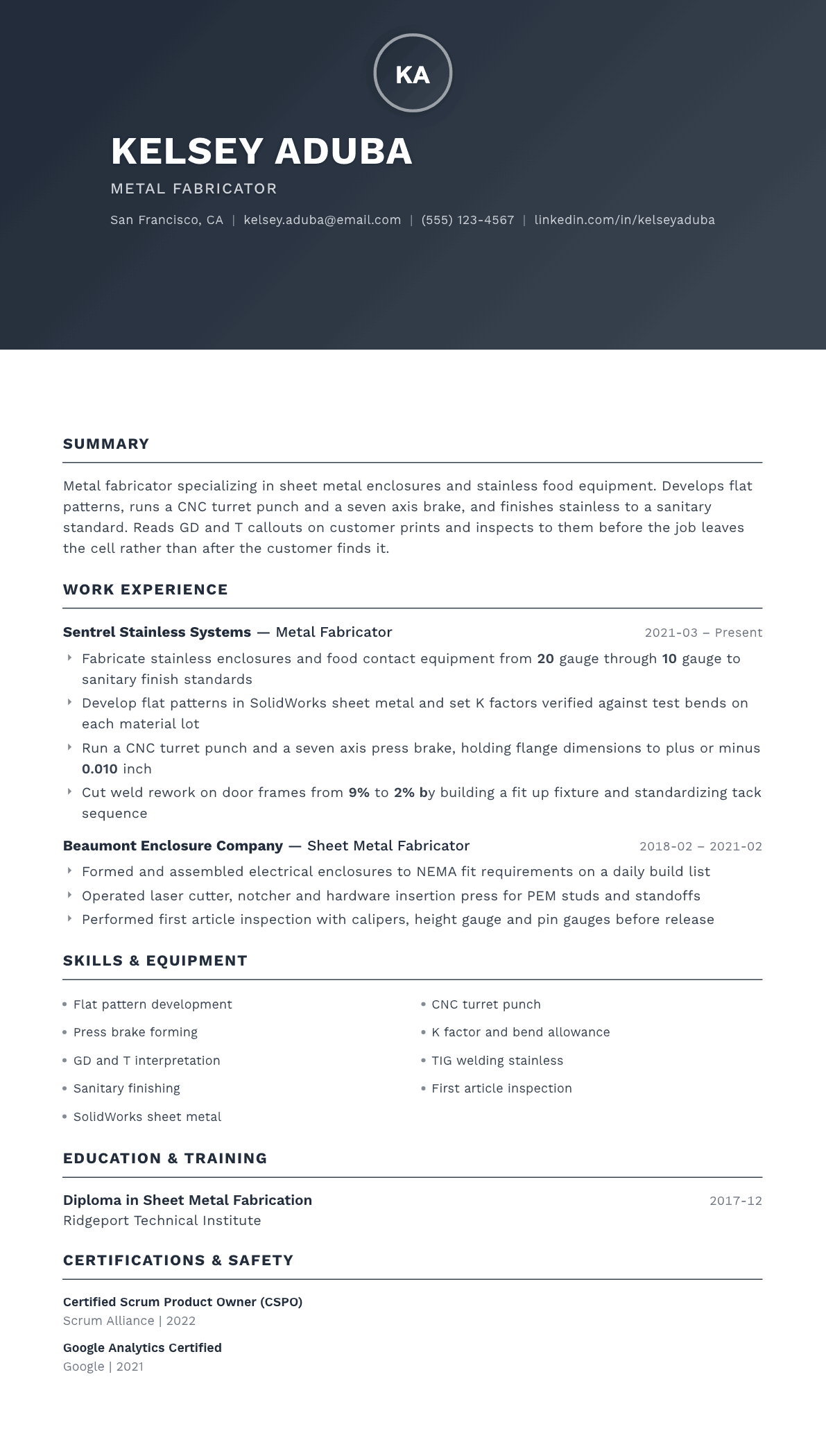
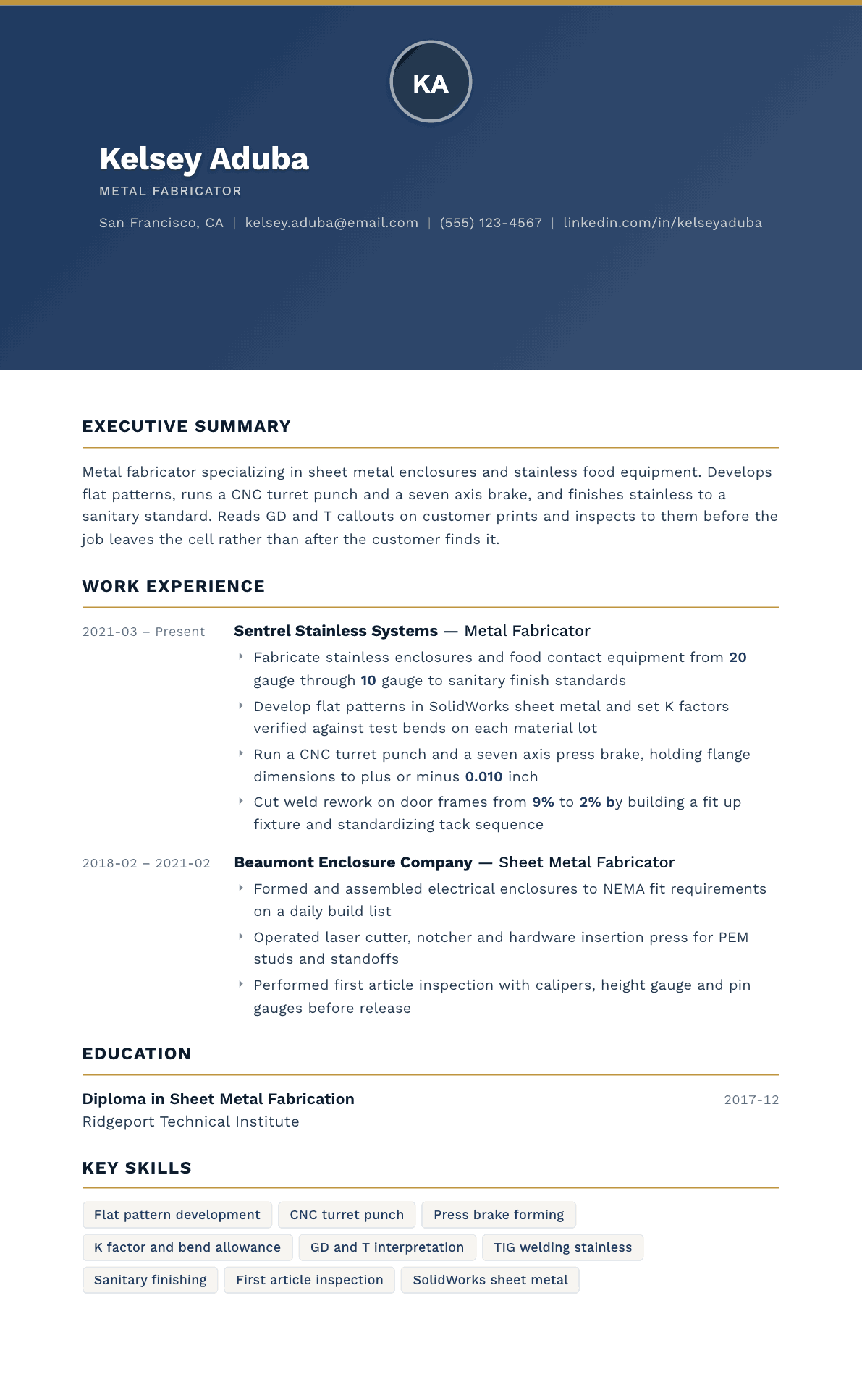
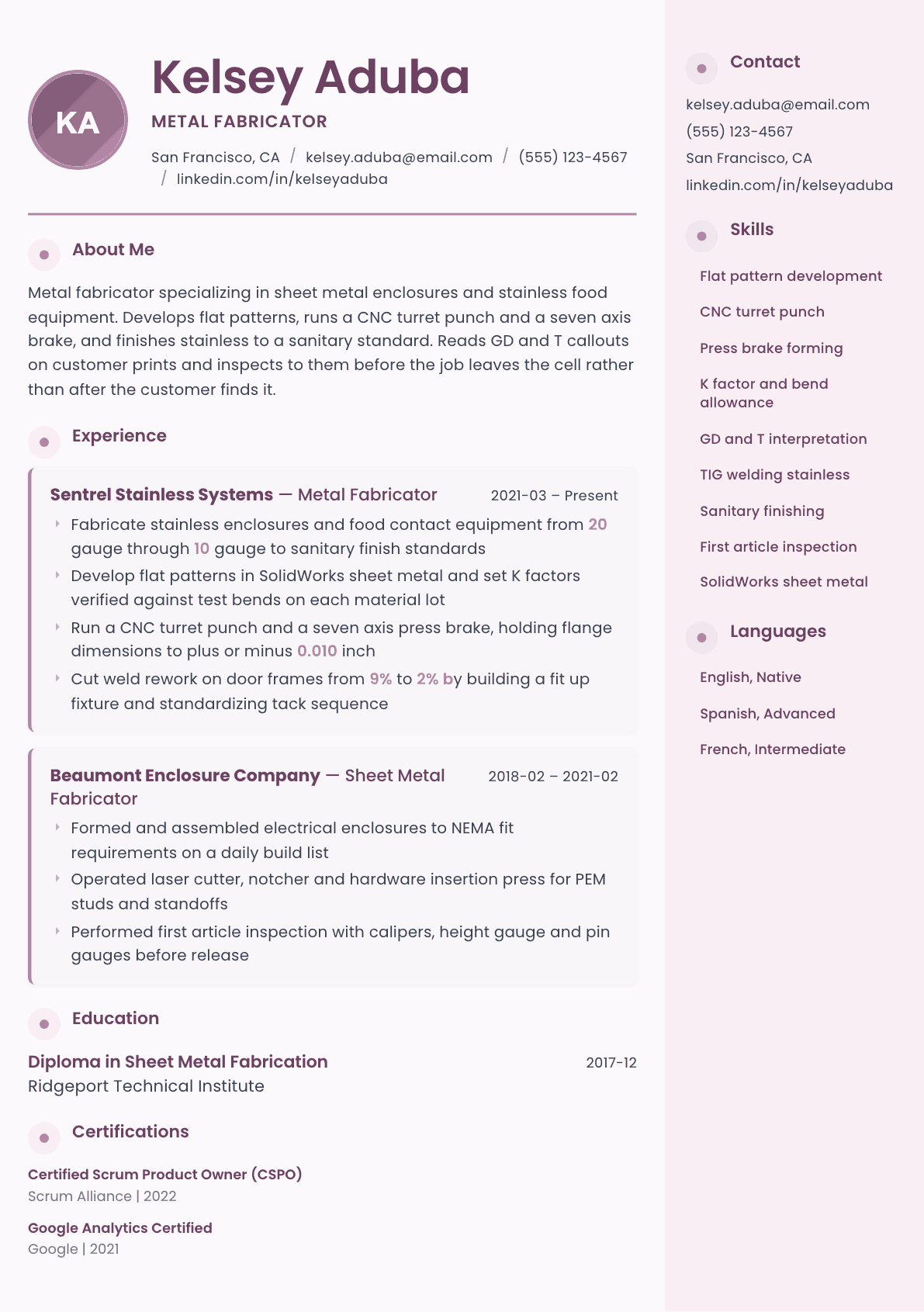
Example Metal Fabricator summary
Metal fabricator building stainless enclosures and food contact equipment from 20 gauge through 10 gauge to sanitary finish standards. Develops flat patterns in SolidWorks and verifies K factors against test bends on each material lot. Runs a CNC turret punch and a seven axis brake to plus or minus 0.010 inch on flange dimensions, and cut door frame weld rework from 9% to 2% with a fit up fixture and a standard tack sequence.
Skills to list on a Metal Fabricator resume
- Flat pattern and blank development
- K factor and bend allowance calculation
- CNC turret punch operation
- Laser cutting setup
- Press brake forming and tooling selection
- Hardware insertion and PEM installation
- TIG welding on stainless and aluminum
- MIG welding on mild steel
- Weld finishing and graining
- Sanitary and food grade finishing
- GD and T interpretation
- First article and in-process inspection
- Calipers, height gauge and pin gauges
- SolidWorks sheet metal environment
- Material grade selection
What actually gets this resume read
- Separate sheet metal work from structural work on the page, because shops hire for one or the other and screen for the words.
- Give the gauge and plate range you form, and the machines by tonnage and axis count, so a shop can place you fast.
- Say that you develop flat patterns yourself and how, since a fabricator who needs patterns handed over costs an engineer time.
- Include the tolerance you hold on flange and hole dimensions, because sheet metal buyers judge you on that number.
- Mention finishing standards you work to, from number four brush to sanitary weld finish, since they are separate skills.
- Show your own inspection routine with the gauges you use, because first article catches are worth more than fast cycle times.
- Name the CAD or nesting software you touch, even if a programmer owns it, since shops value a fabricator who can read the model.
How to write a metal fabricator resume
Metal fabricator covers two very different trades and the resume has to declare which one you are inside the first three lines. Sheet metal work means flat patterns, punch and laser programs, brake tooling, hardware insertion and finish quality on visible surfaces. Structural work means heavy plate, beams, layout on the floor and welds that carry load. A shop hiring one will not interview a resume written for the other.
Once that is clear, the screen turns on precision evidence. A sheet metal shop wants to know the flange tolerance you hold, whether you develop your own patterns and what K factor practice you follow. A structural shop wants your fit up tolerance, your plate thickness range and how you control distortion on long seams. Both want to know how you inspect your own work before it leaves the cell.
This guide covers how to build a metal fabricator resume with that precision on the page: the material and process block, the pattern development claim that most candidates leave off, the finishing standards that carry real money in stainless work, and the self inspection routine that shops value more than speed.
Format: declare the discipline, then the machine list
One page. Line one of the summary names your discipline: sheet metal enclosures, stainless food equipment, architectural work, heavy structural, or a mix with the split stated. Shops search on those words, and a page that is vague about it looks like a candidate hedging across jobs he has not really done.
Below that, the equipment block with real capacities. Turret punch or laser with its bed size and control, brake tonnage and axis count, notcher, hardware insertion press, roll, shear, deburring equipment. A fabrication manager reads it as a compatibility list, and every machine you name that matches his floor shortens your onboarding.
- Discipline line: sheet metal, stainless sanitary, architectural, structural, or the split between them.
- Material families with grades and gauge or plate range: cold rolled, galvanized, 304 and 316 stainless, 5052 and 6061 aluminum.
- Machine list with capacity: punch and laser bed size, brake tonnage and axes, roll capacity, insertion press.
- Software you touch, whether that is a sheet metal CAD environment, a nesting package or a brake control.
- Finish standards you work to: brushed number four, mill finish, weld ground flush, sanitary polished, powder coat prep.
Summary: patterns, tolerance and finish
Four sentences that cover what you build, in what material and thickness, to what tolerance, and to what finish. Then say whether you develop flat patterns yourself. A metal fabricator who produces his own blanks with verified bend allowances saves an engineer time every week, and shops that have paid for that mistake know precisely what it is worth.
If you have worked in a regulated or inspected environment, name it. Food contact equipment, pressure work, architectural specification work and defense parts all carry documentation habits that transfer, and the shops that need those habits screen for the words before they screen for anything else.
Experience: patterns, K factors and forming order
Write about pattern development in specifics. How you derive a flat, whether you use a sheet metal CAD environment or a bend deduction table, how you set the K factor for a new material or thickness, and whether you prove it with a test bend before running the job. That paragraph alone puts you ahead of most applicants, who write that they form parts to print.
Then the forming sequence. Which bend goes first so the next one clears the tooling, where you need a gooseneck punch, how you handle a part that will not fit in the brake in the obvious order, and what you do about springback in stainless versus aluminum. Fabrication managers listen for that reasoning in interviews, and putting it on the page gets you into the interview.
Give the tolerance you hold on flange dimensions, hole positions and overall envelope, with the tools you check it with. Then the quality outcome: rework rate, first article pass rate, or customer returns. A metal fabricator who checks his own work against a print with a caliper and a height gauge before it moves is describing the habit shops most want to buy.
Welding, finishing and the visible surface
On sheet metal work, the weld is usually a cosmetic problem as much as a structural one. Describe how you weld thin material without warping it, whether that is stitch sequence, chill bars, a backing fixture or a lower amperage TIG approach, and how you finish the joint afterward. Grinding a weld flat and blending a grain across a corner are skills a fabrication manager can see in a portfolio photo.
Finishing standards deserve their own lines. Number four brushed finish with grain direction matched across panels, sanitary weld finish for food contact, passivation on stainless, and preparation for powder coat are each separate competencies. Naming the ones you can hold prevents you from being tested on a standard you have never worked to.
Hardware insertion, forming around inserted hardware and assembly tolerance on enclosures are worth a bullet if you do them, because they cause a lot of scrap when done in the wrong order and shops remember who gets it right.
Inspection, documentation and keywords
Describe your own inspection routine with the gauges named: calipers, height gauge, pin gauges, radius gauges, angle finder, surface plate. Then say what you do with a first article, whether you document it and who signs it off. A shop with an inspection backlog will hire a fabricator who catches his own errors ahead of a faster one who does not.
For keywords, postings use flat pattern, bend allowance, K factor, press brake, turret punch, laser cutting, hardware insertion, deburring, weld finishing, first article inspection, geometric dimensioning and tolerancing, and the material grades themselves. Place each where it does real work, and repeat only the two or three that define your specialty.
- Name the gauges you use so the inspection claim has substance behind it.
- Say whether you complete first article paperwork and to what standard.
- Include geometric callout reading only if you genuinely interpret datums and feature controls.
- Add any customer specification work, since specification driven shops screen hard on that experience.
Metal Fabricator resume summary examples
New to the trade
Sheet metal fabrication diploma graduate trained on shear, notcher and press brake, forming cold rolled and 5052 aluminum in 20 to 14 gauge. Reads flat patterns and checks parts with calipers. Seeking an entry metal fabricator seat in an enclosure or equipment shop.
Four years in stainless
Metal fabricator building stainless enclosures and food contact equipment from 20 through 10 gauge to sanitary finish standards. Develops flat patterns in a sheet metal CAD environment with K factors proved on test bends, and runs a turret punch and seven axis brake to plus or minus 0.010 inch on flanges.
Lead fabricator
Lead metal fabricator across punch, laser, brake and weld cells, setting up new part numbers and proving first articles before release. Cut door frame weld rework from 9% to 2% with a fit up fixture and a standard tack sequence, and trains fabricators on bend allowance practice.
Work experience bullets: before and after
Before: Formed sheet metal parts on the press brake.
After: Formed stainless enclosure panels from 20 through 10 gauge on a seven axis press brake, selecting punch and die by material and inside radius and holding flange dimensions to plus or minus 0.010 inch.
Material range, machine capability, tooling judgment and a stated tolerance replace a generic machine claim.
Before: Made flat patterns for parts.
After: Developed flat patterns in a sheet metal CAD environment and set K factors verified against a test bend on each new material lot, which removed the trial and error the shop previously ran on first pieces.
The verification step and the problem it solved show real pattern competence rather than software access.
Before: Welded parts together and cleaned up the welds.
After: Welded thin wall stainless corners with a stitch sequence and copper backing to control warp, then ground and blended the joint so the number four grain ran continuous across the corner.
Distortion control plus a named finish standard is exactly what a stainless shop is evaluating.
Before: Reduced rework on a problem job.
After: Cut weld rework on door frames from 9% to 2% by building a fit up fixture that held the diagonal square and standardizing the tack sequence for every operator on the cell.
A before and after figure with a fixture and a standard applied to the whole cell shows a durable fix.
Before: Checked parts before sending them on.
After: Ran first article inspection with calipers, height gauge and pin gauges against the print before release, documenting each dimension so the quality department could verify rather than re-measure.
Naming the gauges and the documentation output turns self checking into a process a shop can rely on.
Hard skills
- Flat pattern and blank development
- K factor and bend allowance practice
- CNC turret punch operation
- Laser cutting setup and nesting
- Press brake tooling selection and setup
- Rolling, notching and shearing
- Hardware insertion and self clinching fasteners
- TIG welding on stainless and aluminum
- MIG welding on mild steel sheet
- Weld grinding, blending and graining
- Sanitary finishing and passivation
- Geometric dimensioning and tolerancing
- First article and in-process inspection
- Caliper, height gauge and pin gauge measurement
Soft skills
- Protecting a finished surface through every remaining operation
- Slowing down on a first piece to save the whole run
- Asking about a datum instead of guessing at intent
- Keeping a cell tidy enough that nothing gets scratched
- Handing a problem part back with the reason written down
Certifications worth listing
- Certified Welder (American Welding Society)
- Precision Sheet Metal Operator Certification (Precision Metalforming Association Educational Foundation)
- OSHA 10-Hour General Industry (OSHA Outreach Training Program)
Mistakes that cost metal fabricator candidates the interview
- Failing to state whether you are a sheet metal or a structural fabricator, so neither type of shop recognizes you.
- Claiming forming experience without naming the brake tonnage, axis count or the tooling decisions you make.
- Leaving pattern development off the page when it is the skill that saves an engineering department the most time.
- Giving no dimensional tolerance, which forces a fabrication manager to assume the loosest one.
- Treating finish as an afterthought in stainless work, where the customer is buying the surface as much as the part.
- Listing inspection as a skill without naming the gauges, which reads as looking at parts rather than measuring them.
Metal Fabricator resume questions
Should a metal fabricator resume mention CAD software?
Yes, even if a programmer owns the models. Being able to open a model, read the flat, check a bend line and spot a problem before the material is cut makes you far more useful, and shops screen on the software name when they can.
How do I show stainless experience is different from mild steel work?
Write the details that only stainless demands: dedicated tooling and abrasives to avoid carbon contamination, heat control to prevent distortion and discoloration, grain direction matching across panels, and passivation after welding. Those specifics prove real stainless time.
Is a welding certification necessary for a metal fabricator?
Not always, but it removes doubt and opens jobs where certain welds are inspected. If you hold one, list the process, position and thickness range. If you do not, be honest about the welding you can do rather than implying a qualification you have not tested for.
How do I write a resume for architectural metal work?
Emphasize finish quality, visible weld standards, field measurement and installation tolerance, plus any experience matching a designer's specification. Architectural clients reject on appearance, so a portfolio reference and a description of your finishing standards carry a lot of weight.
What if my shop never measured rework or first article pass rates?
Use whatever record exists: parts returned from inspection, scrap tickets you wrote, jobs that needed a second run. If nothing was tracked, describe your inspection routine and one specific error you caught before release, which still shows the habit a shop is buying.
Related resume examples
- Fabricator Resume example
- Welder Resume example
- CNC Machinist Resume example
- Quality Control Inspector Resume example
- Meat Cutter Resume example
- Woodworker Resume example