CNC Machinist Resume Examples: free ATS score and gap list
Craft a CNC Machinist Resume That Stands Out
By Mustafa Tarabya, founder of CVBooster · Published · Updated
Build a precision-focused CNC machinist resume showcasing your programming skills, tight tolerances, and production efficiency.
Sample resumes for a cnc machinist
The same cnc machinist content laid out in three CVBooster templates, so you can see what the finished document looks like before you write a word.
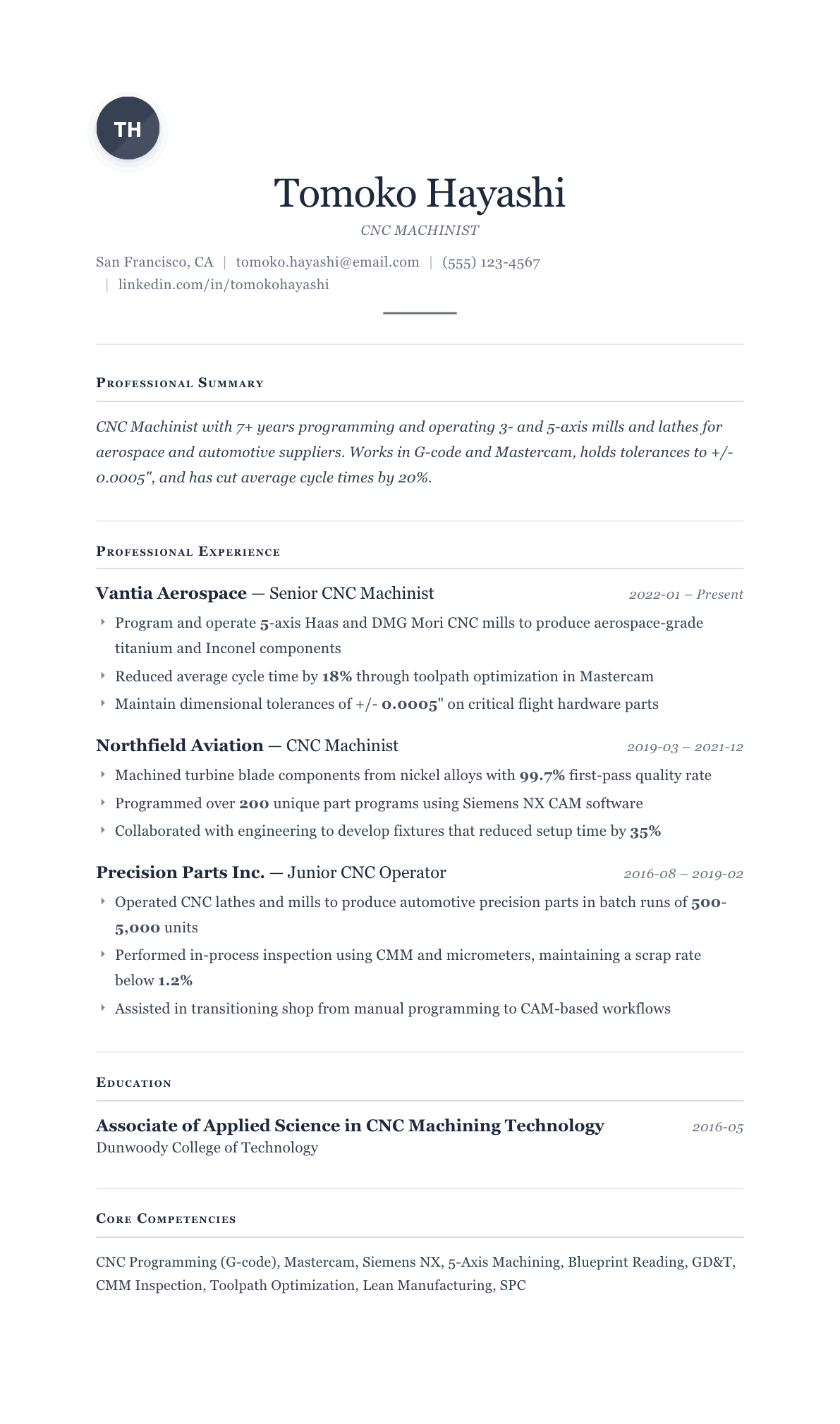
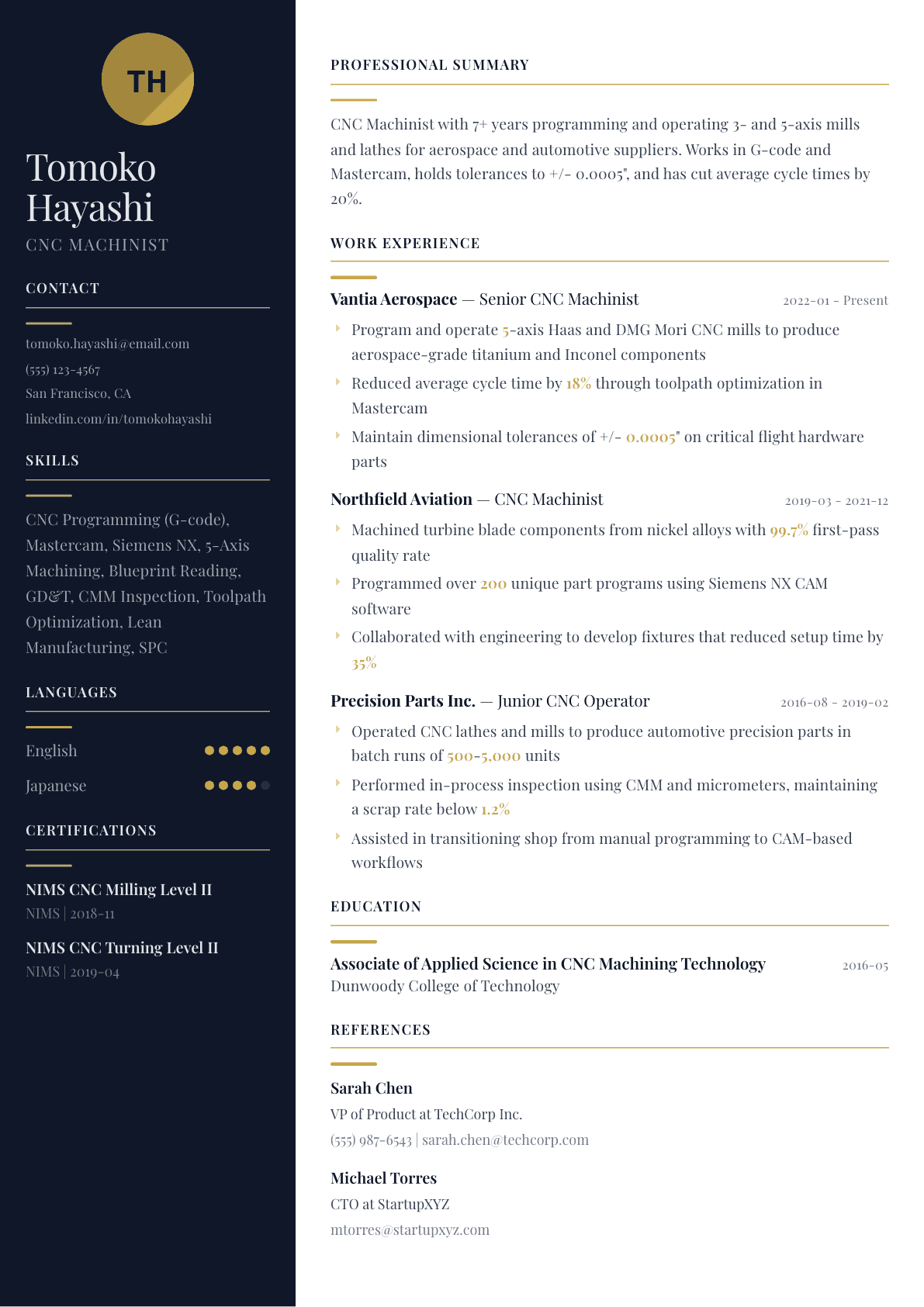
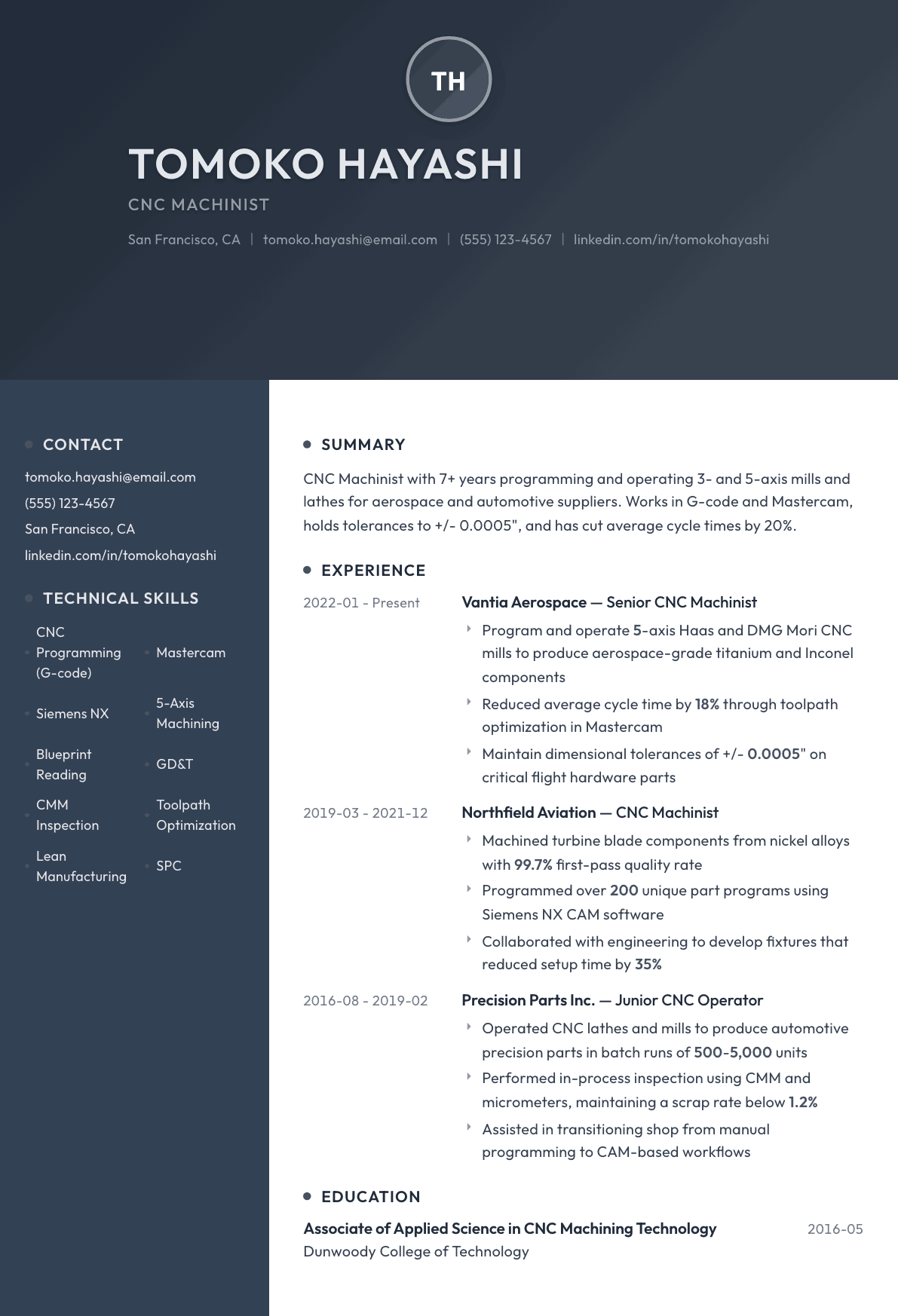
Example CNC Machinist summary
Precision CNC Machinist with 7 years of experience in 3- and 5-axis milling and turning operations. Proficient in Mastercam and G-code programming with a 99.7% first-pass quality rate. Seeking a senior machinist role in aerospace or defense manufacturing.
Skills to list on a CNC Machinist resume
- CNC Programming
- G-code / M-code
- Mastercam
- Fusion 360
- Siemens NX CAM
- 5-Axis Machining
- CNC Turning
- Blueprint Reading
- GD&T
- CMM Operation
- Micrometer Measurement
- Toolpath Optimization
- Lean Manufacturing
- SPC / Quality Control
- Fixture Design
What actually gets this resume read
- Specify the CNC machines you operate by brand and model (Haas VF-2, DMG Mori NLX) to show hands-on expertise.
- Quantify your precision: mention tolerances held, first-pass quality rates, and scrap reduction percentages.
- List CAM software proficiency (Mastercam, Fusion 360, Siemens NX) as these are key ATS keywords.
- Include NIMS certifications or equivalent credentials to differentiate yourself from uncertified operators.
- Highlight any experience with exotic materials (titanium, Inconel, aerospace alloys) for specialized roles.
How to write a cnc machinist resume
A CNC machinist resume is read by a shop manager or a lead programmer who needs to know what you can run, what you can program, and what you can hold. Machine types and controls, the CAM package, the materials, and the tolerance band you work to every day. Those four facts decide whether the page goes into the interview pile.
The second question is which part of the job you own. Running a proven program is a different job from setting up, which is different again from programming from a model, and different again from first article inspection and process improvement. Most resumes blur the four and get screened as operator resumes.
This guide covers how machinists should organize a resume for a job shop or a production floor, how to write tolerances, materials and machine lists so they mean something, three summaries, before and after bullets, and the certification questions that come up most.
Format: one page, machines and controls near the top
One page is enough for most machinists, and two only when you carry programming and quality responsibility. Reverse chronological, plain single column. Add an equipment block near the top listing machine types, brands and controls, because a shop running Haas mills and Mazak lathes searches for exactly those words.
Say what the shop made and how it ran. A job shop with constant one-off setups, production runs in the thousands, aerospace under a quality system, or medical work under validation are different environments, and a manager reads the fit from that one line.
- Equipment block: 3-axis and 5-axis mills, turning centers, live tooling, Swiss, electrical discharge machines, grinders.
- Controls: Fanuc, Haas, Siemens, Okuma, Mazatrol, Heidenhain.
- CAM and CAD: Mastercam, Fusion 360, Siemens NX, Esprit, GibbsCAM, SolidWorks.
- Inspection: micrometers, bore gauges, height gauge, optical comparator, coordinate measuring machine and its software.
Summary: what you run, what you program, what you hold
Three lines. Machine types and axis count, the CAM package, the materials, and the tolerance you work to. Add the industry if it is regulated, because aerospace and medical experience is screened for on its own.
Tolerance is the number machinists most often leave off and shop managers most want. Give the band you hold routinely rather than the tightest feature you ever produced once.
Experience: setups, programs, cycle time and scrap
Write bullets around the four things a floor is measured on: setup time, cycle time, first pass quality and scrap. Then say which of them you personally moved and how, whether by a fixture you designed, a toolpath you reworked, a tooling change, or speeds and feeds you proved out.
Distinguish clearly between operating, setting up and programming. Say how many setups a shift you do, whether you prove out your own programs, whether you edit at the control or only at the desk, and who signs off first articles.
Name the parts. Turbine components, hydraulic manifolds, orthopedic implants and injection mold cores carry different difficulty, and a manager who makes similar parts will read that line and stop scrolling.
Materials, tolerances and inspection
Materials tell a manager how much you know about tooling and heat. Aluminum and mild steel are the baseline. Stainless, titanium, Inconel, hardened tool steel, plastics and composites each carry their own problems, and naming them signals experience that cannot be faked in an interview.
- Tolerances: state the band you hold in normal production and note anything tighter as a specific job.
- Geometric dimensioning and tolerancing: say whether you apply true position, profile and datum structures from the print.
- Inspection: first article reports, in-process checks, control charts, and measurement programs you wrote or ran.
- Quality systems: aerospace and medical device standards, controlled export work, and traceability requirements.
Training and certification
Metalworking skill credentials are the recognized standard in the United States and are worth listing individually by level and area rather than as one line. An associate degree in machine tool technology, a completed apprenticeship, or manufacturer training on a specific control all belong here. Add forklift or crane signaling training if you handle heavy raw stock.
Keywords a machining posting repeats
These postings use a compact vocabulary: CNC programming, G-code, M-code, setup and operation, blueprint reading, tight tolerances, first article inspection, preventive maintenance, and the machine and control brands. Put the brands in your equipment block, since that is where a keyword search lands.
CNC Machinist resume summary examples
Out of the trade program
Machinist with 2 years running 3-axis vertical mills and CNC lathes on production batches in aluminum and mild steel. Performs own setups from a job packet, inspects with micrometers and bore gauges, and holds to plus or minus one thousandth. Credentialed in measurement and milling.
Five years on the floor
CNC machinist with 6 years in a job shop, programming in Mastercam and running 3-axis and 4-axis mills plus live-tool lathes. Works in stainless, titanium and tool steel, holds tolerances to plus or minus half a thousandth, and cut setup time on repeat jobs by designing dedicated fixtures.
Lead machinist and programmer
Senior CNC machinist with 12 years in aerospace under an accredited quality system, programming 5-axis mills in Siemens NX and Mastercam for titanium and nickel alloy components. Owns first article inspection, proves out every program at the control, and mentors 4 machinists across two shifts.
Work experience bullets: before and after
Before: Operated CNC machines to produce parts.
After: Set up and ran 5-axis mills producing titanium and nickel alloy flight hardware, performing 3 to 4 setups per shift from the job packet without supervision.
Machine capability, materials and setup frequency show the independence that an operator bullet hides.
Before: Programmed parts using CAM software.
After: Programmed 200 part numbers in Siemens NX, proving each out at the control and recording speeds, feeds and tooling in the setup sheet for the next run.
Volume plus proof-out and documentation shows a programmer whose work another shift can repeat.
Before: Reduced cycle times.
After: Cut cycle time on a high-runner bracket by reworking the roughing toolpath and moving to a high-feed cutter, taking roughly 18 minutes out of a 90 minute job.
The method and the before and after time make the improvement checkable instead of a claim.
Before: Maintained good quality standards.
After: Held a scrap rate under 1.2% across batch runs of 500 to 5,000 pieces using in-process checks and a control chart on the two critical features.
A quality number tied to batch size and a method is what a manager compares against his own floor.
Before: Helped with fixtures and setup improvements.
After: Designed and built 6 dedicated fixtures for repeat jobs, cutting average setup from 90 minutes to about 35 and removing a manual indicating step.
Naming what you built and the time it removed shows initiative that pays the shop back on every run.
Hard skills
- CNC milling from 3-axis to 5-axis
- CNC turning and live tooling
- G-code and M-code editing at the control
- Mastercam programming
- Siemens NX programming
- Fixture design and workholding
- Blueprint reading and geometric tolerancing
- Speeds, feeds and tool selection
- First article inspection
- Coordinate measuring machine operation
- Statistical process control
- Preventive maintenance on machine tools
- Deburring and finishing to specification
- Tool presetting and offsets
Soft skills
- Attention to detail over long runs
- Shift handover communication
- Problem solving at the machine
- Training junior operators
- Working to a schedule
- Safety discipline
Certifications worth listing
- Machining Level I Credential (National Institute for Metalworking Skills)
- CNC Milling: Programming, Setup and Operations (National Institute for Metalworking Skills)
- CNC Turning: Programming, Setup and Operations (National Institute for Metalworking Skills)
- Certified Manufacturing Technologist (SME)
- OSHA 10-Hour General Industry (OSHA Training Institute)
Mistakes that cost cnc machinist candidates the interview
- Writing operated CNC machines without saying whether you set up, program, or only load and unload.
- Leaving the tolerance band off, which is the first number a shop manager looks for and the easiest one to give.
- Naming CAM software without saying whether you post, prove out and edit, or only open a file someone else built.
- Skipping the materials, so a manager running titanium and nickel alloys assumes you have only cut aluminum.
- Ignoring inspection entirely. A machinist who cannot measure his own work costs a shop more than a slow one.
- Omitting machine brands and controls, which are the exact words a keyword search runs on.
CNC Machinist resume questions
What tolerances should I put on a machinist resume?
The band you hold in routine production, stated plainly, plus any tighter work as a specific example with the part and the feature named. A tolerance you reached once will be tested during the interview or on a first-week setup.
Do I need a metalworking credential to get a CNC machinist job?
Most shops hire on demonstrated ability and a practical test is common. Credentials help most for entry-level candidates and inside larger manufacturers with structured pay grades, so list them by level and area if you hold them.
Should I list every machine I have ever run?
List the types, brands and controls you can set up and run without help. A long list of machines you touched once dilutes the ones you are strong on, and interviewers usually pick a brand off your list to ask about.
How do I move from operator to programmer on paper?
Show program editing at the control, any offline CAM work, the fixtures you designed and the proof-out you did. Programming on your own time counts if you can describe the parts, so name the CAM package and the kind of geometry you have handled.
Does aerospace or medical machining experience need special treatment?
Yes. Name the quality system, the documentation you completed, and whether your parts were subject to source inspection or traceability requirements. Regulated shops screen hard for machinists who already understand the paperwork around the part.
Related resume examples
- Welder Resume example
- Production Supervisor Resume example
- Sheet Metal Worker Resume example
- Machinist Resume example
- CNC Programmer Resume example
- CNC Operator Resume example