Title Agent Resume Examples: free ATS score and gap list
Write a Title Agent Resume That Proves Clean Commitments and Closings
By Mustafa Tarabya, founder of CVBooster · Published · Updated
Title agent resume example, keyword list and writing guide covering title searches, commitments, curative work, underwriter authority and closing volume.
Sample resumes for a title agent
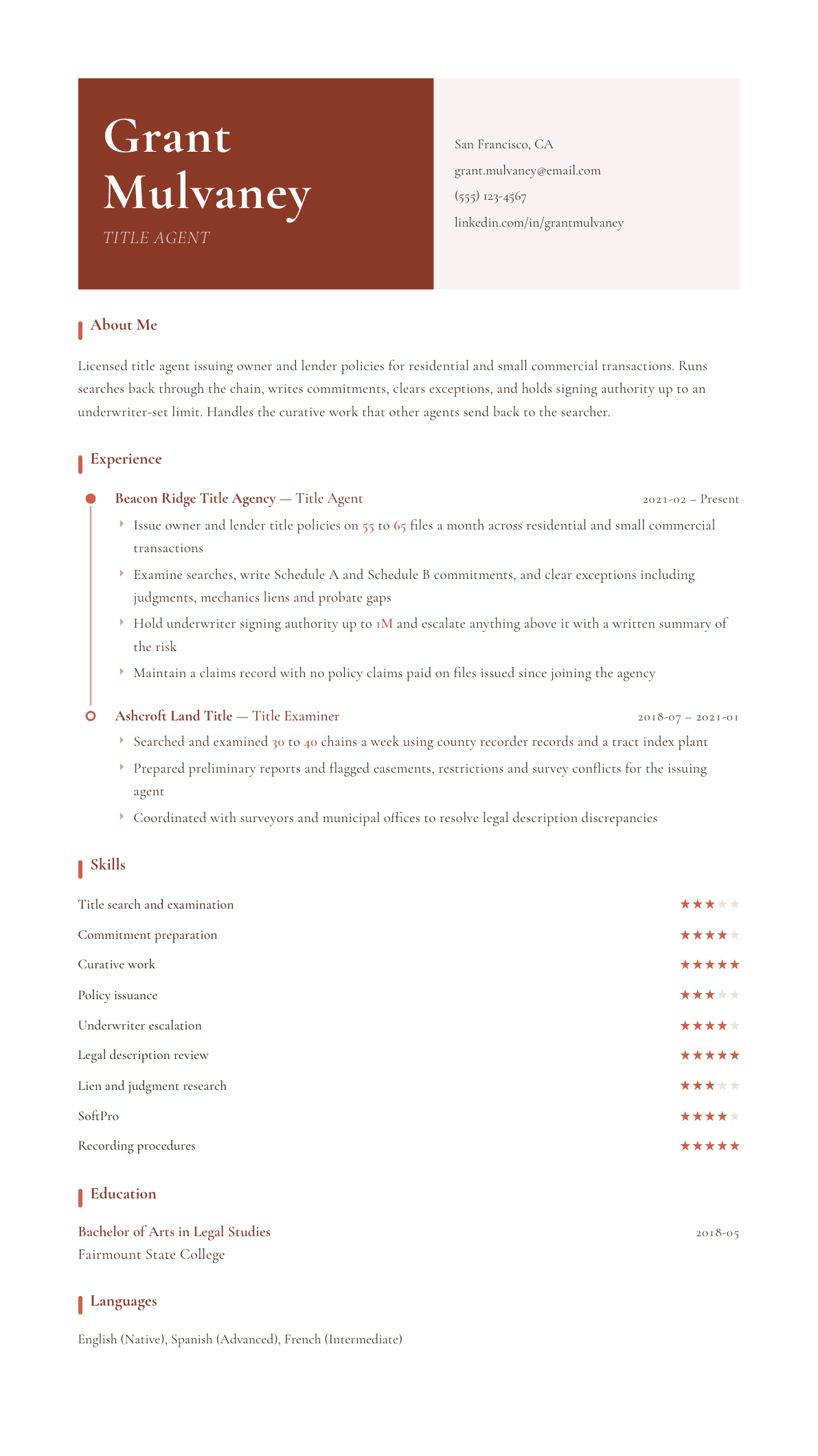
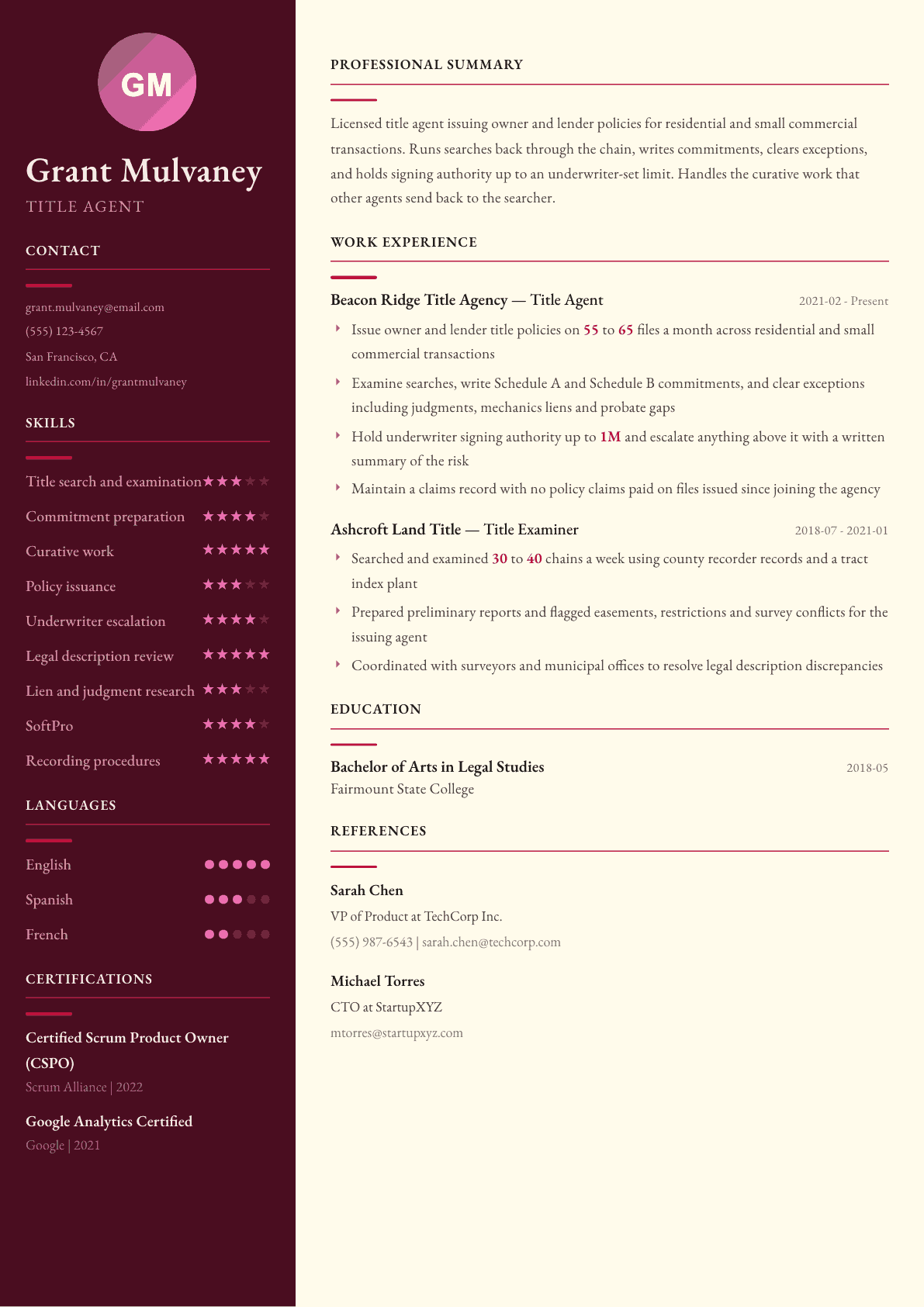
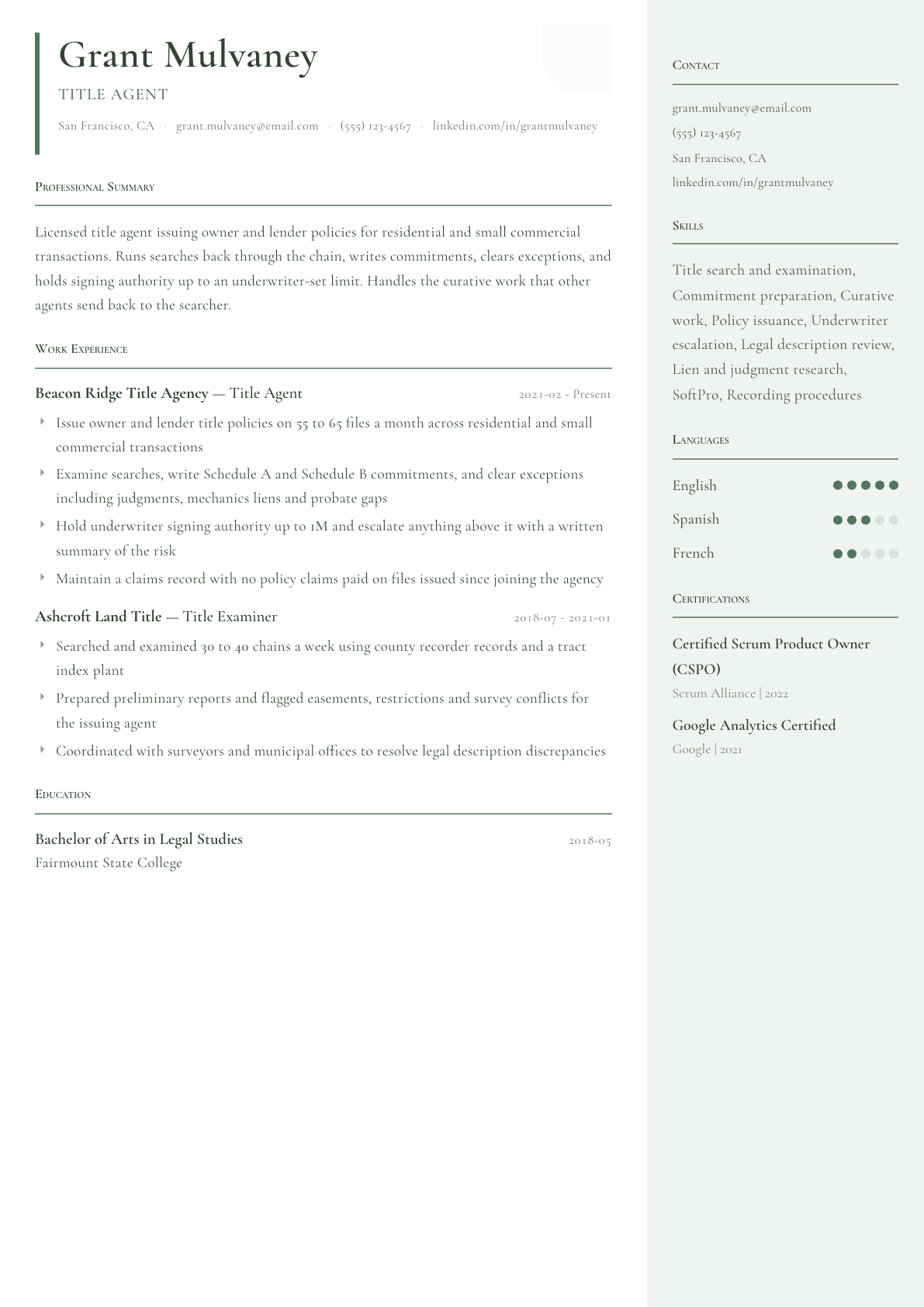
The same title agent content laid out in three CVBooster templates, so you can see what the finished document looks like before you write a word.
Example Title Agent summary
Licensed title agent with seven years across examination and issuance, currently writing owner and lender policies on sixty files a month for residential and small commercial deals. Clears judgments, mechanics liens and probate gaps rather than sending them back, and holds underwriter signing authority with a clean claims record. Works SoftPro daily and escalates high risk files with a written summary.
Skills to list on a Title Agent resume
- Title search and examination
- Chain of title analysis
- Title commitment preparation
- Schedule A and B requirements
- Curative and clearance work
- Owner and lender policy issuance
- Judgment and lien research
- Probate and estate title issues
- Legal description verification
- Survey and easement review
- Underwriter guideline application
- SoftPro and RamQuest
- Qualia
- Recording and county procedures
- Closing and settlement support
What actually gets this resume read
- State your title license, the state that issued it, and any underwriter appointments you carry.
- Give monthly policy volume and split it between residential, commercial, refinance and new construction files.
- Name your signing authority limit, because it tells a hiring agency exactly how much risk you have been trusted with.
- Describe curative work by type, since clearing a probate gap is a different skill from clearing a payoff.
- List the title production system you use, such as SoftPro, RamQuest, Qualia or an underwriter proprietary platform.
- Mention your claims record if it is clean, because underwriters weigh that more heavily than raw file counts.
- Say whether you search from a title plant, county records or a search vendor, since the workflows are different.
How to write a title agent resume
A title agent resume is a risk document. The agency owner or underwriter representative reading it is deciding how much authority they can hand you, so the page has to show what you have examined, what you have insured over, and what you escalated instead. Volume alone will not settle that question.
Candidates commonly write the role as processing: opening orders, ordering searches, issuing policies. Those verbs describe a coordinator. A title agent reads a chain, decides what goes on Schedule B, and signs a policy that commits an underwriter to defend it, which is a judgment role and should read as one.
This guide covers licensing and appointments, how to state signing authority, how to write curative work so it demonstrates skill rather than persistence, how to talk about your claims record, and the production systems and search sources agencies screen for.
Format: credentials at the top, authority stated early
One page for an examiner moving up, two once you have carried commercial files and multiple underwriter appointments. Put licensing, appointments and signing authority in the top third, because an agency cannot evaluate anything else until it knows what you can sign.
Keep formatting plain and text based. Underwriters and larger agencies use applicant tracking, and terms like title commitment, curative, chain of title and Schedule B need to be readable as text rather than embedded in a design element.
- Header: name, city and state, phone, email, title producer license number, and each underwriter appointment held.
- Sections: summary, authority and volume, experience, curative specialties, production systems, search sources, education.
- Under each role state the agency size, monthly policy count, and the split between residential and commercial files.
- Include a claims line if it is clean, since it is the metric an underwriter weighs above raw production.
Authority: the number that sets your level
Signing authority is the clearest level signal on a title agent resume. State the limit you carried, whether it came from an underwriter or from agency policy, and what you did with files above it. An agent who escalates with a written risk summary rather than a forwarded email is describing professional judgment.
Add the exceptions to that authority. Many agents can sign to a limit but must escalate specific matters regardless of amount, such as bankruptcy, eminent domain, mineral rights or unresolved boundary disputes. Naming those shows you know the edges of your own competence.
Where you have insured over a defect, say so carefully and in general terms. Deciding to insure over an old unreleased mortgage with an affidavit and indemnity is a real decision, and describing the category rather than the file demonstrates the reasoning without disclosing anything.
Examination: chain, plant and the sources you search
Say where your search comes from. A tract index title plant, direct county recorder records, a search vendor product, or an abstractor report each produce different confidence and different review obligations. An agency that maintains its own plant will prefer someone who has worked one.
Describe the search depth you perform. Full chain back to a root, a limited search under a prior policy, a two-owner search, or a foreclosure and REO search with a full lien review are different products, and an agent who names them is speaking the reader's language.
Legal description work belongs in this section. Reconciling a metes and bounds description against a plat, catching a scrivener error carried forward through three deeds, or resolving an acreage discrepancy with a surveyor are the tasks that separate an examiner from a data entry role.
Curative: categories, not effort
Write curative work as a list of problem types you can solve. Probate and intestate succession gaps, divorce decrees without conveyance, judgment and tax liens with differing survival periods, mechanics liens still inside a statutory window, missing prior releases, powers of attorney of questionable scope, and entity authority for a corporate or trust seller.
For each category you handle regularly, add the tool you use to close it: an affidavit of identity, an indemnity, a corrective deed, a quiet title referral or a bond. That pairing is what proves the experience, because anyone can list problems and only a practitioner lists remedies.
Say how quickly you turn curative and how often it delays a closing. Agencies lose money on files that sit, so an agent who can quantify that is arguing directly to the owner's interest.
Systems, production and the claims record
Name the production platform and what you do inside it. SoftPro, RamQuest and Qualia each generate commitments and policies differently, and remote work in this field usually assumes fluency in the agency's system on day one.
Volume should be stated by policy type: owner policies, lender policies, endorsements issued, and any commercial work with its own count. Endorsement experience is worth calling out because it is where underwriter guidelines get specific.
Close with the claims record. If no policy you issued has produced a paid claim, say it plainly with the period covered. If one has, be ready to explain it, but do not put it on the resume. A clean record stated honestly is the strongest single line a title agent can offer.
Title Agent resume summary examples
Examiner moving into issuance
Title examiner with three years searching 30 to 40 chains a week from a tract index plant and county records, preparing preliminary reports and flagging easements, restrictions and survey conflicts. Licensed as a title producer and trained on commitment preparation under a senior agent, seeking an issuing seat.
Issuing title agent
Licensed title agent issuing owner and lender policies on 55 to 65 residential and small commercial files a month. Writes Schedule A and B commitments, clears judgments, mechanics liens and probate gaps, and holds underwriter signing authority with a clean claims record on files issued to date.
Senior agent with commercial authority
Senior title agent with twelve years and appointments from three underwriters, issuing commercial policies with endorsement packages and multi-parcel legal descriptions. Handles bankruptcy, entity authority and boundary matters directly with underwriter counsel, and trains examiners on chain analysis and curative drafting.
Work experience bullets: before and after
Before: Issued title insurance policies for real estate transactions.
After: Issued owner and lender policies on 55 to 65 files a month across residential and small commercial transactions, including endorsement packages required by institutional lenders.
Volume, policy types and endorsement work show the scope an agency is buying rather than a generic function.
Before: Reviewed title searches and prepared commitments.
After: Examined searches back to a root deed and drafted Schedule A and Schedule B commitments, reconciling legal descriptions against recorded plats before requirements were set.
Search depth and the legal description check prove examination judgment instead of a document assembly task.
Before: Cleared title problems so files could close.
After: Cleared probate gaps with heirship affidavits, released stale judgments through payoff and satisfaction, and closed mechanics lien exposure with indemnity where the statutory window had run.
Pairing each problem type with the remedy used is the difference between listing issues and demonstrating skill.
Before: Escalated difficult files to the underwriter.
After: Escalated files above signing authority with a written risk summary covering the defect, the chain history and the proposed insuring position, and carried the underwriter response back into the commitment.
It shows a structured escalation that saves the underwriter time, which is what earns higher authority later.
Before: Maintained a good record with the underwriter.
After: Held a claims record with no paid policy claims on files issued across four years, supported by documented curative files and underwriter approval memos retained in the order.
The record is stated with a period and a reason it can be trusted, which turns a vague claim into evidence.
Hard skills
- Title search and examination
- Chain of title analysis to a root deed
- Title commitment drafting
- Schedule A and Schedule B requirements
- Curative drafting and clearance
- Owner and lender policy issuance
- Endorsement selection and issuance
- Judgment, tax and mechanics lien research
- Probate, trust and entity authority review
- Legal description and plat reconciliation
- Underwriter guideline application
- SoftPro and RamQuest
- Qualia and title plant search
- Recording and county procedure
Soft skills
- Risk judgment under time pressure
- Clear written escalation
- Patience with county offices
- Explaining requirements to agents
- Refusing a closing date when the file is not ready
Certifications worth listing
- National Title Professional (NTP) (American Land Title Association)
- Title Insurance Producer License (State department of insurance)
- Notary Public Commission (State commissioning authority)
Mistakes that cost title agent candidates the interview
- Writing the role as order processing, which reads as coordination rather than the judgment work of issuance.
- Omitting signing authority, the single fastest way for an agency to place you at a level.
- Listing title problems without the remedies you used to clear them.
- Failing to say where your searches come from, when plant, county and vendor work differ in confidence and review duty.
- Skipping endorsement experience, which is where lender requirements and underwriter guidelines get most specific.
- Leaving the claims record off the page when it is clean and easy to state.
- Claiming commercial experience on the strength of one deal instead of naming the count and the complexity.
Title Agent resume questions
What licensing should a title agent list on a resume?
List the state title insurance producer license with its number, every underwriter appointment you hold, and your notary commission. Agencies confirm all three before an offer, so stating them upfront removes a step and signals that you know how authorization in this field works.
How do I show the difference between examining title and issuing policy?
Separate them in the experience section. Examination bullets describe searching, chain analysis and preliminary reporting, while issuance bullets describe setting requirements, deciding what stays on Schedule B, and signing the policy. Blurring the two makes an examiner look overstated and an agent look understated.
Should I mention files where I insured over a defect?
Describe the category rather than the transaction. Saying that you insure over stale unreleased mortgages with an affidavit and indemnity under underwriter guidance shows judgment, while naming parties or properties would be inappropriate on a resume and unhelpful to the reader.
How much commercial title experience do agencies expect?
It varies with the agency's book. Give the count and the complexity: multi-parcel descriptions, entity authority chains, leasehold policies, construction loan endorsements. A handful of genuinely complex commercial files often carries more weight than a large number of simple ones.
Is a National Title Professional designation useful on this resume?
It helps in screening because it signals sustained involvement in the field beyond daily production. It will not substitute for signing authority or a clean claims record, so list it in a designations line and keep the top of the page focused on what you can sign.
Related resume examples
- Title Examiner Resume example
- Escrow Officer Resume example
- Real Estate Attorney Resume example
- Real Estate Appraiser Resume example
- Real Estate Transaction Coordinator Resume example
- Mortgage Processor Resume example