Escrow Officer Resume Examples: the lines they read
Build an Escrow Officer Resume That Shows Clean Funding Records
By Mustafa Tarabya, founder of CVBooster · Published · Updated
Escrow officer resume example, keyword list and writing guide covering file volume, settlement statements, trust accounting, title curative work and closings.
Sample resumes for a escrow officer
The same escrow officer content laid out in three CVBooster templates, so you can see what the finished document looks like before you write a word.
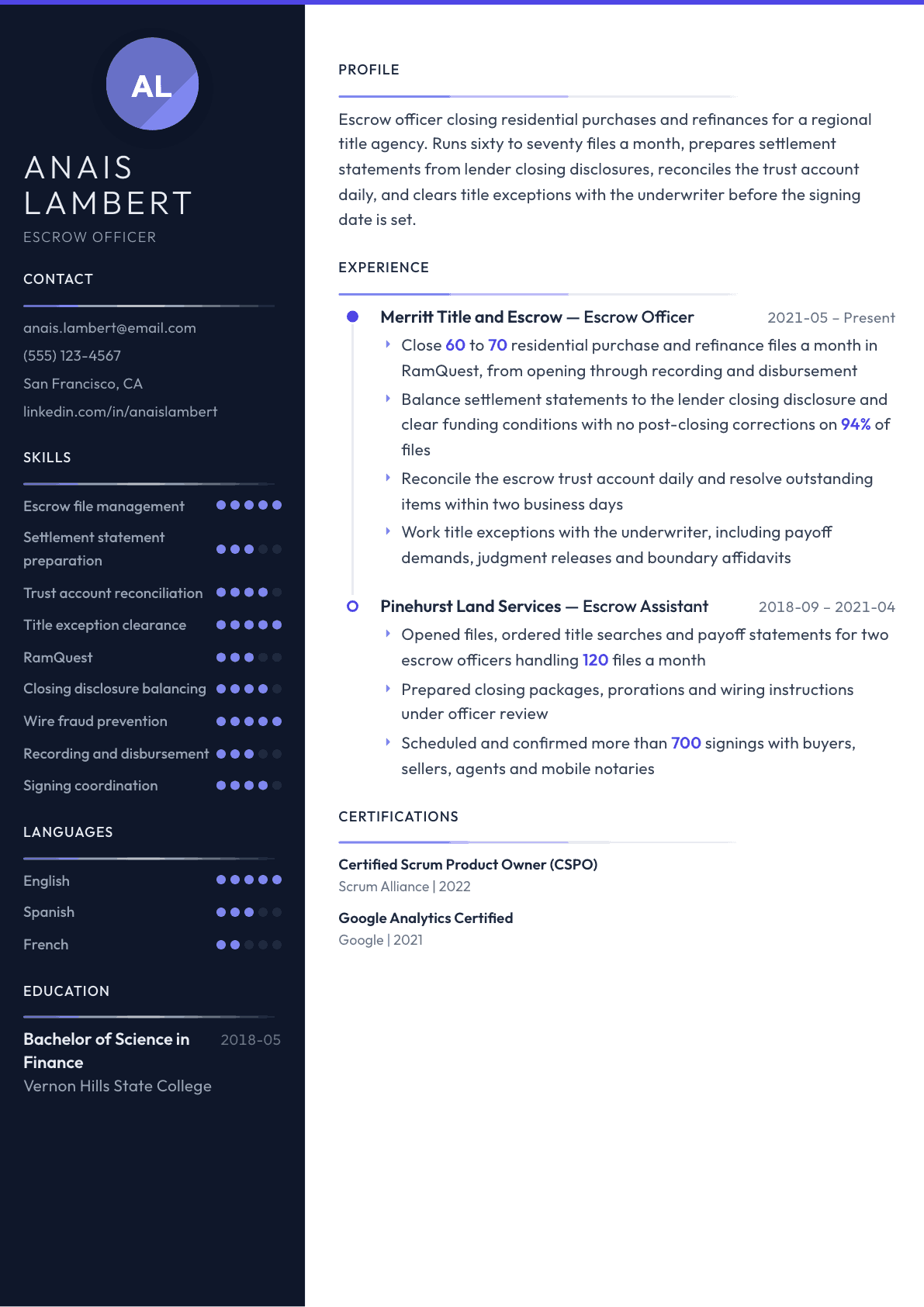
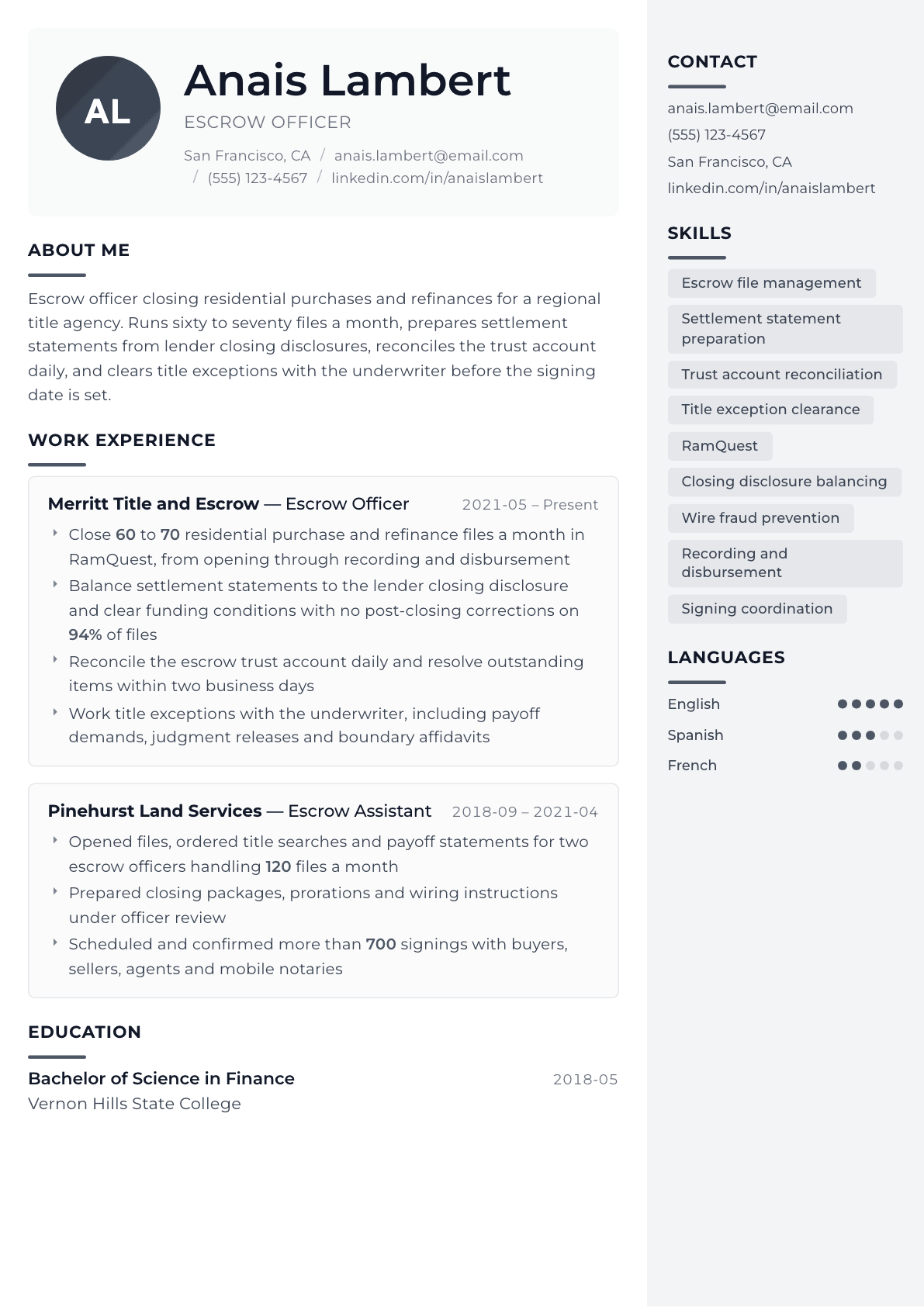
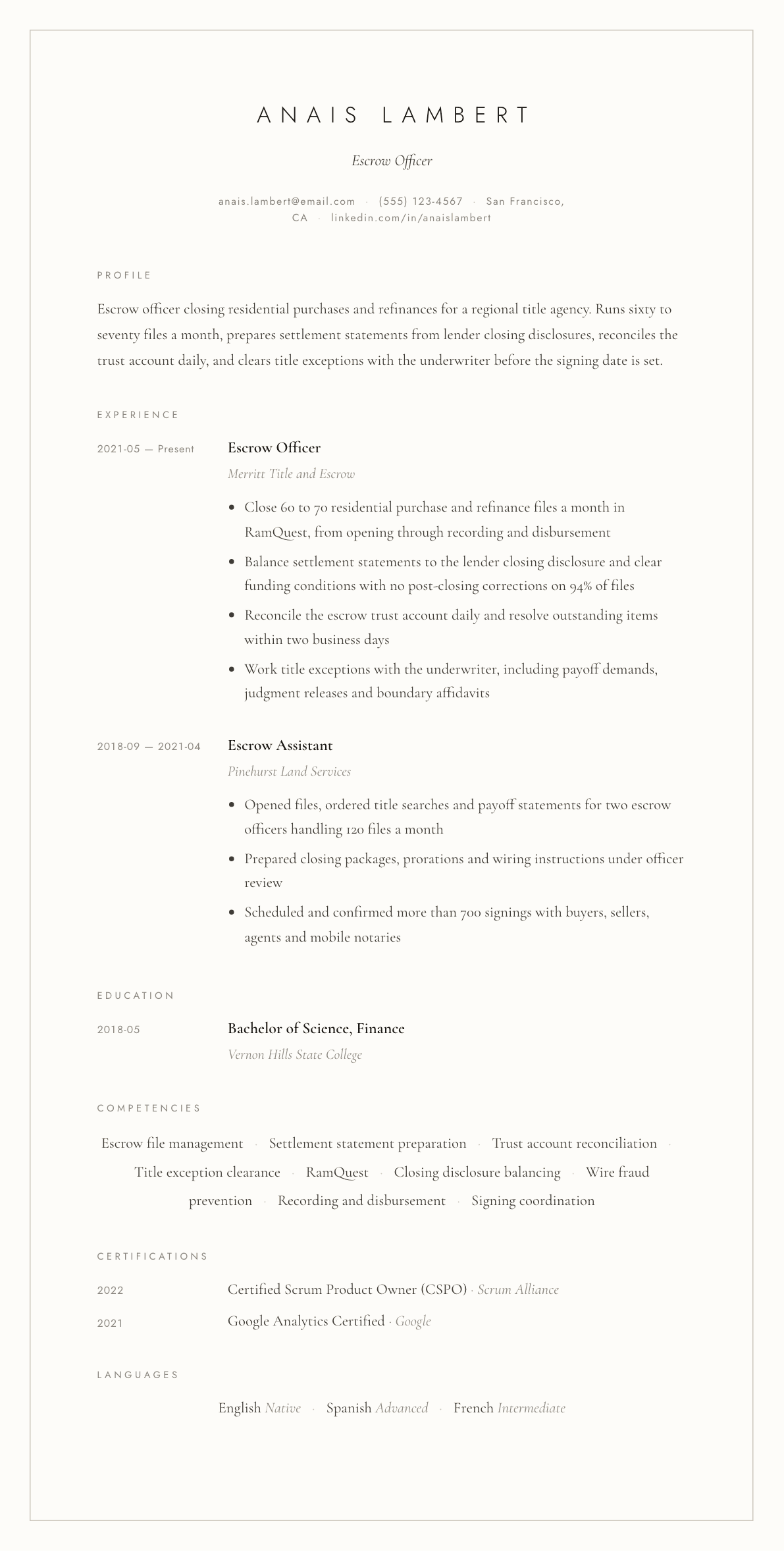
Example Escrow Officer summary
Escrow officer with seven years in residential settlement, closing sixty to seventy purchase and refinance files a month for a regional title agency. Balances settlement statements to the lender closing disclosure, reconciles the escrow trust account daily, and clears title exceptions directly with the underwriter. Strong post-closing correction record and a documented wire verification routine. Licensed and seeking a commercial escrow desk.
Skills to list on a Escrow Officer resume
- Residential and commercial escrow
- Settlement statement preparation
- Closing disclosure balancing
- Escrow trust accounting
- Title commitment review
- Curative and exception clearance
- Payoff demand processing
- Recording and disbursement
- RamQuest and SoftPro
- Qualia and ResWare
- Wire transfer verification
- 1031 exchange coordination
- Notary and signing management
- Lender and agent communication
- RESPA and TRID compliance
What actually gets this resume read
- Open with monthly file volume and the transaction types you close: purchase, refinance, new construction or commercial.
- Say which escrow platform you work in, since RamQuest, SoftPro, Qualia and ResWare are not interchangeable to a hiring manager.
- Give your record on balancing to the lender closing disclosure and on post-closing corrections, because that is the quality metric.
- Show trust accounting responsibility explicitly, including reconciliation frequency and who reviews your work.
- List the underwriters you have worked under and the states where you are licensed or appointed.
- Name your wire fraud controls, because every title agency has been burned or nearly burned by a diversion attempt.
- Mention curative work by type rather than in general: liens, judgments, probate, easements or missing releases.
How to write a escrow officer resume
An escrow officer resume is read by a title agency manager who has been burned before. She wants volume, but she wants accuracy more, because a settlement statement that does not balance costs the company money and a wire that goes to the wrong account can cost it the business. Your resume has to prove both at once.
The resumes that fail describe the closing table instead of the file. They say the candidate greeted signers, explained documents and coordinated with agents, which is the visible surface of a job whose real substance is trust accounting, title clearance and lender condition satisfaction.
What follows is how to present monthly file volume by transaction type, how to write about balancing and post-closing corrections, how to describe curative work by category, and how to put wire fraud controls and trust reconciliation on the page in a way that reassures rather than alarms.
Format: one page early, two once you carry commercial files
Keep it to one page while your work is residential resale and refinance. Once you have handled commercial, construction disbursement or exchange files, a second page is justified because those transaction types need their own explanation.
Escrow hiring is credential and system driven, so put licensing and platform experience where they cannot be missed. A manager evaluating three candidates will start by eliminating the ones who have never opened her escrow software.
- Header: name, city and state, phone, email, escrow license or state appointment, and notary commission status.
- Order the page as summary, transaction volume by type, experience, escrow systems, underwriters worked under, education.
- Under each job give the agency type, monthly file count, and whether you closed with an assistant or alone.
- Add a short underwriters line, because agencies want to know whose guidelines you already work inside.
Volume by transaction type, not one blended number
Split your monthly count. Purchase, refinance, new construction, cash, commercial and exchange files consume different amounts of time, so a blended figure tells the reader very little. Sixty to seventy residential files a month, of which roughly a third are refinances, is a picture a manager can staff around.
Say whether you have an escrow assistant. An officer closing seventy files alone is doing a different job from one supported by two assistants and a post-closing team, and the difference will come up in the interview anyway.
Where you have handled less common file types, name them explicitly: builder disbursement with lien waivers, exchange accommodation coordination, REO with corporate signature packages, or short sale with lender approval letters. Those are the files agencies struggle to staff.
Accuracy: balancing, corrections and trust reconciliation
The quality metric in escrow is whether the file balanced and stayed balanced. Report your record on balancing to the lender closing disclosure and on post-closing corrections, because that is the number a manager would ask about if you did not offer it.
Trust accounting deserves a bullet of its own. State the reconciliation frequency, who reviews it, and how quickly you clear outstanding items. Agencies undergo underwriter audits and state examinations, and an officer who can speak to three-way reconciliation without flinching is a lower risk hire.
Disbursement discipline sits alongside it. Recording confirmation before release, payoff verification with good through dates, and handling of unreleased liens after funding are all specific enough to signal that you have closed real files rather than assisted on them.
Curative work: name the categories you clear
Every escrow officer says they clear title exceptions, so the useful move is to name the categories. Judgment and tax lien releases, mechanics liens with statutory deadlines, probate and estate gaps, divorce decrees and quitclaims, boundary and encroachment affidavits, and missing prior releases each require a different conversation and a different document.
Say who you escalate to and when. Working directly with an underwriter counsel on a chain problem is a level of responsibility worth stating, and it separates an officer who solves from one who forwards.
Payoff work belongs here too. Ordering demands, verifying per diem and good through dates, handling short payoffs and chasing a lender that will not release are ordinary parts of the week and specific enough to prove experience.
Systems, compliance and wire security
Name your escrow production platform, because RamQuest, SoftPro, Qualia and ResWare imply different workflows and different data entry habits. Add the settlement statement format you produce, the recording method you use, whether by electronic recording or courier, and any lender portal you have worked in.
Compliance language should be concrete. Settlement service disclosure rules, closing disclosure timing, best practices frameworks that agencies adopt for underwriter review, and information security handling of nonpublic personal information are all specific responsibilities rather than slogans.
Wire security is the one every hiring manager wants to hear about. Describe your verification routine: callback to a previously known number, no instruction changes accepted by email alone, and confirmation of receipt after transmission. State it as procedure you follow rather than a policy you are aware of.
Escrow Officer resume summary examples
Escrow assistant moving up
Escrow assistant with three years opening files, ordering searches and payoff demands, and preparing closing packages for two officers handling 120 files a month. Scheduled more than 700 signings and prepared prorations under officer review. Notary commissioned and ready for an escrow officer desk.
Residential escrow officer
Escrow officer closing 60 to 70 residential purchase and refinance files a month in RamQuest, balancing settlement statements to the lender closing disclosure and reconciling the trust account daily. Clears judgments, payoff shortfalls and probate gaps with the underwriter before a signing date is set.
Commercial and exchange escrow
Senior escrow officer with eleven years across residential, commercial and exchange transactions, closing builder disbursement files with lien waiver tracking and multi-parcel commercial deals. Mentors three officers, runs the agency wire verification procedure, and has completed two underwriter audits without findings.
Work experience bullets: before and after
Before: Closed residential real estate transactions for buyers and sellers.
After: Closed 60 to 70 residential purchase and refinance files a month in RamQuest, from file opening through recording, disbursement and post-closing policy issuance.
Monthly volume, the platform and the full span of the file tell a manager the level you can carry.
Before: Prepared accurate settlement statements.
After: Balanced settlement statements to the lender closing disclosure on every file, with no post-closing corrections required on 94% of closings over two years.
Accuracy is the whole job, and a correction rate is the only way to prove it rather than assert it.
Before: Handled the escrow trust account.
After: Reconciled the escrow trust account daily against bank and file balances, clearing outstanding items within two business days and supporting two underwriter audits without findings.
Frequency, clearing standard and audit outcome turn a responsibility into evidence of control.
Before: Worked to clear title issues before closing.
After: Cleared title exceptions with the underwriter including judgment releases, mechanics liens, probate gaps and boundary affidavits, resolving most before the signing date was scheduled.
Naming exception categories proves the curative work was real rather than routing documents to someone else.
Before: Followed procedures to prevent wire fraud.
After: Verified every wire instruction by callback to a previously known number, refused instruction changes received by email alone, and confirmed receipt with the receiving institution after transmission.
Three concrete steps show a practiced routine, which is what an agency owner is actually screening for.
Hard skills
- Residential and commercial escrow closing
- Settlement statement preparation and balancing
- Closing disclosure reconciliation
- Escrow trust accounting and three-way reconciliation
- Title commitment review
- Curative and exception clearance
- Payoff demand ordering and verification
- Recording and disbursement
- RamQuest and SoftPro
- Qualia and ResWare
- Wire transfer verification procedure
- Exchange accommodation coordination
- Builder disbursement and lien waivers
- Notary and remote signing coordination
Soft skills
- Explaining figures to nervous signers
- Holding a closing date without cutting corners
- Diplomacy with agents and loan officers
- Documentation habits under audit
- Judgment on when to escalate
Certifications worth listing
- Certified Escrow Officer (CEO) (California Escrow Association)
- Certified Senior Escrow Officer (CSEO) (California Escrow Association)
- National Title Professional (NTP) (American Land Title Association)
- Notary Public Commission (State commissioning authority)
Mistakes that cost escrow officer candidates the interview
- Describing the signing table rather than the file, which makes an officer look like a closer or a notary.
- Giving one blended monthly number instead of splitting purchase, refinance and commercial volume.
- Leaving out trust reconciliation, the responsibility state examiners and underwriters look at first.
- Writing that you clear title issues without naming a single exception category you have resolved.
- Omitting the escrow platform, when platform familiarity is often the deciding factor between two candidates.
- Treating wire verification as a policy you know rather than a routine you personally execute.
- Failing to state whether you closed with assistant support or handled the whole file yourself.
Escrow Officer resume questions
Do I need an escrow license to work as an escrow officer?
It depends entirely on the state. Some regulate escrow as its own licensed activity, others handle it through title agency licensing or through attorney supervision at closing. Put whatever your state requires in the header, including appointment by an underwriter if that is how you are authorized.
How do I show escrow experience when I moved from a lender or a title search desk?
Map the overlapping work. Payoff demands, closing disclosure preparation, funding conditions and title commitment review all appear on both sides, so lead with those and be direct about the parts you have not owned yet, such as trust disbursement.
Should I list the underwriters my agency worked with?
Yes, as a short line rather than a section. Agencies place value on candidates already familiar with an underwriter's requirements and escalation process, and the line also signals the level of file you have been trusted with without needing a separate explanation.
How do I handle a gap caused by a refinance slowdown?
State it plainly with dates and what you did during it, whether that was contract closing work, a related role at a lender, or study toward a designation. Escrow hiring is cyclical and managers recognize a volume driven layoff far more readily than an unexplained gap.
What number best proves quality for an escrow officer?
Post-closing corrections and funding delays caused by file errors are the two that carry weight, because they measure work the agency has to redo. If your company never tracked them, use audit outcomes and the size of the trust ledger you reconciled instead.
Related resume examples
- Title Examiner Resume example
- Title Agent Resume example
- Real Estate Transaction Coordinator Resume example
- Real Estate Attorney Resume example
- Mortgage Processor Resume example
- Leasing Agent Resume example