Motion Designer Resume Examples: the lines they read
Build a Motion Designer Resume That Leads With the Reel
By Mustafa Tarabya, founder of CVBooster · Published · Updated
Motion designer resume examples with reel placement, After Effects and Cinema 4D keywords, and bullets that show craft rather than a list of tools.
Sample resumes for a motion designer
The same motion designer content laid out in three CVBooster templates, so you can see what the finished document looks like before you write a word.
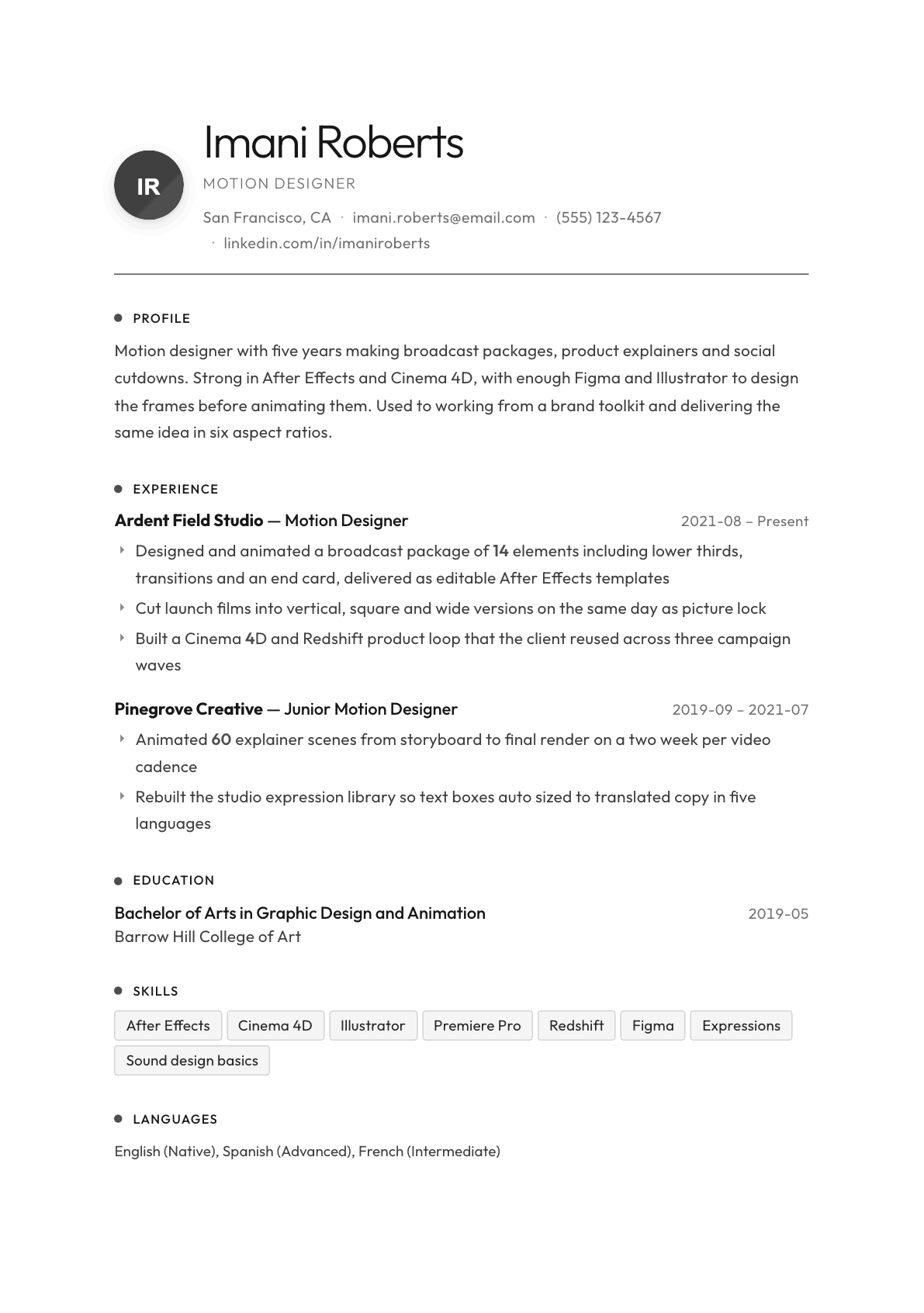
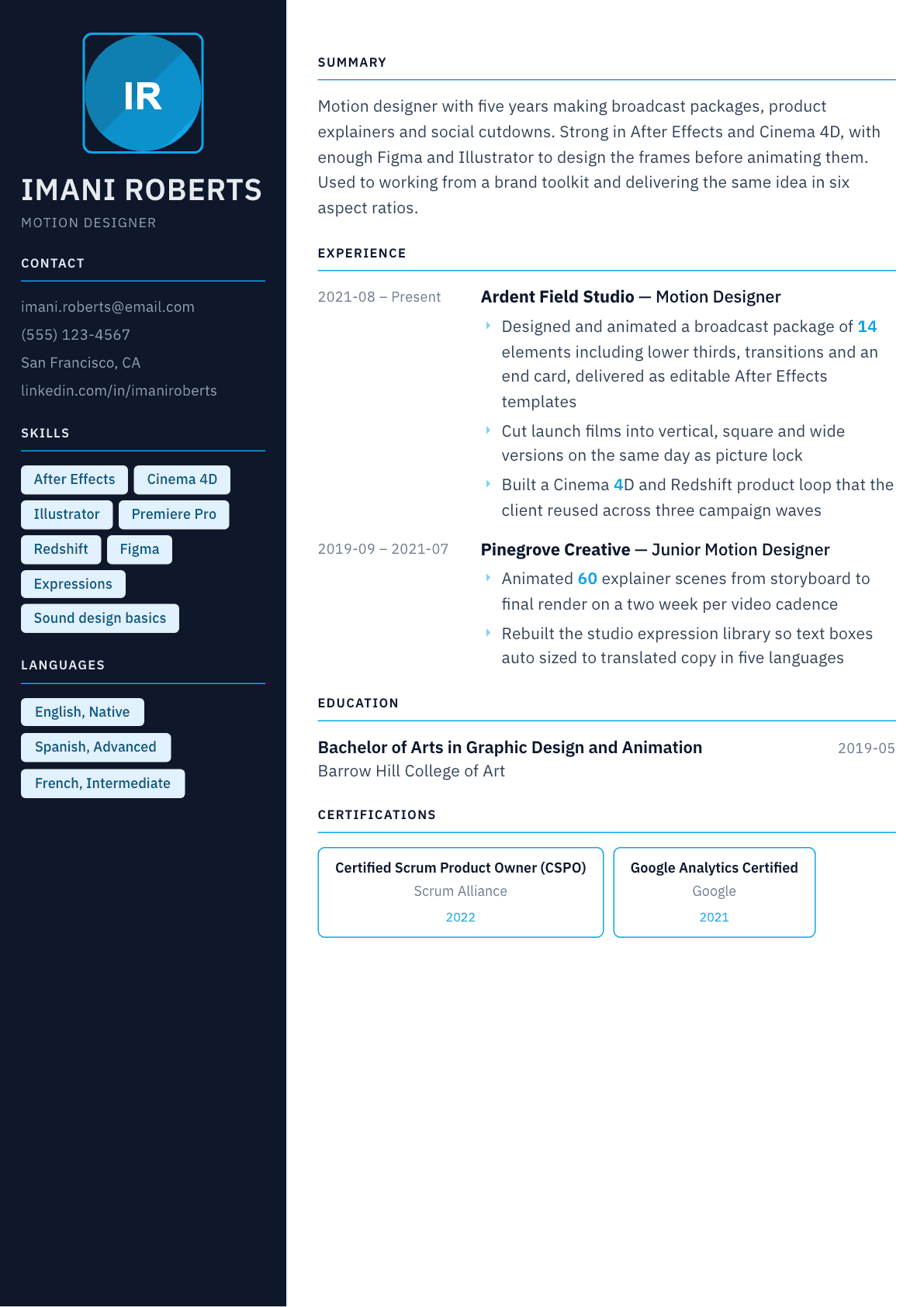
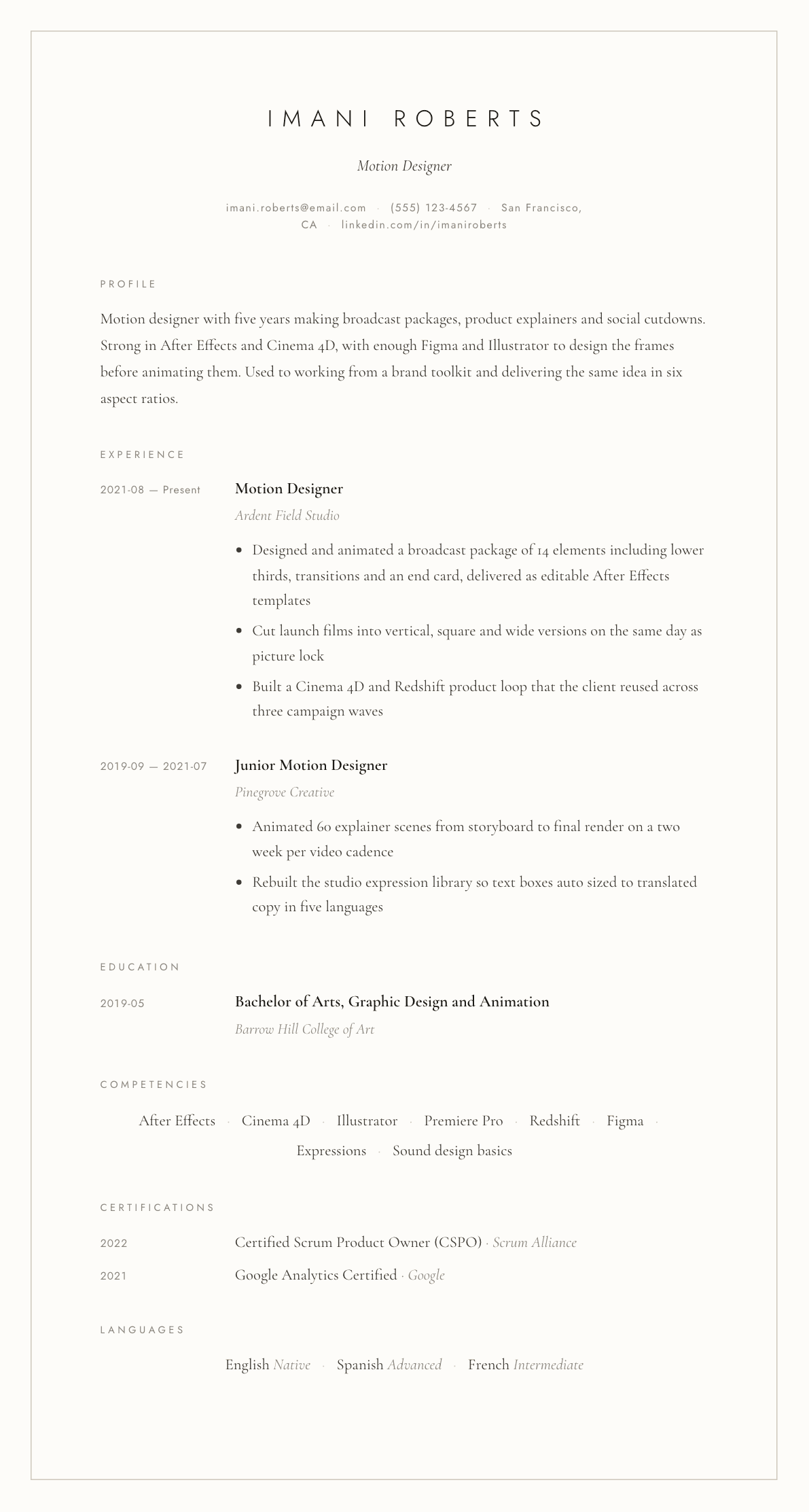
Example Motion Designer summary
Motion designer with five years across agency and in house teams, animating broadcast packages, explainers and social campaigns. Fluent in After Effects, Cinema 4D and Illustrator, and able to design the boards before animating them. Comfortable delivering one idea across vertical, square and wide formats, and building templates the wider team can edit without breaking the layout.
Skills to list on a Motion Designer resume
- After Effects
- Cinema 4D
- Blender
- Illustrator
- Premiere Pro
- Redshift
- Expressions
- Storyboarding
- Typography in motion
- Keyframe timing
- Compositing
- Brand systems
- Template building
- Sound design basics
What actually gets this resume read
- Lead the header with a reel link and note the runtime, because a creative director scans reels in the first minute.
- Break skills into design and animation so a hiring lead can tell whether you can also make the frames.
- Quantify output honestly: number of assets, formats delivered, or turnaround from storyboard to final render.
- Name the render engine, whether Redshift, Octane or Cycles, since studios buy licenses and hire around them.
- Show template work explicitly, since building editable After Effects setups for other people is a paid skill on its own.
- Add one bullet about working from a brand system, because agencies need people who animate inside guidelines.
How to write a motion designer resume
A motion designer is hired off the reel and kept off the resume. The creative director watches the first thirty seconds of your work, decides whether the timing is good, and only then opens the document to answer three practical questions: can this person design the frames as well as animate them, which software does the studio already own that this person knows, and how fast do they turn a board into a render.
That means the reel link belongs in the header, not at the bottom under a heading nobody reaches. Everything below it exists to answer the practical questions. A studio buying After Effects, Cinema 4D and a Redshift license needs to know you can walk into that setup on the first Monday, and an in house brand team needs to know you can animate inside a guideline document without redesigning the logo.
This guide covers the reel first structure, how to write bullets that show craft instead of listing plugins, three summary examples for different career stages, and the mistakes that keep good animators in the maybe pile.
Format: one page, reel link in the header, no decorative layout
One page is standard until you have run teams. Reverse chronological, plain typography, and no animated PDF tricks. The irony of the discipline is that a motion designer resume should sit still: the document is a reference sheet a producer reads while the reel plays on the other monitor.
Give the reel its own line under your name with the runtime and a note that a breakdown is available. Directors budget attention in seconds, so telling them the reel runs ninety seconds rather than six minutes makes them more likely to press play.
- Header: name, city, email, phone, reel link with runtime, portfolio site.
- Order: summary, selected work or experience, software, education, awards if any.
- Split the software block into design applications, animation applications and render engines.
- Freelancers group by client under one heading rather than listing each gig as a job.
Summary: format, sectors, and whether you design or only animate
Three lines. Name the kind of motion work you do, whether that is broadcast packages, product explainers, social campaigns, title sequences or interface motion, and say plainly whether you design the frames yourself. Studios split into two hiring lanes, designer animators and pure animators, and a summary that hides which one you are gets read as the weaker one.
Name the environment too. Agency, in house brand team, post house and freelance are four different working cultures with different revision counts, and a hiring lead is quietly checking that you have survived theirs.
Experience: what you made, in what format, on what clock
Each job needs the studio, the role, the dates and then three to five bullets. Lead each job with the piece a viewer would recognize: a broadcast package, a launch film, a title sequence, a campaign of social cutdowns. Say how many elements it contained and how many aspect ratios you delivered, because deliverable count is the honest measure of motion work and almost nobody writes it down.
Turnaround belongs in the bullets. A studio that runs a two week cadence per explainer hires differently from one that cuts vertical versions on the day of picture lock, and stating your real cadence tells the reader which pressure you are used to.
Template building deserves its own bullet whenever you have done it. Building an editable After Effects setup that an editor can retype without breaking the layout is a separate and paid skill, and it signals that you think about the people downstream of you.
Software: name the render engine, not just the suite
Write the applications the way a studio license list writes them: After Effects, Cinema 4D, Blender, Illustrator, Premiere Pro, and the render engine on top, whether that is Redshift, Octane or Cycles. Engines matter more than they look, because a studio has already paid for one and trained the pipeline around it.
Add the adjacent skills that widen your usefulness: expressions, basic rigging, tracking, simple sound design, and enough Figma to receive a designer handoff without asking for a redraw. Keep the list to tools you would open in an interview screen share.
Keywords a motion studio actually screens on
Postings recycle the same vocabulary: motion graphics, broadcast package, lower thirds, kinetic typography, explainer, storyboard, animatic, style frames, compositing, brand system, social cutdown, template build. Use the ones that are true of you inside real sentences instead of stacking them in a keyword strip, because a creative lead reads that strip as padding even when a parser likes it.
If the posting names a sector, mirror it. Sports broadcast, fintech product marketing, music video and pharmaceutical explainer all use the same tools with completely different taste, and the word that proves you know the difference is the sector name itself.
Motion Designer resume summary examples
First studio job
Junior motion designer with agency internship credits and a reel of explainer and social work. Animates in After Effects, models simple product scenes in Cinema 4D, and builds style frames in Illustrator before keyframing. Delivered 18 social cutdowns during a six month placement, all inside a client brand system.
Five years in
Motion designer with five years across agency and in house teams, working on broadcast packages, product explainers and social campaigns. Designs the boards and animates them, with Cinema 4D and Redshift for product work. Comfortable delivering one idea in vertical, square and wide formats on the day picture locks.
Lead or design director
Lead motion designer running a team of four on brand and broadcast work. Owns the pitch board through to final delivery, builds the editable template libraries other teams work from, and sets the studio expression and naming conventions. Directs client reviews and translates vague feedback into a shot list the team can animate.
Work experience bullets: before and after
Before: Created motion graphics for clients.
After: Designed and animated a 14 element broadcast package including lower thirds, transitions and an end card, delivered as editable After Effects templates the client edits in house.
The element count, the named deliverables and the template handoff turn a category into a body of work.
Before: Made social media videos.
After: Cut each launch film into vertical, square and wide versions on the day of picture lock, keeping type legible at the smallest crop without redesigning the frames.
It names the formats, the deadline pressure and the craft problem instead of naming a channel.
Before: Used Cinema 4D for 3D work.
After: Built a Cinema 4D and Redshift product loop with a repeatable lighting rig that the client reused across three campaign waves without new renders.
Naming the render engine and the reuse shows the work had a second life, which is what clients pay for.
Before: Helped improve studio workflow.
After: Rebuilt the studio expression library so text boxes auto sized to translated copy in five languages, removing the manual reflow pass from every localized version.
A workflow claim becomes credible once the reader sees the specific problem it removed.
Before: Worked from brand guidelines.
After: Animated inside a brand toolkit covering type, color and logo behavior, and extended it with a motion section defining easing curves and transition rules for future vendors.
It shows you can work inside a system and then contribute to it, which is what in house teams hire for.
Hard skills
- After Effects
- Cinema 4D
- Blender
- Redshift
- Illustrator
- Premiere Pro
- Expressions
- Storyboarding and style frames
- Kinetic typography
- Keyframe timing and easing
- Compositing
- Template building
- Sound design basics
- Color and codec delivery
Soft skills
- Taking creative direction
- Client review presence
- Time boxing revisions
- Working inside brand systems
- Handoff documentation
- Pitch collaboration
Certifications worth listing
- Adobe Certified Professional: Video Design Using Adobe After Effects (Adobe)
- Adobe Certified Professional: Visual Design Using Adobe Illustrator (Adobe)
- Maxon Certified Trainer (Maxon)
Mistakes that cost motion designer candidates the interview
- Burying the reel link at the bottom of the page, so the one asset that decides the hire is the last thing found.
- Listing every plugin ever installed instead of the render engine and the four applications you are actually fast in.
- Writing bullets that name clients but never say what you made, which reads as having been in the room rather than on the timeline.
- Submitting a heavily designed resume with animated elements that break when a producer prints it to review with the team.
- Leaving out format counts and turnaround, the two numbers a producer needs to plan a schedule around you.
- Sending one generic reel to a broadcast studio and a product marketing team, when the two want different halves of your work at the front.
Motion Designer resume questions
Should a motion designer resume be one page?
Yes for almost everyone. The reel carries the evidence, so the document only needs to hold the summary, jobs, software and education. Go to a second page once you have led teams or run a template library across several brands.
Where do I put my reel link?
In the header on its own line, directly under your name with the runtime written next to it. Add a second line for a portfolio site with case studies if you have one, and note that a shot breakdown is available on request.
Do I need to list a render engine?
List it if you have used one on paid work. Studios buy Redshift, Octane or Cycles licenses and staff around them, so naming the engine you already know removes a training cost and often decides between two similar candidates.
How do I show freelance work without looking scattered?
Group it under one heading such as independent motion design with the date range, then list the notable clients and the piece you made for each. Three strong named projects read better than eleven one line gigs stacked in date order.
Should I include design work or only animation?
Include it and label it clearly. Studios split hiring between designer animators who make the frames and animators who bring finished boards to life. Saying which one you are, and showing style frames in the reel, puts you in the right pile faster.