VFX Artist Resume Examples: free ATS score and gap list
Write a VFX Artist Resume Studios Actually Shortlist
By Mustafa Tarabya, founder of CVBooster · Published · Updated
VFX artist resume examples, reel-first structure, software keywords and section tips that get your compositing and FX work in front of a supervisor.
Sample resumes for a vfx artist
The same vfx artist content laid out in three CVBooster templates, so you can see what the finished document looks like before you write a word.
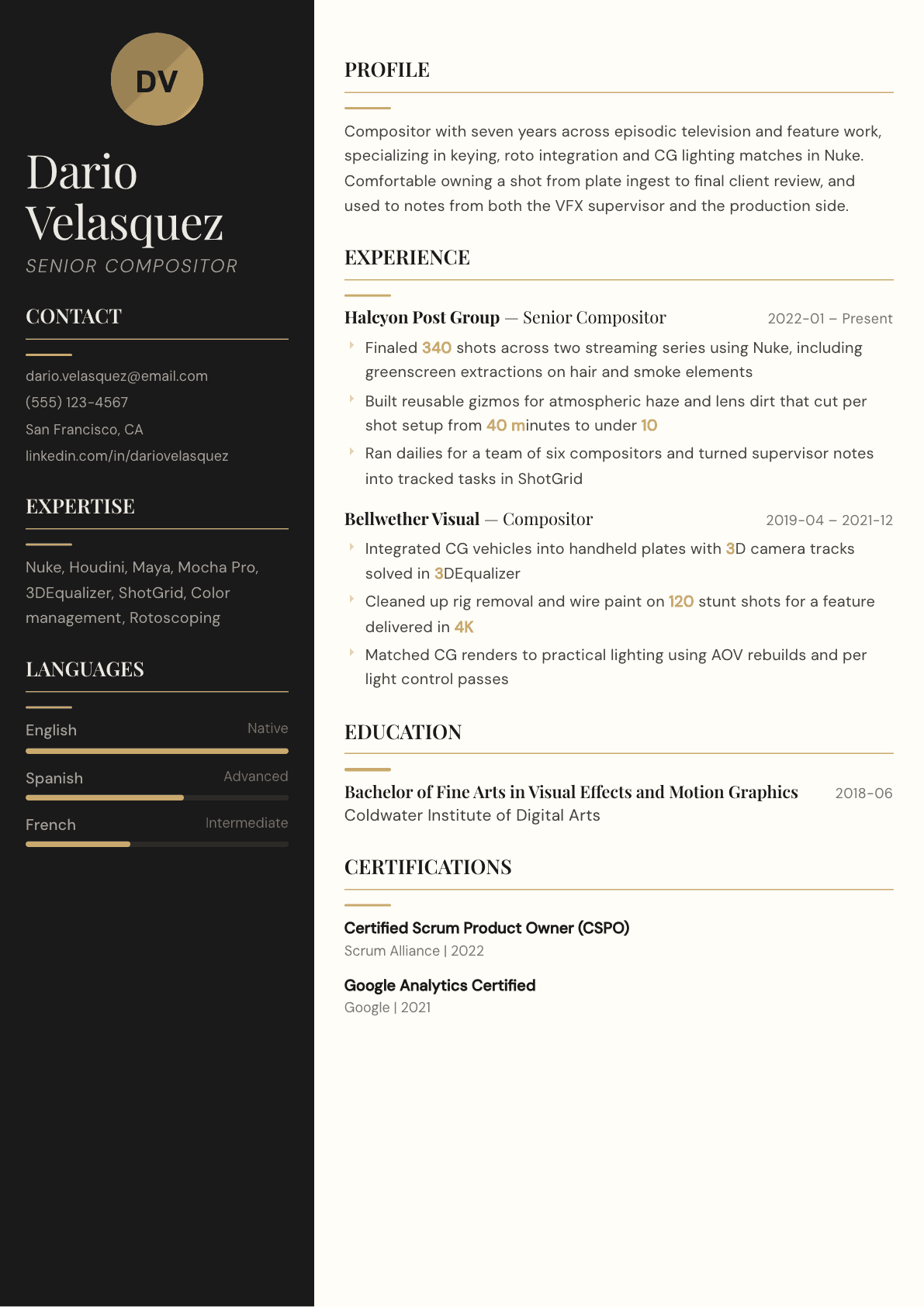
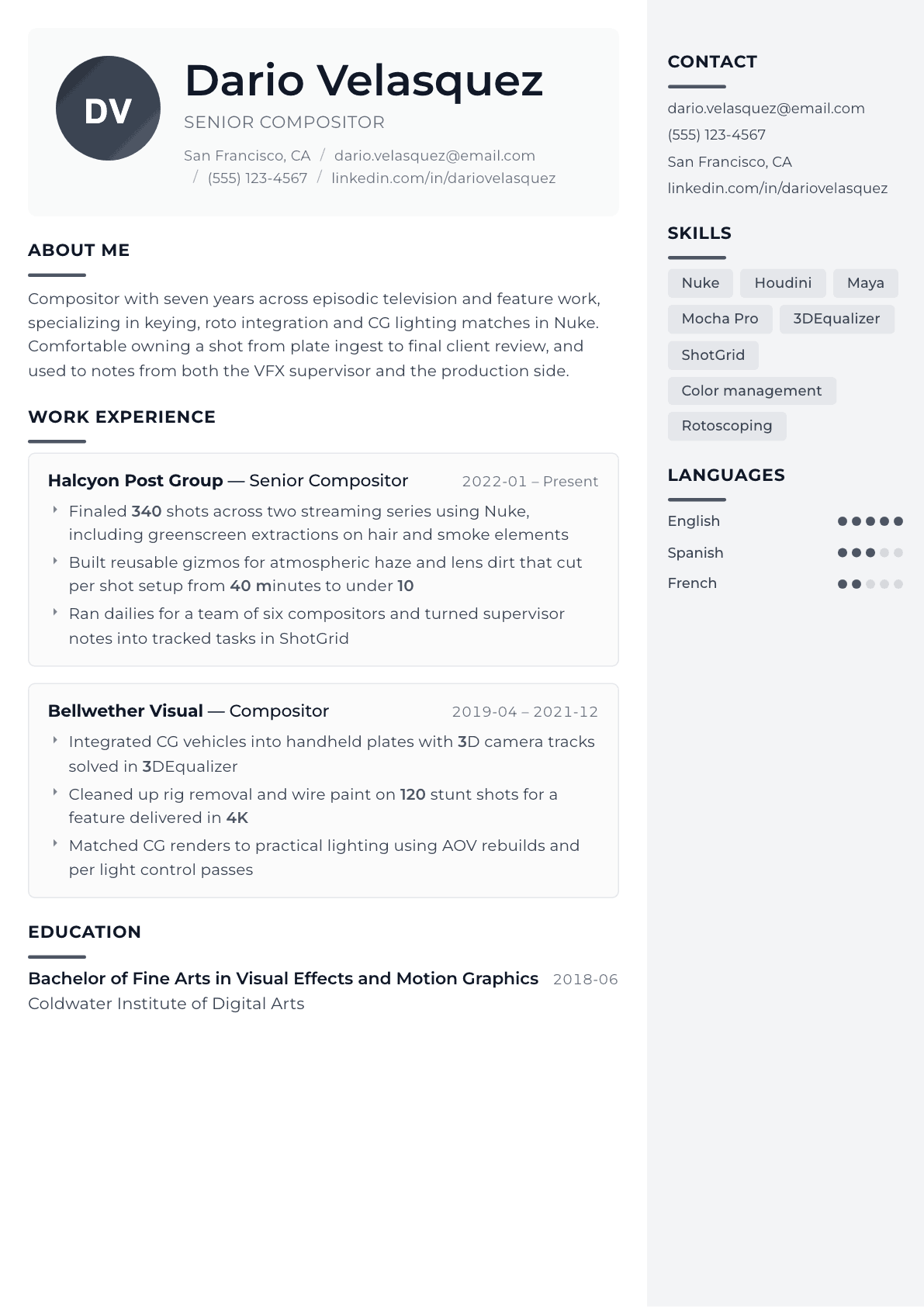
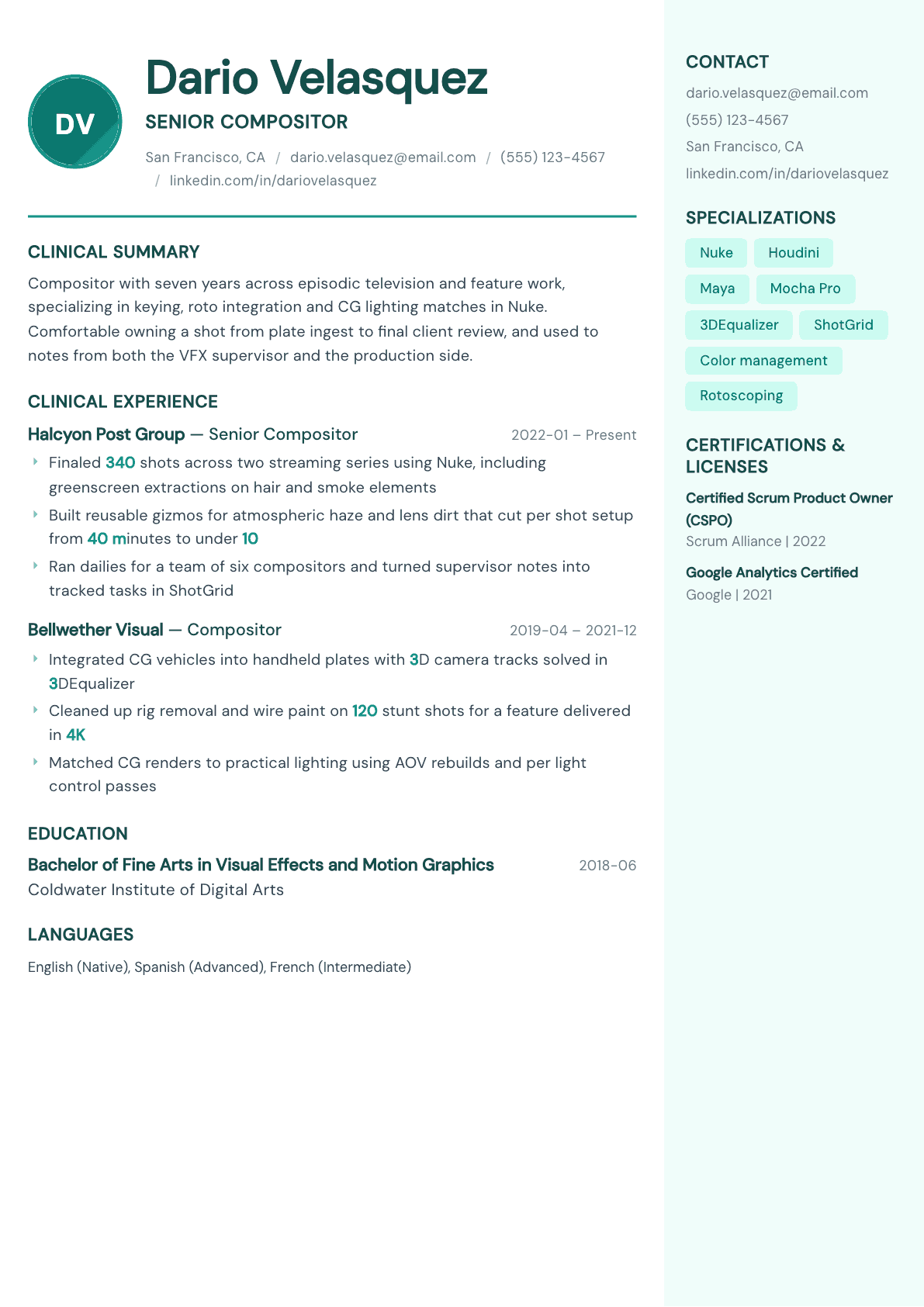
Example VFX Artist summary
Compositor with six years in episodic and feature visual effects, working primarily in Nuke with Houdini and Maya support. Experienced with difficult keys, CG integration, deep compositing and stereo conform. Known on the floor for turning around supervisor notes the same day and for building gizmos the rest of the team keeps using long after the show wraps.
Skills to list on a VFX Artist resume
- Nuke compositing
- Rotoscoping
- Keying and despill
- Match moving
- Camera tracking
- Houdini FX
- Particle simulation
- Maya
- Lighting integration
- AOV rebuilds
- Clean plate work
- Wire and rig removal
- Color management
- ShotGrid
- Deadline render management
What actually gets this resume read
- Put your reel link in the header next to your email, because a supervisor clicks the reel before reading a single bullet.
- Name the software and the version pipeline you worked in: Nuke, Houdini, Maya, Katana, Mocha Pro, 3DEqualizer.
- Say what you finaled, not what the studio delivered: shot counts and sequence names show your own contribution.
- List the production type for each job, whether episodic, feature, commercial or game cinematic, since turnaround culture differs.
- Separate compositing, FX simulation, tracking and lookdev in your skills block so a lead can see your actual specialty.
- Mention pipeline tools such as ShotGrid, Ftrack or Deadline, because larger facilities screen for people who already know the tracking layer.
How to write a vfx artist resume
A VFX artist gets hired on the reel. The resume decides whether the reel gets opened, and then it answers the second question a supervisor always has: which of those shots did you actually do, and in which software. Almost every rejection at the paper stage comes from a resume that shows beautiful frames and never separates the applicant's work from the facility's work.
Facilities also staff by discipline. Compositing, FX simulation, matchmove, roto and prep, lookdev and lighting are separate chairs with separate leads and separate bid lines. A resume that says visual effects generalist without naming a chair makes the coordinator guess, and coordinators do not guess when three hundred people applied for the same show.
This guide covers the reel and breakdown pairing, the section order supervisors read, how to write shot work so it reads as yours, and the questions artists ask when they are moving between episodic, feature and commercial work.
Format: reel link first, one page, discipline named
Put the reel URL and password on the same line as your email. Under it, add the breakdown link. A supervisor watches the reel with the breakdown open in a second tab, and if the breakdown is missing the whole reel is treated as unverified.
Keep the resume to one page until you have credits across more than three shows. After that a second page for the full credit list is normal, but the first page still has to carry the discipline, the software and the last three productions.
- Header: name, city and time zone, email, reel link with password, breakdown link, visa or work authorization status.
- Sections in this order: software, credits or experience, education, additional skills.
- Name the chair under your title: Compositor, FX Artist, Matchmove Artist, Roto and Prep Artist, Lighting and Lookdev Artist.
Software section: put it above experience, not below
Coordinators filter on software before anything else. List Nuke, Houdini, Maya, Katana, Mari, Mocha Pro, 3DEqualizer, Substance and whatever renderer you used, and mark the ones you are fast in rather than the ones you have opened once. Padding this list is the fastest way to fail a technical test.
Add the pipeline layer as well. ShotGrid, Ftrack, Deadline, RV and Perforce are the tools a facility needs you to already know so that your first week is spent on shots and not on how to publish a version.
Experience: shots, sequences and what you owned
Every credit needs the facility, your title, the production type and the dates. Then bullets that name the work: the kind of key, the kind of integration, the kind of simulation. A supervisor reads for difficulty, so a bullet about extracting hair and smoke against a bright sky says more than a bullet about the number of shots.
Give shot counts you finaled rather than shot counts the show delivered. If you took a sequence from plate ingest to client approval, say that, because owning a sequence end to end is a different job from taking assigned tasks.
One bullet per credit should be about tooling or leadership if you have it: a gizmo the team adopted, a HDA you wrote, dailies you ran, junior artists you reviewed. That bullet is what turns a mid artist into a lead candidate.
Skills: name the technique, not the category
Rotoscoping, despill, edge treatment, deep compositing, camera solve, lens distortion, AOV rebuilds, light rig matching and clean plate reconstruction are the vocabulary. Writing compositing on its own tells a lead nothing about whether you can rescue a bad key on a locked delivery date.
If you work in FX, name the solvers: pyro, flip, vellum, rigid bodies, crowd. If you work in matchmove, name object track versus camera solve and whether you handle lidar and survey data.
Keywords facility recruiters search
Screening usually happens inside an applicant tracking system with a keyword list pulled from the bid. Nuke, Houdini, Maya, roto, prep, matchmove, keying, despill, integration, lookdev, ShotGrid and the delivery resolution all appear. Use the exact words once in your software block and once inside a bullet where they are attached to real work.
Include the production types too. Episodic, feature, commercial, virtual production and game cinematic each carry different turnaround assumptions, and a recruiter staffing a fast commercial slate is looking for someone who has survived that pace before.
VFX Artist resume summary examples
First facility job
Junior compositor with a school reel of 9 finished shots and a six month internship on an episodic show, where I finaled 40 roto and prep tasks in Nuke. Comfortable with Mocha Pro tracking, clean plate work and ShotGrid publishing. Looking for a roto and prep seat with a path into compositing.
Four shows in
Compositor with five years across episodic and commercial work, finaling 300 plus shots in Nuke. Strong on difficult keys, CG integration through AOV rebuilds and 3D camera projection cleanup. Built gizmos the team adopted for haze and lens dirt, and regularly hand off notes for junior artists in dailies.
Lead or supervisor track
Compositing lead with nine years in feature and episodic visual effects, running teams of up to eight artists across two facilities. Own sequence level look, script templates and client review turnover. Deep Nuke experience with deep compositing, stereo conform and color managed pipelines under ACES.
Work experience bullets: before and after
Before: Worked on visual effects shots for a TV show.
After: Finaled 96 shots across two seasons of an episodic drama, covering greenscreen extraction, set extension integration and atmospheric grade matching in Nuke.
The count, the show type and the three techniques tell a supervisor exactly which chair you sat in.
Before: Did rotoscoping and cleanup.
After: Rotoscoped motion blurred hair and fabric on handheld plates and reconstructed clean plates for rig removal on 120 stunt shots.
The hard cases, motion blur and handheld plates, are the part a lead is actually testing for.
Before: Used Houdini for effects.
After: Built pyro and debris simulations in Houdini for a building collapse sequence, caching to disk and delivering AOVs for the compositing team to rebuild.
Naming solvers and the downstream handoff shows you understand the shot beyond your own node graph.
Before: Helped improve the team workflow.
After: Wrote a Nuke gizmo for lens dirt and edge softening that the compositing team standardized on, cutting per shot setup from about 40 minutes to under 10.
A tool other artists adopted is evidence of judgment, and the time figure makes the value concrete.
Before: Communicated with the supervisor about notes.
After: Ran daily review sessions for six compositors, converted supervisor notes into tracked ShotGrid tasks and kept a shot status board the producer used for turnover.
It reframes communication as a production function with a named tool and a named audience.
Hard skills
- Nuke compositing
- Rotoscoping and prep
- Keying and despill
- Clean plate reconstruction
- Camera and object tracking
- Houdini FX simulation
- CG integration and AOV rebuilds
- Lens distortion and undistort workflows
- Deep compositing
- Color managed pipelines
- ShotGrid and Ftrack
- Deadline render management
Soft skills
- Note taking in dailies
- Working to a locked delivery date
- Giving junior artists direction
- Cross department handoff
- Calm under client review
- Self review before turnover
Mistakes that cost vfx artist candidates the interview
- Sending a reel with no breakdown, which leaves a supervisor unable to tell your work from the facility's work.
- Listing every package you have ever opened in the software block, then failing the technical test on the one you claimed first.
- Writing generalist as your title when the facility is staffing a specific chair with a specific bid line.
- Quoting show wide shot counts instead of the shots you personally finaled.
- Leaving out pipeline tools like ShotGrid or Deadline, which are the difference between a slow first week and a productive one.
- Using a heavy designed layout with columns and icons for a resume that a coordinator will paste into a tracking system.
VFX Artist resume questions
Does a VFX artist resume matter if the reel is strong?
Yes, because the reel proves the frames and the resume proves ownership. A coordinator uses the resume to confirm the discipline, the software, the facility names and the dates before anyone senior spends three minutes watching your work.
How do I list shots I only partly worked on?
Say what you contributed on those shots and keep the count separate from shots you finaled. Roto, prep, matchmove or an element pass are all legitimate credits when they are labeled honestly, and supervisors respect the precision.
Should I include unreleased or unannounced projects?
Only if your non disclosure agreement allows it. When it does not, list the facility, the production type and the discipline without the title, and note that details are available under a signed agreement during the interview.
Do I need a degree to get a visual effects job?
No. Facilities hire on the reel and the software. A degree helps with visa applications in some countries and with structured training early on, but a strong breakdown from personal or freelance work opens the same doors.
How should I present freelance and remote VFX work?
Group it under one heading with your own name as the employer and list clients as sub entries with the production type and discipline. Add your time zone and remote review setup, since facilities staffing across regions screen for that directly.