Wellness Coach Resume Examples: the lines they read
Build a Wellness Coach Resume That Shows Client Change
By Mustafa Tarabya, founder of CVBooster · Published · Updated
Wellness coach resume example with coaching keywords and a guide to writing caseloads, program outcomes, scope of practice and referrals.
Sample resumes for a wellness coach
The same wellness coach content laid out in three CVBooster templates, so you can see what the finished document looks like before you write a word.
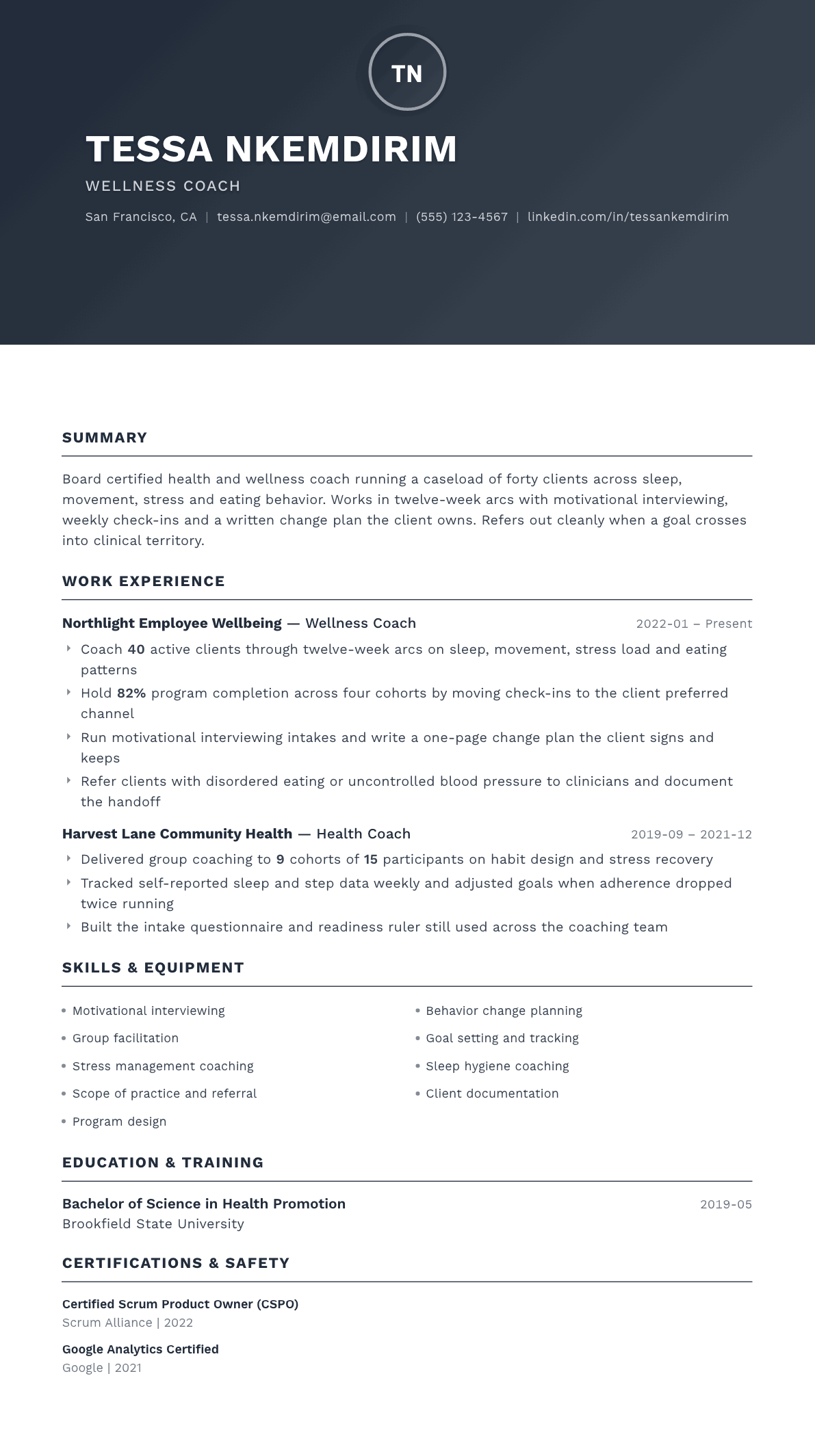
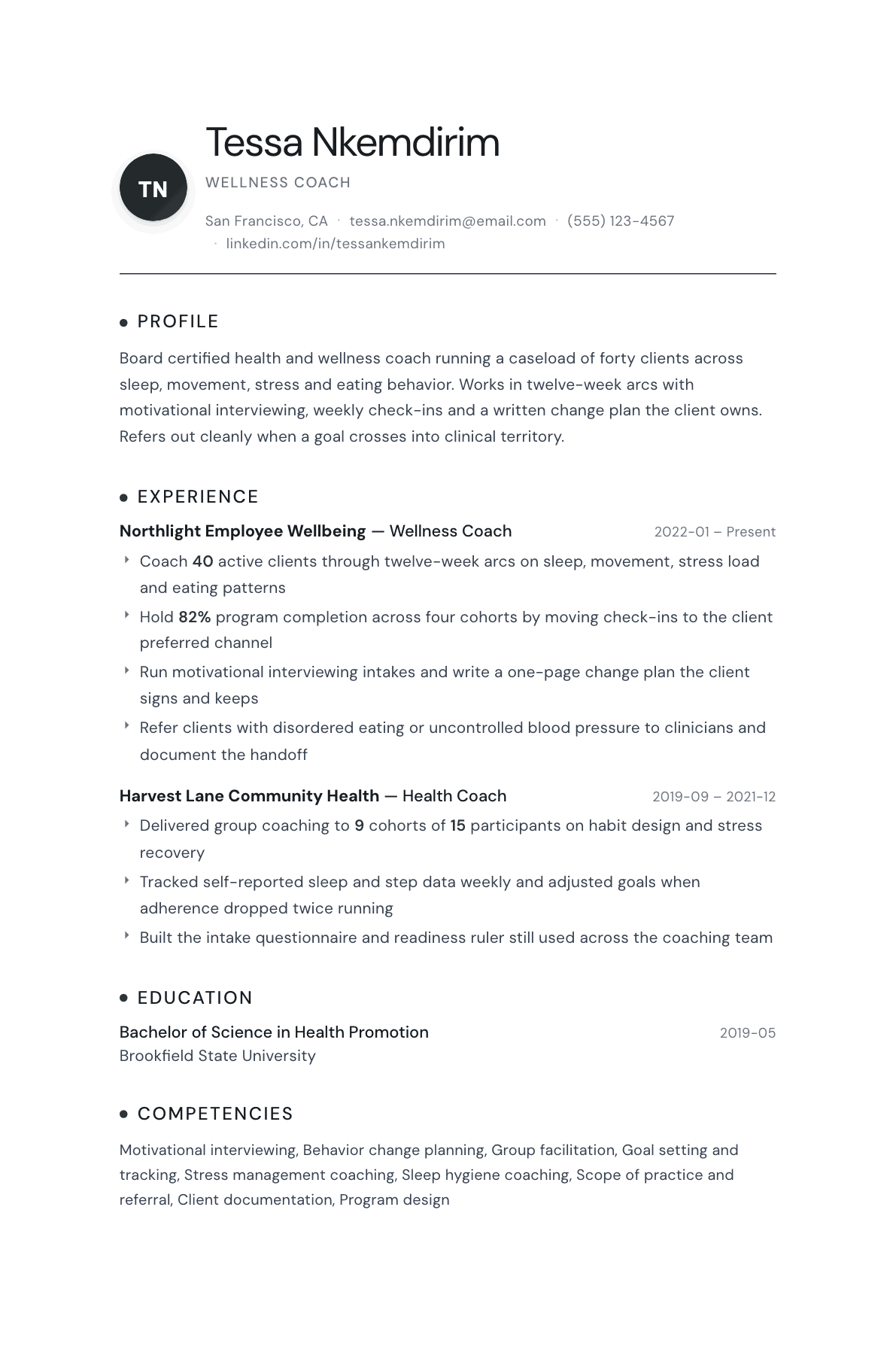
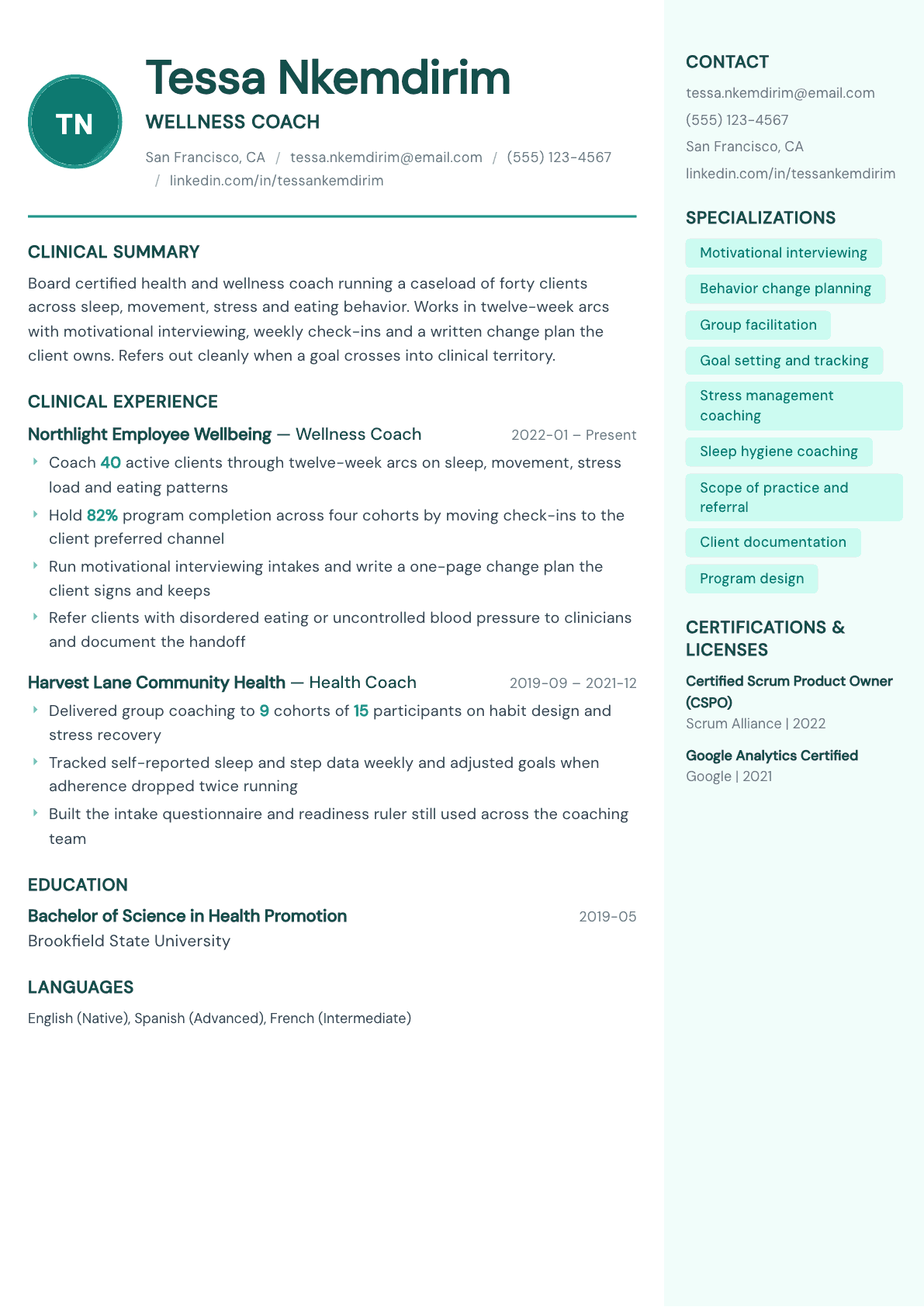
Example Wellness Coach summary
Board certified health and wellness coach carrying a forty client caseload across sleep, movement, stress and eating behavior. Works in twelve-week arcs built on motivational interviewing, a signed change plan and weekly check-ins on the channel the client actually answers. Holds strong program completion across employer cohorts and refers out cleanly when a goal turns clinical. Seeking a coaching lead role inside an employer wellbeing team.
Skills to list on a Wellness Coach resume
- Motivational interviewing
- Behavior change coaching
- Habit and routine design
- Goal setting frameworks
- Readiness assessment
- Group facilitation
- Sleep hygiene coaching
- Stress and recovery coaching
- Movement programming basics
- Nutrition guidance within scope
- Referral and handoff protocol
- Client note documentation
- Employer wellbeing programs
- Outcome tracking
What actually gets this resume read
- Name your coaching method by name: motivational interviewing, habit design, or the model you were trained in.
- Give the caseload and the arc length so a hiring manager knows what a full week looks like for you.
- Report completion and adherence, not weight numbers, because coaching outcomes are measured on follow-through.
- Show where your scope ends and who you refer to, which is what a clinical employer screens hardest for.
- Say whether you coach one to one, in groups, on the phone or in an employer program, and in what mix.
- List your board certification with the full issuing body and keep training hours attached to the school.
How to write a wellness coach resume
Wellness coaching attracts a lot of resumes that say the same warm, unfalsifiable things. Passionate about helping people live their best lives. Empowering clients on their journey. A hiring manager at an employer wellbeing team or a health system has read hundreds of those, and she cannot tell any of them apart, so she reads for the three specifics instead: your method, your caseload, and where your scope ends.
Method means the coaching model you were trained in and can name. Caseload means how many active clients you hold, over what arc, on what contact rhythm. Scope means what you do when a client tells you something that belongs to a clinician. A resume that answers all three reads as professional practice rather than enthusiasm.
This guide takes each section in the order a wellness employer reads it, with summaries for a newly certified coach, a coach with a full book and a program lead, five rewritten bullets, and the questions coaches ask when they move from group work into one to one, or from private clients into an employer contract.
Format: one page, certification and model above the fold
One page, reverse chronological. Coaching is a credential-checked field now, so board certification and the training program that qualified you belong in the top third with the awarding body spelled out in full. Abbreviations alone get skipped by readers who are screening for a specific credential.
Give coaching hours their own line if you are early. Board pathways count them, and an employer who has hired coaches before knows what a documented hour count means. Vague phrases like extensive coaching experience invite exactly the doubt you were trying to avoid.
- Credential block: board certification with the full name of the awarding body, the training program, and documented coaching hours.
- Method line: the coaching model you work in, the intake structure, and the written plan the client leaves with.
- Delivery mix per job: one to one, group cohorts, phone, video or on-site, and the share of each.
- Population line: the clients you have actually coached, whether that is employees, chronic condition groups, athletes or older adults.
Summary: model, caseload, arc, referral discipline
Three lines that name the model, the number of active clients, the program length and the fact that you refer out cleanly. That last one earns more trust than any claim about client outcomes, because every clinical employer has seen a coach drift into advice they were not qualified to give.
If you specialize, say so early. Sleep, stress load, movement adoption, tobacco cessation and eating behavior are coached very differently, and a health system hiring for one of them will not read to the bottom to discover you have it.
Experience: the arc, the contact, the follow-through
Structure each role around the program you delivered rather than the values you held. A reader wants the arc length, the session cadence, the channel clients actually answered on, and what the client walked away holding. A twelve-week arc with weekly check-ins and a one-page written plan is a real product, and it can be compared to the reader own program.
Then report follow-through instead of results you cannot own. Completion rates, session attendance, and the proportion of clients still active at the end of a cohort are honest coaching outcomes. Weight numbers and biometric changes usually belong to a clinician, a medication change or a season, and experienced readers discount them on sight.
Add one bullet on the systems side: the intake questionnaire you built, the note template the team adopted, the readiness measure you introduced, or the way you moved check-ins to the channel that stopped clients disappearing after week four.
Scope, referral and documentation
Give this its own short section if you have worked anywhere near clinical care. Say what triggers a referral, who you refer to and how the handoff is recorded. Disordered eating, uncontrolled blood pressure, chest symptoms during exertion and worsening mood are the common ones, and naming them shows you have been trained rather than merely careful.
Documentation matters more than coaches expect. If your notes live in a health record or a case management system, name it. A coach whose notes are legible to a nurse or a care manager is far easier to place inside a health system than one whose practice exists entirely in memory.
Keywords wellness employers filter on
Employer and health system postings reuse a compact vocabulary: motivational interviewing, behavior change, health coaching, goal setting, self-management support, population health, biometric screening events, incentive design, group facilitation, engagement and participation. Mirror the true ones once in your skills block and again where you show them working.
Name the delivery platforms too, from the video tool you coach on to the wellbeing platform that holds the cohort. A team switching platforms costs weeks, and a coach who already knows theirs gets shortlisted for reasons nobody writes down.
Wellness Coach resume summary examples
Newly certified
Newly certified health and wellness coach with 60 documented coaching hours across sleep, movement and stress goals, trained in motivational interviewing and readiness assessment. Built the intake questionnaire used by a community health team. Seeking a first salaried caseload inside an employer wellbeing program.
Full caseload
Wellness coach carrying 40 active clients through twelve-week arcs on sleep, movement, stress load and eating patterns. Holds 82% program completion across four cohorts, writes a signed one-page change plan at intake, and refers clinical concerns out with a documented handoff.
Program lead
Coaching lead for an employer wellbeing team, supervising four coaches and owning the program curriculum, intake tooling and referral protocol. Board certified, trained in motivational interviewing, and responsible for cohort design across on-site and remote delivery for a multi-site workforce.
Work experience bullets: before and after
Before: Coached clients on health and wellness goals.
After: Coached 40 active clients through twelve-week arcs on sleep, movement, stress load and eating patterns, opening each with a motivational interviewing intake and a signed one-page change plan.
Caseload, arc, method and artifact together describe a program rather than a good intention.
Before: Improved client engagement in the program.
After: Raised program completion to 82% across four cohorts by moving weekly check-ins to the channel each client already answered, whether that was text, phone or a five-minute video call.
A completion figure with the change that produced it is an outcome you can honestly own.
Before: Ran group sessions for participants.
After: Facilitated nine cohorts of 15 participants through a six-week habit design series, with a written commitment at the end of each session and a peer check-in between weeks.
Cohort count, group size and structure let a reader picture the room and the workload.
Before: Knew when to send clients to a doctor.
After: Referred clients presenting disordered eating patterns or uncontrolled blood pressure to clinical colleagues, documented the handoff in the shared record, and closed the coaching goal until cleared.
Named triggers and a documented handoff prove trained scope discipline rather than instinct.
Before: Created materials for the coaching team.
After: Built the intake questionnaire and readiness ruler now used across the coaching team, cutting first-session time spent on history gathering by roughly a third.
Naming the artifact and its adoption shows influence past your own caseload.
Hard skills
- Motivational interviewing
- Behavior change coaching
- Habit and routine design
- Readiness and confidence assessment
- Goal setting frameworks
- Group facilitation
- Sleep hygiene coaching
- Stress and recovery coaching
- Nutrition guidance within scope
- Referral and handoff protocol
- Coaching note documentation
- Cohort and program design
- Engagement and completion tracking
Soft skills
- Listening without prescribing
- Holding a client accountable kindly
- Managing ambivalence
- Cultural humility across client backgrounds
- Staying inside scope under pressure
Certifications worth listing
- National Board Certified Health and Wellness Coach (NBC-HWC) (National Board for Health and Wellness Coaching)
- ACE Health Coach Certification (American Council on Exercise)
- Certified Wellness Practitioner (CWP) (National Wellness Institute)
- Certified Personal Trainer (CPT) (National Academy of Sports Medicine)
Mistakes that cost wellness coach candidates the interview
- Filling the page with mission language when the reader is screening for a model, a caseload and a referral rule.
- Claiming biometric or weight outcomes that depend on clinicians, medication and season rather than on coaching.
- Abbreviating the board credential without spelling out the awarding body, so a screener filtering on it misses you.
- Leaving coaching hours undocumented, which reads as avoidance to anyone familiar with board pathways.
- Describing sessions without the arc length or contact rhythm, so no reader can compare your program to theirs.
- Saying nothing about where your scope ends, the single fastest way to lose a clinical employer.
Wellness Coach resume questions
Do I need board certification to work as a wellness coach?
It is not universally required, but health systems and larger employers increasingly filter on it, and some contracts require it outright. If you are on the pathway, list the training program, the awarding body and your documented coaching hours while you complete it.
What outcomes can I honestly claim on a wellness coach resume?
Completion rates, session attendance, cohort retention, and client-reported changes in the behaviors you coached. Leave clinical markers to clinicians. Experienced readers trust a coach more for reporting follow-through than for claiming numbers coaching alone cannot move.
How do I show scope of practice on the page?
Name the situations that trigger a referral, name who you refer to, and say how the handoff is recorded. Two sentences do it. That paragraph reassures a clinical employer faster than any amount of description of your coaching philosophy.
I coach privately. How do I make that look substantial?
Report it like a practice: active clients, arc length, session cadence, retention and the niche you serve. Add the intake and note systems you use. Private practice reads thin only when it is described without the operating numbers a salaried role would carry.
What is the difference between a wellness coach and a health coach on a resume?
The titles overlap heavily and many employers use them interchangeably, so mirror the title in the posting. Where they differ, health coaching leans toward chronic condition self-management inside care teams, while wellness coaching leans toward workplace programs and general behavior goals.
Related resume examples
- Sports Nutritionist Resume example
- Naturopath Resume example
- Massage Therapist Resume example
- Beauty Educator Resume example
- Sports Massage Therapist Resume example
- Nail Technician Resume example