Sports Nutritionist Resume Examples: what gets the call
Build a Sports Nutritionist Resume That Fuels Your Career
By Mustafa Tarabya, founder of CVBooster · Published · Updated
Create a professional sports nutritionist resume that highlights your meal planning expertise, athlete outcomes, and nutrition certifications.
Sample resumes for a sports nutritionist
The same sports nutritionist content laid out in three CVBooster templates, so you can see what the finished document looks like before you write a word.
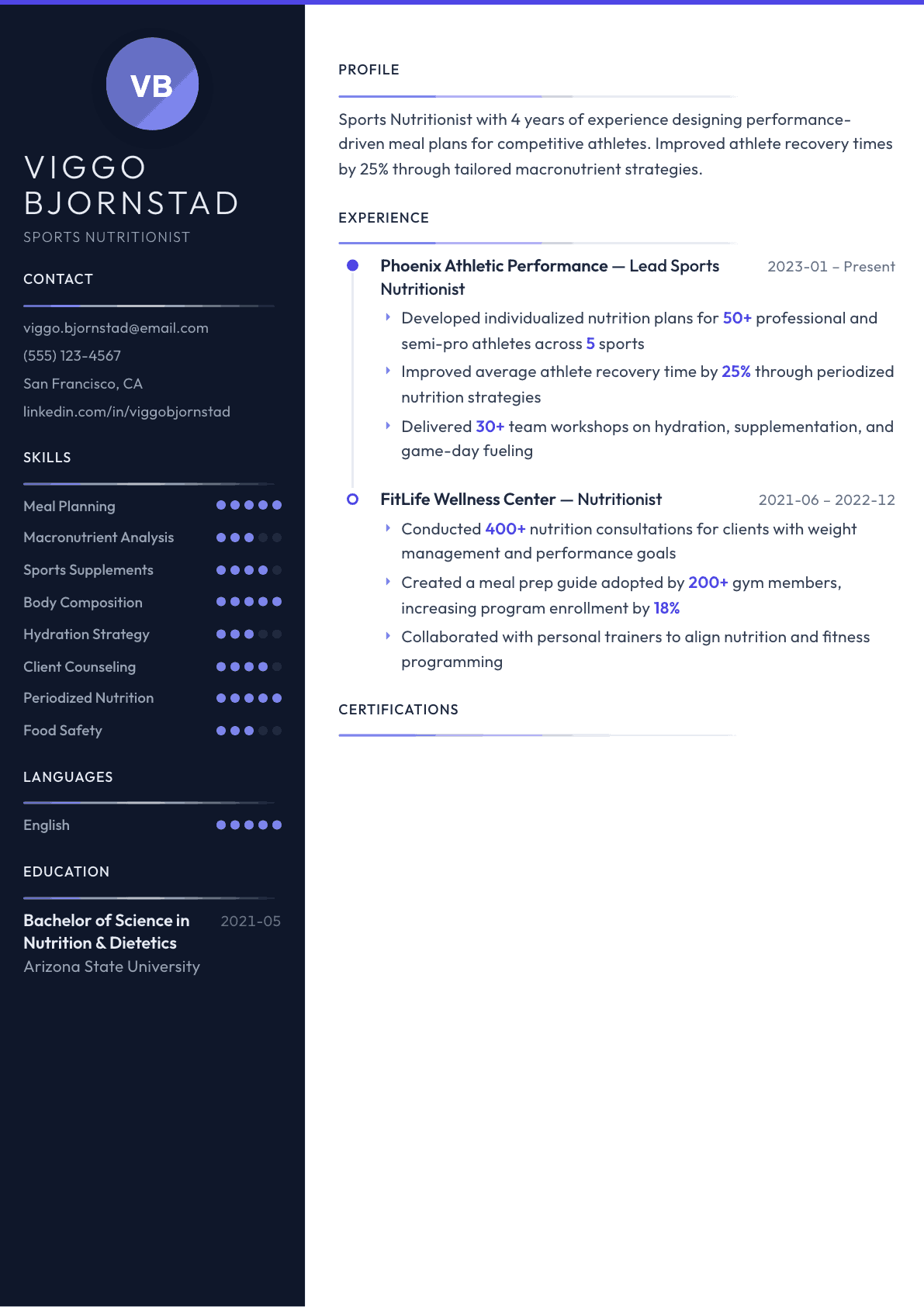
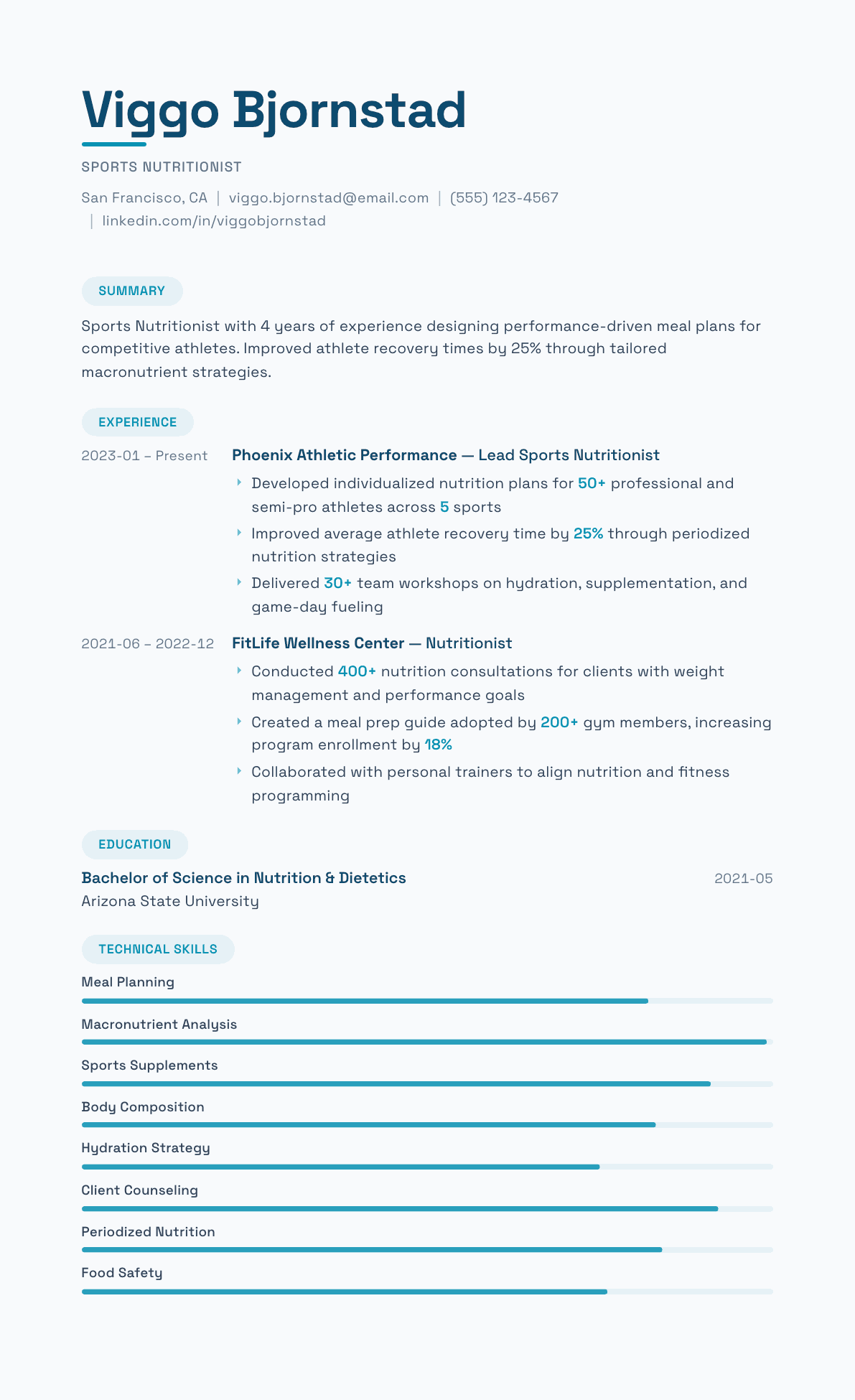
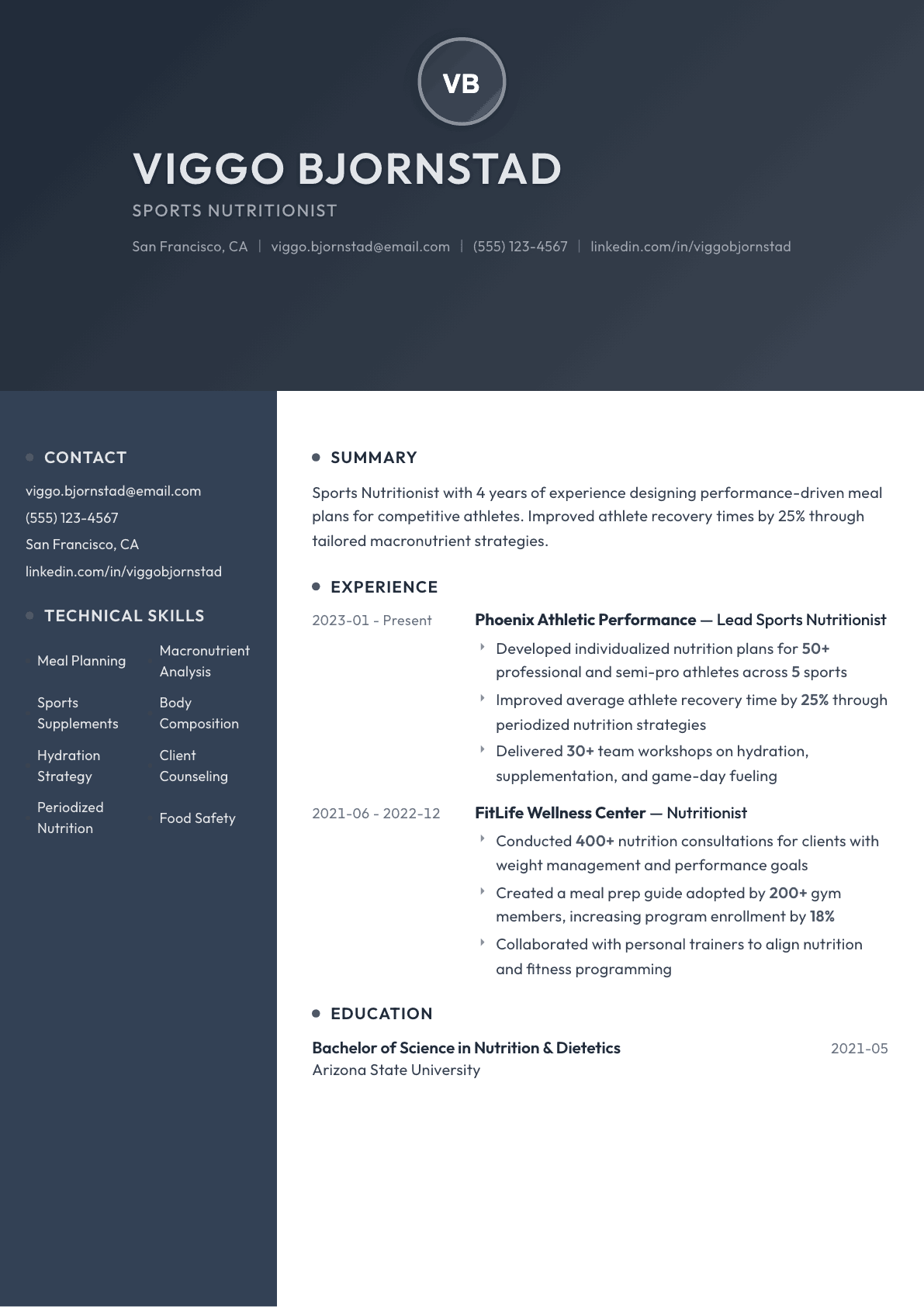
Example Sports Nutritionist summary
CISSN-certified Sports Nutritionist with 4 years of experience creating performance nutrition plans for competitive athletes. Delivered measurable recovery and body composition improvements across 50+ clients.
Skills to list on a Sports Nutritionist resume
- Sports Nutrition Planning
- Macronutrient Periodization
- Supplement Guidance
- Body Composition Analysis
- Hydration Protocols
- Meal Prep Programming
- Client Education
- Food Allergy Management
- Performance Optimization
- Dietary Assessment
What actually gets this resume read
- Feature your CISSN, CSSD, or RD credentials at the top since they validate your expertise.
- Quantify athlete performance improvements tied to your nutrition interventions.
- Highlight experience with specific sports or dietary needs like vegan or ketogenic protocols.
- Include workshop or seminar delivery experience to show your communication skills.
How to write a sports nutritionist resume
Sports nutrition hiring splits on one line: are you credentialed to provide medical nutrition therapy, or are you credentialed to coach performance fueling. A collegiate athletics department, a professional club or a hospital-affiliated performance center will screen for a registered dietitian credential and often the sports dietetics specialty on top of it. A private gym, an online coaching practice or a supplement brand will accept a sports nutrition certification. Writing one resume for both worlds is the fastest way to be rejected by each.
Beyond the credential, the person hiring reads for population and delivery model. Fueling a rowing squad through a two-a-day training block, running body composition testing for a football roster, planning travel meals for a road trip, and counseling a general population client on weight management are separate skills with separate evidence. The resume needs to say which athletes, in which sport, at which phase of the season, and what the intervention changed.
This guide covers section order for team, clinical and private practice roles, how to write the credential block, how to quantify a nutrition intervention without overclaiming, three summaries from a new graduate to a director of performance nutrition, before-and-after bullets, and the questions practitioners ask when they rewrite.
Format: credentials in the header, scope obvious in the first line
Put the credential string after your name the way the field writes it, for example "Dana Reyes, MS, RDN, CSSD" or "Dana Reyes, MS, CISSN". A screener at a college or a clinic is checking eligibility in the header, and a resume that makes them find the credential in the education section reads as evasive about which one you hold.
Keep one page until you have supervised staff or built a department. Reverse-chronological throughout. If you hold state licensure to provide nutrition care, name the state and status in its own line, because the requirement varies and a hiring manager cannot assume.
- Header: name with credentials, city and state, phone, email, state license status where applicable.
- Sections in this order: summary, credentials and licensure, performance nutrition experience, education and supervised practice, skills.
- Applicants to collegiate roles add a line on the sports covered and the number of athletes served.
- Private practitioners add the delivery model: in person, telehealth, or team retainer.
Summary: credential, sports, athlete count, one intervention you own
Three lines. Name the credential, the years, the sports and level, roughly how many athletes you have carried, and the intervention you are strongest at, whether that is body composition change, energy availability, travel and competition fueling, hydration and sweat testing, or return-to-play nutrition after injury.
Athletes are not interchangeable. A nutritionist who has fueled endurance athletes through carbohydrate periodization is a different hire from one who has driven mass gain in linemen or made weight-class management safe for wrestlers. Say which, and the reader stops guessing.
Experience: the roster, the setting, the intervention, the outcome
Head each entry with the organization, your role, the sports covered and the athlete count. "Performance dietitian, 240 athletes across nine varsity sports, with primary coverage of rowing, wrestling and track" tells a director exactly what caseload you have carried and which teams trusted you.
Then write bullets that follow an actual nutrition workflow: assessment, plan, delivery, review. Assessment covers intake screening, energy availability screens, dietary recalls, body composition testing method and blood work reviewed with a physician. Plan covers periodized fueling around training loads, pre-competition and recovery protocols, and hydration strategy from sweat testing. Delivery covers the fueling station, the training table, travel meal ordering, and grocery and cooking education. Review covers reassessment intervals and how you reported to coaches and the sports medicine staff.
Quantify what you can defend. Athlete counts, consultations delivered, workshops run, meals planned, testing sessions completed and retention of athletes in a program are all countable. Performance improvements are shared with the strength staff and the coaches, so claim them as contributions rather than as your result alone. A director notices the difference immediately.
- Caseload: athlete count, sports, competitive level, one-on-one versus team coverage.
- Testing: body composition method used, hydration and sweat testing, energy availability screening, resting metabolic rate testing.
- Operations: fueling station stocking, training table menu input with dining services, travel and competition meal planning, budget.
- Collaboration: how you worked with strength coaches, athletic trainers, team physicians and dining services.
Credentials, licensure and supplement safety
List each credential with its issuing body and status. The registered dietitian credential and the sports dietetics specialty are awarded by the Commission on Dietetic Registration, while sports nutrition certifications come from other bodies entirely, and a hiring manager in athletics knows the difference even when applicants blur it.
Add supplement literacy explicitly. Collegiate and professional employers care that you understand third-party testing programs such as NSF Certified for Sport and Informed Sport, and that you know which substances are prohibited under the governing body your athletes compete under. One line on banned substance education is worth more than a paragraph on macronutrients.
Food safety credentials belong here too if you have any hand in a fueling station, training table or camp kitchen, because the moment food is served the employer inherits liability.
Skills and the vocabulary a posting uses
Match the posting. Collegiate and professional listings use energy availability, relative energy deficiency, body composition, fueling station, training table, travel nutrition, sweat testing, supplement review and interdisciplinary collaboration. Private practice listings use consultation, meal planning, behavior change, adherence, telehealth and client retention. Brand and product roles use claims review, education content, and regulatory compliance.
Name the tools: the body composition device you are trained on, the dietary analysis software you use, the athlete management system a team runs on, and any telehealth platform. Employers weigh training time, and a candidate already fluent in their systems starts earning sooner.
Sports Nutritionist resume summary examples
New graduate
Registered dietitian nutritionist with 1,200 supervised practice hours including a rotation with a Division I athletics department covering track and swimming. Trained in dietary recall analysis, skinfold body composition testing and group fueling education. Seeking an assistant performance nutrition role in collegiate athletics.
Four years in
Sports nutritionist with four years serving 50 competitive and semi-professional athletes across five sports, running periodized fueling plans, sweat testing and post-training recovery protocols. Delivered 30 team workshops on hydration and supplement safety, and cut athlete no-show rates at consultations by 40%.
Director of performance nutrition
Director of performance nutrition with ten years in collegiate athletics, leading two dietitians and four interns across 480 athletes and eighteen sports. Owns the fueling station program, the training table menu with dining services, the supplement review process and the department nutrition budget.
Work experience bullets: before and after
Before: Created meal plans for athletes.
After: Built periodized fueling plans for 50 athletes across five sports, adjusting carbohydrate targets by training day type and rebuilding each plan at the transition into competition phase.
Periodization by training day and a review point show a working system rather than a static document handed over once.
Before: Educated athletes about nutrition.
After: Delivered 30 team workshops on hydration, recovery and third-party tested supplements, then followed each with a locker room fueling guide the athletes could use on travel days.
Naming the topics and the follow-up material shows education that changed behavior instead of a slide deck presented once.
Before: Helped athletes improve body composition.
After: Ran skinfold testing on a six-week cycle for 34 athletes and worked with the strength staff on paired nutrition and training adjustments, with 26 athletes reaching their agreed target range.
The testing interval, the shared credit with strength staff and a countable outcome make the claim defensible.
Before: Worked with the coaching and medical staff.
After: Screened athletes for low energy availability at preseason physicals and referred flagged cases to the team physician and sports psychologist under a written care pathway.
A named screening point and a referral pathway show clinical judgment and respect for scope, which employers weigh heavily.
Before: Managed the fueling station for the team.
After: Stocked and ran a daily fueling station used by 180 athletes, ordering to a fixed monthly budget and rotating offerings by season phase and training load.
Usage volume, budget discipline and seasonal rotation turn a housekeeping task into evidence of program management.
Hard skills
- Periodized fueling plans
- Energy availability screening
- Body composition testing
- Sweat testing and hydration protocols
- Dietary recall and intake analysis
- Competition and travel meal planning
- Supplement review and banned substance education
- Fueling station and training table operations
- Resting metabolic rate testing
- Weight-class management support
- Group workshop delivery
- Food safety and allergen management
Soft skills
- Motivational interviewing
- Interdisciplinary collaboration
- Athlete confidentiality
- Coach communication
- Behavior change coaching
- Scope of practice judgment
Certifications worth listing
- Registered Dietitian Nutritionist (RDN) (Commission on Dietetic Registration)
- Board Certified Specialist in Sports Dietetics (CSSD) (Commission on Dietetic Registration)
- Certified Sports Nutritionist (CISSN) (International Society of Sports Nutrition)
- Certified Nutrition Specialist (CNS) (Board for Certification of Nutrition Specialists)
- Certified Strength and Conditioning Specialist (CSCS) (National Strength and Conditioning Association)
- ISAK Level 1 Anthropometrist (International Society for the Advancement of Kinanthropometry)
- ServSafe Food Handler (National Restaurant Association)
Mistakes that cost sports nutritionist candidates the interview
- Blurring a sports nutrition certification with a registered dietitian credential, which an athletics employer spots at once and treats as an integrity problem.
- Claiming performance gains as your own when strength coaches and sport coaches share the intervention.
- Leaving out the athlete count and the sports covered, so a director cannot judge the caseload you have handled.
- Recommending supplements on the resume without mentioning third-party testing or prohibited substance rules.
- Writing only about macronutrients while ignoring the operational half of the job: fueling stations, dining services, travel orders and budgets.
- Sending a private practice resume to a collegiate posting, where the vocabulary and the compliance expectations are entirely different.
- Omitting state licensure status when the role includes medical nutrition therapy.
Sports Nutritionist resume questions
Do I need to be a registered dietitian to work as a sports nutritionist?
For collegiate, professional and clinical roles, usually yes, and often with the sports dietetics specialty as well. Private gyms, online coaching and product education roles frequently hire on a sports nutrition certification, so read the posting and lead with whichever credential it names.
How do I show results without overclaiming athlete performance?
Report what you controlled: athletes served, consultations delivered, testing cycles completed, plans built, workshop attendance, adherence and retention. Where performance changed, describe your contribution alongside the strength and coaching staff rather than presenting the outcome as yours alone.
What belongs in the credentials section of a sports nutrition resume?
Every credential with the issuing body and current status, your state license if the role includes medical nutrition therapy, food safety training if you touch a fueling station or kitchen, and any body composition testing certification, since employers check who is qualified to run testing.
How should I write experience from an internship or supervised practice?
Treat each rotation as an entry with the site, the length in hours, the population and what you did unsupervised by the end. A rotation covering a collegiate track squad with dietary recalls, group education and testing support is real experience and should be written like it.
Should I list the sports I have worked with?
Yes, because fueling demands differ sharply between endurance, power, weight-class and team sports. Naming the sports and the competitive level lets a hiring director match you to their roster instead of assuming your experience does not transfer.
Related resume examples
- Fitness Instructor Resume example
- Athletic Trainer Resume example
- Sports Coach Resume example
- Personal Trainer Resume example
- Kinesiologist Resume example
- Fitness Coach Resume example