Naval Architect Resume Examples: the lines they read
Shape a Naval Architect Resume Around Vessels, Class Rules and Delivered Tonnage
By Mustafa Tarabya, founder of CVBooster · Published · Updated
Naval architect resume example listing vessel types, stability and structural work, class society rules, keywords and a full writing guide.
Sample resumes for a naval architect
The same naval architect content laid out in three CVBooster templates, so you can see what the finished document looks like before you write a word.
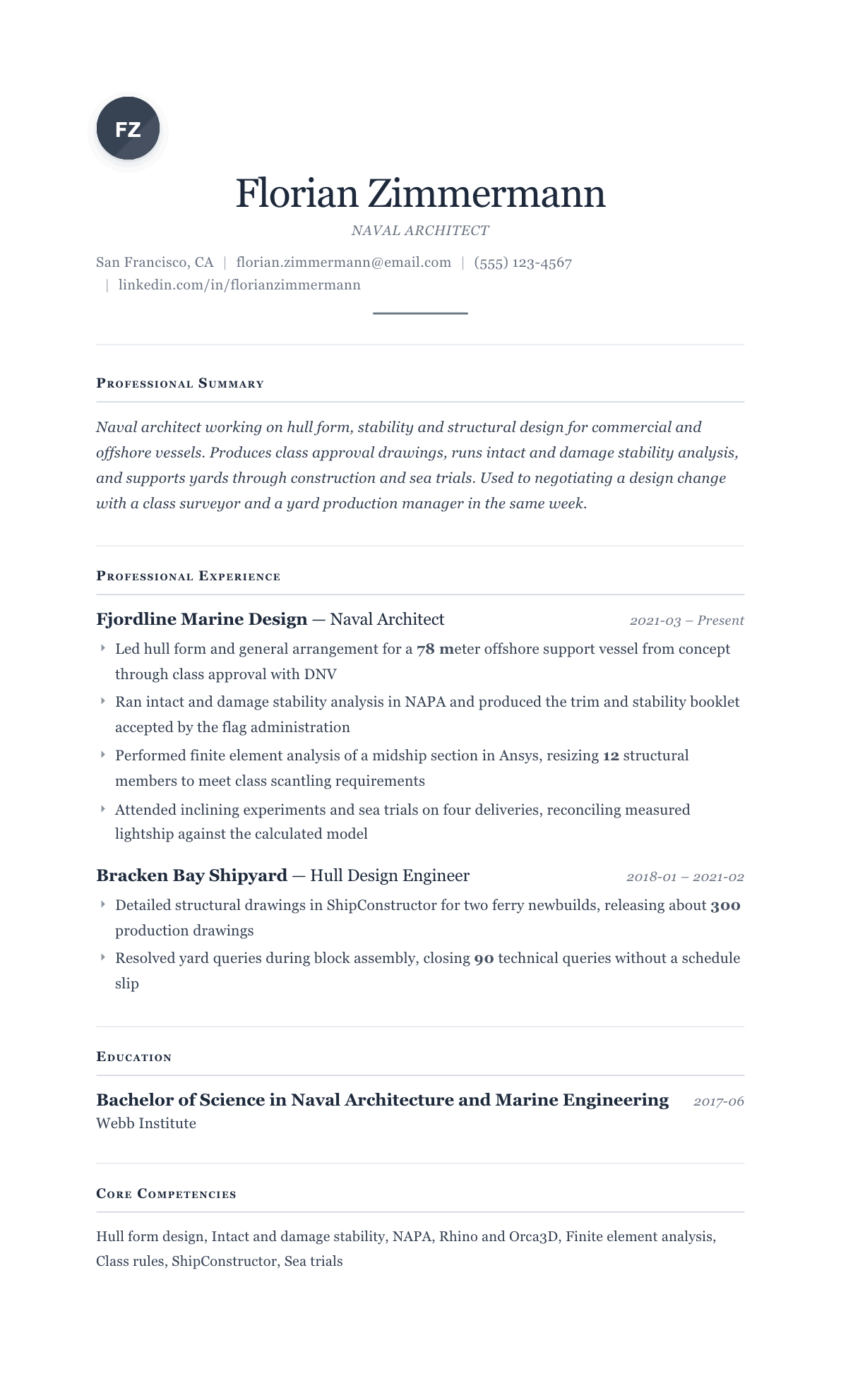
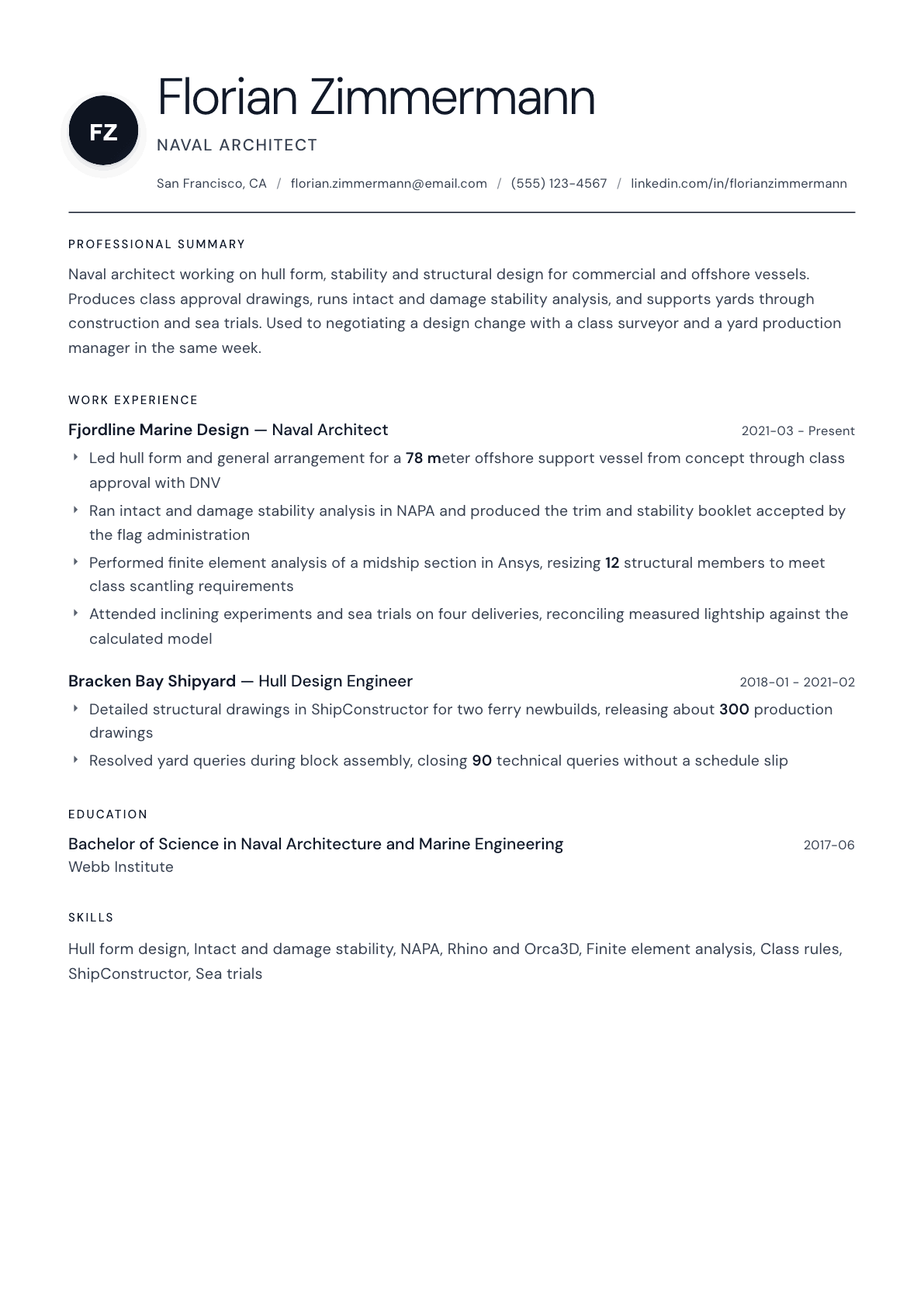
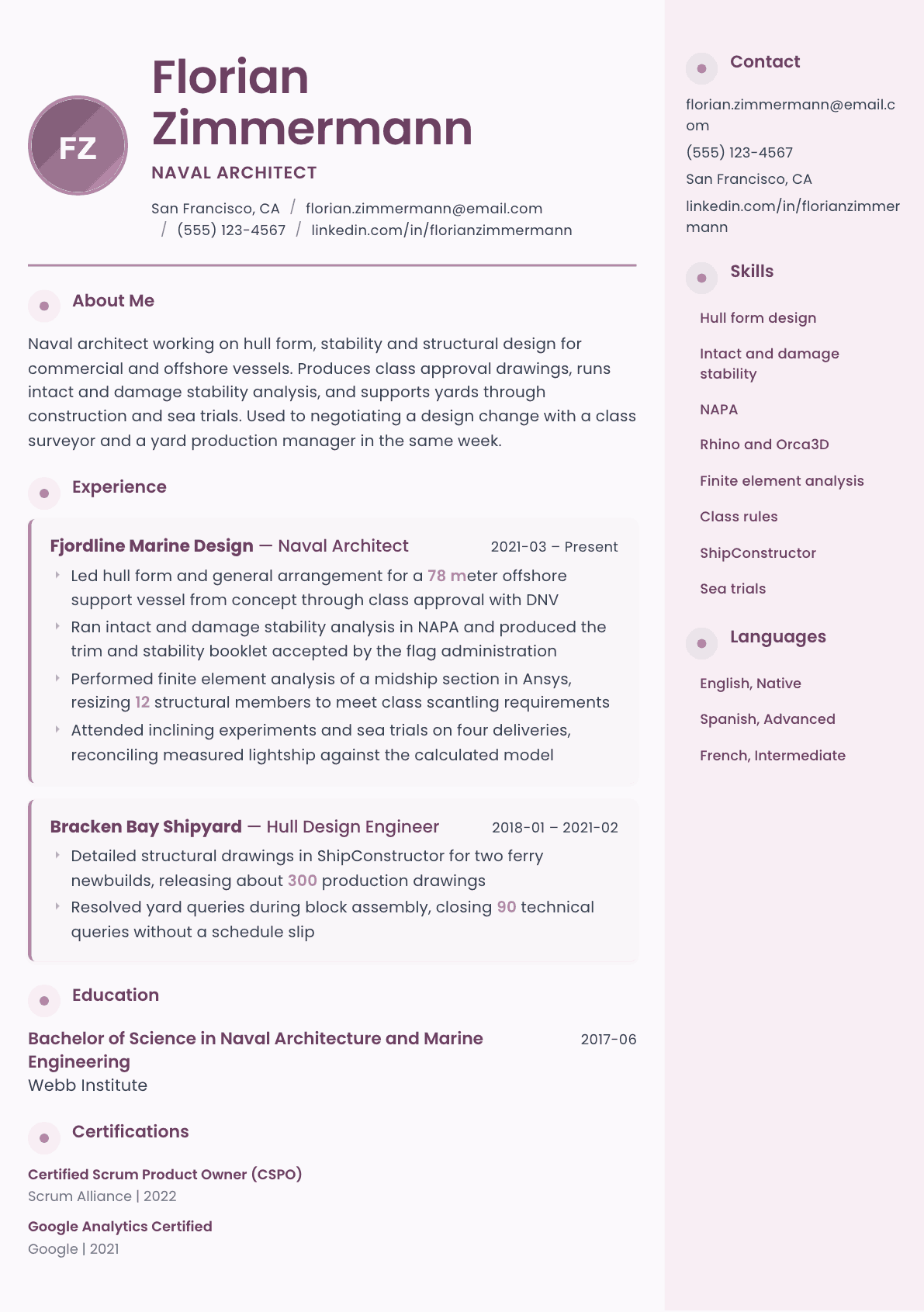
Example Naval Architect summary
Naval architect with seven years on offshore support vessels and passenger ferries, covering hull form, stability and structural scantlings through class approval. Works in NAPA and Ansys, produces trim and stability booklets accepted by flag administrations, and attends inclining experiments and sea trials at the yard. Comfortable resolving production queries during block assembly. Seeking a lead design role on newbuild programs.
Skills to list on a Naval Architect resume
- Hull form development
- Intact and damage stability
- Trim and stability booklets
- Resistance and powering prediction
- Structural scantling design
- Finite element analysis
- NAPA
- Rhino and Orca3D
- AutoCAD and ShipConstructor
- Class society rules
- Load line and tonnage regulations
- Weight control and lightship surveys
- Inclining experiments
- Sea trial support
What actually gets this resume read
- Head every project with the vessel type, principal dimensions and the class society, because that is the fastest credibility signal.
- Separate concept and basic design work from detail design, since firms hire for one or the other.
- Name the stability software you used and whether your booklet was approved by class or a flag administration.
- Say which rules you worked to, whether DNV, ABS, Lloyds Register, or a coast guard subchapter.
- Include yard and sea trial attendance, as design offices value an architect who has stood on the deck.
- List professional registration and any coast guard or IMO related coursework in a separate credentials block.
How to write a naval architect resume
A naval architect resume is read by people who have designed vessels themselves, and they check three things before anything else: what hulls you have worked on, at what design stage, and under whose rules. Vessel type, principal dimensions and class society are the credentials of this profession, and they belong at the head of every project entry.
The discipline splits in ways the job title hides. Concept and basic design work, detail structural design, stability and weight control, and production support at a yard are four different careers with different employers. A resume that treats them as one leaves the reader unable to place you.
This guide sets out how design offices and yards expect these resumes to read, summaries for three stages, before and after bullets from stability and structural work, and the questions naval architects ask when their projects are proprietary or never got built.
Format: a project list with vessels named by type and size
Under each employer, list projects rather than duties. Each project entry opens with the vessel type, the length or displacement, the class society and the stage you worked, then two or three bullets on what you produced. A design manager can size your experience from the headers alone, which is exactly the intention.
Two pages is standard for a mid-career naval architect because the vessel list carries weight. Keep it single column, and put professional registration and any regulatory training in a credentials block under education.
- Header: name, city and country, phone, email, and a note on willingness to travel to yards.
- Sections: summary, technical skills and software, project experience, education, professional registration.
- Add a rules line naming the class societies and flag regimes you have worked under.
Summary: vessel types, stage, and the analysis you own
Say what you have designed and how far you took it. A naval architect who has run hull form and stability through class approval on offshore support vessels is a specific hire. One who describes themselves as experienced in marine design could be almost anyone in the field.
Name your strongest analysis. Intact and damage stability, resistance and powering prediction, structural scantling design, weight control, or seakeeping: design offices staff against these gaps, and the summary is where you tell them which one you fill.
Stability, structures and the approval trail
Stability work is only credible when you say who accepted it. A trim and stability booklet produced, reviewed by class and approved by a flag administration is a complete claim. A statement that you performed stability calculations is not, because the calculation is the easy part and the approval is where the judgment shows.
For structural work, give the rule set and what changed because of your analysis. Resizing twelve members of a midship section to meet class scantling requirements after finite element analysis tells a reader that you understand both the rule and the model, and that you can defend a change to a surveyor.
Weight is its own discipline. Lightship control, weight and center of gravity reporting, and reconciling an inclining experiment against the calculated model are tasks that separate a working naval architect from someone who has only run software.
Yard, production and sea trial experience
Design offices value an architect who has stood on a partly built vessel. Say how many technical queries you closed during block assembly, what production constraints changed your drawings, and which deliveries you attended. That experience is what stops a design that is elegant on screen and unbuildable in steel.
Sea trials and inclining experiments deserve explicit mention with the vessel count. Attending four deliveries and reconciling measured lightship against the model is a concrete, checkable claim and a rare one among early career candidates.
Software, rules and regulatory literacy
Name the tools by product: NAPA, Rhino with Orca3D, Maxsurf, ShipConstructor, AutoCAD, and the finite element package you used. Then name the rules: the class society, the load line and tonnage regimes, and any coast guard subchapter or convention set you worked to.
Regulatory literacy is a hiring criterion in this profession, not a bonus. A candidate who can say which convention drove a freeboard decision, and why, is immediately more useful than one who lists software alone.
Naval Architect resume summary examples
New graduate
Naval architecture graduate with a thesis on hull form optimization for a coastal ferry, including resistance prediction and a full intact stability assessment. Trained in Rhino, Orca3D and Maxsurf, with a summer at a yard supporting block assembly drawings. Seeking a junior naval architect position.
Seven years in
Naval architect covering hull form, stability and structural design on offshore support vessels and passenger ferries. Has taken a 78 meter vessel from concept through class approval, produced trim and stability booklets accepted by flag administrations, and attended inclining experiments and sea trials on four deliveries.
Principal naval architect
Principal naval architect with sixteen years across commercial and offshore newbuilds, leading basic design packages and owning the class approval relationship. Has delivered fourteen vessels, runs the weight control discipline for the office, and mentors four junior architects through their first stability approvals.
Work experience bullets: before and after
Before: Worked on hull design for a support vessel.
After: Led hull form and general arrangement development for a 78 meter offshore support vessel from concept through class approval, including three rounds of resistance prediction against the powering target.
Length, vessel type, stage and the analysis loop give a design manager everything needed to place the work.
Before: Performed stability calculations.
After: Ran intact and damage stability analysis in NAPA and produced the trim and stability booklet that was reviewed by class and accepted by the flag administration without a comment cycle.
Naming the software and the approving authority converts a calculation into a completed regulatory deliverable.
Before: Used finite element analysis on the structure.
After: Performed finite element analysis of a midship section in Ansys and resized 12 structural members to meet class scantling requirements while holding the steel weight estimate.
The rule reference and the weight constraint show engineering judgment rather than a completed model.
Before: Produced production drawings.
After: Detailed structural drawings in ShipConstructor for two ferry newbuilds, releasing about 300 production drawings and closing 90 yard technical queries during block assembly.
Drawing count plus query closure proves the package survived contact with a production floor.
Before: Attended sea trials.
After: Attended inclining experiments and sea trials on four deliveries, reconciling measured lightship and center of gravity against the calculated model and issuing the revised stability information for the master.
The reconciliation step is the actual naval architecture, and it is missing from the original bullet entirely.
Hard skills
- Hull form development
- Intact and damage stability analysis
- Trim and stability booklet preparation
- Resistance and powering prediction
- Structural scantling design
- Finite element analysis
- Weight control and lightship surveys
- Inclining experiment execution
- NAPA
- Rhino and Orca3D
- Maxsurf
- AutoCAD and ShipConstructor
- Class society rule application
- Load line and tonnage regulations
- Seakeeping assessment
Soft skills
- Defending a design to a class surveyor
- Working with yard production managers
- Clear technical query responses
- Owner and operator communication
- Discipline in weight reporting
- Mentoring junior architects
Certifications worth listing
- Professional Engineer (PE), Naval Architecture and Marine Engineering (NCEES and state licensing boards)
- Fundamentals of Engineering (FE) (NCEES)
- Chartered Engineer (CEng) (Engineering Council, assessed through the Royal Institution of Naval Architects)
Mistakes that cost naval architect candidates the interview
- Describing projects without vessel type, principal dimensions or class society, which leaves the reader unable to size your work.
- Blurring concept design, detail design and production support when firms hire for one of the three.
- Claiming stability work without naming who reviewed and accepted the booklet.
- Listing software fluency in place of rule literacy, since the rules are what a design office is paying for.
- Omitting yard attendance and technical query work, which is the strongest evidence a design was buildable.
- Padding the vessel list with projects where you contributed a single drawing, rather than stating your actual scope.
Naval Architect resume questions
How should a naval architect list vessels on a resume?
One line per project with the vessel type, the length or displacement, the class society and the design stage you covered. That header format is how the profession talks about work, and it lets a reviewer place fifteen years of projects in under a minute.
What if my designs were never built?
Say so plainly and give the stage reached, such as concept study or basic design package delivered. Unbuilt projects are common in this field, particularly in feasibility and tender work, and the analysis you produced is still the evidence a design office is evaluating.
Do I need a professional engineering license as a naval architect?
It depends on the market and the work. Licensure matters for engineering firms that stamp drawings and for some government contracts, while many yards and design offices do not require it. Chartered status through a professional institution serves a similar purpose in other regions.
How do I show class society experience without breaching confidentiality?
Name the society and the rule set rather than the owner or the contract. Describing an approval with DNV or a coast guard subchapter review is standard practice and reveals nothing commercially sensitive, while owner names and contract values generally should stay off the page.
Should I separate stability work from structural work?
Yes, because offices staff those disciplines separately. Give each its own bullets under a project, and make clear which one you would want to own in your next role. Candidates who present themselves as equally strong in both are usually assumed to be moderate in each.
Related resume examples
- Marine Engineer Resume example
- Structural Engineer Resume example
- Mechanical Design Engineer Resume example
- Project Engineer Resume example
- Pipeline Engineer Resume example
- Civil Engineer Resume example