Structural Engineer Resume Examples: what gets the call
Build a Structural Engineer Resume on a Solid Foundation
By Mustafa Tarabya, founder of CVBooster · Published · Updated
Create a structural engineer resume that showcases your analysis expertise, building codes knowledge, and project portfolio with recruiter-friendly formatting.
Sample resumes for a structural engineer
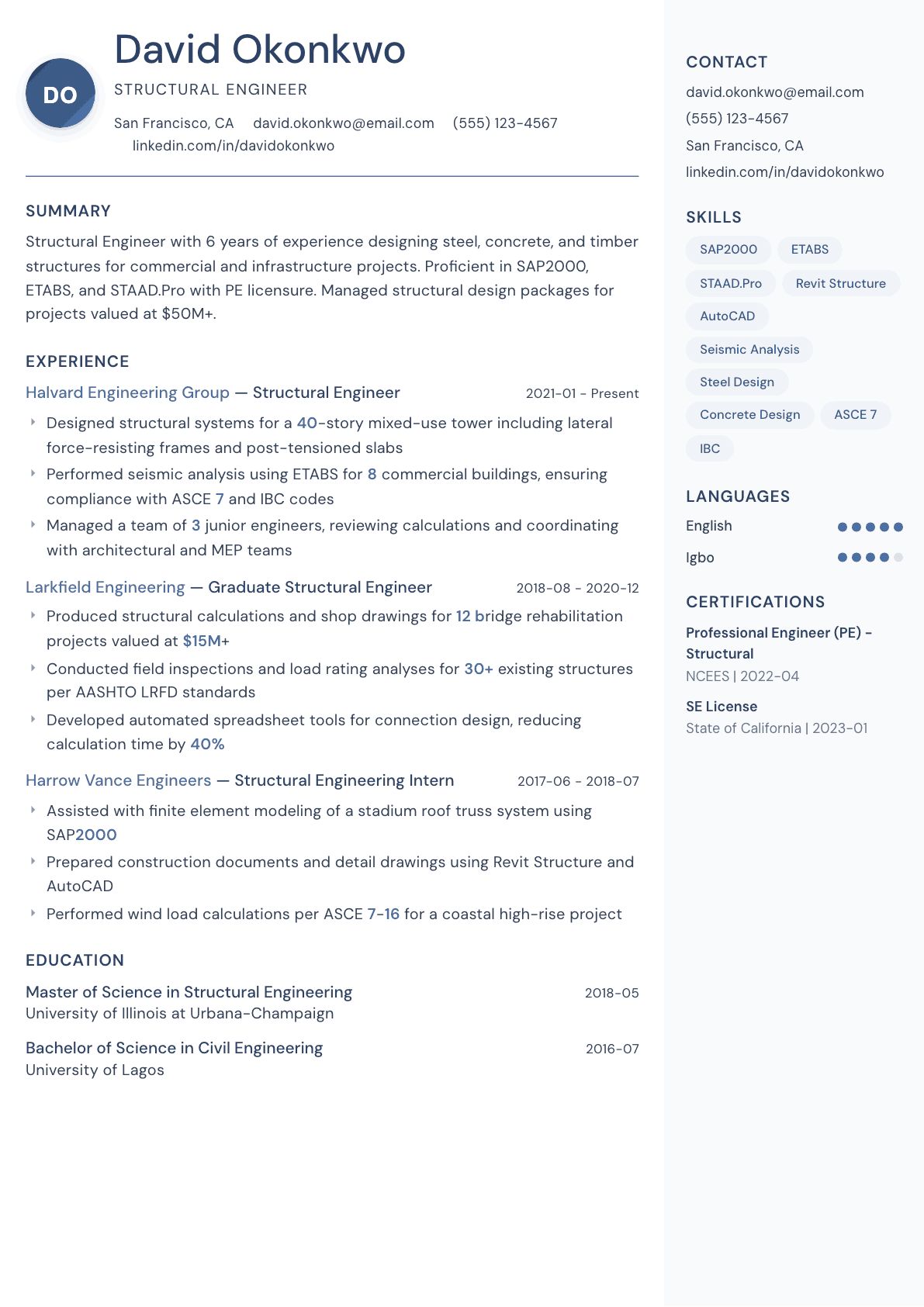
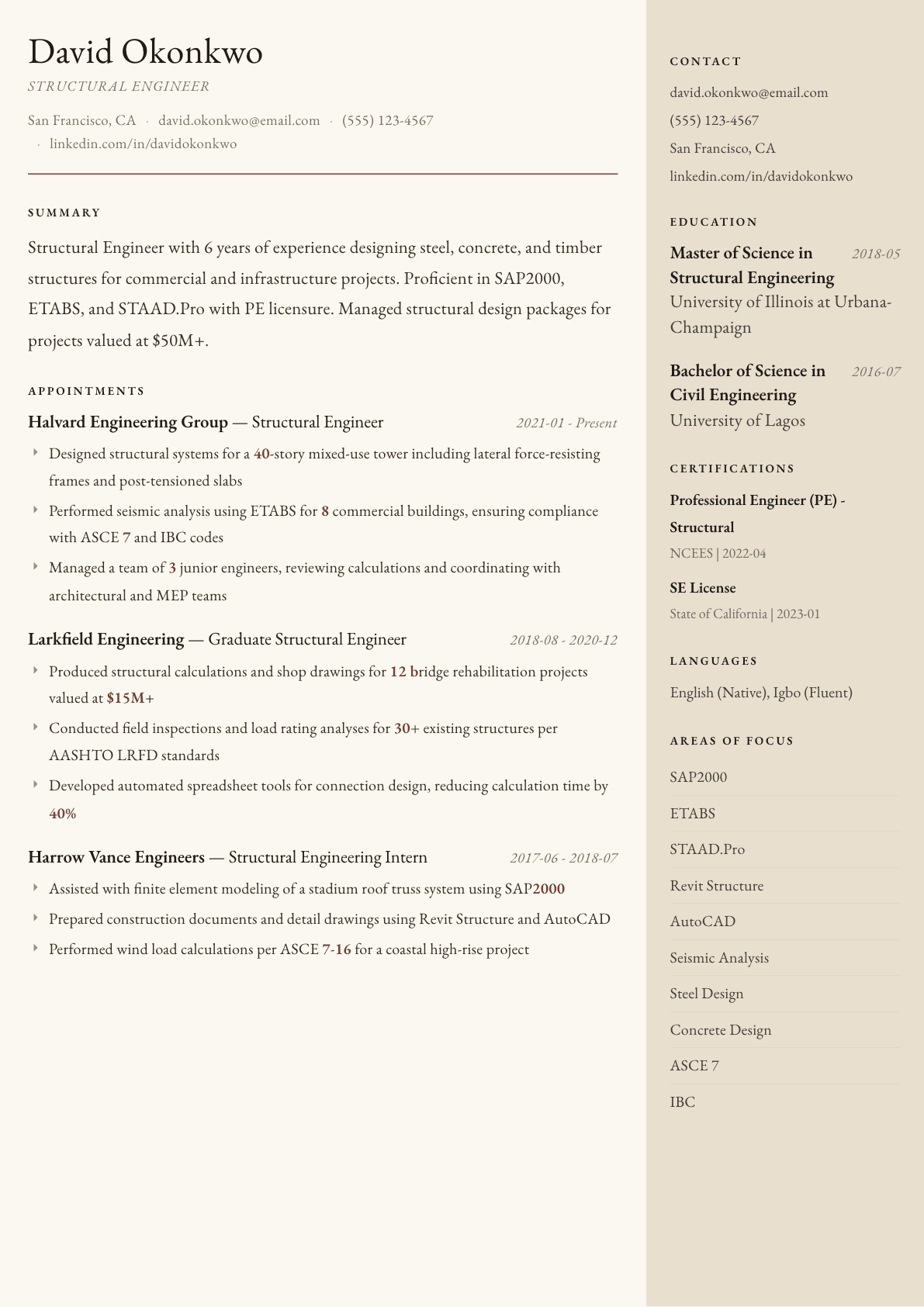
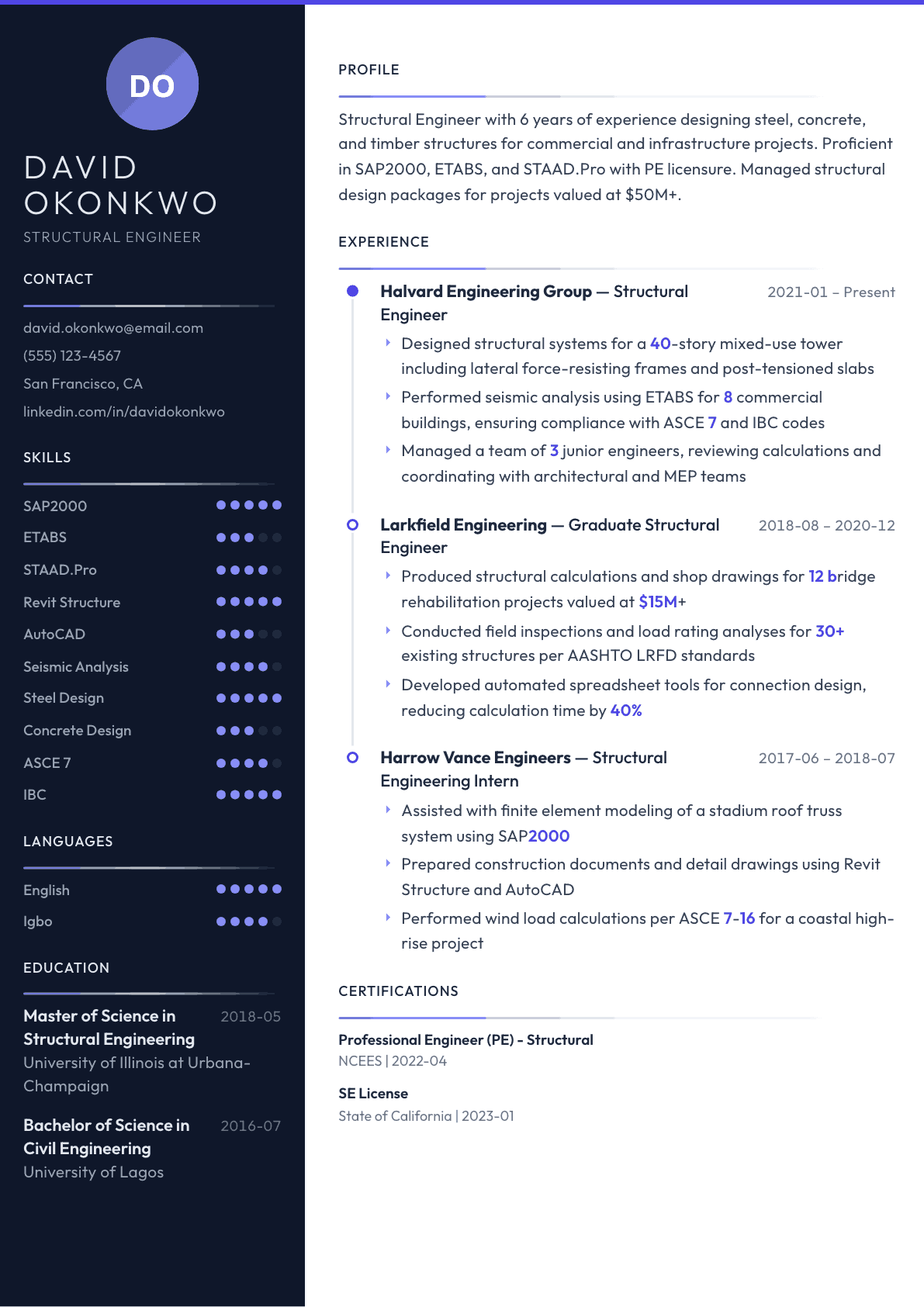
The same structural engineer content laid out in three CVBooster templates, so you can see what the finished document looks like before you write a word.
Example Structural Engineer summary
Licensed Professional Engineer with 6 years of experience in structural design for commercial buildings and infrastructure. Expert in SAP2000, ETABS, and Revit Structure with deep knowledge of IBC, ASCE 7, and AISC standards. Successfully delivered structural packages for projects exceeding $50M in total value.
Skills to list on a Structural Engineer resume
- SAP2000
- ETABS
- STAAD.Pro
- RISA-3D
- Revit Structure
- AutoCAD
- Seismic Design
- Wind Engineering
- Steel Design (AISC)
- Concrete Design (ACI)
- Foundation Design
- Finite Element Analysis
- Construction Documents
- Load Path Analysis
- Bridge Engineering
What actually gets this resume read
- List structural analysis software prominently: SAP2000, ETABS, STAAD.Pro, RISA, RAM Structural System.
- Reference building codes and standards you work with: IBC, ASCE 7, ACI 318, AISC 360, AASHTO.
- Quantify project scale: building height, span lengths, project value, or square footage.
- Include your PE/SE license and FE certification prominently.
- Describe material types you specialize in: steel, reinforced concrete, prestressed concrete, timber, masonry.
- Mention software for BIM coordination: Revit Structure, Tekla Structures, or Navisworks.
How to write a structural engineer resume
Structural engineering hiring runs on three questions: what have you designed, what codes did you design it to, and are you licensed. A principal at a consulting firm can place a candidate within about thirty seconds if the resume names the building types, the materials, the governing codes and the license status. When those are missing, the file goes to the bottom of the pile regardless of how the bullets are written.
The second filter is material and market. Steel high-rise design, concrete parking structures, timber mid-rise, bridge rehabilitation, industrial platforms and seismic retrofits are separate practices with separate code sets. Firms hire for a practice area, so a resume that lists projects without saying what they were made of and what they had to resist forces the reader to guess.
This guide covers the project list that structural firms expect, how to write analysis and design bullets that show judgment, the codes and software to name, summaries for an engineer in training, a project engineer and a licensed lead, and the construction phase experience that separates a designer from a practitioner.
Format: a project list is the heart of the resume
Alongside the standard experience section, include a representative project list. For each entry give the building or structure type, size in square feet or span, the framing system, the material, your role and the phase you covered. Structural principals read this list before they read anything else, because it is the closest thing to a portfolio a text document can carry.
Keep the layout parseable. A single column with clear headings survives applicant tracking systems, and firms in this field frequently use them for the first pass even when a principal makes the decision.
- Header: name, city and state, phone, email, and license or engineer in training status.
- Order: summary, licensure, experience, representative projects, software, education.
- Give the delivery method when it matters: design-bid-build, design-build, or an integrated delivery arrangement.
Design bullets: system, load path, code, decision
A strong bullet names the structural system and what it had to resist. Special moment frames, braced frames, shear walls, post-tensioned slabs, composite floor systems, mat foundations, deep foundations and diaphragm design are all specific and all checkable. Pair the system with the governing demand: seismic category, wind speed and exposure, snow, blast, vibration or fatigue.
Then show the decision you made. Structural engineering is a discipline of tradeoffs, so the interesting sentence is the one where you chose a framing scheme to save depth, revised a lateral system after a drift check, or found a load path problem in coordination that would have cost the contractor a month.
Give the calculations you owned and how they were checked. Hand calculations to verify a model, a peer review response, or a plan check comment resolved are all evidence that your work has been tested by someone who was paid to find errors in it.
Codes and software: name both, and connect them
Name the codes you design to: the minimum design loads standard, the building code, the concrete code, the steel specification, the masonry and timber standards, and the bridge design specifications if you work on transportation structures. Add the local amendments where you practice, because a firm hiring in a high-seismic jurisdiction reads that as regional competence.
Then name the analysis software with what you used it for. A finite element model built for a lateral analysis, a design suite used for gravity framing, detailing and coordination models, and the spreadsheet or scripting tools you built for repetitive connection checks all belong here. Modeling packages listed alone read as a training list.
Construction phase experience is a differentiator
Many resumes stop at issued drawings. Firms value engineers who have carried a project through construction: submittal and shop drawing review, requests for information, field observation reports, deficiency resolution, and the change directives that follow when conditions differ from the drawings.
Existing structures deserve their own mention if you have done them. Condition assessment, load rating, strengthening design, temporary shoring and demolition sequencing require judgment that new-build work does not teach, and they are in constant demand.
- Say how many submittals or requests for information you have processed and for what project size.
- Name any site visit and observation reporting you have signed.
- Include coordination with architects, mechanical trades and contractors as concrete work, not as an adjective.
Licensure and career stage
Put your status in the header and in a dedicated line: passed fundamentals examination and engineer in training designation, professional engineering license with states listed, or structural engineering licensure where the jurisdiction issues it. State the states, since multi-state licensure is a hiring asset for firms working across jurisdictions.
For engineers still on the path, name the examination you have passed and the expected sitting for the next one. Firms plan staffing around who will be able to seal drawings in two years, so an explicit timeline helps rather than hurts.
Structural Engineer resume summary examples
Engineer in training
Structural engineer in training with a master's degree and 18 months producing gravity framing calculations and drawings for low-rise commercial buildings in steel and light-gauge framing. Passed the fundamentals examination, models in a standard analysis suite, and supports submittal review.
Six years in
Structural project engineer with 6 years designing concrete and steel buildings up to 12 stories, including post-tensioned floor systems and braced frame lateral systems in a high-seismic jurisdiction. Licensed professional engineer in two states, and runs construction administration on 3 active projects.
Licensed project lead
Licensed structural engineer with 14 years leading design on commercial and institutional buildings, sealing drawings for projects of up to 300 thousand square feet. Owns lateral system selection, peer review response and code interpretation, and mentors 5 engineers through licensure.
Work experience bullets: before and after
Before: Designed structural systems for commercial buildings.
After: Designed the gravity and lateral systems for an 8-story concrete office building, selecting shear walls over a moment frame after drift checks showed a shallower floor sandwich was achievable.
The system, the check that drove the choice and the benefit show engineering judgment rather than production work.
Before: Used analysis software to model buildings.
After: Built the lateral analysis model for a 12-story steel frame and verified base shear and story drift against hand calculations before releasing the design for peer review.
Independent verification of a model is what a principal wants to see, because it shows you do not trust output blindly.
Before: Reviewed shop drawings and RFIs.
After: Reviewed 240 submittals and answered 90 requests for information during construction of a hospital addition, resolving a foundation conflict discovered during excavation without a schedule impact.
Volume plus one resolved field problem proves construction phase capability that drawing-only experience does not.
Before: Worked on bridge inspection projects.
After: Performed condition assessments and load ratings on 22 highway bridges under the applicable bridge design specifications, recommending posting for 3 structures and strengthening details for 2 more.
The structure count and the specific recommendations show you carried the assessment through to a decision.
Before: Coordinated with architects and other disciplines.
After: Coordinated framing depths with mechanical routing across 4 floors, revising the beam layout to hold a ceiling height the architect required without adding structural tonnage.
A named constraint and a solved conflict turn coordination from an adjective into a demonstrable contribution.
Hard skills
- Structural analysis and modeling
- Seismic design and lateral system selection
- Wind load analysis
- Reinforced and post-tensioned concrete design
- Structural steel and connection design
- Masonry and timber design
- Foundation and retaining structure design
- Load path and diaphragm analysis
- Building code interpretation
- ETABS and SAP2000
- RISA and RAM structural systems
- Revit and structural detailing coordination
- Construction administration and submittal review
- Condition assessment and load rating
Soft skills
- Design judgment under incomplete information
- Coordination with architects and trades
- Clear calculation documentation
- Responding to reviewer comments
- Mentoring engineers toward licensure
Certifications worth listing
- Professional Engineer (PE), Civil or Structural (State engineering licensing boards, via NCEES examinations)
- Structural Engineer (SE) licensure (State engineering licensing boards, via the NCEES structural examination)
- Fundamentals of Engineering (FE) and Engineer in Training (NCEES)
- Certified Welding Inspector (CWI) (American Welding Society)
- Special Inspector certifications (International Code Council)
Mistakes that cost structural engineer candidates the interview
- Listing projects without the material, the framing system or the size, which leaves a principal unable to place your practice area.
- Omitting the governing codes, when code fluency is the core technical qualification the firm is buying.
- Naming analysis software without any bullet showing a model you built and verified.
- Hiding license status, which is the single fastest filter applied to a structural resume.
- Stopping the story at issued drawings, when construction phase judgment is what firms find hardest to hire.
- Claiming credit for an entire landmark project when your role was one framing package inside it.
Structural Engineer resume questions
How many projects should a structural engineer resume list?
Six to ten representative ones, chosen to show the range of materials, building types and phases you have covered. For each, give the structure type, size, framing system and your specific role. Summarize the remainder by count rather than listing everything.
Do I need a professional engineering license to get hired?
Not for entry and project engineer positions, but you need a visible path. State that you passed the fundamentals examination, hold the engineer in training designation, and when you plan to sit for the principles examination. Firms staff around who can seal drawings later.
What is the difference between a PE and an SE on a resume?
The professional engineering license permits general practice in a jurisdiction, while the structural license is a separate credential some states require for significant or high-risk structures. List both with the states, since a firm working across state lines values multi-state coverage.
Should I include construction phase work if I mainly do design?
Yes, and give it real space. Submittal review, field observation and request for information volume prove you understand how a drawing becomes a building. Firms consistently find this harder to hire for than modeling skill, so it deserves its own bullets.
How do I present a structural resume when changing sectors?
Lead with the analysis fundamentals and the codes that overlap, then name the sector-specific standards you have studied for the new market. Building and bridge practices share mechanics but not specifications, so acknowledge the gap and show what you have done to close it.
Related resume examples
- Civil Engineer Resume example
- Mechanical Engineer Resume example
- Environmental Engineer Resume example
- Pipeline Engineer Resume example
- Electrical Design Engineer Resume example
- Naval Architect Resume example