Project Engineer Resume Examples: the lines they read
Build a Project Engineer Resume That Shows Scope and Delivery
By Mustafa Tarabya, founder of CVBooster · Published · Updated
Project engineer resume example with budget, schedule and vendor coordination bullets, capital project keywords and a full writing guide.
Sample resumes for a project engineer
The same project engineer content laid out in three CVBooster templates, so you can see what the finished document looks like before you write a word.
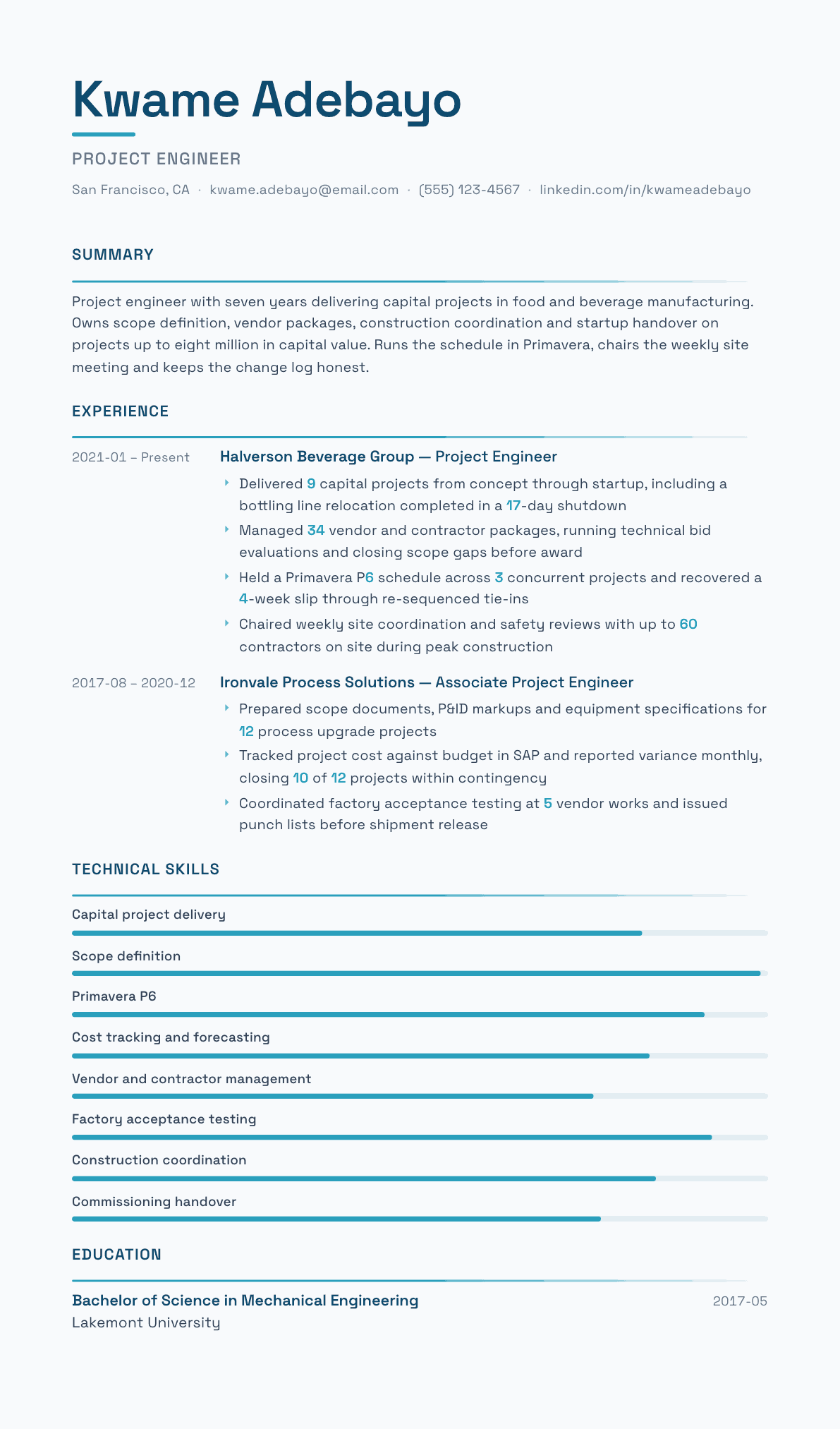
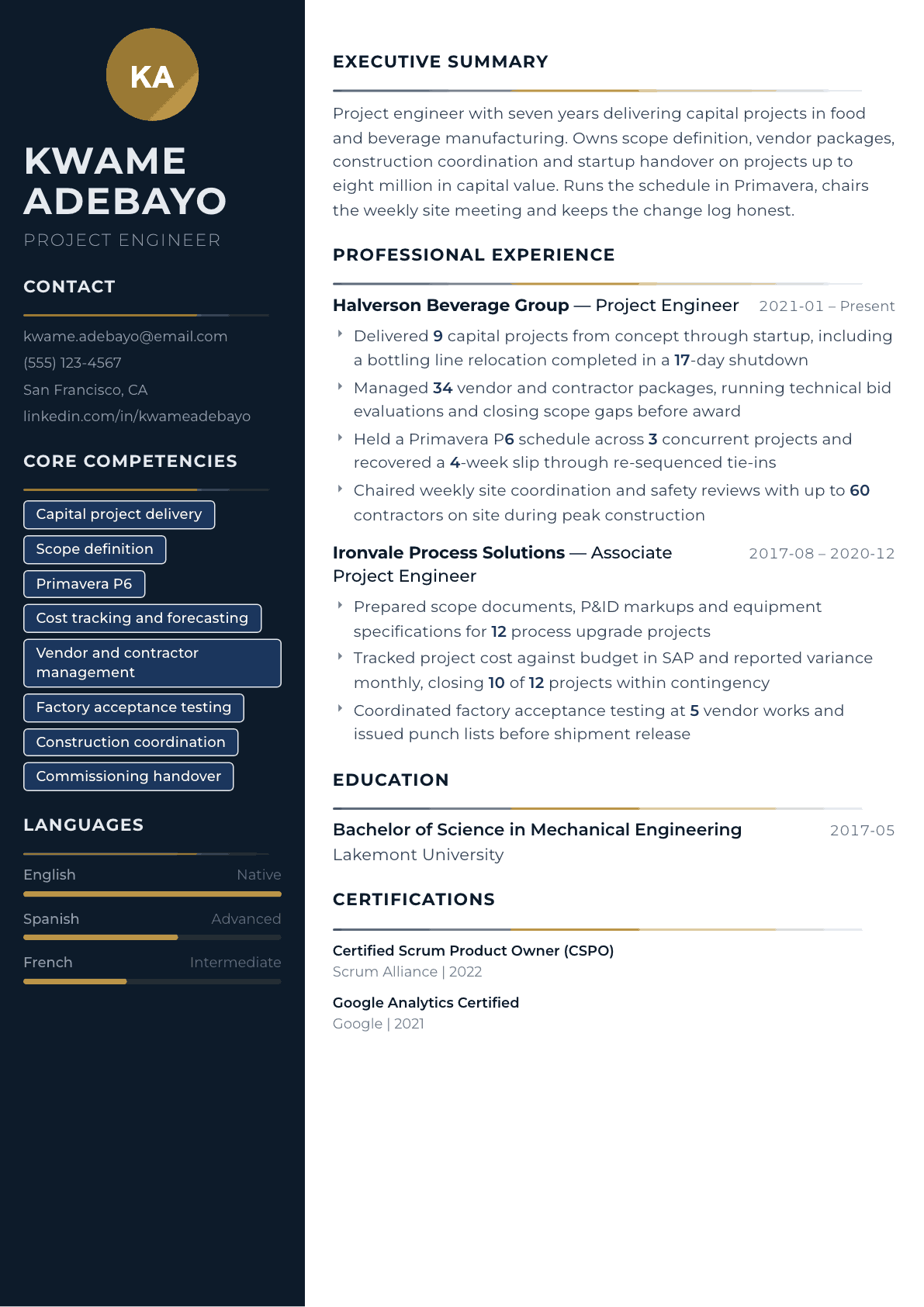
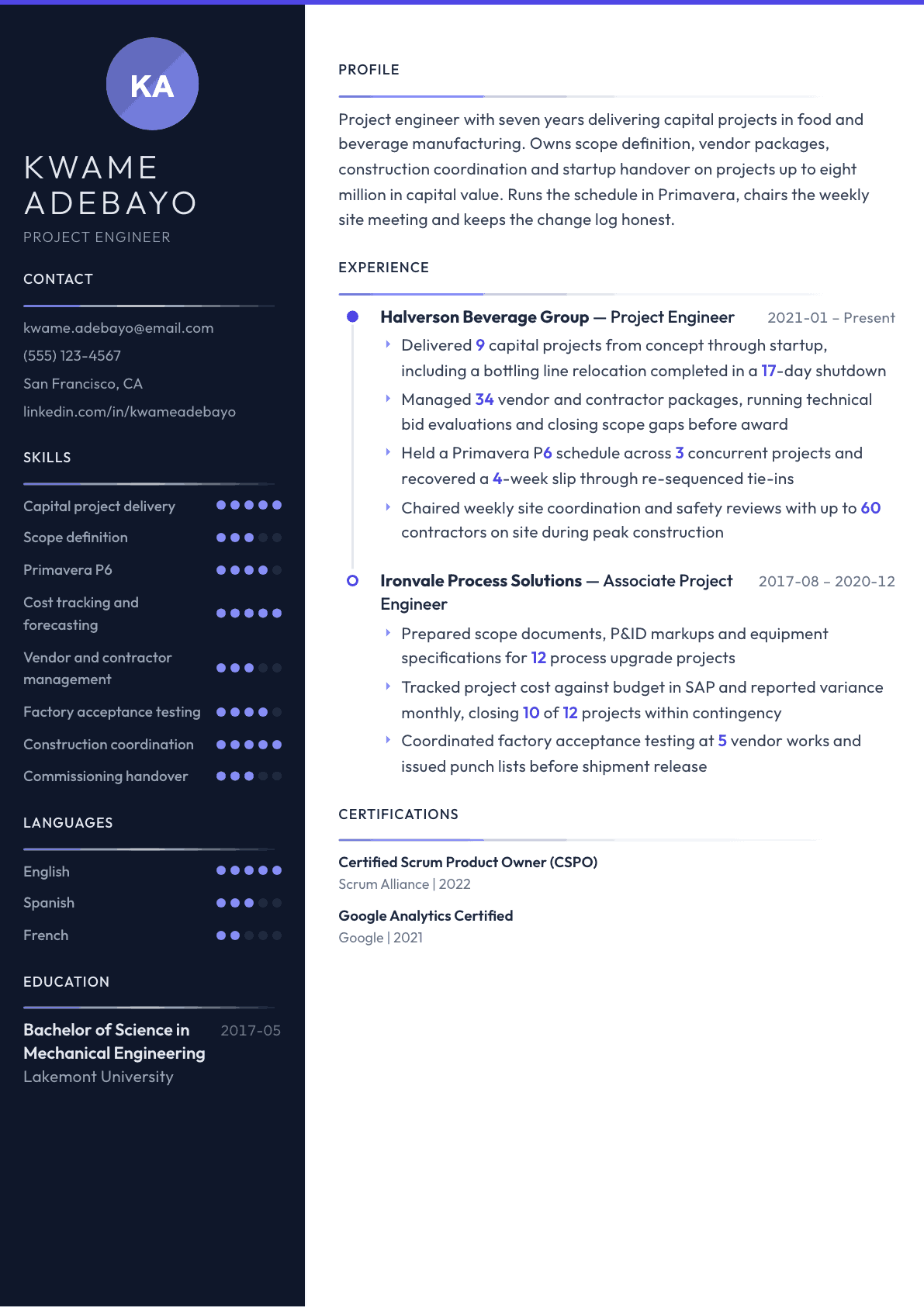
Example Project Engineer summary
Project engineer with seven years delivering capital projects across food and beverage manufacturing plants. Owns scope, vendor packages, construction coordination and startup handover, and holds the schedule and cost forecast for concurrent projects. Has delivered a line relocation inside a fixed shutdown window and recovered schedule slip through re-sequencing rather than overtime. Seeking a lead project engineer role on larger capital programs.
Skills to list on a Project Engineer resume
- Capital project delivery
- Scope definition
- Cost estimating
- Budget and variance tracking
- Primavera P6
- Microsoft Project
- Vendor management
- Technical bid evaluation
- Construction coordination
- Factory acceptance testing
- Site acceptance testing
- Commissioning handover
- Change management
- Contractor safety oversight
- P&ID review
What actually gets this resume read
- Give the capital value and duration of each project, because scale is the first filter a project manager applies to your resume.
- Separate what you owned from what you supported, since a project engineer who ran vendor packages reads differently than one who observed.
- Name the scheduling and cost tools you used, because Primavera, Microsoft Project and SAP each signal a different project environment.
- Show the shutdown or tie-in work explicitly, as delivering inside a fixed outage window is the hardest thing on the resume.
- Record safety performance during construction, since contractor hours worked without a recordable is a claim project managers respect.
- Describe how you handled a change: the change order, the cost impact and how you kept the schedule are the real story.
How to write a project engineer resume
Project engineer sits between technical work and project management, and resumes for the role fail when they pick neither side clearly. A hiring manager wants to know two things: how much scope you have personally carried, and whether the projects landed on time, on budget and in a condition operations was willing to accept. Everything else is supporting evidence.
The most common weakness is describing involvement instead of ownership. Coordinated with vendors, assisted with commissioning and supported the project manager all describe a person in the room. Named a scope, awarded a package, held a schedule and signed a handover describe a person who was accountable.
What follows is the structure that suits capital project work, what belongs in each block, three example summaries, five before and after bullets, and the questions project engineers ask most often.
Format: a project list is not optional
Reverse chronological experience, plus a dedicated project list. The list is what a project manager reads first: project name or type, capital value band, duration, your role, and the outcome. Five or six lines of that block communicate more than a page of prose.
Two pages is normal. Keep the layout single column so schedule tools, standards and contractor counts survive text extraction cleanly, and keep the capital values in a consistent format so the reader can compare projects at a glance.
- Header: name, project engineering discipline, city and state, contact details, license status if held.
- Section order: summary, project list, experience, technical and commercial skills, education, certifications.
- Per project: capital band, duration, your role, scope owned, and delivery result.
Summary: sector, capital scale, and delivery record
Open with the sector and the plant or facility type, since a project engineer in food manufacturing, one in pharmaceutical fit-out and one in mining infrastructure face different regulatory and construction realities. Then state the capital band you have delivered within, which is the fastest way for a reader to place you.
Close with the delivery claim. Projects delivered inside a fixed shutdown window, budgets closed within contingency, or a startup handed over without outstanding safety items are all concrete. Avoid describing yourself as detail oriented, which every applicant writes.
Experience: scope, packages, schedule, and the change log
Scope bullets should show what you defined, not just what you executed. Writing the scope document, marking up process drawings, specifying equipment and building the estimate basis are the front end tasks that determine whether a project succeeds, and they are the ones that separate a project engineer from a coordinator.
Package bullets should name the vendor and contractor work you owned: enquiry documents, technical bid evaluation, clarification rounds, award recommendation, expediting and factory acceptance testing. Give the number of packages, because that is the workload measure a project manager uses.
Schedule and cost bullets need the tool and the recovery story. Anyone can report a schedule. A project engineer who recovered a slip by re-sequencing tie-ins rather than by paying overtime has demonstrated the judgment the role exists for. Change control belongs here too: state how many changes you processed and what the cost impact was.
Construction, safety and site coordination
Describe your site presence. Chairing coordination meetings, managing contractor interfaces, running permit systems and handling the sequencing of tie-ins during an outage are all site skills, and a project engineer who has only worked from an office should not imply otherwise.
Safety performance during construction is worth stating plainly. Contractor hours worked, inductions delivered, and any safety observation program you ran give the reader confidence that your projects did not achieve their dates by cutting corners.
- Site work: coordination meetings, contractor interfaces, permit and isolation control, tie-in sequencing.
- Handover: punch list closure, as-built documentation, spares handover, operator training, acceptance sign-off.
- Safety: contractor inductions, risk assessment review, observation programs, incident reporting.
Commercial literacy that gets you promoted
Project engineers who understand the money move into project management. Show your cost tracking method, your forecasting cadence, how you managed contingency and how you handled a variation claim. Naming the finance or enterprise system you tracked cost in adds credibility.
Contract awareness helps too. Knowing whether you worked under a lump sum, reimbursable or target cost arrangement, and how that shaped your change control, tells a reader you understand why the paperwork mattered.
Project Engineer resume summary examples
Graduate project engineer
Mechanical engineering graduate with a year supporting capital projects in a beverage plant, preparing equipment specifications, tracking purchase orders and compiling handover documentation. Comfortable on site during installation. Seeking a graduate project engineer role in manufacturing or process industries.
Five years in
Project engineer with 5 years delivering capital projects in food and beverage plants at values up to 8 million. Owns scope, vendor packages and construction coordination, and completed a bottling line relocation inside a 17-day shutdown window without a late restart.
Senior project engineer
Senior project engineer with 12 years across process industry capital programs, running concurrent projects and leading multidiscipline teams from concept through startup. Holds project management certification and has closed 9 of the last 10 projects inside approved contingency.
Work experience bullets: before and after
Before: Worked on capital projects at the plant.
After: Delivered 9 capital projects from concept through startup, including a bottling line relocation completed inside a 17-day shutdown window with production restarted on the planned date.
Project count and a fixed window delivered on time show accountability that the word worked cannot carry.
Before: Coordinated with vendors and contractors.
After: Owned 34 vendor and contractor packages, writing enquiry documents, running technical bid evaluations and closing scope gaps in clarification rounds before award recommendation.
Naming the package count and each front end task proves ownership rather than attendance at meetings.
Before: Kept projects on schedule.
After: Held a Primavera schedule across 3 concurrent projects and recovered a 4-week slip by re-sequencing tie-ins into an earlier outage rather than funding overtime.
The recovery method is the evidence of judgment, and it is what a project manager will ask about.
Before: Tracked project costs.
After: Tracked committed and forecast cost monthly against approved budget, reported variance with recovery actions, and closed 10 of 12 projects inside contingency across three years.
A forecasting cadence and a closing record demonstrate commercial control instead of clerical tracking.
Before: Ran site meetings during construction.
After: Chaired weekly coordination and safety reviews with up to 60 contractors on site, controlling interfaces between mechanical, electrical and civil crews through a shared tie-in schedule.
The headcount and the interface mechanism show real construction management rather than meeting attendance.
Hard skills
- Scope definition and basis of design
- Cost estimating and budget control
- Schedule development in Primavera or Microsoft Project
- Technical bid evaluation
- Vendor and contractor management
- Purchase requisition and expediting
- Factory and site acceptance testing
- Construction coordination
- Change and variation control
- Commissioning and startup handover
- Punch list and as-built documentation
- Process drawing review
- Contractor safety oversight
- Risk register management
Soft skills
- Holding contractors to commitments
- Chairing meetings that end in decisions
- Escalating early rather than late
- Balancing operations and construction needs
- Written reporting to steering groups
Certifications worth listing
- Project Management Professional (PMP) (Project Management Institute)
- Certified Associate in Project Management (CAPM) (Project Management Institute)
- Certified Cost Professional (CCP) (AACE International)
- Professional Engineer (PE) (NCEES member state licensing boards)
Mistakes that cost project engineer candidates the interview
- Listing projects without capital value or duration, so the reader cannot judge the scale you have carried.
- Using the language of support rather than ownership across every bullet.
- Reporting schedule and budget outcomes with no explanation of how a problem was recovered.
- Omitting site and construction experience, which makes an office-only background look like the whole career.
- Skipping change control, which is where most project engineering credibility is actually earned.
- Leaving handover and commissioning out, so operations acceptance never appears anywhere on the page.
Project Engineer resume questions
Should a project engineer resume include a separate project list?
Yes, once you have three or more projects. Give each one a capital band, duration, your role and the delivery result. Hiring managers use that block to calibrate you in seconds, and it lets your experience bullets describe how you worked rather than repeating what you worked on.
How do I show capital value without disclosing confidential figures?
Use bands rather than exact numbers, such as projects up to one million or programs in the multi-million range. Bands communicate scale, keep you inside any confidentiality obligation, and are what an interviewer would ask you to estimate anyway.
What is the difference between a project engineer and a project manager resume?
A project engineer resume leads with technical scope, packages and site delivery, with cost and schedule as supporting evidence. A project manager resume leads with accountability for cost, schedule, contract and team. Choose based on the role you want next, not the title you last held.
Do I need a project management certification?
It is not required for most project engineer roles but it helps when you apply upward, especially in organizations that run a formal stage gate process. List it in the header abbreviation form and in full with the issuing body in your certifications section.
How should I present projects that were canceled or paused?
Include them and describe what you delivered before the stop, such as a completed front end package or an issued design. Reviewers understand that funding decisions are outside your control, and the front end work still demonstrates capability.
Related resume examples
- Mechanical Engineer Resume example
- Civil Engineer Resume example
- Commissioning Engineer Resume example
- Plant Engineer Resume example
- Quantity Surveyor Resume example
- Chief Engineer Resume example