Pipeline Engineer Resume Examples: the lines they read
Write a Pipeline Engineer Resume Operators Take Seriously
By Mustafa Tarabya, founder of CVBooster · Published · Updated
Pipeline engineer resume examples, hydraulic and integrity keywords, sample bullets and a writing guide for midstream and utility hiring.
Sample resumes for a pipeline engineer
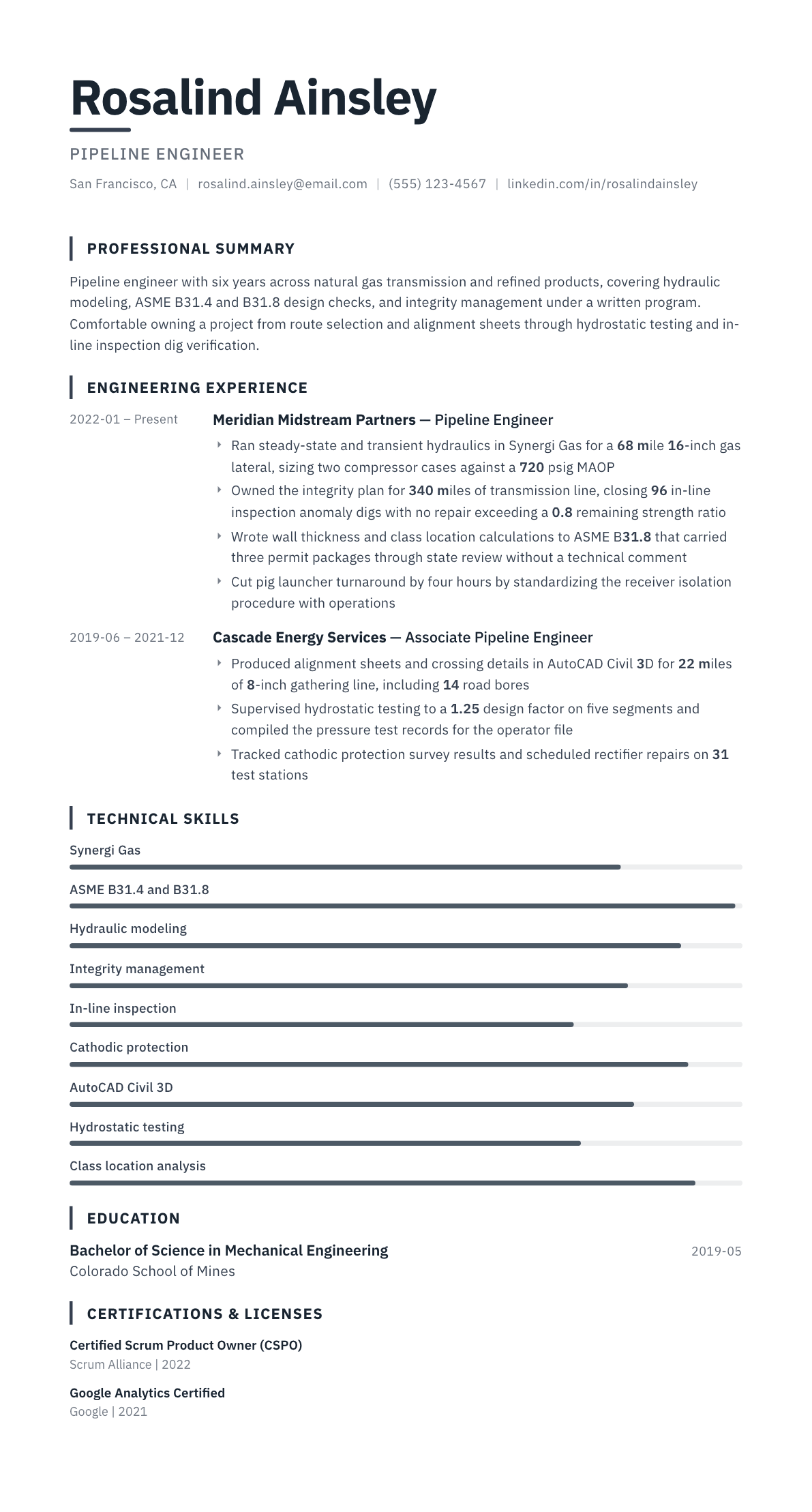
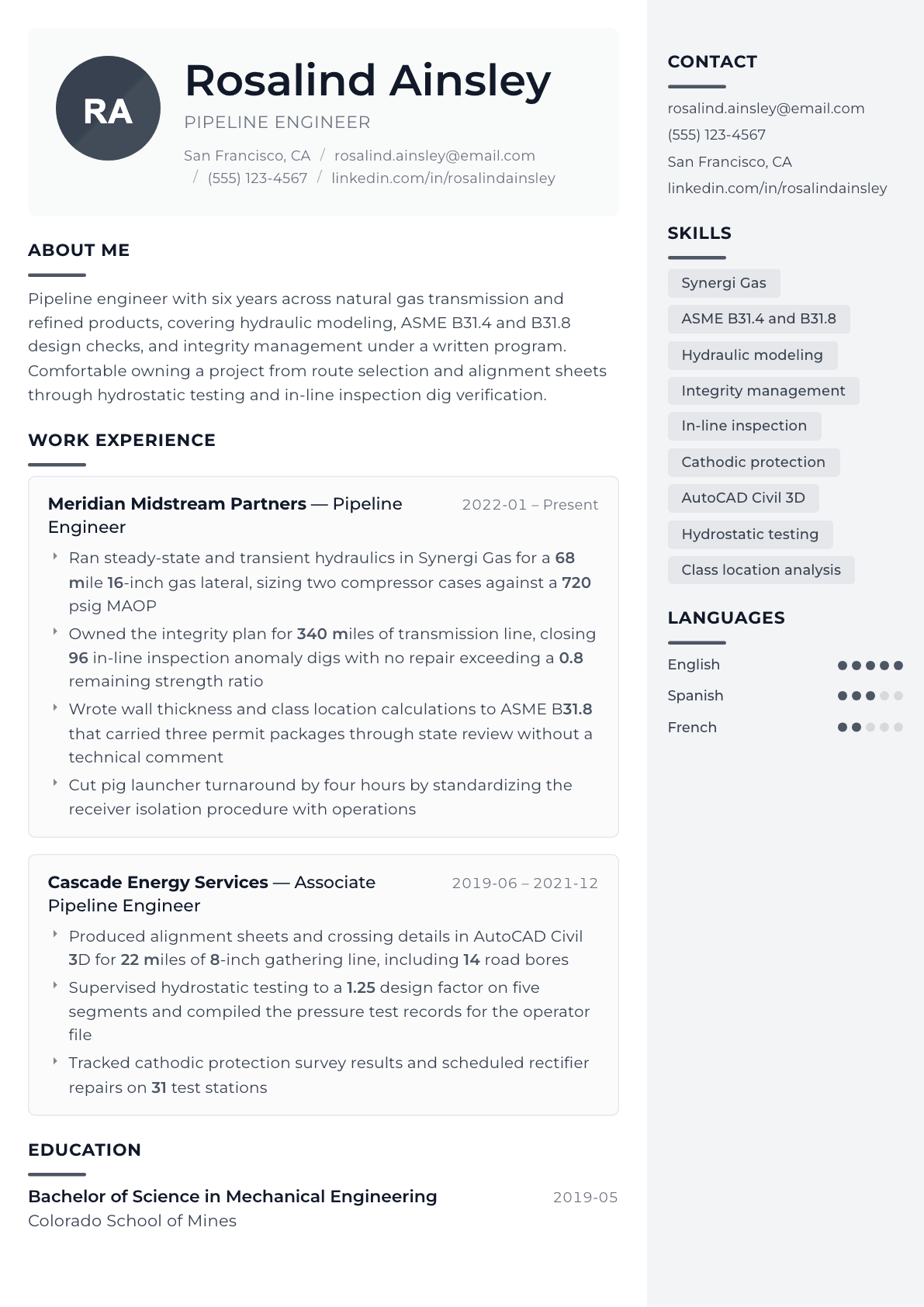
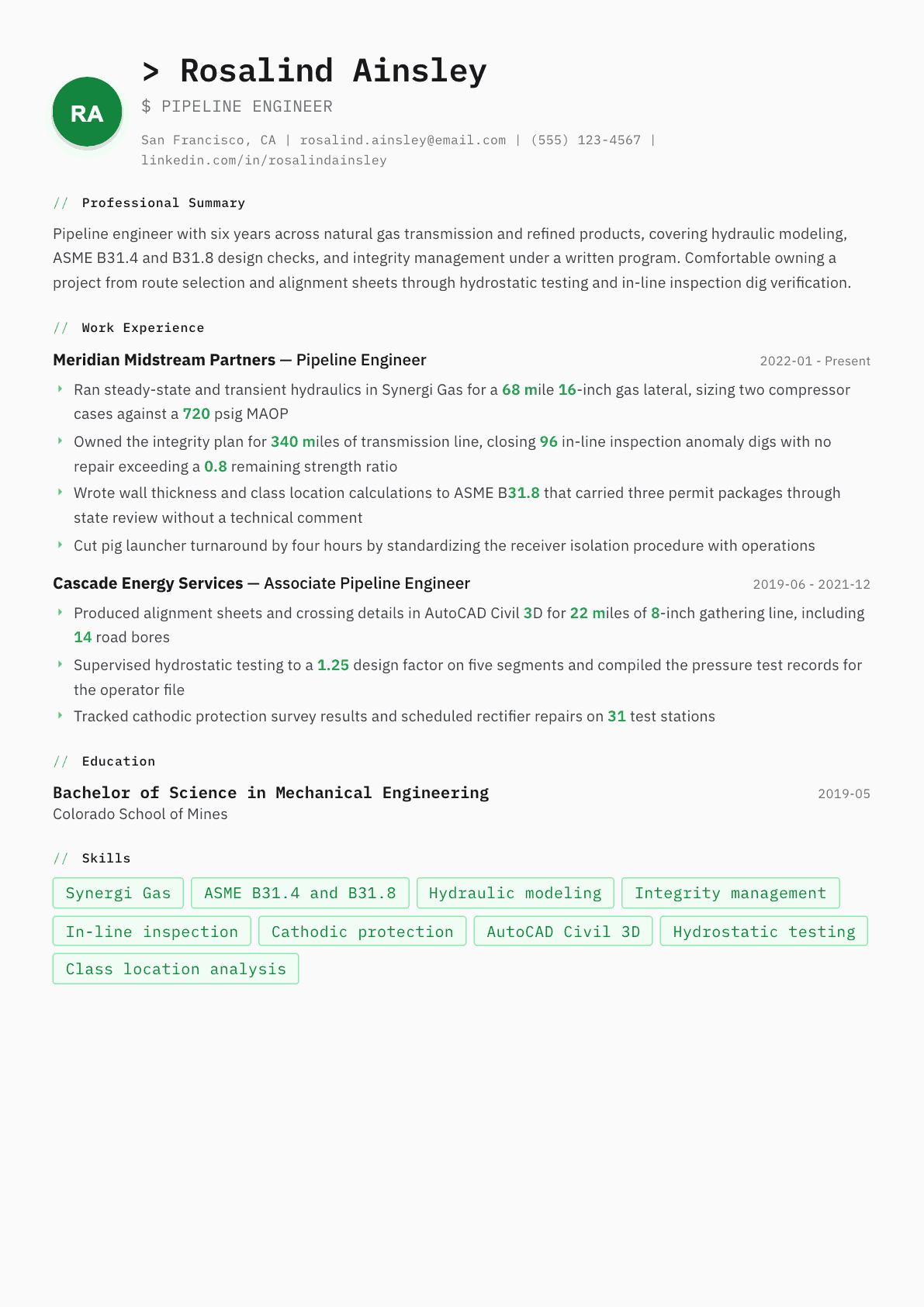
The same pipeline engineer content laid out in three CVBooster templates, so you can see what the finished document looks like before you write a word.
Example Pipeline Engineer summary
Pipeline engineer with six years in gas transmission and refined product systems. Models steady-state and transient hydraulics, prepares wall thickness and class location calculations to ASME B31.8, and manages in-line inspection programs from tool run through dig verification. Delivered a 68 mile lateral from route study to commissioning and closed 96 integrity digs without a repair exception. Seeking a design lead role with a midstream operator.
Skills to list on a Pipeline Engineer resume
- Pipeline hydraulics
- ASME B31.4
- ASME B31.8
- Integrity management
- In-line inspection analysis
- Cathodic protection
- Class location analysis
- MAOP determination
- Route selection
- Alignment sheets
- Hydrostatic testing
- Pipeline stress analysis
- AutoCAD Civil 3D
- Synergi Gas
- Corrosion control
- Permitting support
What actually gets this resume read
- Name the commodity, the diameter, the mileage and the operating pressure for every system you have worked on.
- State the design code you calculated to, whether that is ASME B31.4 for liquids or B31.8 for gas.
- List the hydraulic package by name, because operators filter on Synergi Gas, Stoner or PIPESIM directly.
- Show integrity work as anomalies assessed and digs closed, not as a general claim about program support.
- Put your PE license, state and discipline in the header where a recruiter finds it without scrolling.
- Separate design projects from operations support so a hiring manager can see which side you lean toward.
How to write a pipeline engineer resume
Pipeline engineer covers three fairly different jobs that share a title. One designs new line: route studies, wall thickness, hydraulics, alignment sheets, permits. One keeps existing line legal and safe: integrity management, in-line inspection runs, dig verification, MAOP records. One sits in operations and answers the control room when a pressure or a flow does not behave. The screener at a midstream operator, a gas utility or a design consultancy is looking for the version of the job they are hiring for, and a resume that blurs all three reads as junior even when it is not.
The second thing that gets checked is code fluency. A hiring manager wants to see ASME B31.4 or B31.8 attached to real calculations you performed, the federal pipeline safety regulations you worked under, and the diameter, commodity and operating pressure of the systems you touched. Vague phrasing such as design support or assisted with integrity tells them nothing about whether you can seal a calculation package.
This guide covers the section order that pipeline hiring expects, three example summaries at different career points, before and after bullets drawn from design and integrity work, and the questions that come up when engineers move between gas, liquids and utility work.
Format: one page early, two pages once you have a project list
Reverse chronological, one column, no graphics inside the experience section. Operators and engineering firms both run resumes through parsers that mangle sidebars, and a dropped date on a pipeline resume raises a question about continuity that you will not be there to answer.
Put the PE license, the state and the discipline in the header next to your name. If you are pursuing licensure, write that you passed the FE exam and give the expected sit date for the PE. Engineering firms bill your stamp, so this line has commercial value and belongs where the eye lands first.
- Header: name, PE and state, city, phone, email, and whether you are open to field rotation.
- Order: summary, licenses, technical skills, experience, projects if you consult, education.
- Consultants add a project list with client type, scope and your role on each.
Summary: commodity, code, scale, and the half of the job you own
Three lines. Name the commodity you have moved, the codes you calculate to, the largest system you have been responsible for in miles and diameter, and whether you sit on design or on integrity. A gas transmission engineer and a refined products engineer read very differently to the person hiring, and the summary is where you settle which one you are.
If you are crossing over, say so plainly. A civil engineer moving into pipelines should name the route, survey, crossing and permitting work that transfers, then say what you are studying to close the gap, rather than leaving a reader to guess whether you have ever opened a hydraulic model.
Experience: system facts first, then what you calculated
Open every job with the system: commodity, mileage, diameter range, operating pressure and whether it is transmission, gathering or distribution. That single line tells a hiring manager the regulatory regime you lived under and the size of the problems you saw. Then write bullets about the engineering, not about attendance at meetings.
Good bullets name the calculation and the outcome. Wall thickness to a class location study. Transient surge analysis that set a relief valve setting. A pig run whose anomaly list you turned into a dig program. A hydrostatic test whose records you compiled and defended. If the work ended in a permit, a stamped drawing or a repair decision, say what the end product was.
Field time is worth its own bullet. Operators want to know you have stood at a bell hole, watched a tie in weld, or witnessed a pressure test, because engineers who have never left the office write designs that construction crews cannot build.
Technical skills: software, codes, and inspection methods
Group the list. Hydraulic and modeling packages such as Synergi Gas, PIPESIM or a transient tool go in one line. Design and drafting tools such as AutoCAD Civil 3D, Caesar II and GIS platforms go in another. Codes and regulations get their own line so the parser finds ASME B31.4, ASME B31.8 and the federal pipeline safety parts you worked under.
Add inspection and corrosion methods as a separate line: magnetic flux leakage and ultrasonic in-line inspection, direct assessment, close interval survey, coating surveys, cathodic protection design. Integrity roles filter hard on those terms and a general engineering skills list will not surface you.
Projects and keywords the screener searches
If you work for a consultancy, a short project list beats a longer experience section. Give each project the client type, the system, your scope and one result. Three to six projects is plenty, and the newest ones should be the ones closest to the posting.
The phrases that recur in postings are worth mirroring once each: integrity management program, maximum allowable operating pressure, class location, high consequence area, in-line inspection, dig verification, hydrostatic testing, pigging, cathodic protection, right of way and pipeline stress analysis. Put each one where it is true, in a bullet, not stacked in a block at the bottom.
Pipeline Engineer resume summary examples
First engineering role
Mechanical engineering graduate with an internship on a natural gas gathering system, producing alignment sheets in Civil 3D and assisting wall thickness calculations to ASME B31.8. FE passed. Comfortable in the field on bore crossings and pressure tests, and looking for an associate pipeline engineer position.
Five years in
Pipeline engineer with five years on refined products systems up to 20 inches. Runs steady state and transient hydraulics, sizes pumps and relief cases, and prepares class location and MAOP documentation. Delivered a 45 mile expansion from route study through hydrostatic testing on a schedule that held to within two weeks.
Lead engineer
Senior pipeline engineer and licensed PE with twelve years across gas transmission and midstream liquids. Leads integrity programs covering 1,200 miles, seals design packages for compressor and pump station piping, and mentors four engineers. Took an operator through a full in-line inspection cycle with every anomaly dig closed inside the regulatory window.
Work experience bullets: before and after
Before: Supported pipeline design projects for the engineering team.
After: Designed a 68 mile 16-inch natural gas lateral to ASME B31.8, setting wall thickness by class location and sizing two compressor cases against a 720 psig MAOP.
The reader now knows the commodity, the size, the code and the specific calculations, which is what a design manager screens for.
Before: Assisted with integrity management activities.
After: Turned a magnetic flux leakage tool run on 340 miles into a prioritized dig program, closing 96 excavations with no repair below an 0.8 remaining strength ratio.
It replaces a program name with the inspection method, the mileage and the engineering criterion that decided each repair.
Before: Performed hydraulic modeling of pipeline systems.
After: Built steady state and transient models in Synergi Gas to test a compressor outage case, and set the relief valve settings that kept surge pressure inside the design limit.
Naming the tool, the scenario and the decision the model drove turns modeling from a task into engineering judgment.
Before: Worked on cathodic protection for company assets.
After: Reviewed close interval survey data across 31 test stations, scheduled rectifier repairs on four low reading segments, and restored protective potentials on the whole run within one quarter.
It shows the survey method, the assets and the corrective action instead of a general corrosion claim.
Before: Helped prepare permits and regulatory documents.
After: Assembled three state permit packages including class location analysis, crossing details and pressure test plans, all approved with no technical comment on first submission.
A first pass approval is a measurable result that regulatory heavy employers value more than a document count.
Hard skills
- ASME B31.4 and B31.8 design
- Steady state and transient hydraulics
- Wall thickness and MAOP calculation
- Class location analysis
- Integrity management programs
- In-line inspection data review
- Cathodic protection and corrosion control
- Hydrostatic testing and records
- Pipeline stress analysis
- Route selection and alignment sheets
- AutoCAD Civil 3D and GIS
- Synergi Gas and PIPESIM
- Pump and compressor station piping
- Pigging and launcher design
Soft skills
- Working with construction crews
- Regulatory communication
- Technical writing for permits
- Cross discipline coordination
- Risk based prioritization
- Mentoring junior engineers
Certifications worth listing
- Professional Engineer (PE) (State licensing board via NCEES examination)
- Fundamentals of Engineering (FE) (NCEES)
- API 1169 Pipeline Construction Inspector (American Petroleum Institute)
- NACE CP Level 1 Cathodic Protection Tester (AMPP, formerly NACE International)
- Project Management Professional (PMP) (Project Management Institute)
Mistakes that cost pipeline engineer candidates the interview
- Writing pipeline experience without the commodity, so a gas utility cannot tell whether you have ever worked under gas rules.
- Listing software without saying what you modeled in it, which reads as classroom exposure rather than project work.
- Hiding the PE license in an education block at the bottom where a recruiter scanning the header will miss it.
- Describing integrity work as program support instead of naming the tool run, the anomalies and the dig outcomes.
- Leaving out field and construction exposure, which makes a design engineer look like they have never seen a trench.
- Using the same resume for a design consultancy and an operator when the two want opposite halves of your history.
Pipeline Engineer resume questions
Do I need a PE license to work as a pipeline engineer?
Not for every position. Operators hire unlicensed engineers into integrity and operations roles. Design consultancies need someone to seal drawings, so licensure moves you up the pile there and often gates promotion into a lead engineer title.
How do I move from gas pipelines to liquids, or the other way?
Lead the summary with the transferable half, which is hydraulics, integrity method and construction oversight. Then name the code you already calculate to and say plainly that you are working toward the other one. Hiring managers accept the crossover when the gap is named.
Should I list in-line inspection vendors on my resume?
List the inspection technologies rather than the vendors: magnetic flux leakage, ultrasonic wall measurement, caliper and inertial mapping. Vendors change, methods do not, and integrity managers search on the method when they filter a stack of applications.
How much field experience should a pipeline engineer show?
Enough to prove you have been on a right of way. One or two bullets covering pressure test witnessing, tie in welds, bell hole inspections or construction oversight is usually the difference between an office engineer and one an operator trusts on a project.
What belongs in the skills section of a pipeline engineer resume?
Group it into modeling software, drafting and GIS tools, design codes and regulations, and inspection or corrosion methods. Four short labeled lines parse cleanly and let a recruiter confirm every keyword from the posting in a few seconds.
Related resume examples
- Petroleum Engineer Resume example
- Civil Engineer Resume example
- Piping Engineer Resume example
- Process Engineer Resume example
- Nuclear Engineer Resume example
- Naval Architect Resume example