Sewing Machine Operator Resume Examples: free ATS score
Write a Sewing Machine Operator Resume That Shows Output
By Mustafa Tarabya, founder of CVBooster · Published · Updated
Sewing machine operator resume example with machine types, stitch and seam keywords, plus a guide to piece rate, quality and fabric evidence.
Sample resumes for a sewing machine operator
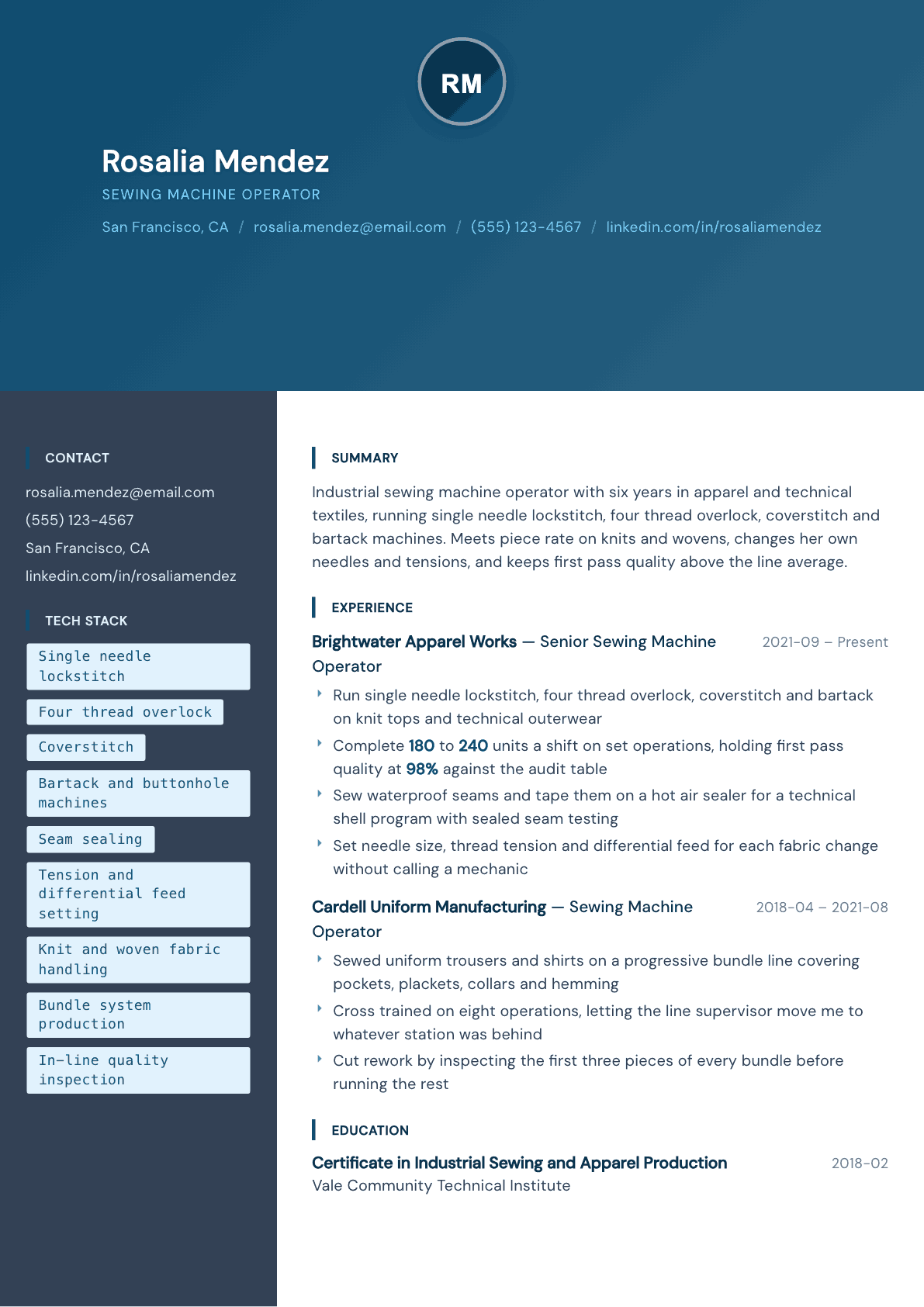
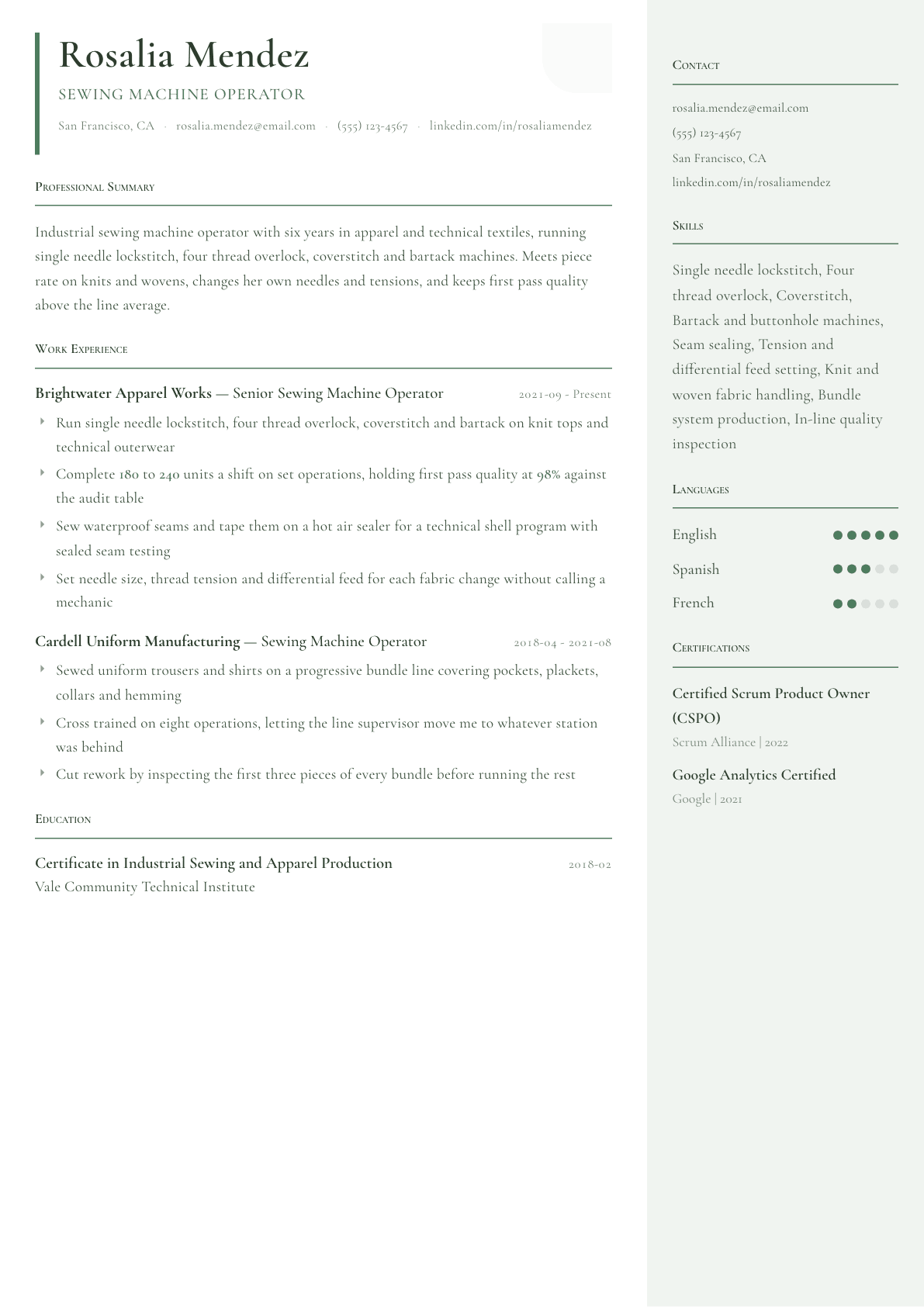
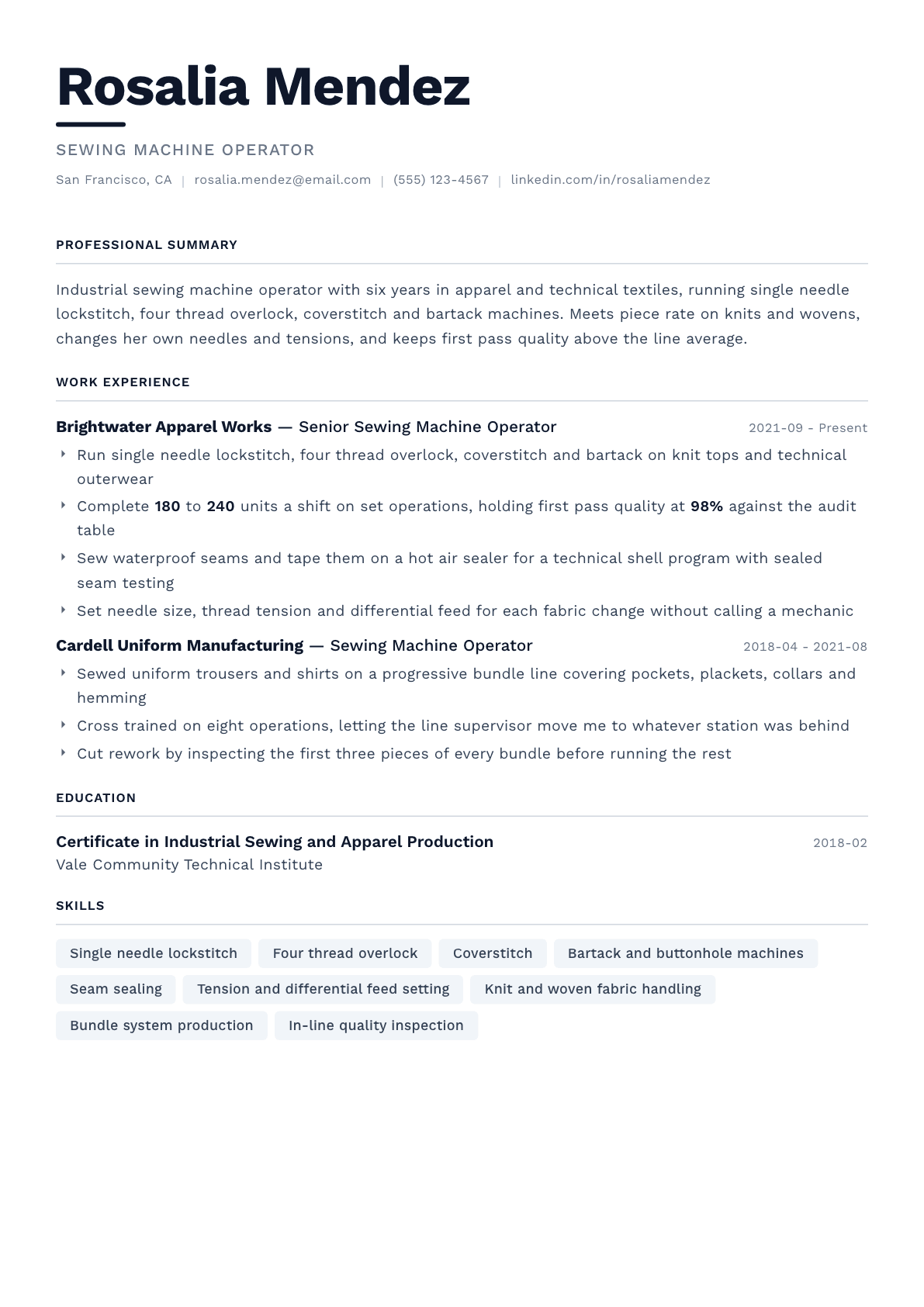
The same sewing machine operator content laid out in three CVBooster templates, so you can see what the finished document looks like before you write a word.
Example Sewing Machine Operator summary
Industrial sewing machine operator with six years in apparel and technical textiles, running single needle lockstitch, four thread overlock, coverstitch and bartack on knits and wovens. Turns 180 to 240 units a shift on set operations while holding first pass quality at 98% on the audit table. Sets her own needles, tensions and differential feed for each fabric change, and is cross trained across eight bundle line operations.
Skills to list on a Sewing Machine Operator resume
- Single needle lockstitch
- Double needle stitching
- Four and five thread overlock
- Coverstitch and flatlock
- Bartack machine
- Buttonhole and button attach
- Blind hem stitching
- Seam sealing and taping
- Needle and tension setting
- Differential feed adjustment
- Knit and woven handling
- Pattern and marker reading
- Bundle and unit production systems
- In-line quality inspection
- Trimming and thread clipping
What actually gets this resume read
- Name every machine class you run, because a plant hires by machine and not by the word sewing.
- Give your units per shift on a named operation so a supervisor can compare you to the standard.
- State your first pass quality or rework rate, since that is what the audit table records every day.
- Say which fabrics you handle, because knits, wovens, leather and coated technical fabric each need different hands.
- List the operations you are cross trained on, which is what lets a supervisor move you when the line backs up.
- Mention whether you set your own needles, tensions and feed, or wait for a machine mechanic.
How to write a sewing machine operator resume
A plant hiring a sewing machine operator is filling a station on a line that is already running. The line supervisor knows which operation is short, what the standard is on that operation, and how much rework the last operator generated. She reads your resume looking for one thing: whether you can sit down at her machine and make the standard without slowing the bundle behind you.
What she does not learn from "operated sewing machines to assemble garments according to specifications" is anything at all. Machine classes are specific and so are operations. Single needle lockstitch, four thread overlock, coverstitch, bartack, buttonhole, blind hem, walking foot for heavy goods, seam sealing for technical shells. Fabrics are specific too, because handling a slippery knit and handling coated nylon are different pairs of hands.
This guide covers how to present machines and operations so a supervisor can place you, how to write about output and quality honestly, what to do if you learned on domestic machines, and how to describe technical or industrial sewing that is not apparel at all.
Format: machines and operations before anything else
One page. A production floor supervisor is not going to read two. The top of the page carries a machine list and an operation list, and those two lists do more hiring work than the rest of the resume combined.
Write machines by class and, where you know it, by make. Juki, Brother, Pegasus, Kansai, Union Special are names a plant recognizes instantly. Write operations by what the piece needs: setting sleeves, closing side seams, attaching waistbands, topstitching plackets, hemming, binding, attaching zippers, bartacking stress points. The pairing of machine and operation is what tells a supervisor where you fit on her line.
- Contact line: name, phone, email, city, plus the shift you can work and whether you can start immediately.
- Machine list by class and make, marked with the ones you are fastest on.
- Operation list with the garments or products they belong to.
- Fabric list: knits, wovens, denim, leather, coated technical fabric, webbing and elastic.
- Experience: plant or workroom type, product, output per shift and quality result.
Output: give a number a supervisor can compare
Every plant runs to a standard, whether it is paid as piece rate, measured in units per hour, or tracked as efficiency against a time study. Give your number with the operation it belongs to, because units per shift means nothing floating free. Two hundred hemmed knit tops and forty finished technical jackets are both good numbers on the right operation.
If you have worked in a bundle system, say so and say how many bundles you clear. If you have worked cellular or single unit flow, say that instead, because those two floors are organized differently and an operator used to one needs a short adjustment to the other. Mention whether you have ever worked to a time study or been part of a standard being set, since that shows you understand where the number comes from.
Quality: first pass rate, audit results and the rework you prevent
Speed without quality costs a plant more than slow work, and supervisors know it. Give your first pass quality or your rework rate, and name the check that produces it: an in line auditor, an end of line audit table, a random pull from the bundle. If you inspect the first pieces of each bundle before running the rest, that habit is worth writing down, because it is the single most common way experienced operators prevent a whole bundle of scrap.
Say what defects you watch for on your operation: skipped stitches, puckering, uneven seam allowance, needle damage on knits, thread tension showing on the face, twisted plackets. Naming defects is how you show you know the difference between sewing a seam and sewing an acceptable seam.
- First pass quality or rework rate, with the audit method that measured it.
- The specific defects your operation is prone to and how you catch them early.
- Any bundle or lot you stopped before it ran, and what you found.
- Whether you sign off your own work or hand it to an inspector.
- Experience with customer or brand specification sheets and how tightly they are enforced.
Machine handling: needles, tension and the mechanic question
One line separates an operator a plant fights to keep from one it merely tolerates: whether you can set your own machine. Changing needle size and point type for the fabric, setting thread tension top and bobbin, adjusting differential feed for a stretchy knit, changing a folder or a binder attachment, clearing a jam and rethreading without calling anyone. Say plainly which of those you do yourself.
If you do basic maintenance, list it: oiling, cleaning lint from the hook area, changing a broken needle plate, replacing a bobbin case. Plants have a limited number of mechanics and every call to one stops a station. An operator who handles the routine adjustments keeps her own line moving.
Cross training, technical sewing and the words plants search on
Cross training is a hiring argument all by itself. List every operation you can run to standard, not just your main one, because a supervisor values an operator she can move to whichever station is behind. Say how many operations you hold and how quickly you have picked up new ones.
If your work is not apparel, use its own vocabulary. Industrial and technical sewing covers upholstery, marine canvas, awnings, safety harnesses, medical textiles, filtration and airbags, and those employers search for walking foot machines, heavy thread sizes, webbing, bar tack strength testing and seam sealing rather than for garment terms. Match the words in the posting: piece rate, bundle, standard allowed minutes, first quality, second quality, line balancing, single needle, overlock, coverstitch.
Sewing Machine Operator resume summary examples
New to the floor
Sewing machine operator trained on industrial single needle lockstitch and three thread overlock, with a certificate covering machine threading, tension setting and basic maintenance. Sews straight and curved seams on knits and wovens, and completed a workroom placement hemming and closing side seams on uniform shirts.
Six years on the line
Industrial sewing machine operator with six years in apparel and technical textiles, running lockstitch, four thread overlock, coverstitch and bartack. Turns 180 to 240 units a shift on set operations while holding first pass quality at 98%. Sets her own needles, tensions and differential feed, and is cross trained on eight operations.
Line lead
Sewing line lead with twelve years, running a fourteen station bundle line and training new operators to standard. Balances the line each morning against the day's order mix, covers any station herself, and works with the mechanic on recurring tension and feed faults. Runs sample sewing for new styles before they go into production.
Work experience bullets: before and after
Before: Operated industrial sewing machines.
After: Ran single needle lockstitch, four thread overlock, coverstitch and bartack machines on knit tops and technical outerwear, covering side seams, hemming, binding and stress point reinforcement.
The machine classes paired with the operations tell a supervisor exactly which stations you can take.
Before: Met daily production targets.
After: Completed 180 to 240 units a shift on set operations, holding first pass quality at 98% against the end of line audit table across a rotating order mix.
Output and quality together are the pair of numbers a plant uses to rank operators, and neither means much alone.
Before: Made adjustments to my machine as needed.
After: Set needle size and point type, top and bobbin tension and differential feed for every fabric change, and cleared jams and rethreaded without calling a mechanic.
Listing the specific adjustments proves independence, which is what keeps a station running when mechanics are stretched.
Before: Checked my work for defects.
After: Inspected the first three pieces of every bundle for skipped stitches, puckering and uneven seam allowance before running the rest, which kept whole bundle rework off the line.
A named inspection habit with the defects it targets shows quality discipline instead of a general claim.
Before: Trained on different sewing operations.
After: Cross trained on eight operations including pockets, plackets, collars and hemming, letting the supervisor move me to whichever station fell behind during the shift.
The operation count and the reason it matters turn training into a scheduling advantage a supervisor can use.
Hard skills
- Single needle lockstitch operation
- Double needle and chainstitch work
- Four and five thread overlock
- Coverstitch and flatlock
- Bartack and buttonhole machines
- Blind hem stitching
- Walking foot and heavy goods sewing
- Seam sealing and taping
- Needle selection and tension setting
- Differential feed adjustment
- Folder, binder and guide attachments
- Knit, woven and coated fabric handling
- Pattern piece and marker recognition
- In line quality inspection
Soft skills
- Holding a steady rhythm through a full shift
- Speaking up when a bundle arrives cut wrong
- Learning a new operation quickly when the line changes
- Working shoulder to shoulder without losing focus
- Handling a piece rate day that starts badly without giving up on quality
Mistakes that cost sewing machine operator candidates the interview
- Writing that you operate sewing machines without naming the classes, which leaves a supervisor unable to place you on any station.
- Giving no output number, so nobody can tell whether you make standard or fall short of it.
- Claiming speed with no quality figure behind it, which reads as an operator who generates rework.
- Leaving out fabric types, when handling slippery knits, denim and coated technical fabric are three different skills.
- Hiding whether you set your own tensions and needles, which is the difference between an independent operator and one who idles waiting for a mechanic.
- Using domestic sewing language on an industrial application, since a plant reads home machine terms as inexperience.
Sewing Machine Operator resume questions
I learned on a home machine. Can I still apply for industrial work?
Yes, but be direct about it and lead with what transfers: fabric handling, seam accuracy, reading a pattern and understanding tension. Then say you are ready to train on industrial equipment. Plants train willing beginners regularly, and honesty beats language that pretends to floor experience.
How do I write a resume when I was paid piece rate?
Give your units per shift on your main operations and say what the plant standard was, so a supervisor can read your figure in context. If your earnings consistently ran above standard, describe that as making or exceeding standard rather than quoting pay.
Does technical sewing experience count for an apparel job?
It counts, and often for more than people expect, because heavy goods work builds precision and machine independence. Translate the vocabulary though: talk about seam types, fabric weights and machine classes rather than assuming an apparel supervisor knows harness or canvas terminology.
Should I list how many operations I can run?
Absolutely, because cross training is one of the strongest arguments an operator has. A supervisor balancing a line every morning needs people she can move. Give the count and name the operations rather than saying you are flexible.
What should I say about speed if I am careful rather than fast?
Lead with quality figures and the defects you prevent, then give your honest output. Some plants, particularly in technical textiles and small batch work, deliberately hire for accuracy over volume, and pretending to be fast puts you on a line where you will struggle.
Related resume examples
- Production Worker Resume example
- Assembler Resume example
- Machine Operator Resume example
- Quality Control Inspector Resume example
- Production Operator Resume example
- Manufacturing Associate Resume example