Pharmacy Technician Resume Examples: what gets the call
Pharmacy Technician Resume: Pharmacy Tech Skills and Examples
By Mustafa Tarabya, founder of CVBooster · Published · Updated
Pharmacy tech skills for a resume written out as a ready skills block, with summaries by level, before and after bullets and where certification belongs.
Sample resumes for a pharmacy technician
The same pharmacy technician content laid out in three CVBooster templates, so you can see what the finished document looks like before you write a word.
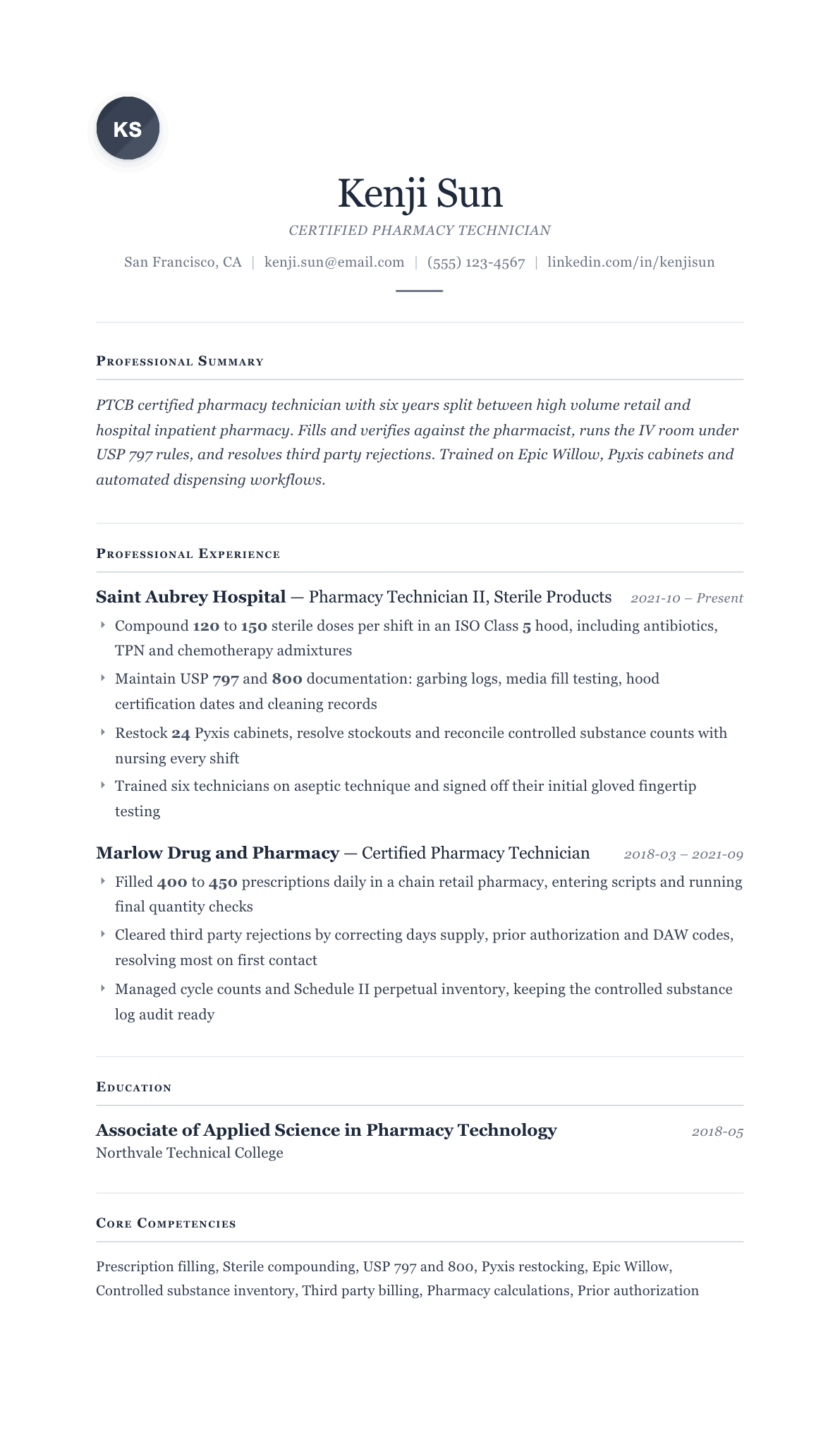
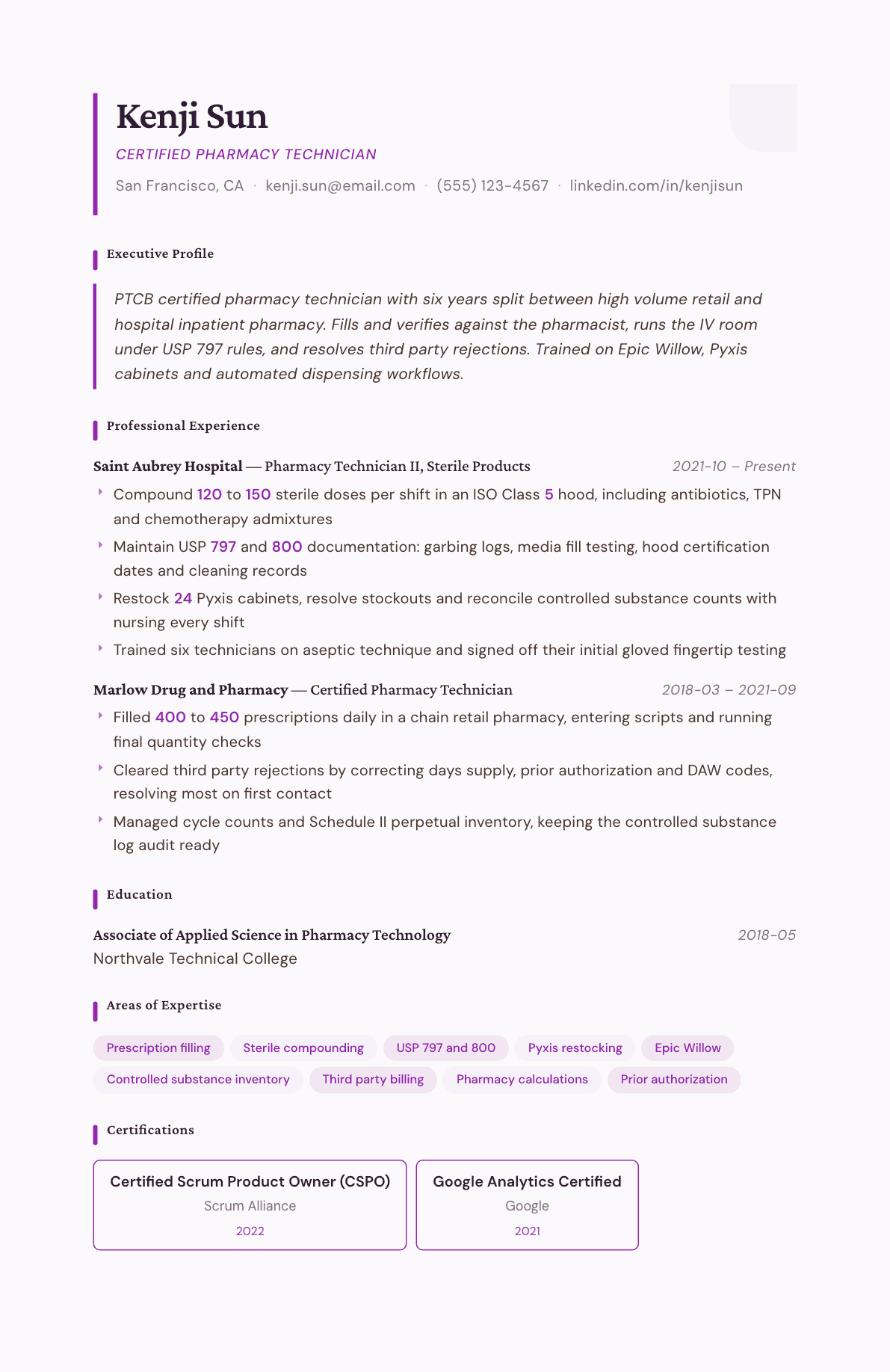
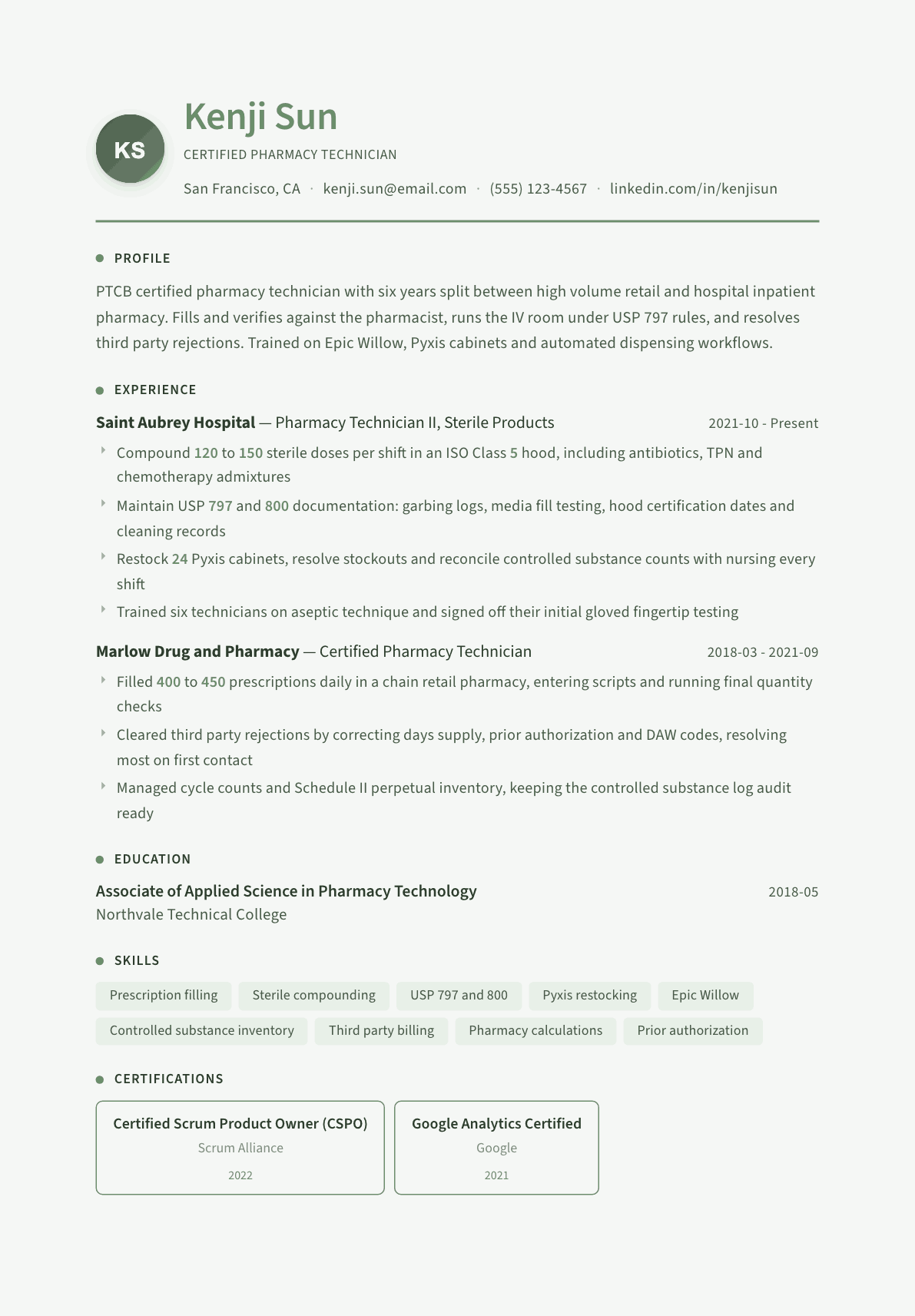
Example Pharmacy Technician summary
PTCB certified pharmacy technician with six years across retail and hospital inpatient pharmacy, filling more than four hundred prescriptions a day in retail and compounding sterile doses in an ISO Class 5 hood. Strong on USP 797 documentation, controlled substance reconciliation and third party rejection resolution. Trained on Epic Willow and Pyxis automation. Looking for a lead technician role in a hospital sterile products team.
Skills to list on a Pharmacy Technician resume
- Prescription intake and entry
- Prescription filling accuracy
- Sterile compounding
- Nonsterile compounding
- USP 797 and USP 800 compliance
- Hazardous drug handling
- Automated dispensing cabinets
- Controlled substance inventory
- Third party insurance billing
- Prior authorization support
- Pharmacy calculations
- Medication reconciliation support
- Inventory and cycle counts
- Pharmacy information systems
- Patient confidentiality
What actually gets this resume read
- Lead with prescription volume per day or doses compounded per shift, because that is the pace a manager is buying.
- Say whether your experience is retail, hospital, long term care or mail order, since the workflows barely overlap.
- List PTCB or ExCPT certification and your state technician registration number status, both of which gate the offer.
- If you have sterile compounding hours, name USP 797 and USP 800 and the hazardous drugs you have handled.
- Show insurance work explicitly: rejection codes, prior authorization follow up and days supply corrections all count.
- Name the pharmacy system and the automation you have run, from Epic Willow to Pyxis and carousel dispensing.
How to write a pharmacy technician resume
Pharmacy technician postings look interchangeable and are not. A chain retail store wants someone who can hold four hundred prescriptions a day and argue a rejection back to an approval. A hospital sterile products room wants someone whose garbing and aseptic technique will survive a media fill test. Long term care wants cart fill accuracy and cycle discipline.
The pharmacist in charge who reads your resume is deciding which of those settings you actually come from, because retraining across them takes months. Everything on the page should make that answer obvious in the first five seconds.
This guide covers the setting-first structure, how to write volume and accuracy bullets that a pharmacist believes, where certification and state registration belong, how a resume for a pharmacy assistant differs, how to present sterile compounding hours so a hospital reads them correctly, and the pharmacy tech skills a resume should list, written out as a block you can copy. Each pharmacy tech resume example below is tagged by level, from a newly certified technician to a lead technician, so you can copy the one closest to your setting.
Format: setting first, certification in the header
One page for under eight years, single column, reverse chronological. Put your certification and state registration status in the header with your name. Both are legally required in most states before you can work a single shift, so a pharmacy manager checks them before reading anything else.
Directly under each job title, add a setting line: chain retail, independent retail, hospital inpatient, sterile products, long term care, mail order, specialty pharmacy or compounding. That single line saves the reader from guessing and stops your retail speed being read as hospital experience.
- Header: name, certification with issuing body, state registration status, contact details, shift availability.
- Section order: summary, certification and registration, experience by setting, technical skills, education.
- Recent graduates add an externship section with the sites and hours completed.
Summary: volume, setting, and the specialty skill
Three lines. Give the settings you have worked, your years, the daily prescription count or doses compounded per shift, and the one specialty skill that separates you: sterile compounding, hazardous drug handling, controlled substance inventory, third party billing or immunization support where your state allows technicians to assist.
If you are moving between settings, say so and name the transferable part. A retail technician heading for a hospital should point at the accuracy record, the inventory work and the systems knowledge rather than hoping the reader builds that bridge.
Experience: throughput, accuracy, and the regulated work
Lead with the throughput bullet. Prescriptions filled per day in retail, doses compounded per shift in sterile products, carts filled per cycle in long term care. This is the number a pharmacy manager uses to compare candidates and the one most resumes leave out.
Then the regulated work, which is where a pharmacist decides whether you are careful. Sterile compounding under USP 797, hazardous drug handling under USP 800, garbing and gloved fingertip testing, media fill validation, hood certification dates, cleaning logs, beyond use dating and segregated compounding areas. In retail the equivalent is Schedule II perpetual inventory, cycle counts, DEA form handling and the controlled substance log.
Then the insurance and billing work, which is real technician skill even though it looks clerical. Rejection resolution, prior authorization follow up, days supply and quantity corrections, dispense as written codes, coordination of benefits and coupon or assistance program processing.
Finish with the automation you have run: Pyxis or Omnicell cabinets, carousel storage, robotic dispensing, packagers and the pharmacy information system itself.
- Name the pharmacy system: Epic Willow, Cerner, Meditech, QS/1, PioneerRx, Rx30, Liberty.
- State the pharmacy type and daily volume for every position, without exception.
- Include any technician training or competency sign-off you have performed for new hires.
Certification, registration and advanced credentials
List the certification with its issuing body and your state board registration or license status, including the expiration cycle if it is current. A pharmacy cannot schedule you without both, and a manager who has to chase either one moves to the next file.
Advanced technician credentials are worth their own lines because they map directly to postings. Sterile compounding and hazardous drug credentials, technician product verification programs where a state authorizes them, and billing and reimbursement credentials each open a different job. Name the issuing body every time.
A resume for a pharmacy assistant follows the same setting-first order with a different credential line. In Canada, pharmacy technicians are regulated in most provinces and register with the provincial regulator after the national qualifying exam, while pharmacy assistants are not regulated and work under the pharmacist and the technician, so an assistant should never call the role technician on the page. An invented example: Daniel Wong, Pharmacy Assistant, city, province, phone, email. Summary: Pharmacy assistant with two years in a busy community pharmacy, handling prescription intake, counting and packaging for pharmacist check, blister pack preparation for long term care clients, insurance billing questions and the front counter. Certificate: pharmacy assistant diploma from a career college, with a placement in a hospital outpatient pharmacy. Skills: Kroll or the posting's own system named exactly, inventory orders and receiving, cash and the prescription pickup counter, confidentiality.
Pharmacy tech skills for a resume: the words postings reuse
Keep the skills list to countable things: prescription entry, filling accuracy, sterile and nonsterile compounding, aseptic technique, automated dispensing cabinet restocking, controlled substance reconciliation, third party adjudication, prior authorization support, inventory cycle counts and pharmacy calculations.
Pharmacy job descriptions reuse the phrases pharmacist supervision, medication safety, patient confidentiality, inventory management, insurance adjudication, aseptic technique and compounding accuracy. Mirror the ones that are true of you once, and prove at least one inside a bullet.
If you are newly certified with no pharmacy job yet, your pharmacy tech skills come from the training program and the externship. List the skills you practiced under a pharmacist, such as prescription entry, counting and labeling, nonsterile compounding and inventory counts, and add the externship site type and hours in the same line so the reader knows where you learned them.
Pharmacy technician resume skills: the list, written out
Pharmacy technician resume skills fall into three groups, and a pharmacist reads them in this order: the regulated technical work, the systems you run, and the people skills that keep a counter or a cleanroom moving. Put the technical and system skills in a skills block under the summary, then prove two or three of them inside your experience bullets with a volume or an accuracy figure.
Below is a skills block for a certified technician with retail and hospital time, written the way it would sit on the page. Delete anything you cannot talk through in an interview and add the exact system names from the posting you are answering.
- Dispensing: prescription intake and data entry, filling and labeling, counting and pouring, unit dose packaging, cart fill, refill and transfer processing.
- Compounding: nonsterile compounding, sterile compounding under USP 797, hazardous drug handling under USP 800, aseptic technique, garbing, beyond use dating.
- Insurance and billing: third party adjudication, rejection resolution, prior authorization follow up, coordination of benefits, manufacturer coupon processing.
- Inventory: ordering and receiving, cycle counts, Schedule II perpetual inventory, expired and recalled drug returns, automated dispensing cabinet restocking.
- Systems: Epic Willow, PioneerRx, QS/1, Pyxis, Omnicell, Parata or ScriptPro counting automation.
- Calculations and safety: pharmacy math, days supply and quantity checks, look-alike and sound-alike drug awareness, HIPAA and patient confidentiality.
- People skills, proved in bullets rather than listed: calm at a busy pickup window, clear with prescribers on the phone, careful under a pharmacist's verification.
Pharmacy Technician resume summary examples
Newly certified
PTCB certified pharmacy technician with a 240-hour retail externship, trained on prescription entry, filling, insurance adjudication and inventory cycle counts in PioneerRx. Comfortable with pharmacy calculations and controlled substance handling under pharmacist supervision. State registration active. Seeking a retail or hospital technician role with structured training.
Five years in
Certified pharmacy technician with five years in chain retail, filling 400 to 450 prescriptions a day and clearing third party rejections on first contact. Owns Schedule II perpetual inventory and monthly cycle counts. Trained on Epic Willow and PioneerRx. Moving toward hospital inpatient work with an interest in sterile compounding.
Lead technician
Lead pharmacy technician with ten years in hospital pharmacy, running the sterile products room and compounding 120 to 150 doses per shift including chemotherapy admixtures. Maintains USP 797 and 800 documentation, trains and signs off new compounders, and coordinates automated cabinet restocking across the building.
Work experience bullets: before and after
Before: Filled prescriptions accurately and quickly.
After: Filled 400 to 450 prescriptions daily in a chain retail store, entering scripts, running quantity and drug utilization checks, and staging for pharmacist verification.
Volume plus the actual steps you own tells a manager both your pace and where your work stops.
Before: Made IV medications in the clean room.
After: Compounded 120 to 150 sterile doses per shift in an ISO Class 5 hood, including antibiotic drips, parenteral nutrition and chemotherapy admixtures.
Air classification, dose count and product types show the exact compounding environment you can step into.
Before: Followed compounding regulations.
After: Maintained USP 797 and 800 records for the sterile suite: garbing logs, media fill results, hood certification dates and daily cleaning documentation.
Naming the standards and the specific documents proves you have lived through an inspection rather than heard about one.
Before: Dealt with insurance issues.
After: Resolved third party rejections by correcting days supply, quantity limits and dispense as written codes, and submitted prior authorization requests to prescriber offices.
The rejection types you can fix are the skill; dealing with insurance describes a category, not an ability.
Before: Counted controlled substances.
After: Reconciled Schedule II perpetual inventory daily and led monthly cycle counts, keeping the controlled substance log ready for board inspection at any time.
Cadence and audit readiness turn a routine count into evidence of the discipline a pharmacist is hiring for.
Hard skills
- Prescription entry and filling
- Sterile compounding
- Nonsterile compounding
- Aseptic technique and garbing
- USP 797 and USP 800 documentation
- Hazardous drug handling
- Automated dispensing cabinet restocking
- Controlled substance reconciliation
- Third party adjudication
- Prior authorization support
- Pharmacy calculations
- Inventory and cycle counts
- Pharmacy information systems
- Medication cart fill and delivery
Soft skills
- Accuracy under counter pressure
- Clear communication with prescriber offices
- Patience with insurance escalations
- Handover discipline between shifts
- Training new technicians
- Escalating to the pharmacist early
Certifications worth listing
- Certified Pharmacy Technician (CPhT) (Pharmacy Technician Certification Board)
- Certified Compounded Sterile Preparation Technician (CSPT) (Pharmacy Technician Certification Board)
- Exam for the Certification of Pharmacy Technicians (ExCPT) (National Healthcareer Association)
- Basic Life Support (BLS) (American Heart Association)
Mistakes that cost pharmacy technician candidates the interview
- Writing pharmacy technician experience without naming the setting, which forces the reader to guess whether you have ever worked inpatient.
- Leaving out daily prescription or dose volume, the one number a pharmacy manager uses to rank candidates quickly.
- Listing certification without the state registration status, when the pharmacy legally cannot schedule you until both are confirmed.
- Describing compounding in general terms instead of naming the air classification, the standards and the documentation you maintain.
- Treating insurance work as clerical filler rather than showing the specific rejection types you resolve.
- Omitting the pharmacy information system and the automation, which are the two things that shorten your onboarding.
- Applying to a hospital with a purely retail resume and never addressing the transition anywhere on the page.
Pharmacy Technician resume questions
What should a resume for a pharmacy assistant include?
Your setting first, community, hospital outpatient or long term care, then the tasks you do under the pharmacist: prescription intake, counting and packaging for check, blister packs, inventory and the pickup counter. Name the pharmacy system, list your assistant certificate and placement, and keep the job title as assistant, because technician is a regulated title in most provinces.
Should I list my prescription volume on a pharmacy tech resume?
Yes, and give a range rather than a single number. Pair it with the setting so a reader understands what the number means, because four hundred retail prescriptions a day and one hundred and fifty sterile doses a shift describe completely different kinds of pressure.
Does certification matter if my state does not require it?
It still helps, because many employers require it regardless of state rules and it is often tied to pay grade. If you are not certified, name the exam you are scheduled for and the date, which tells a manager the file will be complete before your start date.
How do I show sterile compounding experience properly?
Give the air classification of the space, the dose count per shift, the product families you compound, and the documentation you maintain under the current compounding standards. Add your media fill and gloved fingertip testing history, since those are the records an inspector asks for first.
What pharmacy tech skills should I put on a resume?
The skills a posting asks for, named exactly: prescription data entry, insurance adjudication, inventory and controlled substance counts, compounding if you have done it, and the pharmacy system and automation you run. Keep the list to checkable items and prove two or three of them in experience bullets with a number.