Optician Resume Examples: free score, then the gap list
Create an Optician Resume That Shows Dispensing and Lab Skill
By Mustafa Tarabya, founder of CVBooster · Published · Updated
An optician resume example with dispensing, edging and insurance detail, the certifications employers screen for, and a full resume writing guide.
Sample resumes for a optician
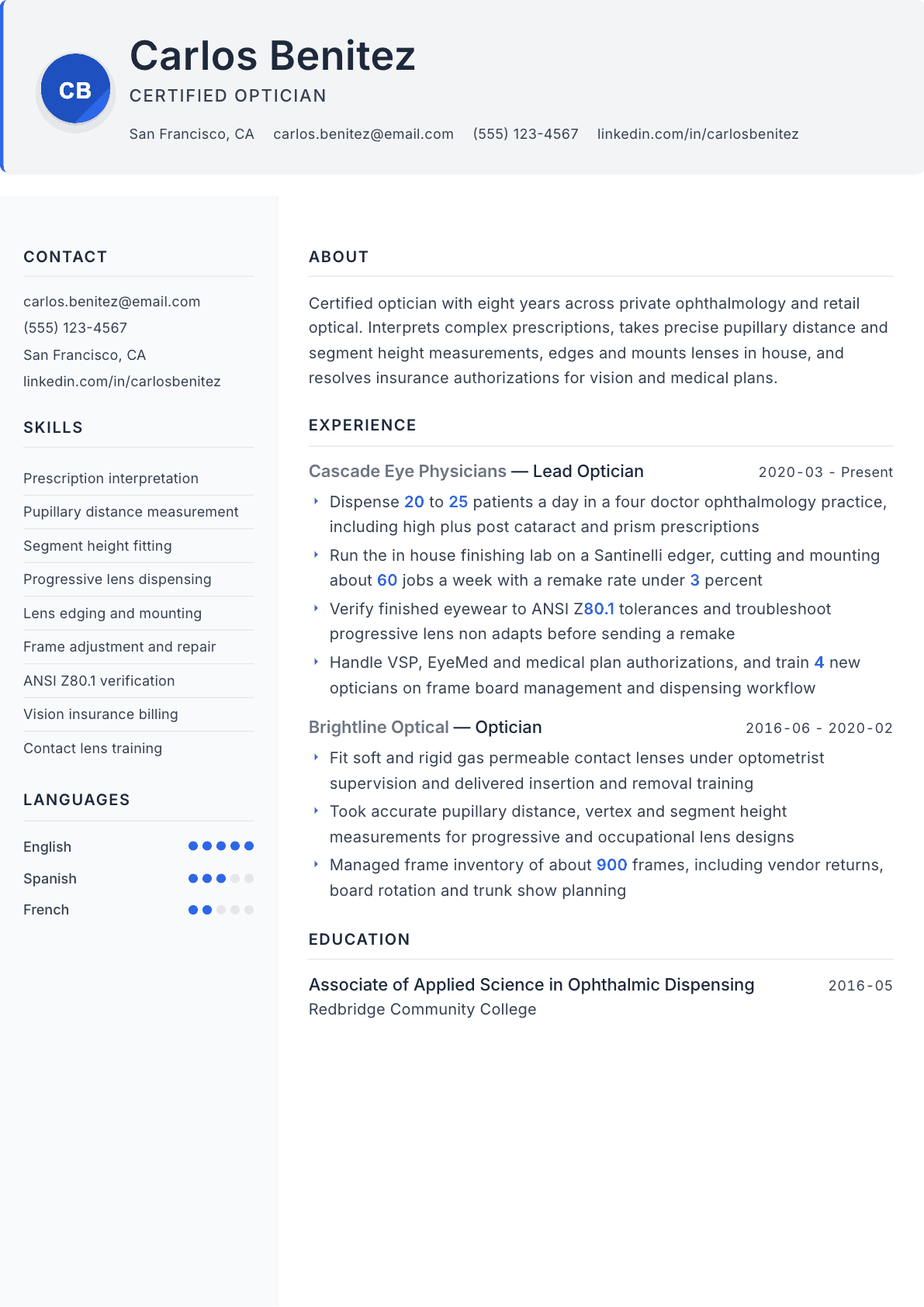
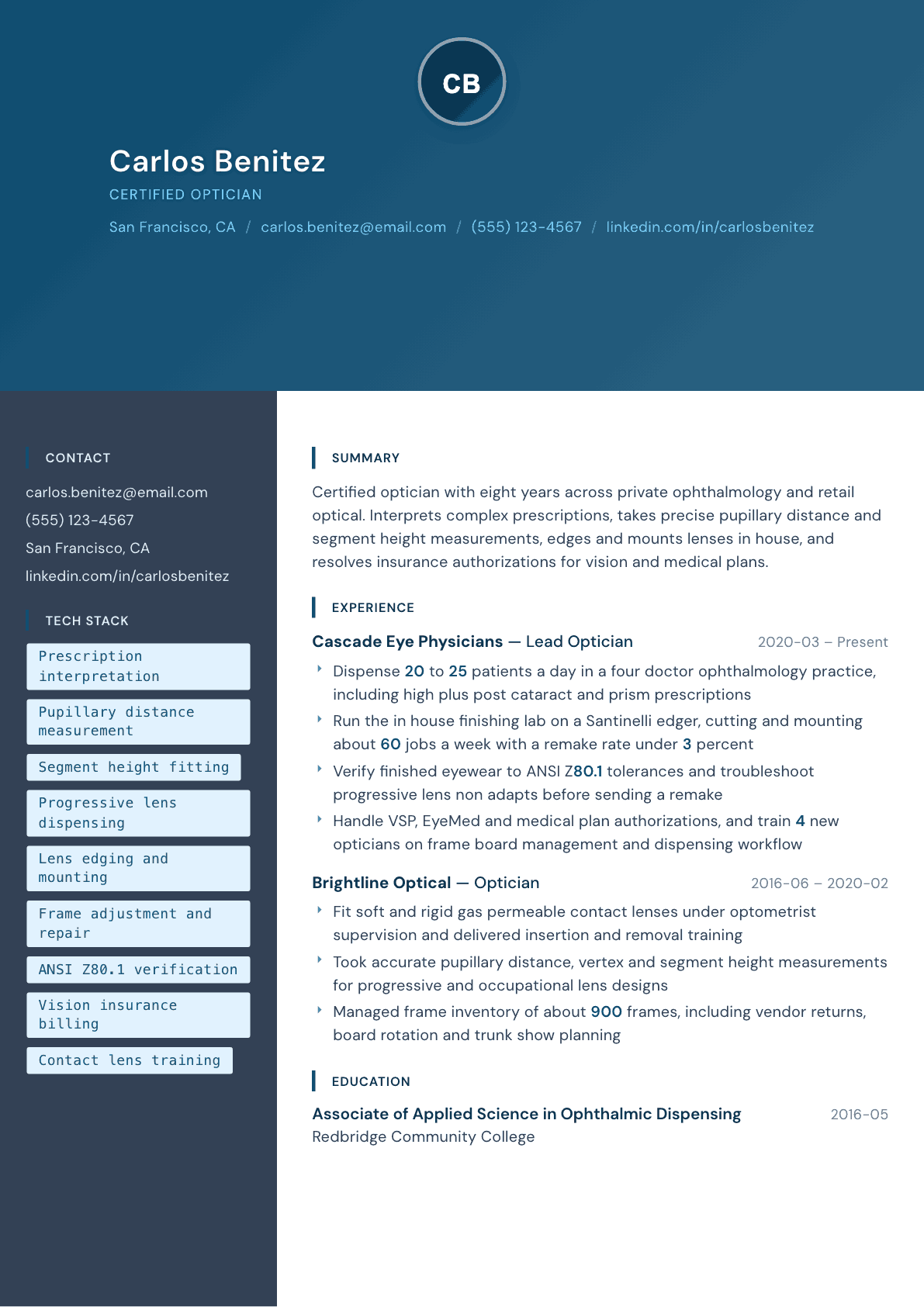
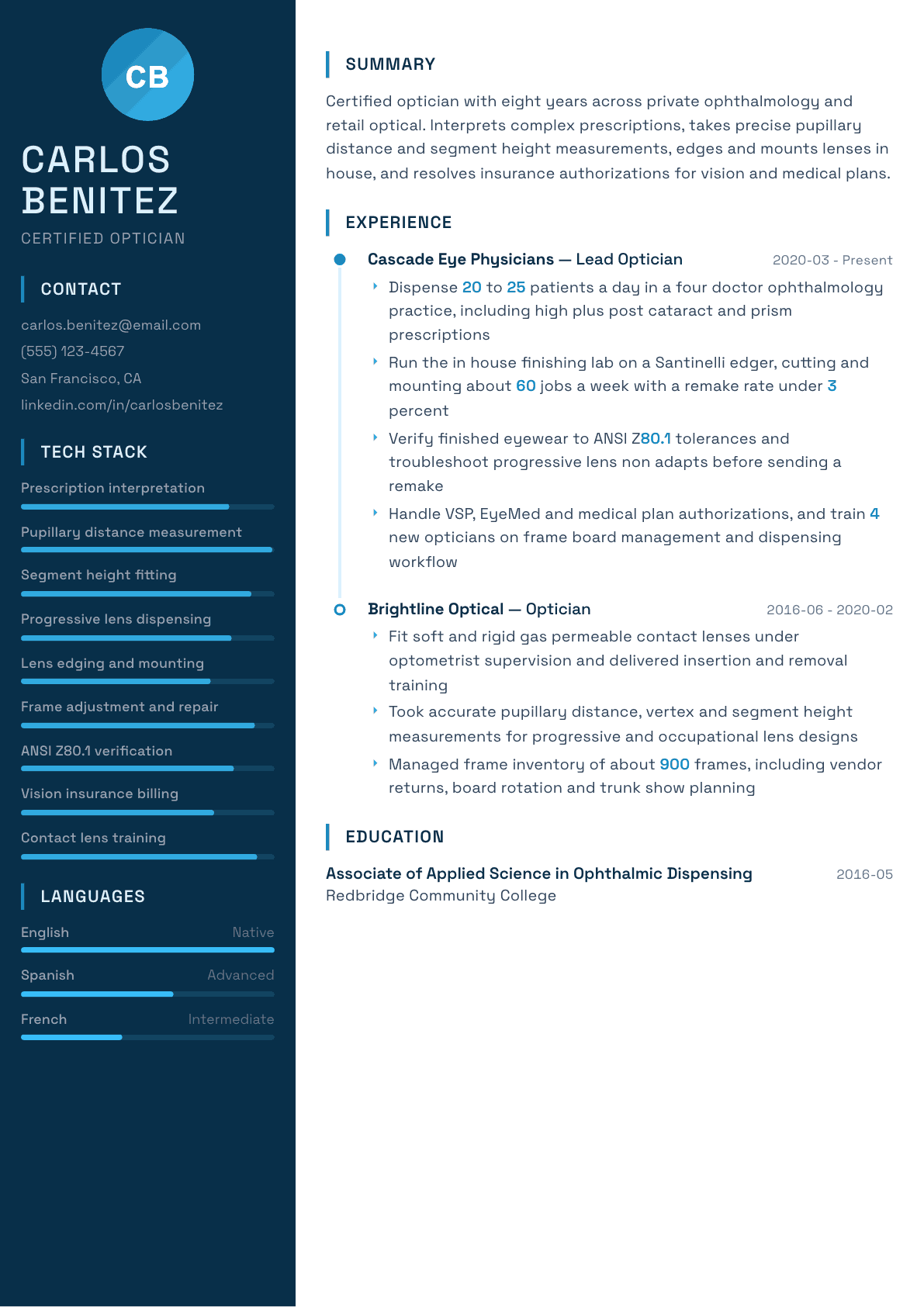
The same optician content laid out in three CVBooster templates, so you can see what the finished document looks like before you write a word.
Example Optician summary
Certified optician with eight years in ophthalmology and retail optical dispensing. Interprets complex prescriptions including prism and post cataract corrections, takes precise pupillary distance and segment height measurements, and finishes lenses in house on an edger. Verifies eyewear to ANSI tolerances, resolves vision and medical plan authorizations, and trains new dispensers on frame selection and non adapt troubleshooting.
Skills to list on a Optician resume
- Prescription interpretation
- Pupillary distance and vertex measurement
- Segment height fitting
- Progressive lens dispensing
- High index and specialty lens selection
- Prism and post cataract prescriptions
- Lens edging and mounting
- Frame adjustment and repair
- ANSI Z80.1 verification
- Lensometry
- Contact lens insertion training
- Vision insurance authorization
- Frame board and inventory management
- Point of sale systems
What actually gets this resume read
- Put your American Board of Opticianry and contact lens certifications with your name, because employers filter on them.
- Say whether you have finishing lab experience, since an optician who can edge and mount is a different hire entirely.
- Name the lens designs you dispense confidently, including progressives, high index, prism and occupational task lenses.
- Show insurance work by plan name, because authorization skill saves a practice more time than most other duties.
- Include remake rate, capture rate or units per day if you tracked them, since optical managers manage on those numbers.
- Distinguish retail optical from medical practice dispensing, because pace, prescriptions and patient mix all differ.
How to write a optician resume
Optician hiring splits along one line more than any other: can you only dispense, or can you also finish. A practice with an in house lab needs someone who can block, edge, mount and verify. A retail optical sending everything to a central lab needs speed at the board, accurate measurements and clean insurance work. Both read the same resume looking for different proof, so the finishing question should be answered in the first few lines.
The second thing a reader checks is complexity. Anyone can dispense a low single vision prescription. Progressives on a high plus post cataract patient, a prism correction, a slab off, an occupational lens for a dental hygienist or a wrap frame with compensated powers are where opticians earn their keep. Naming those tells an optical manager how much of the difficult work you can absorb.
This guide covers the section order optical managers expect, three summaries from an apprentice through a lead optician, before and after bullets from the dispensing table and the lab, and the questions opticians ask when moving between retail and medical practice.
Format: certifications at the top, one page throughout
Put your American Board of Opticianry certification and your contact lens certification directly under your name, along with your state license where your state licenses opticians. Those acronyms are the first filter in states with licensure and a strong preference elsewhere.
Keep the resume to one page. Under the summary, add a capability line covering dispensing, finishing lab, contact lens support and insurance work, so a manager can immediately see which of the four you bring.
- Header: name, certification acronyms, state license status, city and state, phone, email.
- Order: summary, certifications and licensure, capabilities, professional experience, education and apprenticeship, skills and systems.
- Apprentices list registered apprenticeship hours and the supervising optician or optometrist credential.
Summary: setting, complexity, and daily dispensing volume
Three lines. Setting first: private ophthalmology, optometric practice, hospital optical, retail chain or independent boutique. Then complexity: the prescription types you handle comfortably. Then volume: patients dispensed per day and jobs finished per week if you run a lab.
A certified optician dispensing twenty to twenty five patients a day in a four doctor ophthalmology practice, including high plus post cataract and prism prescriptions, while finishing sixty jobs a week in house has answered every screening question in one sentence.
Experience: measurements, lens choices, and the fix
Write bullets around the decisions you make. Taking a pupillary distance is a task; taking monocular pupillary distances, vertex distance, pantoscopic tilt and segment heights for a progressive on a wrap frame is a set of judgments that determines whether the patient adapts. Say which measurements you take and on which lens designs.
Lens selection is the second decision layer. Index choice for a high minus prescription, aspheric design for a high plus, polarized against photochromic for a specific lifestyle, occupational task lenses for a computer distance, and prism handling all belong in bullets. So does recommending against something because it would not work in the chosen frame.
Then show the troubleshooting. A progressive non adapt, a patient reporting swim or distortion, a spatial complaint after a power change, or a persistent frame slip are the daily problems. Describe how you diagnose them: rechecking the finished lens on a lensometer, remeasuring the fitting height, checking the frame adjustment before ordering a remake.
The lab, the verification standard, and the remake rate
If you finish in house, name the equipment. The edger brand, the blocker, the tracer, the drill mount capability and the tinting setup all matter, and so does the material range you cut: polycarbonate, high index, trivex and glass. Rimless drill mounts and groove work on nylon supra frames are specific skills worth naming.
Verification is where quality lives. State that you verify to the ANSI Z80.1 tolerance standard, checking power, cylinder axis, prism, optical center height, and segment placement before dispensing. Then give your remake rate if you tracked it, since that single number tells an optical manager more than any adjective.
- Edger and lab equipment by name, plus the lens materials you cut.
- Verification against the ANSI standard, including what you check on every job.
- Remake rate, and the causes you eliminated to bring it down.
Insurance, inventory and the keywords
Vision plan work is unglamorous and heavily valued. Name the plans you have processed, describe authorization and eligibility checks, and mention where you have coordinated a medical benefit against a vision benefit for a post surgical patient. An optician who resolves authorizations without escalating saves the front desk hours every week.
Add inventory and board work: frame count managed, vendor relationships, board rotation, discontinued returns and trunk shows. Then place the filter words once each: ophthalmic dispensing, pupillary distance, segment height, progressive lenses, lensometry, edging, frame adjustment, contact lens training and vision insurance.
Optician resume summary examples
Apprentice optician
Optician apprentice with 18 months in a three doctor optometric practice, dispensing single vision and entry progressive prescriptions under a certified optician. Takes monocular pupillary distances and segment heights, adjusts and repairs frames, and verifies finished eyewear on a manual lensometer before dispensing.
Certified optician, five years in
Certified optician dispensing 20 to 25 patients a day in a four doctor ophthalmology practice, including high plus post cataract and prism prescriptions. Finishes about 60 jobs a week in house on an edger, verifies to ANSI tolerances, and resolves vision and medical plan authorizations without escalation.
Lead optician
Lead optician with nine years across private practice and retail optical. Runs a two person optical department, manages a 900 frame board with vendor returns and rotation, holds remake rate under 3% through consistent verification, and trains new dispensers on progressive fitting and non adapt troubleshooting.
Work experience bullets: before and after
Before: Helped patients pick out glasses and took measurements.
After: Dispensed 20 to 25 patients a day, taking monocular pupillary distances, vertex distance, pantoscopic tilt and segment heights for progressive and occupational lens designs.
Daily volume plus the specific measurements taken shows technical dispensing rather than frame styling.
Before: Worked in the lab cutting lenses.
After: Cut and mounted about 60 jobs a week on an edger across polycarbonate, high index and trivex, including rimless drill mounts and grooved nylon supra frames.
Weekly volume, materials and the harder mount types tell a practice exactly what lab work you can absorb.
Before: Checked glasses before giving them to patients.
After: Verified every finished pair to ANSI Z80.1 tolerances for sphere, cylinder axis, prism and optical center height, holding a remake rate under 3%.
Naming the standard and the resulting remake rate turns a routine check into a measurable quality outcome.
Before: Dealt with patients who did not like their new progressives.
After: Troubleshot progressive non adapts by relensometering the pair, remeasuring fitting height on the worn frame and correcting pantoscopic tilt before authorizing any remake.
A stated diagnostic sequence proves you solve non adapts instead of reflexively reordering the lenses.
Before: Handled insurance for the optical department.
After: Processed vision plan authorizations and eligibility checks daily and coordinated medical against vision benefits for post surgical patients so claims cleared on first submission.
Benefit coordination and first pass claim success are the parts of insurance work that actually save a practice money.
Hard skills
- Prescription interpretation
- Monocular pupillary distance and vertex measurement
- Segment height and pantoscopic tilt fitting
- Progressive and occupational lens dispensing
- High index and aspheric lens selection
- Prism and post cataract prescriptions
- Lens edging blocking and mounting
- Rimless drill mount and groove work
- Lensometry and ANSI verification
- Frame adjustment and repair
- Contact lens insertion and removal training
- Vision insurance authorization
- Frame board and inventory management
Soft skills
- Reading a patient lifestyle before recommending lenses
- Setting adaptation expectations honestly
- Staying calm with a dissatisfied patient
- Coordinating with doctors on prescription questions
- Training new dispensers
- Attention to detail under a busy schedule
Certifications worth listing
- Certified Optician (ABOC) (American Board of Opticianry)
- Contact Lens Registered (NCLEC) (National Contact Lens Examiners)
- Master in Ophthalmic Optics (ABOM) (American Board of Opticianry)
- Advanced Certification in Contact Lenses (NCLEM) (National Contact Lens Examiners)
Mistakes that cost optician candidates the interview
- Never saying whether you can finish lenses, which is the single biggest hiring variable in optical.
- Describing frame styling and customer service while leaving out measurements and lens design decisions.
- Omitting the certification acronyms from the header in states where licensure depends on them.
- Listing insurance vaguely instead of naming plans and describing authorization and benefit coordination.
- Skipping remake rate, capture rate or dispensing volume when optical managers manage on exactly those numbers.
- Using a general retail sales resume, which buries every technical skill under register and stocking duties.
Optician resume questions
Do I need to be certified to work as an optician?
Some states license opticians and require examination, while others do not regulate the title at all. National certification is widely preferred everywhere because it proves standardized knowledge, so list your status and any examination date you have scheduled.
How do I show lab experience if my practice sends work out?
Say so plainly and emphasize what you do control: measurement accuracy, lens design selection, verification on arrival, adjustment and troubleshooting. Then name any edging coursework or apprenticeship lab hours you completed, since employers will train a willing candidate.
What is the difference between a retail optical and a medical practice resume?
Retail applications emphasize dispensing volume, capture rate, board knowledge and sales support. Medical practice applications emphasize complex prescriptions, post surgical patients, coordination with the physician and medical benefit handling. Rewrite the summary and top bullets for each.
Should I list the frame brands I have sold?
List vendors only if they signal something useful, such as managing a large independent board or handling a premium line with specific fitting requirements. Otherwise spend the space on lens designs and measurement skills, which transfer to any practice.
How do I get into contact lens work as an optician?
Add the contact lens certification and describe any insertion and removal training, follow up support and lens care education you have done under an optometrist. State scope varies, so mirror the wording of the state where you are applying.