Elevator Technician Resume Examples: what gets the call
Elevate Your Career with an Elevator Technician Resume
By Mustafa Tarabya, founder of CVBooster · Published · Updated
Create an elevator technician resume showcasing your installation, maintenance, and modernization expertise for vertical transportation systems.
Sample resumes for a elevator technician
The same elevator technician content laid out in three CVBooster templates, so you can see what the finished document looks like before you write a word.
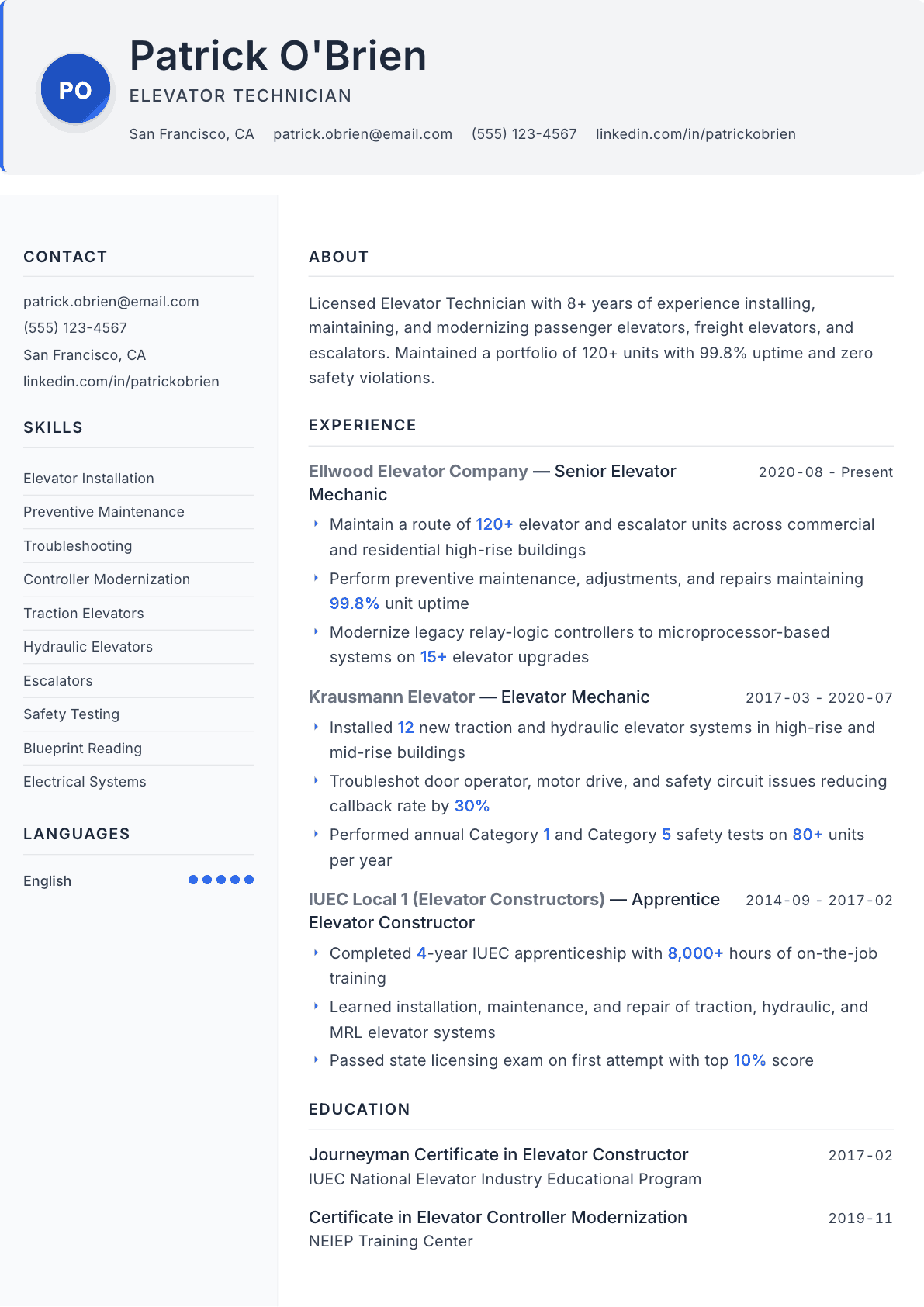
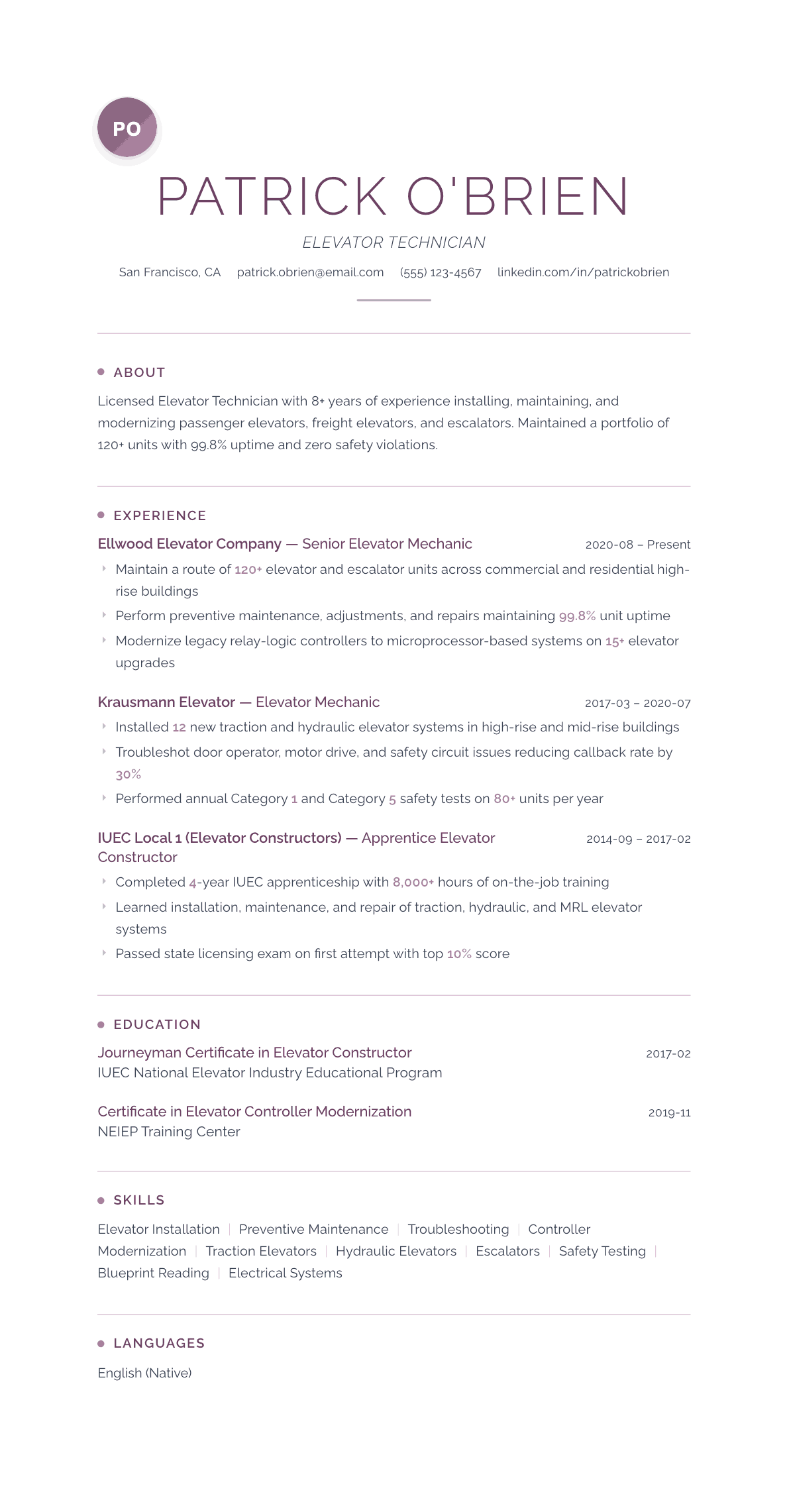
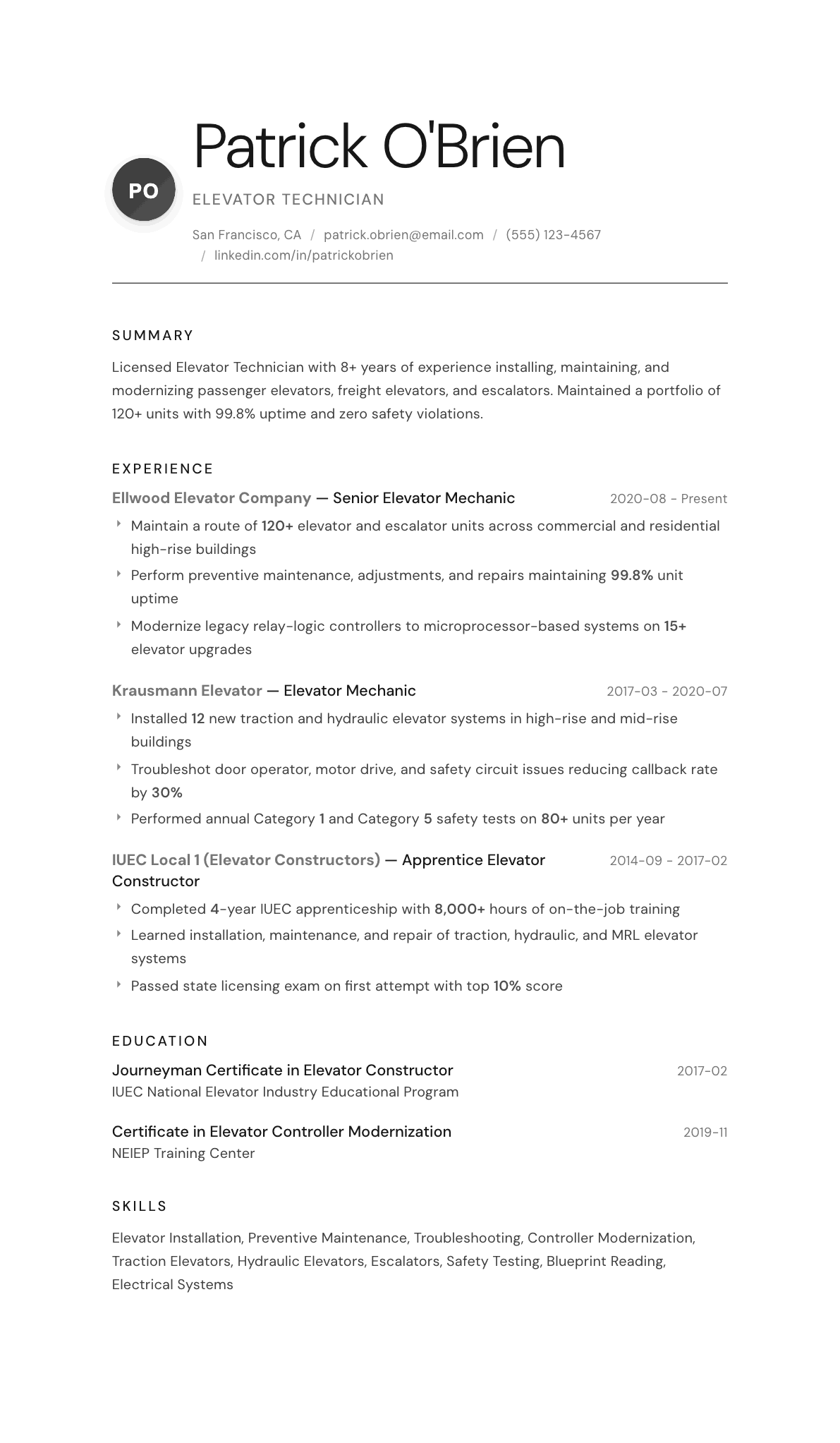
Example Elevator Technician summary
Licensed Elevator Technician with 8 years of experience maintaining 120+ elevator and escalator units with 99.8% uptime. Expert in installation, modernization, and safety testing. Seeking a lead mechanic or service manager position.
Skills to list on a Elevator Technician resume
- Elevator Installation
- Preventive Maintenance
- Troubleshooting & Repair
- Controller Modernization
- Traction Systems
- Hydraulic Systems
- MRL Elevators
- Escalators & Moving Walks
- Safety Testing (ASME A17.1)
- Blueprint Reading
- Electrical Systems
- Motor Drives (VFD)
- Door Operator Repair
- Code Compliance
What actually gets this resume read
- Include your state elevator license and NAEC CET certification prominently.
- Specify elevator types: traction, hydraulic, MRL, freight, escalator, moving walkway.
- Quantify your route: number of units maintained, uptime percentages, callback rates.
- Highlight modernization experience as this is a growing segment of the industry.
- Mention safety testing qualifications: Category 1, 3, and 5 tests per ASME A17.1.
- Include union membership (IUEC) and journeyman status.
How to write a elevator technician resume
Elevator work is one of the most tightly licensed trades in the building industry, and the resume reflects that. The service manager or branch superintendent reading it starts with three questions: what is your license status and in which jurisdiction, did you come through a recognized apprenticeship, and can you be handed a route on Monday without a mechanic riding along.
The second thing they read for is what kind of equipment you have actually touched. Geared and gearless traction, hydraulic, machine room less, escalators and moving walks, plus the controller generation. A technician who has only worked relay logic in older buildings is a different hire than one who troubleshoots current microprocessor controllers and serial door operators.
This guide walks through the resume in the order an elevator company reads it, how to describe a route and a modernization, three summaries from apprentice to adjuster, before and after bullets, and the safety record language that matters in a trade where a mistake is fatal.
Format: license first, then equipment, then the route
One page, reverse chronological. Put license and union status directly beneath your contact details. Many jurisdictions require a state or city elevator mechanic license, and the branch cannot dispatch you without it, so the reader will look for it before anything else.
Follow with an equipment block. List the drive types, the controller manufacturers and generations you have adjusted, the door operator families, and whether you have escalator experience. This is the fastest way to tell a superintendent which route you fit.
- Header: name, city and state, phone, email, elevator mechanic license and jurisdiction, apprenticeship completion.
- Order: summary, license and certifications, equipment experience, work history, education and safety training.
- Name the discipline for each job: construction and installation, service and repair, modernization, or adjusting.
Summary: discipline, equipment, and callback record
Three lines naming your years in the trade, the license, the drive types and controllers, and whether you sit on the construction side or the service side. Those are different careers inside the same trade and the summary should not leave the reader guessing.
End on the number the branch cares about: callbacks per unit per month, or unit availability across your route. An elevator technician whose route runs clean is the one who keeps the building contract renewed.
Experience: route size, unit types, and what you did to them
Every service entry starts with the route: how many units, what buildings, what drive types, and whether the contract was full maintenance or on demand. Give the building context too, because a hospital route with bed elevators and a residential mid-rise route have different response requirements and different overtime.
Then the technical bullets. Preventive maintenance to a defined schedule, brake adjustment, rope and sheave inspection, hoistway and pit cleaning, door operator adjustment and safety edge testing, controller fault diagnosis, valve and packing service on hydraulics, and the required periodic safety tests. Say which test categories you have performed, since regulators check those dates and buildings pay for them.
Modernization deserves its own bullets. Naming the old controller you removed and the new system you installed, wired and adjusted shows the top end of the trade, because adjusting a car to ride correctly is the skill companies are shortest of.
Safety and code: the section that cannot be vague
Nothing on an elevator resume matters more than the safety record. State it plainly: lost time incidents, near miss reporting, and adherence to the company safety program. Reference the safety code for elevators and escalators by its role in your work rather than reciting clause numbers, and name the jurisdictional inspections you have prepared units for.
Show the specific hazard discipline of this trade: top of car operation, pit access rules, hoistway barricading in occupied buildings, lockout on the main line disconnect, working near counterweights, and entrapment release procedure. A technician who writes about passenger entrapment response calmly and correctly reads as trained rather than lucky.
Skills and keywords in elevator job postings
Postings repeat a compact vocabulary: traction, hydraulic, machine room less, escalator, controller troubleshooting, door operator, preventive maintenance, modernization, adjusting, callbacks, and periodic safety testing. Mirror the ones that are true of you once in the skills block and once in the work history.
Name the manufacturers you have serviced and the diagnostic tools you use, including controller interface software, meters, tachometers and vibration measurement for ride quality. Ride quality work is what marks an adjuster, and adjusters are promoted from the field, not hired off the street.
Elevator Technician resume summary examples
Apprentice constructor
Elevator apprentice with 2 years and roughly 4,000 documented hours in a recognized program, assisting on traction and hydraulic installations, rail alignment, wiring and door equipment. Holds current safety training and is preparing for the state mechanic license examination.
Licensed service mechanic
Licensed elevator mechanic with 7 years running a service route of 90 traction and hydraulic units across commercial and residential buildings. Performs preventive maintenance, controller troubleshooting and periodic safety testing, and has held callbacks on the route below one per unit each month.
Modernization adjuster
Elevator technician with 14 years split between service and modernization, adjusting geared, gearless and machine room less equipment for ride quality and door timing. Led controller replacements in occupied high-rise buildings and mentored four apprentices through their license examinations.
Work experience bullets: before and after
Before: Maintained elevators in commercial buildings.
After: Carried a service route of 90 traction and hydraulic units across eight commercial and residential buildings on full maintenance contracts, covering preventive visits, callbacks and scheduled safety testing.
Route size, drive types and contract type describe the workload a superintendent is trying to cover.
Before: Fixed elevator problems when they broke down.
After: Diagnosed intermittent door and safety circuit faults down to the failing relay, encoder or wiring run rather than swapping boards, holding callbacks on the route below one per unit each month.
The diagnostic approach plus the callback figure is exactly how service performance is judged internally.
Before: Worked on elevator modernization projects.
After: Replaced relay logic controllers with microprocessor systems on 15 units in occupied buildings, wiring the new controller, tying in fire service and adjusting ride and door timing before turnover.
Naming the old and new systems and the adjusting work shows the full scope, not just demolition and install.
Before: Followed all safety procedures on the job.
After: Worked top of car and in the pit under lockout of the main line disconnect, barricaded hoistway openings in occupied lobbies, and completed passenger entrapment releases to procedure with no injuries.
A concrete safety practice with the specific hazards of the trade beats a general claim of compliance.
Before: Did required inspections and tests.
After: Performed and documented annual and five-year periodic safety tests including buffer, governor and safety device testing, and prepared units for jurisdictional inspection with no outstanding violations.
Naming the test categories and the inspection outcome proves regulatory competence rather than attendance.
Hard skills
- Traction elevator maintenance
- Hydraulic elevator service
- Machine room less systems
- Escalator and moving walk service
- Controller troubleshooting
- Door operator adjustment
- Ride quality adjusting
- Rope, sheave and brake inspection
- Periodic safety testing
- Fire service and emergency operation
- Electrical schematic reading
- Modernization installation
Soft skills
- Building manager communication
- Calm entrapment response
- Working at height and in confined spaces
- Accurate maintenance record keeping
- Mentoring apprentices
- On-call availability
Certifications worth listing
- Certified Elevator Technician (CET) (National Association of Elevator Contractors)
- Certified Accessibility and Private Residence Lift Technician (CAT) (National Association of Elevator Contractors Education)
- Qualified Elevator Inspector (QEI) (National Association of Elevator Safety Authorities International)
- Mechanic license for elevators (State or municipal licensing authority)
- OSHA 30-Hour Construction (Occupational Safety and Health Administration Outreach Training)
Mistakes that cost elevator technician candidates the interview
- Leaving out the license and the jurisdiction, which stops the file before a superintendent reads a single bullet.
- Not saying whether your background is construction, service, modernization or adjusting, since branches staff those separately.
- Describing the buildings without ever giving the number of units on the route.
- Skipping the controller manufacturers and generations, the detail that predicts how quickly you can be productive.
- Treating safety as a closing line rather than showing the specific hoistway, pit and lockout practice you follow.
- Omitting apprenticeship hours, which the trade treats as a formal qualification rather than a nice detail.
Elevator Technician resume questions
Do I need a license to put elevator technician on my resume?
In most jurisdictions yes, and the resume should state the license type, the issuing authority and the status. If you are still an apprentice, say so with your documented hours and the license examination you are working toward rather than blurring the difference.
How do I show apprenticeship hours on an elevator resume?
Give the program name, the years served and the approximate documented hours, then list the disciplines you covered such as installation, wiring, door equipment and maintenance. Employers treat those hours as the qualification, so they belong near the top rather than buried in education.
What is the most valuable experience to highlight?
Adjusting. Companies can find people to change parts, but technicians who can dial in ride quality, door timing and controller parameters after a modernization are scarce, so lead with that if you have it.
Should I include callback numbers on my resume?
Yes if your branch tracked them and you can quote them accurately. Callbacks per unit each month is the standard service measure in this trade, and a route that runs clean is the single strongest evidence that your preventive work is real.
Does escalator experience belong on the same resume?
Absolutely, and list it separately from elevator work. Step chains, handrail drives, comb plates and safety switches are a different maintenance discipline, and branches with transit or retail contracts hunt specifically for people who have done it.
Related resume examples
- Maintenance Technician Resume example
- Electrician Resume example
- Building Maintenance Worker Resume example
- Elevator Mechanic Resume example
- Plumber Resume example
- Industrial Maintenance Technician Resume example