Legislative Assistant Resume Examples: read this first
Advance Your Political Career with a Legislative Assistant Resume
By Mustafa Tarabya, founder of CVBooster · Published · Updated
Create a legislative assistant resume that showcases your policy expertise, constituent relations, and legislative drafting skills.
Sample resumes for a legislative assistant
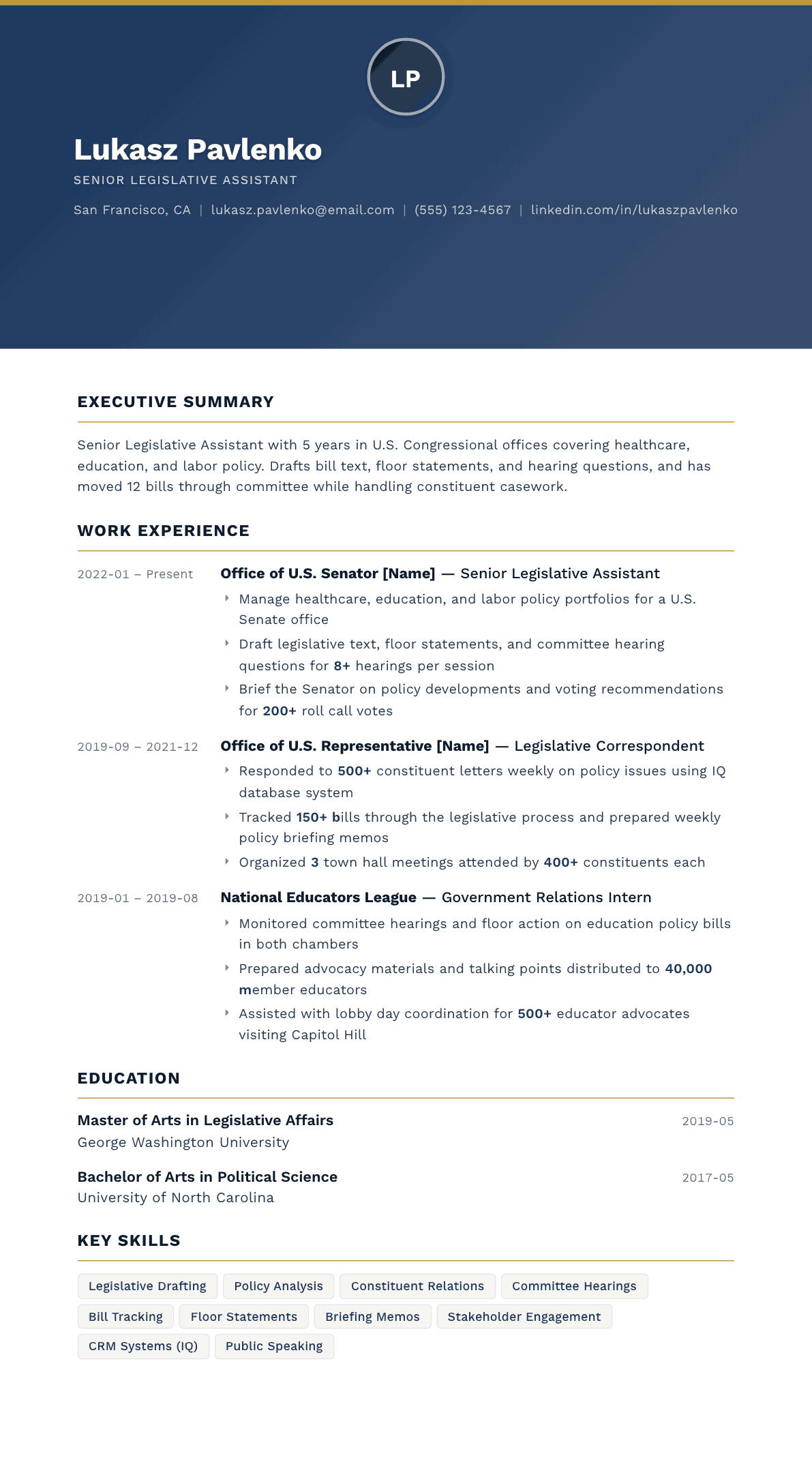
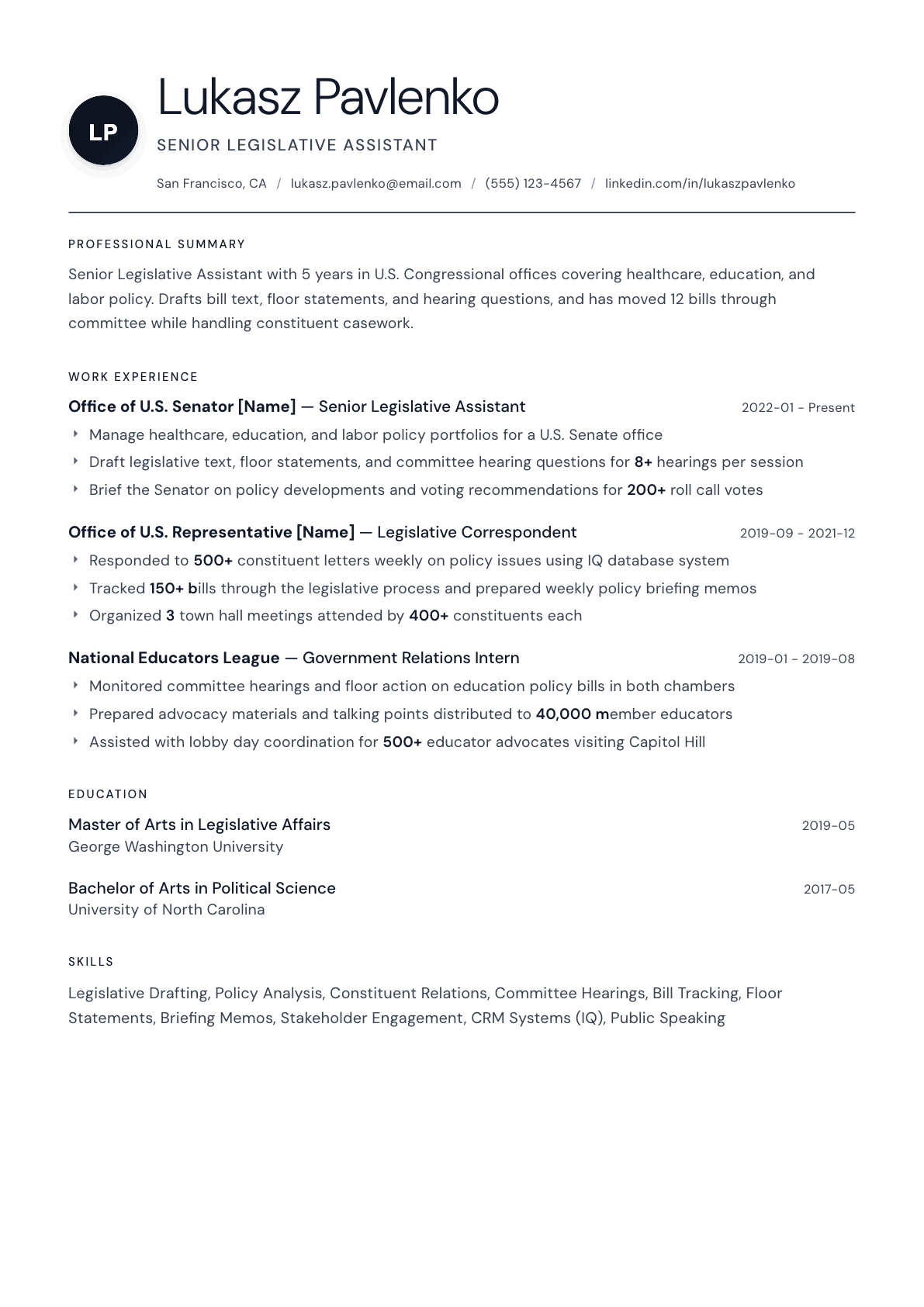
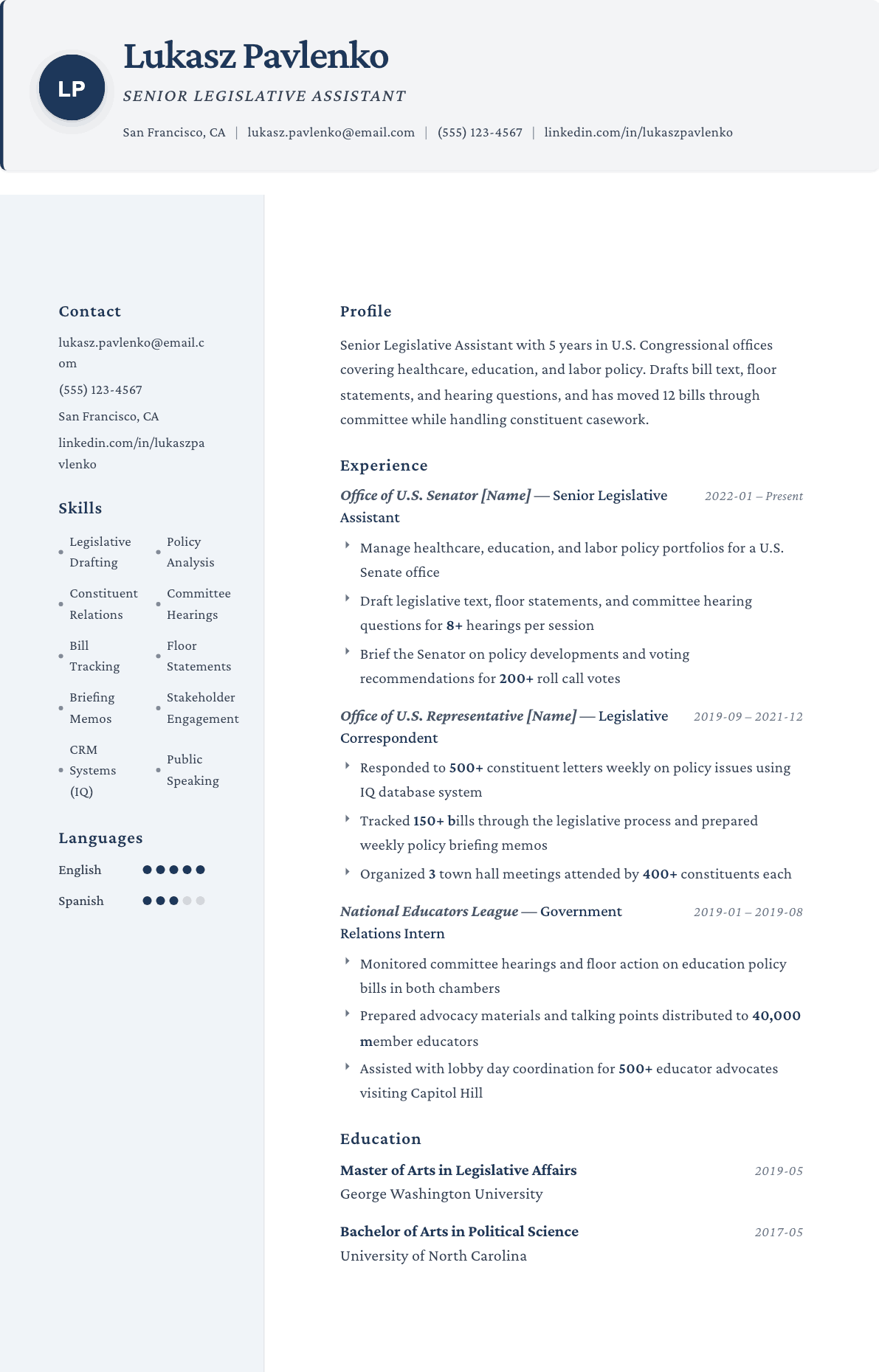
The same legislative assistant content laid out in three CVBooster templates, so you can see what the finished document looks like before you write a word.
Example Legislative Assistant summary
Senior Legislative Assistant with 5 years of Capitol Hill experience managing healthcare and education policy portfolios. Drafted legislation, prepared committee hearing materials, and responded to 500+ constituent inquiries weekly. Seeking a legislative director or senior policy role in Congress or government affairs.
Skills to list on a Legislative Assistant resume
- Legislative Drafting
- Policy Analysis
- Constituent Services
- Committee Operations
- Bill Tracking
- Floor Procedures
- Briefing Preparation
- Stakeholder Engagement
- Coalition Building
- Media Relations
- CRM Systems (IQ, Quorum)
- Public Speaking
- Research & Writing
- Advocacy
What actually gets this resume read
- Highlight specific policy areas you cover and the legislation you have helped advance.
- Quantify your constituent engagement: letters answered, town halls organized, casework resolved.
- Show progression from intern or LC to legislative assistant. Hill hiring values loyalty and growth.
- Include committee hearing experience: questions drafted, witnesses prepped, statements written.
- Mention bipartisan collaboration and coalition-building skills.
- List CRM and legislative tracking systems you use (IQ, Quorum, Congress.gov).
How to write a legislative assistant resume
A legislative assistant resume is usually read by a chief of staff or a legislative director who has a stack of them and about forty seconds each. She is checking three things in order: which office or offices you have worked in, which issue portfolio you have carried, and whether someone she trusts can vouch for you. Hill hiring runs on portfolios and referrals more than on formatting.
The mistake that costs candidates interviews is writing the job in the abstract. Legislative work has visible artifacts: bills drafted and introduced, amendments filed, cosponsors recruited, hearing questions written, vote recommendations made, appropriations requests submitted, letters signed by other members. A resume that lists responsibilities without naming any of those reads as if the writer sat near the work rather than doing it.
This guide covers the layout Hill offices expect, how to present an issue portfolio, how to show legislative output without overclaiming credit for a law, how to handle the staff assistant and legislative correspondent progression, and the questions people ask when they move between a personal office, a committee and outside advocacy.
Format: one page, office and portfolio at the top of each entry
One page, and Hill offices mean it. A legislative director hiring for a portfolio wants the whole record visible at once. Keep formatting plain, since resumes circulate as attachments through several hands and often get printed.
Each entry should name the office and the member or committee, the title, and the portfolio in the first line. Personal office of a member on a specific committee, or a subcommittee staff role, tells the reader what jurisdiction you have lived in. The portfolio line, such as health, tax and financial services, is the single most useful piece of information on the page.
- Header: name, city, phone, email. No photo, no summary of career objectives.
- Order: experience, education, skills and systems, and any relevant activities such as campaign work.
- List internships and campaign roles if you are early, since Hill offices treat both as real experience.
Summary or profile: portfolio, chamber, and the committee jurisdiction
If you use a profile at all, keep it to two lines and make them concrete. Name the chamber, the length of Hill service, the issue portfolio, and the committee jurisdiction you have worked within. A legislative assistant covering agriculture and trade for a member of an authorizing committee and one covering judiciary and immigration for a leadership office do very different work.
If you are entering from a campaign, a state legislature, an agency or an advocacy organization, name the crossing and lead with what transfers: bill analysis, coalition work, constituent facing communication, research under deadline, and any experience tracking a chamber calendar. Hill offices hire outsiders regularly, but they want to see that you understand the legislative process rather than just the policy.
Experience: legislative output, not legislative activity
Name the products. Bills you drafted or helped draft and whether they were introduced, amendments filed in committee or on the floor, report language secured, cosponsors recruited and how many, a letter you drafted that other offices signed, an appropriations or community project request submitted, a hearing question set and a witness prepared.
Be careful and accurate about credit. Staff rarely pass laws, and experienced readers know it. Write what you did: drafted the introduced text, negotiated language with the committee, built the cosponsor list, secured a hearing. Claiming to have passed a bill invites a question you cannot answer and Hill circles are small enough that the answer travels.
Vote recommendations and floor work are worth their own lines. Preparing vote recommendations on your issues, writing floor statements, staffing markups, handling a member through an amendment process, and coordinating with leadership staff. That work is invisible to outsiders and immediately legible to the person hiring you.
Constituents, stakeholders and coalitions
Even in a policy role, constituent contact is a real part of the job. Meetings taken with visiting groups, letters answered on your issue areas, a town hall you supported, and casework you coordinated with the district office when it turned into a policy problem. Give volumes where you have them, since offices measure correspondence output.
Stakeholder work should show range, not just access. Advocacy organizations, industry representatives, labor, local officials, agency legislative affairs staff, and the nonpartisan research and scoring bodies that offices rely on. Say when you built a coalition across offices or across the aisle, because bipartisan cosponsorship is one of the clearest signals of competence in this role.
Systems, writing samples and the vocabulary of the job
Name the constituent management and legislative tracking systems you have used, since offices run different ones and onboarding speed matters. Add the research resources you work in daily and any experience with the chamber drafting service or with legislative counsel.
Recurring language in Hill postings includes issue portfolio, bill drafting, vote recommendations, hearing preparation, memoranda, constituent correspondence, coalition building, appropriations requests, and committee jurisdiction. Offices also frequently ask for a writing sample, so keep a memo or a floor statement ready that shows judgment rather than length.
Legislative Assistant resume summary examples
Staff assistant or legislative correspondent
Legislative correspondent in a House personal office answering roughly 900 constituent letters a month across five issue areas, drafting responses for the member signature and briefing the legislative assistant on incoming volume trends. Prior campaign field experience and a political science degree.
Legislative assistant
Legislative assistant in a Senate personal office carrying the health, education and labor portfolio for a member of the authorizing committee. Drafted four introduced bills, prepared vote recommendations on the portfolio, staffed three markups and recruited bipartisan cosponsors on two measures.
Senior legislative assistant or legislative director
Legislative director managing a three person legislative team and the full issue agenda for a House member on two committees. Owns the floor and vote recommendation process, negotiated report language on two appropriations cycles, and moved a bipartisan bill from introduction through committee markup.
Work experience bullets: before and after
Before: Managed a portfolio of legislative issues for the member.
After: Carried the health, education and labor portfolio, tracking committee activity, preparing vote recommendations on 140 roll call votes and briefing the member before each markup.
Named issue areas plus vote and markup work show the actual weekly rhythm of the job.
Before: Helped write and pass legislation.
After: Drafted the introduced text of two bills with legislative counsel, negotiated technical changes with committee staff and recruited 18 cosponsors including 6 from the other party.
It claims the work the writer really did and shows bipartisan reach without overstating authorship of a law.
Before: Prepared the member for hearings.
After: Wrote question sets for eight subcommittee hearings, prepared background memoranda on each witness and staffed the member at the dais through two rounds of questioning.
Volume and the specific preparation products make hearing support a demonstrated skill rather than a duty.
Before: Responded to constituent letters and inquiries.
After: Answered roughly 900 constituent letters a month across five issue areas, wrote the office response templates on two contested bills and flagged sentiment shifts to the legislative director weekly.
Correspondence volume with a policy feedback loop turns routine mail work into intelligence the office uses.
Before: Worked with outside groups and stakeholders.
After: Ran the office meeting schedule with advocacy, industry and local government stakeholders on the portfolio, and built a cross office coalition that produced a 40 signature letter to the agency.
A signature count and a named product show coalition building that a reader can verify.
Hard skills
- Bill and amendment drafting support
- Legislative research and bill analysis
- Vote recommendation preparation
- Committee hearing and markup staffing
- Appropriations and project request submissions
- Policy memoranda and briefing papers
- Constituent correspondence management
- Coalition and cosponsorship building
- Legislative tracking systems
- Constituent relationship management systems
- Floor statement and talking point writing
- Agency legislative affairs liaison
Soft skills
- Discretion with a member position
- Working to an unpredictable chamber calendar
- Rapid written turnaround
- Bipartisan relationship building
- Judgment about what reaches the member
Mistakes that cost legislative assistant candidates the interview
- Omitting the issue portfolio, which is the first thing a legislative director looks for and the basis on which offices hire.
- Claiming to have passed legislation, when experienced Hill readers know staff draft, negotiate and organize rather than vote.
- Running to two pages, which signals to an office that the candidate has not worked in a one page culture.
- Leaving off internships and campaign work early in a career, when both are treated as real Hill experience.
- Describing policy views instead of legislative output, which makes the resume read like an application to a think tank.
- Failing to name the chamber and the committee jurisdiction, so the reader cannot place the work you have done.
Legislative Assistant resume questions
How do I get a legislative assistant job without prior Hill experience?
Target legislative correspondent and staff assistant openings first, since most legislative assistants are promoted from inside. State legislative staff, campaign work, agency legislative affairs and advocacy roles all translate, but be ready to enter a step below the title you held elsewhere.
Should I list the member I worked for by name?
Yes. Offices care about the member, the party, the state or district and the committees, because that establishes the environment you worked in. If you are applying while employed and discretion matters, describe the office generically and be explicit with the recruiter separately.
How do I show impact when a bill never became law?
Measure the stages you reached. Introduction, cosponsor count, a hearing held, committee markup, floor consideration, or language folded into a larger package. Everyone in this world knows that most bills do not pass, and progress through the process is the real currency.
Do I need a graduate degree to advance as a legislative assistant?
No. Advancement on the Hill runs on portfolio depth and trust rather than credentials. A law degree or a policy masters helps in specific portfolios such as judiciary, tax or health, and it matters more if you plan to move into a committee or an agency role later.
What writing sample should I send with a legislative assistant application?
A short policy memorandum with a recommendation, or a floor statement, rather than an academic paper. Offices want to see whether you can state an issue, lay out options with the political tradeoffs and recommend a course in a page or two under a deadline.
Related resume examples
- Policy Analyst Resume example
- Public Affairs Specialist Resume example
- Diplomat Resume example
- Government Relations Manager Resume example
- Congressional Staffer Resume example
- Legislative Aide Resume example