Private Chef Resume Examples: free ATS score and gap list
Write a Private Chef Resume That Wins Household Clients
By Mustafa Tarabya, founder of CVBooster · Published · Updated
Private chef resume examples, sample menus and client-facing keywords, plus a full writing guide for household and yacht placements.
Sample resumes for a private chef
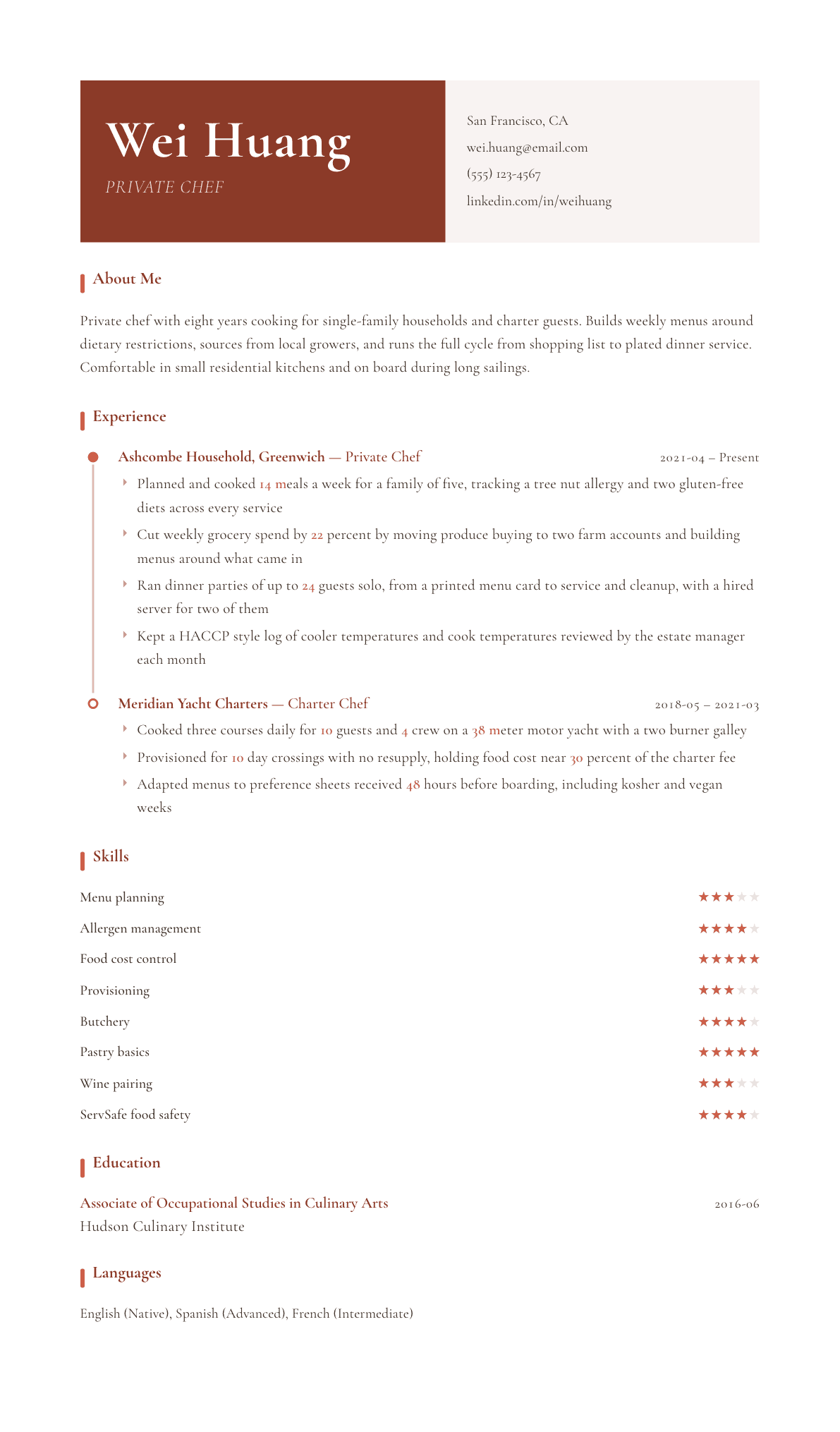
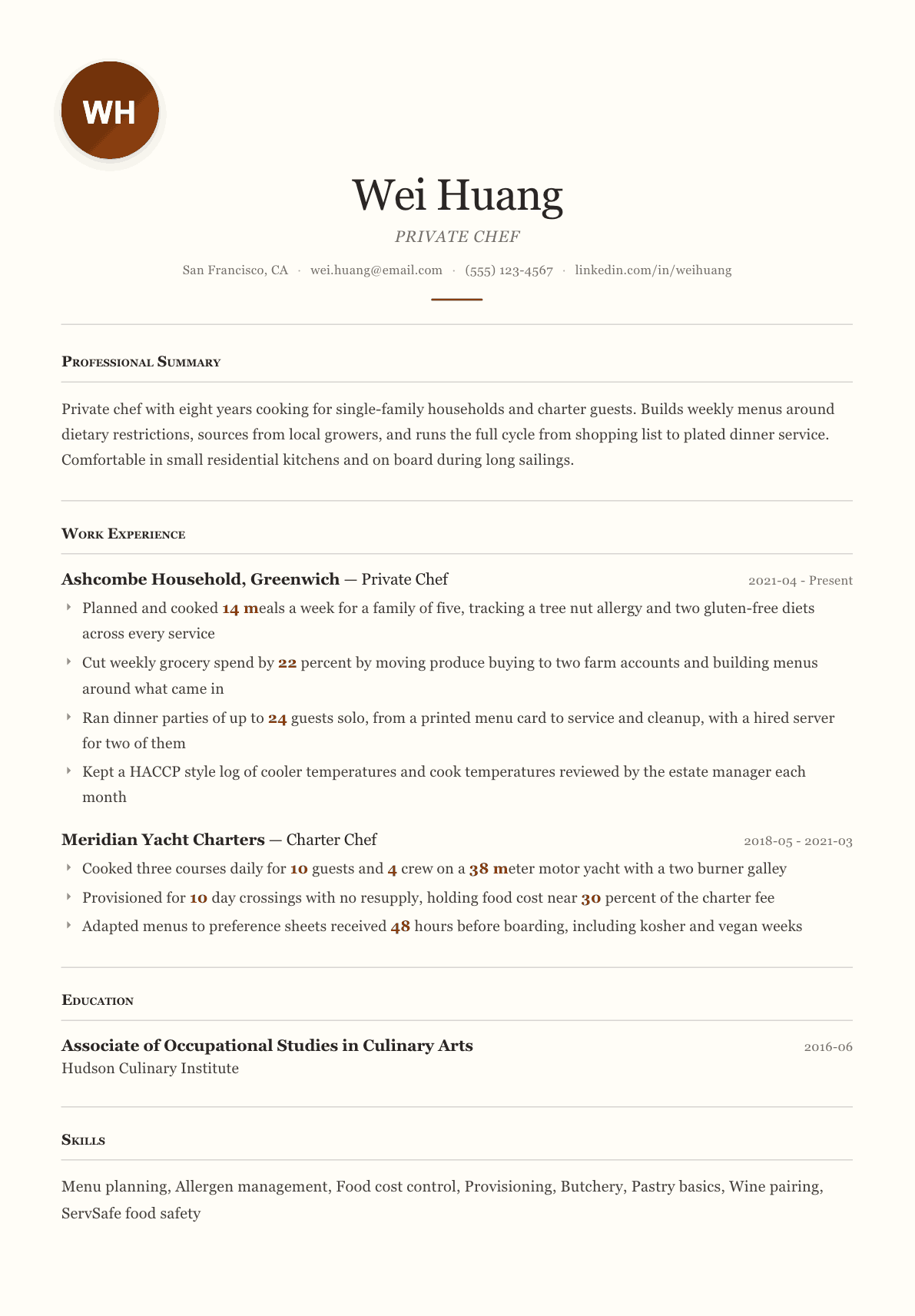
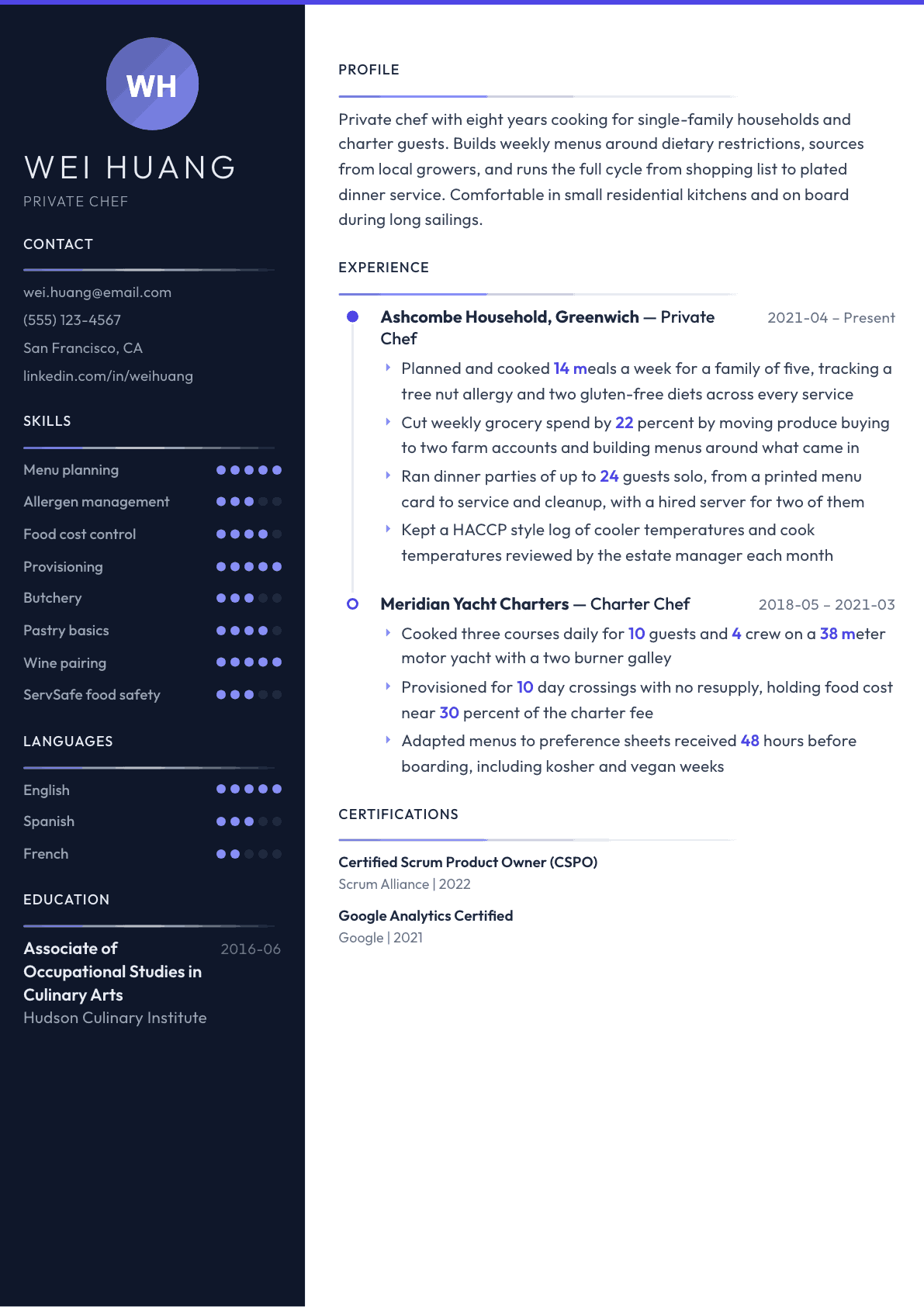
The same private chef content laid out in three CVBooster templates, so you can see what the finished document looks like before you write a word.
Example Private Chef summary
Private chef with eight years in family residences and on charter yachts, cooking daily service for households of four to twelve and dinner parties of up to twenty four. Builds seasonal menus around allergies and preference sheets, provisions and tracks the food budget, and holds a ServSafe Manager certification. Seeking a full time residential placement with travel.
Skills to list on a Private Chef resume
- Menu development
- Allergen and dietary management
- Food cost and budget tracking
- Provisioning and vendor sourcing
- Butchery and fish fabrication
- Sauce work
- Pastry and bread
- Wine and beverage pairing
- Meal prep and batch cooking
- HACCP record keeping
- Kitchen inventory
- Event and dinner party service
- Nutrition and macro planning
- Discretion and client confidentiality
What actually gets this resume read
- Name the household size, the service pattern and the dietary restrictions you cooked around in every placement.
- Show discretion by describing the setting without naming the family, and say that references are available privately.
- List cuisines you can cook to a paying standard rather than every style you have tasted or admired.
- Include provisioning, budget tracking and vendor relationships, because households hire a chef who also runs the kitchen.
- Add yacht, ski chalet or seasonal estate work in its own line, since those employers screen for that pattern.
- Keep a short sample menu on the second page or in the portfolio link so a client can taste the resume.
How to write a private chef resume
A private chef resume is almost never read by a recruiter first. It is read by a principal, an estate manager, a family office assistant or a yacht captain, and each of them is deciding one thing: can this person feed our household every day without becoming a problem. That means the cooking is assumed and the operating detail is what earns the interview.
The households that pay well hire a chef who also runs the kitchen. They want someone who plans a week of menus around a tree nut allergy, buys against a budget, keeps the walk in labeled and dated, cooks a Tuesday family dinner and a twenty four cover party in the same week, and never repeats a story about the last family they worked for.
This guide covers the format agencies expect, how to describe a placement without breaking confidentiality, the sample menu that belongs alongside the resume, and the summaries and bullets that separate a working private chef from a restaurant cook applying sideways.
Format: one page for the resume, a menu page behind it
Reverse chronological, one page if you have fewer than four placements, two if you have more. Placement agencies read a lot of these and they want the household type, the size, the location pattern and the dates in a straight line down the page. Keep it clean and legible in print, because a principal will often be handed a paper copy by the estate manager.
Behind the resume, attach one page holding a sample week of menus or a sample dinner party menu. That page does more selling than the resume itself, because a client can taste your food from it. Keep it to real dishes you cook to a paying standard, with seasonality visible in the choices.
- Header: name, city, phone, email, and a line saying you travel or relocate if you do.
- Order: summary, placements, culinary training, certifications, cuisines, then references available privately.
- A discreet portfolio link with plating photos and a sample menu belongs in the header, not buried at the end.
Describe the placement without naming the family
Discretion is a hiring criterion, not a courtesy. Write the employer as a household or an estate with a region, never a family name, and never a detail that identifies the residence. A line such as household of five, Greenwich, with a summer residence and travel weeks tells the reader everything they need and proves you can be trusted with the next family too.
The same rule holds for charter work. Name the charter company or write it as a motor yacht with the length and the guest and crew count. Preference sheets, guest counts and itineraries are enough detail; guest identities never are.
Close the resume with a single line stating that written references are available on request. Serious clients will ask, and the offer signals that you left previous placements on good terms.
Placements: household size, service pattern, restrictions, budget
Every placement needs four facts in the first line: how many people you cooked for, how many meals a week, what dietary restrictions you cooked around, and whether the household traveled. A chef who cooked fourteen meals a week for five people with a nut allergy and two gluten free diets is answering the exact question the next family has.
Then bullets on the operating side of the job. Sourcing accounts and grower relationships, the weekly grocery budget and how you held it, the cooler and cook temperature logs the estate manager reviewed, provisioning for stretches with no resupply, and dinner parties run solo or with hired service staff. Household clients hire someone who removes the kitchen from their attention completely.
Leave out the tasks that describe cooking itself. Prepared meals and maintained a clean kitchen are true of everyone who has ever held a knife and take the space that a real detail needs.
Cuisines, training and certifications
List the cuisines you can cook to a paying standard on demand, not the ones you have eaten and admired. Four or five honest entries read as confidence. Twelve entries read as a chef who will be caught out in the trial cook, which in this field is a real dinner in a real kitchen with a real family sitting down at the end of it.
Culinary school goes in its own short section with the program and the year of completion. Stages, an apprenticeship under a named chef, or a pastry or butchery course all belong here because they explain where your technique came from. Certifications sit next to it: a food safety manager certification is the standard one, and a valid passport, driver license and clean driving record are worth stating outright for placements that travel.
Keywords household and agency screeners search
Placement agencies keep candidate databases and search them by phrase. The searches that recur are private chef, personal chef, estate chef, household chef, yacht chef, menu planning, dietary restrictions, allergen management, food cost control, provisioning, meal prep, dinner party service, seasonal sourcing and confidentiality. Use the ones that are true of you, in the sentences where they belong, not in a keyword block at the bottom.
The single strongest keyword pattern is the setting itself. Yacht, ski chalet, seasonal estate and family residence are searched as filters because each one predicts a different working life, and a chef with the matching pattern gets called first.
Private Chef resume summary examples
Moving from restaurant line to private service
Line cook of three years in a seasonal farm to table kitchen, moving into private service. Cooks confidently across saute, garde manger and pastry, builds menus from what the market has, and has cooked weekly meal prep for two households on a freelance basis. Food safety manager certified, and available to travel.
Five years in households
Private chef with five years cooking for single family households of four to eight, running fourteen meals a week around nut and gluten restrictions. Sources through two farm accounts, holds the weekly grocery budget, and cooks dinner parties of up to twenty guests solo. Comfortable in compact residential kitchens and on travel weeks.
Estate and charter chef
Private chef with nine years across family residences and charter yachts, cooking daily service for households of up to twelve and provisioning ten day crossings with no resupply. Builds seasonal menus to preference sheets, manages vendor accounts and the food budget, and keeps cooling and cook temperature logs reviewed monthly by the estate manager.
Work experience bullets: before and after
Before: Cooked meals for a private family.
After: Planned and cooked 14 meals a week for a family of five, tracking a tree nut allergy and two gluten free diets across every service.
The meal count, the household size and the named restrictions tell a client whether you have already done their job.
Before: Managed the grocery budget.
After: Cut weekly grocery spend by 22% by moving produce buying to two farm accounts and building menus around what arrived that week.
A number and the method behind it prove you run the kitchen as a business, not only as a stove.
Before: Hosted dinner parties.
After: Ran dinner parties of up to 24 guests solo, from printed menu cards through service and cleanup, with one hired server for two of them.
Guest count and the level of help you needed let a client size the event work you can absorb without extra cost.
Before: Worked on a yacht.
After: Cooked three courses daily for 10 guests and 4 crew on a 38 meter motor yacht with a two burner galley, provisioning for 10 day crossings.
The vessel size, the galley limitation and the resupply gap show a captain that you have cooked under real constraint.
Before: Followed food safety rules.
After: Kept a food safety log of cooler and cook temperatures reviewed monthly by the estate manager, with dated labeling on every prepped container.
Naming the record and who reviewed it turns a claim into a routine somebody else verified.
Hard skills
- Menu development
- Allergen and dietary management
- Food cost and budget tracking
- Provisioning and vendor sourcing
- Butchery and fish fabrication
- Sauce work
- Pastry and bread
- Wine and beverage pairing
- Meal prep and batch cooking
- Food safety record keeping
- Kitchen inventory
- Dinner party and event service
- Nutrition and macro planning
Soft skills
- Discretion
- Adaptability to household routine
- Calm solo service
- Guest reading
- Clear vendor communication
- Self direction
Certifications worth listing
- ServSafe Food Protection Manager Certification (National Restaurant Association)
- ServSafe Allergens (National Restaurant Association)
- Certified Executive Chef (CEC) (American Culinary Federation)
- Certified Personal Chef (CPC) (United States Personal Chef Association)
- STCW Basic Safety Training (International Maritime Organization member state authorities)
Mistakes that cost private chef candidates the interview
- Naming the family you cooked for, which tells the next client exactly how you will talk about them.
- Sending a restaurant resume unchanged, so the reader sees covers and stations but never a household size or a budget.
- Listing fifteen cuisines, none of which survive a trial cook in the client kitchen.
- Leaving out provisioning, sourcing and budget work, which is half of what a household is actually paying for.
- No sample menu anywhere in the application, so the client has no idea what your food tastes like.
- Hiding travel availability at the bottom when travel weeks are the first question a traveling family asks.
- Writing every placement as full time when some were freelance or seasonal, which unravels during reference checks.
Private Chef resume questions
How do I write a private chef resume without naming my clients?
Describe the household by type, size and region instead of by name: household of six in coastal Maine with a winter residence. Give the meal pattern, the restrictions and the budget scope, then add one line offering written references privately on request.
Should a private chef resume include a sample menu?
Yes. Attach one page with a sample week of family meals or a single dinner party menu. Clients hire on food, and a menu page lets them imagine eating at their own table, which no list of previous placements can do.
Can I move from a restaurant kitchen into private chef work?
Regularly, but the resume has to be rebuilt. Translate covers into household meals, stations into menu range, and add anything that shows solo operation: freelance meal prep, private events you cooked alone, sourcing you owned, and a food safety manager certification.
What certifications matter for a private chef?
A food safety manager certification is the baseline and an allergen course backs it up. Culinary school or an American Culinary Federation credential adds weight, and yacht placements will ask for basic safety training and a valid passport before anything else.
How do I show food cost control if the family never gave me a budget?
Show what you tracked instead. Weekly spend you recorded and reported, vendor accounts you opened, waste you cut by menu planning around deliveries, and any comparison you can honestly make between your first months and your later ones.
Related resume examples
- Chef Resume example
- Executive Chef Resume example
- Sous Chef Resume example
- Head Chef Resume example
- Sushi Chef Resume example
- Food Service Manager Resume example