Food Service Manager Resume Examples: what gets the call
Build a Food Service Manager Resume for Contract Dining
By Mustafa Tarabya, founder of CVBooster · Published · Updated
Food service manager resume examples for healthcare, school and campus dining, with budget, compliance and staffing keywords.
Sample resumes for a food service manager
The same food service manager content laid out in three CVBooster templates, so you can see what the finished document looks like before you write a word.
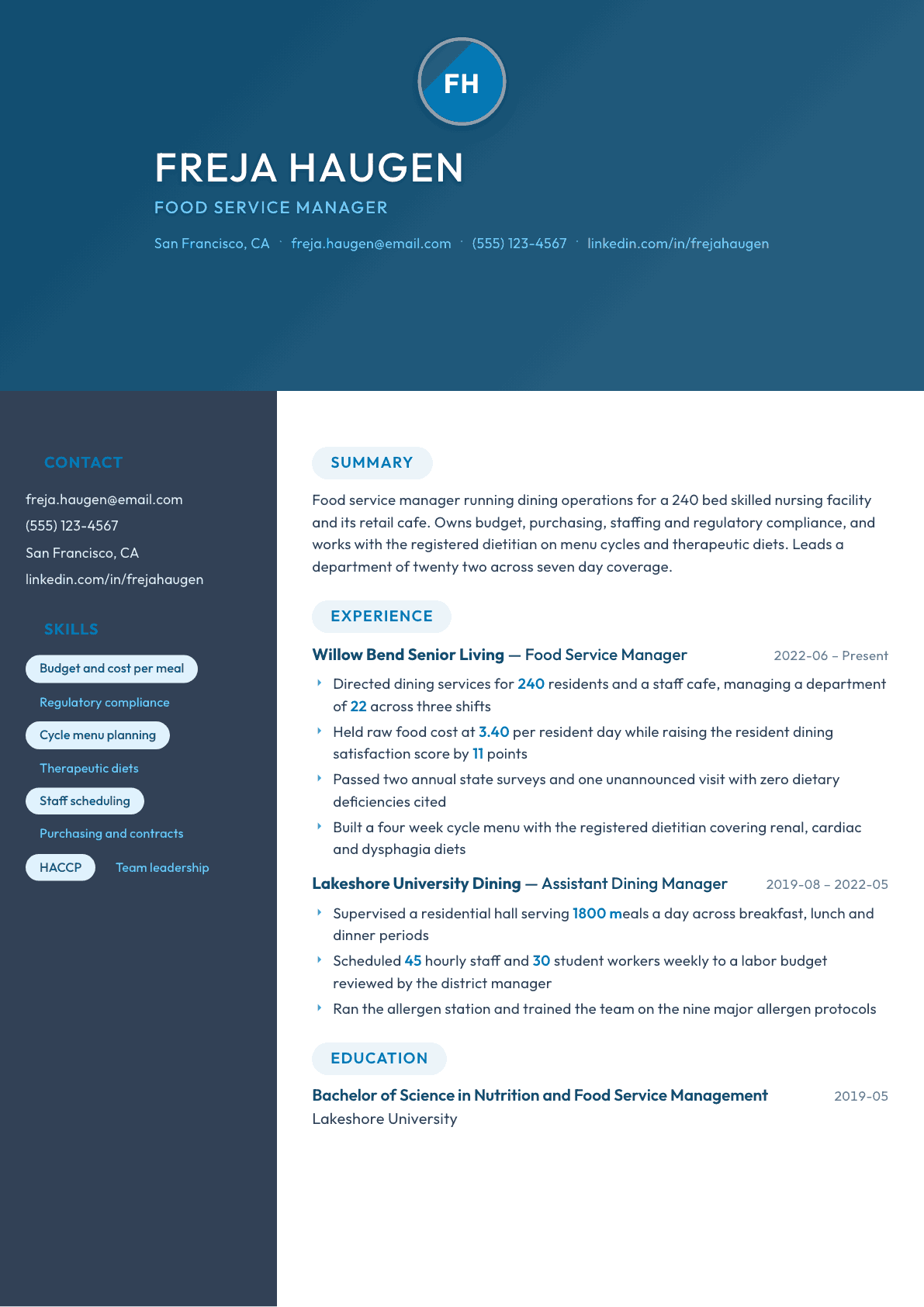
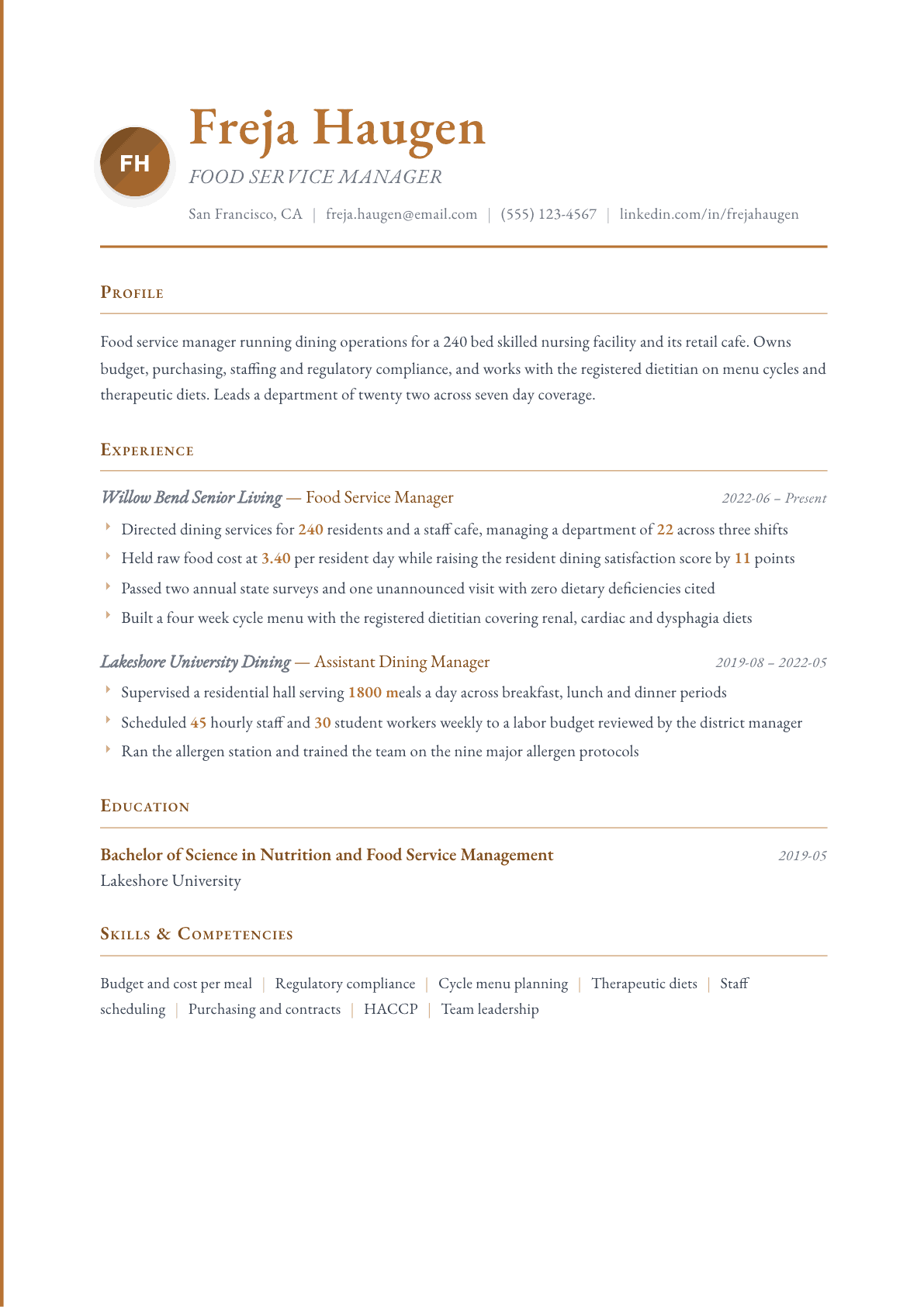
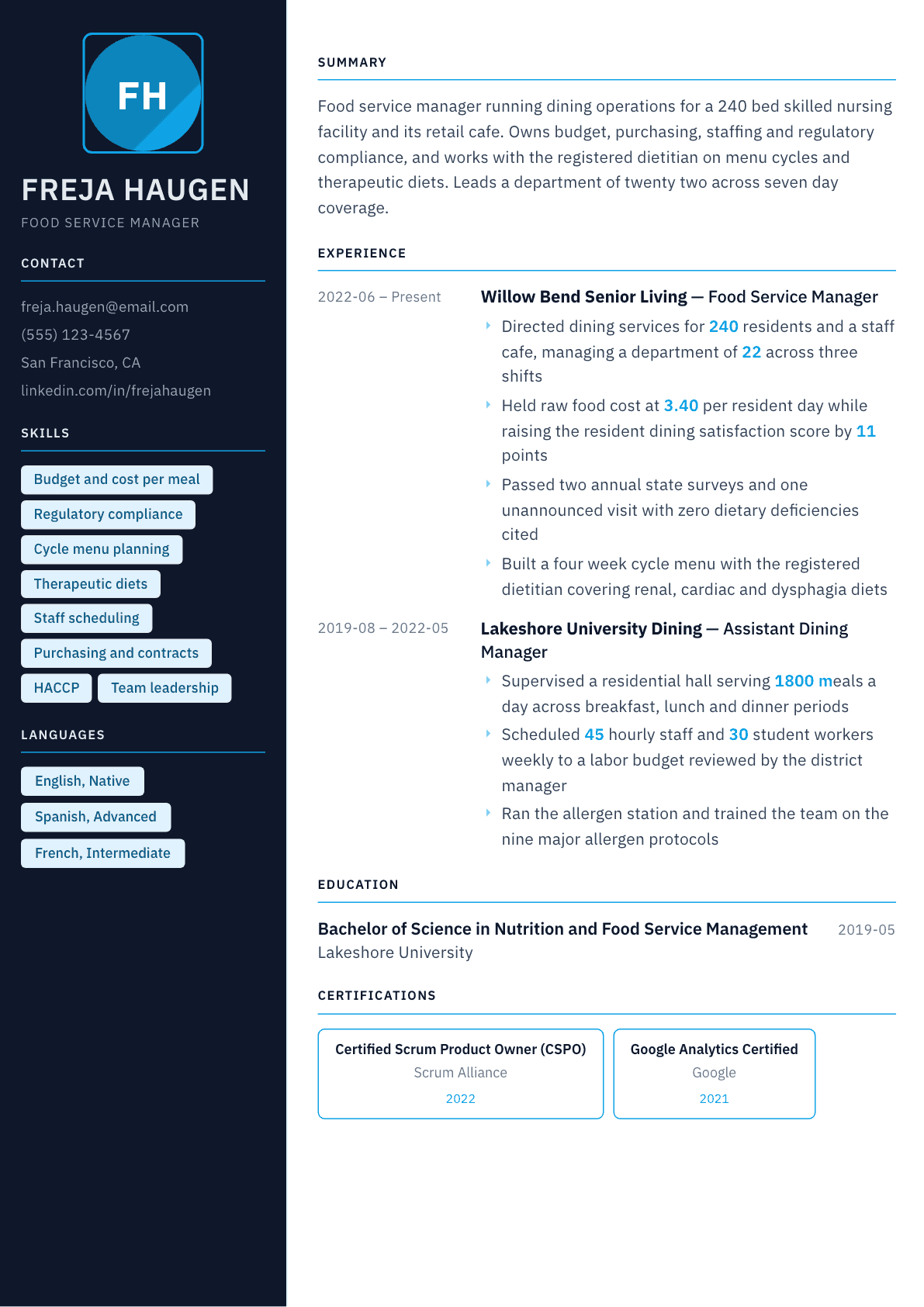
Example Food Service Manager summary
Food service manager with seven years leading dining departments in senior living and campus settings, covering more than eighteen hundred meals a day at peak. Owns budget, purchasing, staffing and survey readiness, and partners with registered dietitians on cycle menus and therapeutic diets. Certified Dietary Manager with a record of state surveys closed without dietary deficiencies.
Skills to list on a Food Service Manager resume
- Dining operations management
- Cost per meal control
- Purchasing and prime vendor
- Cycle menu development
- Therapeutic and texture modified diets
- Regulatory survey readiness
- HACCP and sanitation systems
- Labor budgeting
- Staff scheduling
- Hiring and training
- Inventory management
- Resident and customer satisfaction
- Contract compliance
- Catering and special events
What actually gets this resume read
- State the population you fed and the daily meal count, since contract dining hires against volume and setting.
- Use cost per meal or cost per resident day rather than raw dollar totals, because that is the industry measure.
- Name the survey or inspection body you passed under, whether state, county, Joint Commission or a district audit.
- Show the dietitian relationship if you work in healthcare, because clinical partnership is half the job.
- Include the purchasing group or prime vendor agreement you ordered under and any rebate compliance work.
- Quantify staffing: headcount, shifts covered, turnover reduction and the training program you ran.
How to write a food service manager resume
Food service manager is a contract dining and institutional title, not a restaurant one. The reader is a district manager, a nursing home administrator or a campus dining director, and their questions are narrow: how many people did you feed, what did each meal cost you, did you pass your surveys, and can you keep a department staffed across seven days.
Resumes for this role fail in a predictable way. They read like restaurant management, all covers and guest experience, and never mention cost per meal, cycle menus, therapeutic diets or the regulator. In institutional dining those four things are the job, and their absence tells the reader you have not done it.
This guide sets the numbers the industry uses, shows how to write survey and inspection outcomes, how to describe the registered dietitian relationship in healthcare settings, and how to present purchasing under a group agreement so a district manager can see their own operation in your history.
Format: two pages once you have run a department
Reverse chronological, one page early on and two once you have carried a full department with a budget. Contract dining companies and health systems screen through applicant tracking systems, so a single column with plain headings survives the parse. Save the design instincts for the interview presentation.
Give each employer a setting line before the bullets: a 240 bed skilled nursing facility with a staff cafe, or a residential hall serving eighteen hundred meals a day. Setting plus volume is how this industry sizes a candidate, and it belongs above the achievements rather than buried inside them.
- Order: summary, experience, education, certifications, systems, then a short line on regulatory environments worked under.
- Name the population: residents, patients, students, employees, inmates. Each one changes the job.
- State the department headcount and the number of shifts covered under every management role.
Summary: population, meal volume, budget and compliance
Three lines. Years leading dining operations, the settings, the daily meal count at peak, and the fact that you own budget, purchasing, staffing and survey readiness. Then the credential, because a dietary manager credential is a genuine filter in senior living and healthcare postings.
If you are moving from restaurant management into contract dining, say so and translate. Covers become meals served, food cost becomes cost per meal, and health inspections become surveys. The transferable half is real, but the reader will not perform the translation for you.
Use the industry cost measures, not raw totals
Cost per meal and cost per resident day are the measures this field speaks in. A total budget number tells a district manager nothing they can compare, while a raw food cost per resident day held flat across a year tells them exactly how you operate. Pair the figure with the method: menu engineering, purchasing compliance, waste tracking, production sheets tied to actual counts.
Labor is the other half. Write the department headcount, the shifts and days covered, the labor budget you scheduled against, and what happened to overtime and turnover. Institutional dining runs seven days with no dark nights, so coverage discipline is a real differentiator.
Surveys, dietitians and menus
Name the body you were inspected by: the state survey agency, the county health department, an accrediting organization, or your own company audit. Then the outcome, and if there were findings, the plan of correction you wrote and closed. A manager who has cleared a deficiency is often more credible than one who has never faced one.
In healthcare and senior living, describe the registered dietitian partnership directly. Cycle menu development, therapeutic and texture modified diet implementation, diet order flow from the clinical side to the tray line, and resident food committee input. Clinical partnership is half the job and postings are written by people who know it.
Purchasing rounds it out. The group purchasing organization or prime vendor agreement you ordered under, contract compliance and rebate reporting, and the bid work you did on produce or bakery. Contract dining companies hire against purchasing discipline because it is where their margin lives.
Keywords institutional dining recruiters search
The recurring phrases are food service manager, dining services manager, cost per meal, cycle menu, therapeutic diets, regulatory compliance, state survey, prime vendor, labor budget, food safety systems, certified dietary manager, senior living dining, campus dining, catering operations and staff scheduling.
Match the sector language to the posting. Senior living writes in resident days and surveys, campus dining writes in board plans and retail sales, and healthcare writes in patient satisfaction and diet orders. Using the wrong dialect makes an experienced manager read as an outsider.
Food Service Manager resume summary examples
Supervisor moving into management
Dining supervisor with three years in campus residential dining, scheduling 30 hourly and student staff and running the allergen station. Handles ordering, production sheets and daily temperature records, and covers the manager on duty rotation. Completing a dietary manager credential and ready for a full department seat.
Five years running a department
Food service manager running dining for a 240 bed skilled nursing facility and its staff cafe, leading a department of 22 across three shifts. Holds raw food cost per resident day flat while building a four week cycle menu with the registered dietitian covering renal, cardiac and dysphagia diets. Passed two annual state surveys with no dietary deficiencies.
Multi site director
Dining services leader with ten years across senior living and campus accounts, covering more than 1800 meals a day at peak and a combined department of 60. Owns budget, purchasing under a prime vendor agreement, staffing and survey readiness, and has opened two accounts. Certified Dietary Manager with a clean regulatory record.
Work experience bullets: before and after
Before: Managed the dining department.
After: Directed dining services for 240 residents and a staff cafe, managing a department of 22 across three shifts and seven day coverage.
Population, department headcount and shift coverage size the operation the way this industry actually reads it.
Before: Controlled food costs.
After: Held raw food cost per resident day flat across the year through menu engineering, production sheets tied to actual counts and a waste log reviewed weekly.
Cost per resident day is the measure a district manager compares, and the methods show it was managed rather than lucky.
Before: Passed inspections.
After: Passed two annual state surveys and one unannounced visit with zero dietary deficiencies cited, maintaining the temperature, sanitation and diet order records the surveyor reviewed.
Naming the survey type and the record set turns a claim into something a reader can verify in an interview.
Before: Worked with the dietitian on menus.
After: Built a four week cycle menu with the registered dietitian covering renal, cardiac and dysphagia diets, and rolled it out with training for the tray line and cooks.
The menu structure, the named diets and the rollout show clinical partnership instead of a nodding relationship.
Before: Scheduled the staff.
After: Scheduled 45 hourly staff and 30 student workers weekly to a labor budget reviewed by the district manager, cutting overtime through a fixed weekend rotation.
Headcount, the review relationship and the overtime outcome prove cost control through scheduling.
Hard skills
- Dining operations management
- Cost per meal control
- Purchasing and prime vendor compliance
- Cycle menu development
- Therapeutic and texture modified diets
- Regulatory survey readiness
- Food safety systems
- Labor budgeting
- Staff scheduling
- Hiring and training
- Inventory management
- Resident and customer satisfaction programs
- Catering and special events
Soft skills
- Clinical collaboration
- Steady leadership across shifts
- Documentation discipline
- Resident and family communication
- Coaching supervisors
- Composure during surveys
Certifications worth listing
- Certified Dietary Manager, Certified Food Protection Professional (CDM, CFPP) (Association of Nutrition and Foodservice Professionals)
- ServSafe Food Protection Manager Certification (National Restaurant Association)
- Foodservice Management Professional (FMP) (National Restaurant Association)
- HACCP Manager Certification (International HACCP Alliance accredited providers)
- School Nutrition Specialist (SNS) (School Nutrition Association)
Mistakes that cost food service manager candidates the interview
- Writing a restaurant resume for an institutional posting, all covers and guest experience, no cost per meal or survey.
- Giving a total budget instead of cost per meal or cost per resident day, which nobody in this field can compare.
- Skipping the regulator entirely, so the reader cannot tell whether you have ever been through a state survey.
- Leaving the dietitian relationship out of a healthcare resume, when clinical partnership is half the role.
- Omitting the purchasing agreement and contract compliance work, which is where a contract company makes its margin.
- Listing staff numbers with no shift or day coverage, in an operation that never closes.
- Treating catering as an afterthought when retail and events are often the growth part of the account.
Food Service Manager resume questions
What metrics belong on a food service manager resume?
Cost per meal or cost per resident day, meals served daily, department headcount and shifts covered, labor against budget, survey outcomes and satisfaction scores. Those are the figures a district manager already tracks and can compare instantly.
Do I need the Certified Dietary Manager credential?
Many senior living and healthcare postings require a dietary manager credential or a nutrition degree, so it is a real screening gate. If you are working toward it, put the expected completion on the resume rather than leaving the line blank.
Can a restaurant manager move into contract dining?
Yes, and it is a common move. Translate the numbers: covers into meals served, food cost into cost per meal, inspections into surveys. Then be explicit about what you have not done, such as therapeutic diets, and show how you plan to learn it.
How do I write about a survey that found deficiencies?
Write the finding briefly, then the plan of correction you wrote, the changes you made and the clean follow up. Managers who have closed a deficiency are credible, because the reader knows every long running department eventually gets one.
Should I include catering and retail sales?
Yes. Retail cafes, catering and special events are often the revenue growth in an account, so give the event volume, the sales trend you influenced and any new service you launched alongside the core resident or student meal operation.
Related resume examples
- Catering Manager Resume example
- Restaurant Manager Resume example
- Kitchen Manager Resume example
- Hospitality Manager Resume example
- Food and Beverage Manager Resume example
- Head Chef Resume example