Probation Officer Resume Examples: the lines they read
Write a Probation Officer Resume That Clears Agency Screening
By Mustafa Tarabya, founder of CVBooster · Published · Updated
Probation officer resume sample with caseload numbers, risk assessment tools, report writing bullets and the keywords county hiring panels look for.
Sample resumes for a probation officer
The same probation officer content laid out in three CVBooster templates, so you can see what the finished document looks like before you write a word.
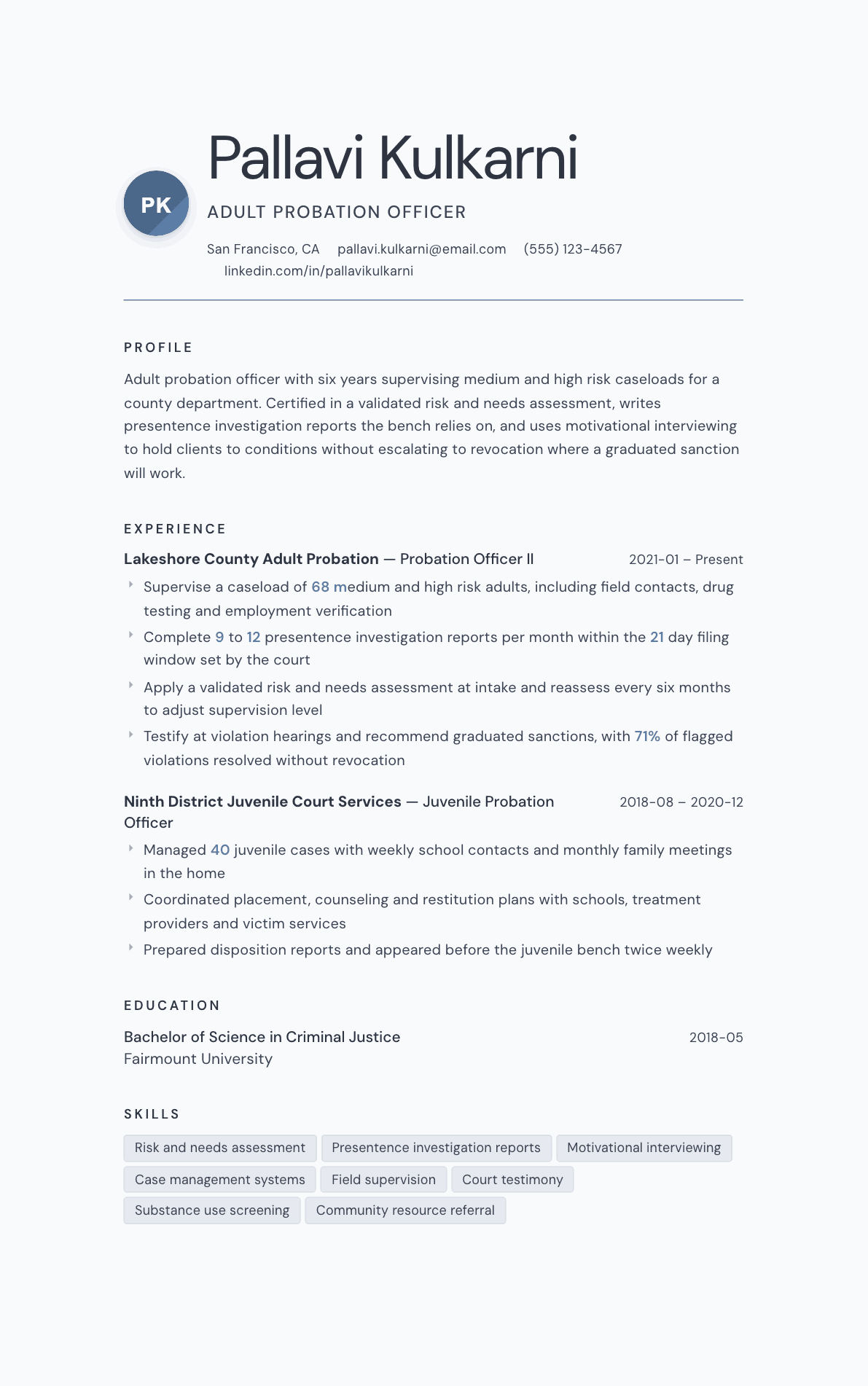
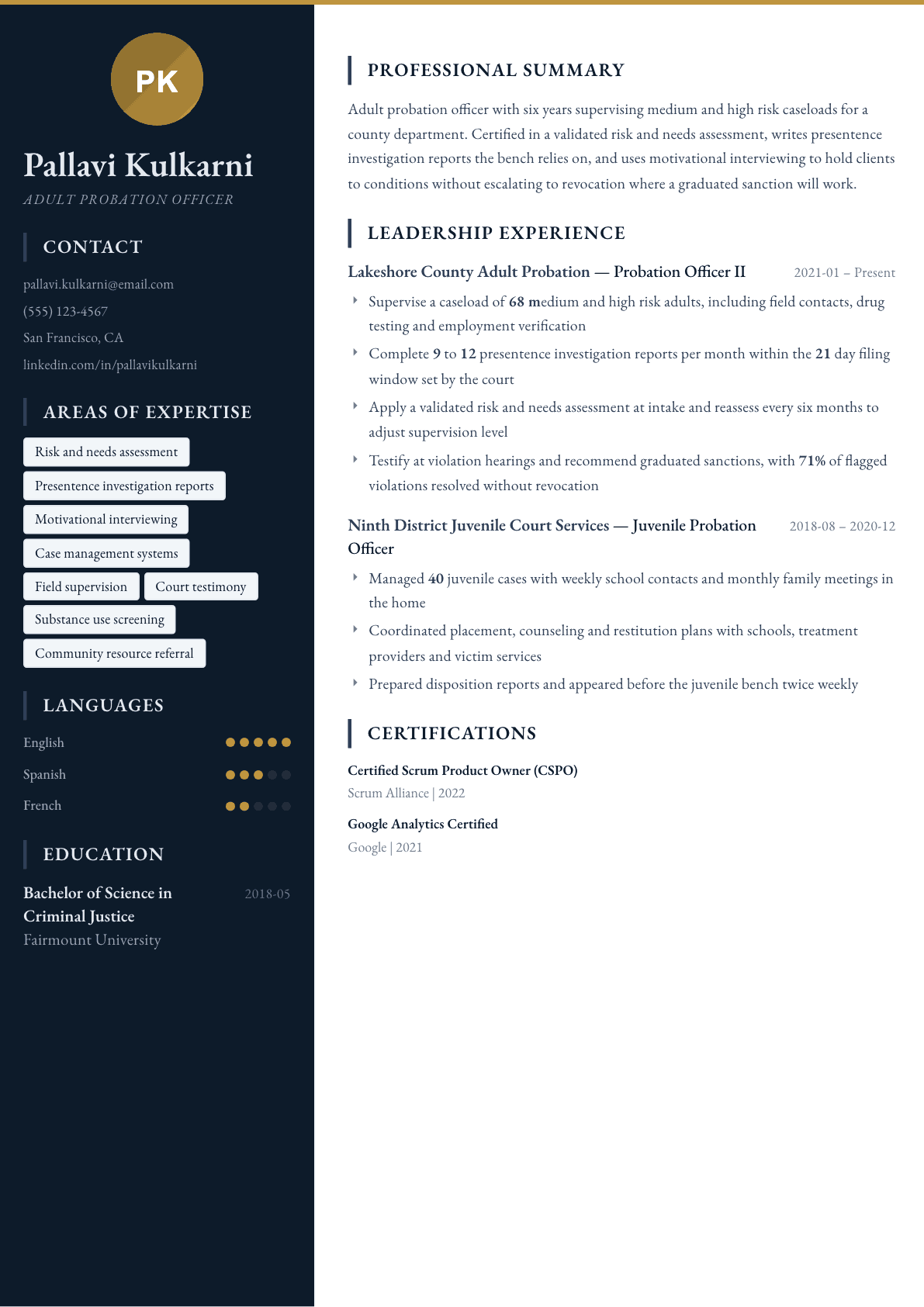
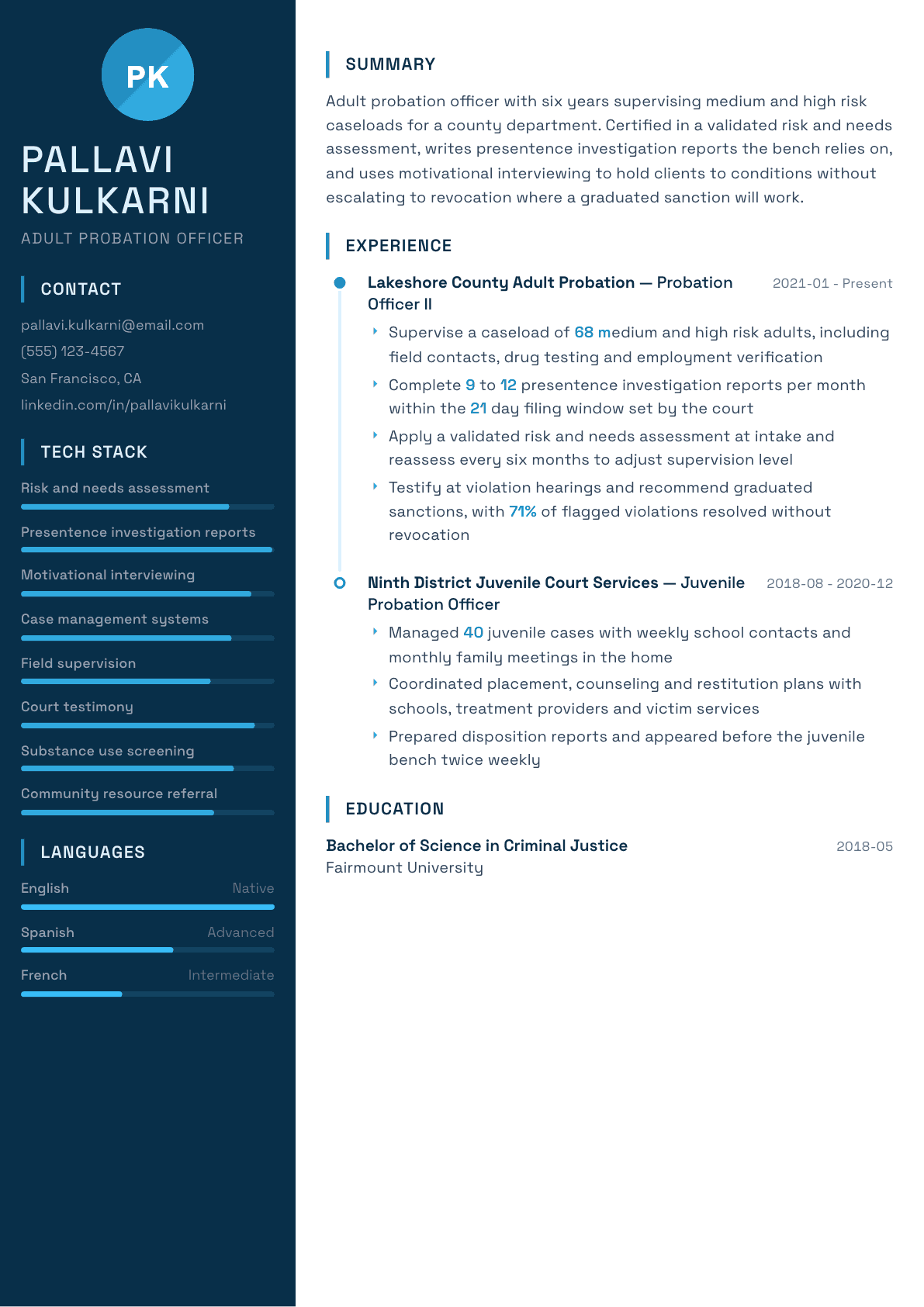
Example Probation Officer summary
Probation officer with six years on adult supervision and two on juvenile cases, currently carrying a medium to high risk caseload of nearly seventy. Trained on a validated risk and needs instrument, files presentence investigations inside the court deadline, and testifies at violation hearings. Looking for a specialized caseload in a drug court or reentry unit.
Skills to list on a Probation Officer resume
- Caseload supervision
- Presentence investigation
- Risk and needs assessment
- Motivational interviewing
- Violation reports
- Court testimony
- Field and home visits
- Drug and alcohol testing
- Graduated sanctions
- Cognitive behavioral programming
- Victim restitution tracking
- Case notes and documentation
- Interagency coordination
- Crisis de-escalation
What actually gets this resume read
- State your caseload size and risk level in each job, because that single number tells a hiring panel your workload.
- Name the validated risk and needs instrument you are trained on, along with the certifying agency and the year you trained.
- Quantify report output: presentence investigations per month, disposition reports, and whether you met the filing deadline.
- Show your court presence with violation hearings, testimony frequency and the sanctions you recommended to the bench.
- Include the case management system you work in daily, since agencies filter on their own platform by name.
- Add academy training, firearms qualification or defensive tactics only where the posting requires an armed officer.
How to write a probation officer resume
County and state probation departments hire through a civil service process, which means your resume is scored against a posted list of minimum qualifications before a human reads it for judgment. Degree, background eligibility, driving record, and any academy training are the gates. The narrative you write only matters once you clear them.
After that, the chief or the supervising officer reads for one thing: whether you can hold a caseload accountable without either losing control of it or sending everyone back to custody. That shows up in caseload numbers, assessment tools, report deadlines and how you describe a violation you chose not to file.
This guide covers the section order departments expect, three summaries for different points in a supervision career, before and after bullets from field work and report writing, and the questions officers ask when they move between adult, juvenile and specialty caseloads.
Format: civil service first, narrative second
Use reverse chronological order and two pages if you have more than one agency behind you. Government applications frequently ask you to restate the resume in a form, so keep dates, hours per week and supervisor titles accurate enough to copy across without contradiction.
Put a short qualifications block under the header listing degree, academy or basic training completion, assessment tool certification and any state officer certification. A screener checking minimum qualifications should not have to read three jobs down to find them.
- Header: name, city and state, phone, email, and any state officer certification number if your agency uses one.
- Order: summary, qualifications and training, supervision experience, education, skills.
- Applicants coming from corrections or social services lead with the transferable caseload work.
Summary: population, risk level, caseload size
Three lines. Name the population you supervise, adult or juvenile, the risk level, the caseload size, and any specialty docket you have carried such as drug court, mental health court, domestic violence or sex offender supervision. Those specialties are staffed separately and departments search for them by name.
If you are entering the field, use the summary to connect what you did to what supervision requires: interviewing, documentation, working with treatment providers, and testifying or presenting to a decision maker.
Experience: the caseload, the tools, the court
Lead each job with the caseload picture. Number of clients, risk classification, whether the caseload was geographic or specialized, and how contacts were structured: office visits, field contacts, home visits, employer verification. A supervisor reading that line already knows how hard your week was.
Then show the instruments. Name the validated risk and needs assessment your agency uses, who trained you on it, and how you translated the score into a supervision plan. Departments moving toward evidence based practice screen for exactly this and rarely find it written clearly.
Give the court work its own bullets. Presentence or disposition reports per month, whether you met the filing deadline, how often you testify at violation hearings, and what you recommended. If you use graduated sanctions instead of automatic revocation, say so, because that is a philosophy question every panel asks.
Training, certifications and the safety line
List basic training or academy completion with the academy name and hours. Add motivational interviewing training, cognitive behavioral curriculum delivery, crisis intervention training and any assessment instrument certification, each with the provider.
Handle the safety question the way the posting does. If the position is armed, list firearms qualification, defensive tactics and your current qualification date. If it is unarmed, leave it out rather than signaling you expect to carry.
Skills and the words a county portal indexes
Government portals index literally, so mirror the posting: community supervision, presentence investigation, risk and needs assessment, case plan development, violation report, field contact, collateral contact, restitution monitoring. Add the case management system by name if the agency runs one you know.
Skip generic claims about being detail oriented. A probation supervisor reads a violation report to judge your writing, and the resume bullets are the only sample she has.
Probation Officer resume summary examples
Entering the field
Criminal justice graduate with 2 years as a residential counselor in a juvenile placement facility and a 400 hour internship with a county probation department. Trained in motivational interviewing and crisis de-escalation, experienced writing daily behavioral documentation, and seeking an entry level supervision caseload.
Five years supervising
Adult probation officer with 5 years carrying a medium to high risk caseload of 65, certified on a validated risk and needs instrument, and filing 10 presentence investigations a month inside the court deadline. Testifies regularly at violation hearings and favors graduated sanctions over automatic revocation.
Senior officer or unit supervisor
Senior probation officer with 12 years across adult and juvenile supervision, the last 3 leading a 7 officer drug court unit. Owns quality review of presentence reports, trains new officers on assessment scoring and case planning, and represents the department at treatment provider and bench meetings.
Work experience bullets: before and after
Before: Supervised probationers and made sure they followed the rules.
After: Supervised a caseload of 68 medium and high risk adults with monthly office reporting, field contacts at home and work, and random urinalysis on an assessment driven schedule.
Caseload size, risk level and contact structure describe a workload a supervisor can compare against her own unit.
Before: Wrote reports for the court.
After: Completed 9 to 12 presentence investigation reports monthly, each filed within the 21 day window, drawing on victim contact, treatment records and criminal history verification.
Volume, deadline and information sources show a report writer the bench can rely on rather than a general claim.
Before: Used risk assessments with clients.
After: Scored a validated risk and needs assessment at intake and every 6 months, then rebuilt case plans around the top two criminogenic needs identified.
The scoring cadence and the link from score to case plan prove evidence based practice instead of a checked box.
Before: Handled violations when they came up.
After: Applied graduated sanctions on 40 technical violations and reserved formal filings for absconding and new offenses, with 71% of flagged violations resolved in the community.
Distinguishing technical from new offense conduct, with an outcome, answers the revocation philosophy question directly.
Before: Worked with treatment providers and other agencies.
After: Coordinated placements with outpatient substance use, mental health and workforce providers, and chaired monthly staffings on shared clients with the county behavioral health team.
Named partners and a recurring meeting show real interagency work rather than an occasional referral.
Hard skills
- Community supervision
- Presentence investigation reports
- Validated risk and needs assessment
- Case plan development
- Violation reports and warrant requests
- Field and home contacts
- Substance use screening protocols
- Cognitive behavioral curriculum delivery
- Court testimony
- Restitution and fee monitoring
- Case management systems
- Interstate compact transfers
Soft skills
- Motivational interviewing
- De-escalation
- Boundary setting
- Objective written judgment
- Cultural humility
- Time control across a large caseload
Certifications worth listing
- Certified Corrections Officer (CCO) (American Correctional Association)
- Certified Corrections Supervisor (CCS) (American Correctional Association)
- Mental Health First Aid (National Council for Mental Wellbeing)
Mistakes that cost probation officer candidates the interview
- Leaving the caseload number off, which makes it impossible to compare your week to the posted position.
- Describing supervision as monitoring compliance with no mention of assessment, case planning or behavior change.
- Burying academy completion and assessment training three jobs down where a minimum qualification screener misses them.
- Listing every violation you filed as an achievement, which reads to a modern department as an inability to work a case.
- Copying the civil service job description back into the resume instead of describing your own caseload and reports.
- Omitting the juvenile or specialty docket experience that would have qualified you for the unit you actually want.
Probation Officer resume questions
How long should a probation officer resume be?
Two pages is normal once you have more than one agency, because departments want dates, hours and supervisor detail they can verify. Keep a single page only if you are applying straight out of school or an internship.
Should I include arrests or enforcement actions I took part in?
Describe the activity type, never the individual case. Officers can say they served warrants or participated in compliance sweeps with the sheriff, but naming clients or repeating case facts breaks confidentiality and worries a hiring panel.
How do I move from juvenile probation to adult supervision?
State the move in the summary and lead your bullets with the transferable work: assessment scoring, case planning, report writing on deadline and court testimony. Add any adult contact you had through family cases or joint staffings.
Does correctional officer experience count toward a probation posting?
It counts for security awareness, documentation discipline and population knowledge, so keep it. Pair it with anything resembling case work, classification, program facilitation or release planning, because that is the part supervision departments are buying.
What do hiring panels look for in the interview after the resume?
They test the balance between accountability and support with a scenario about a technical violation. Write the resume so that answer is already visible in your bullets on graduated sanctions, case planning and provider coordination.