Correctional Officer Resume Examples: what gets the call
Sample Resume for Corrections and Correctional Officer Jobs
By Mustafa Tarabya, founder of CVBooster · Published · Updated
Sample resume for corrections officer jobs from first application to sergeant: custody line, counts, incident reports, de-escalation and housing unit keywords.
Sample resumes for a correctional officer
The same correctional officer content laid out in three CVBooster templates, so you can see what the finished document looks like before you write a word.
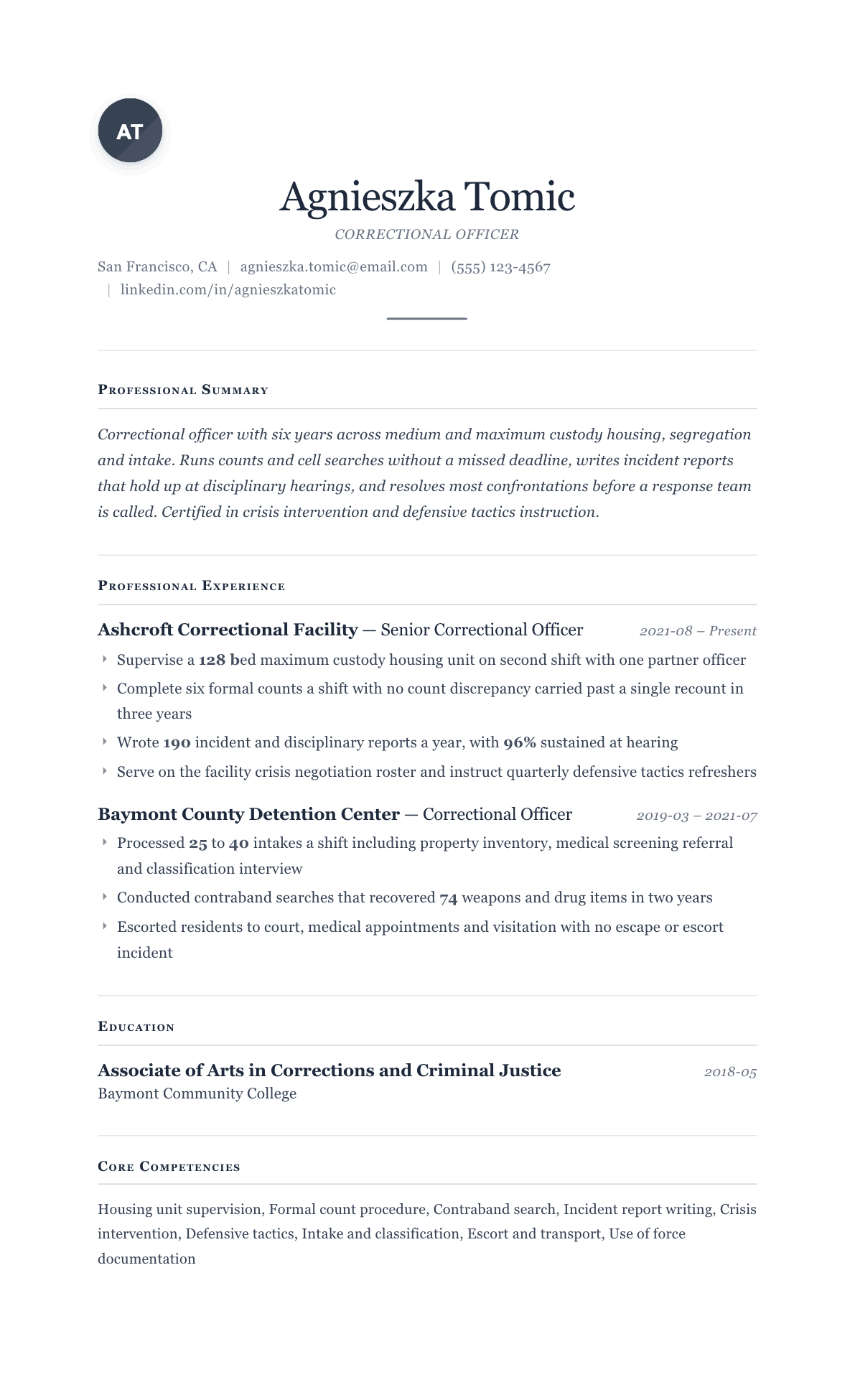
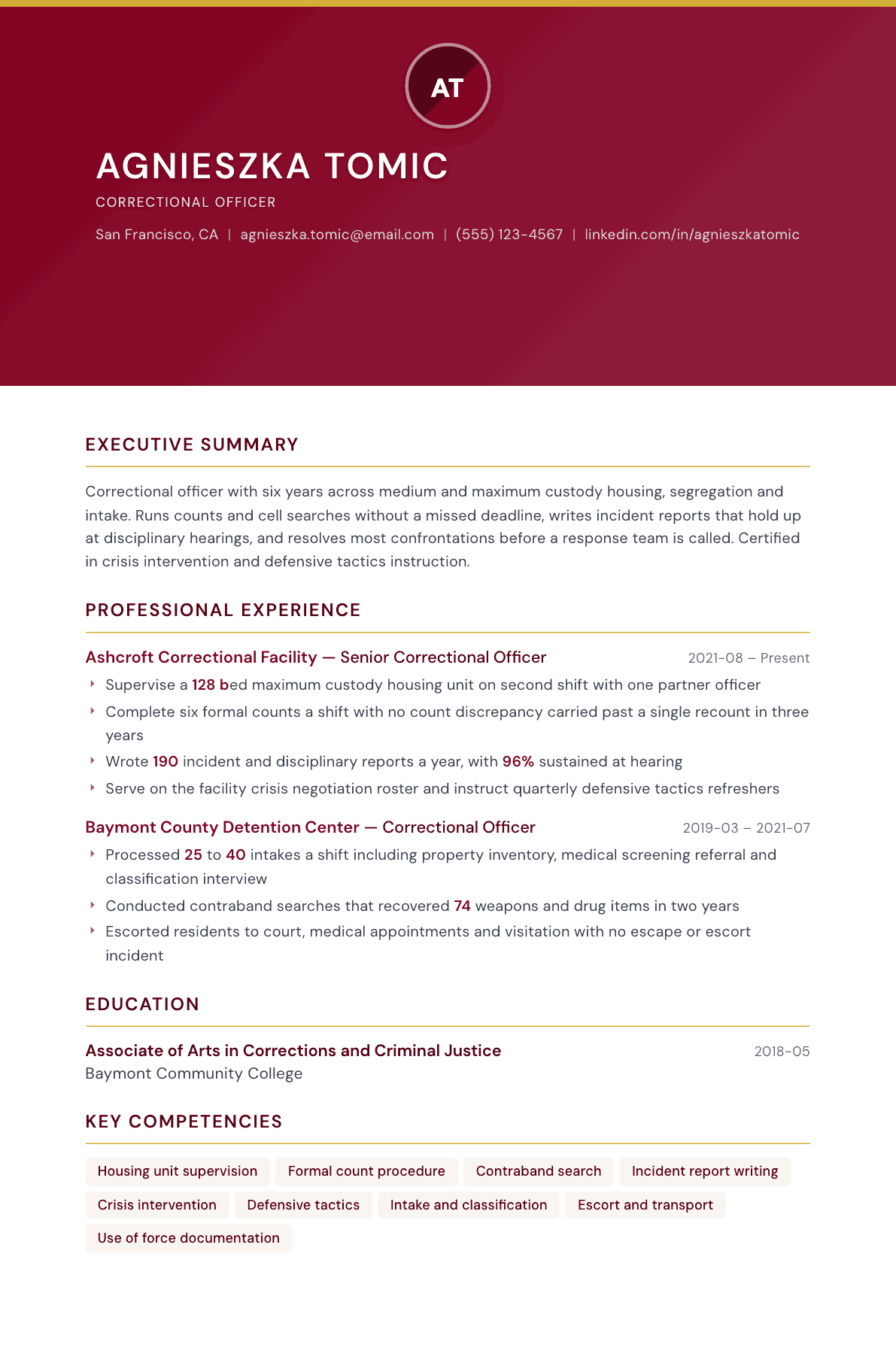
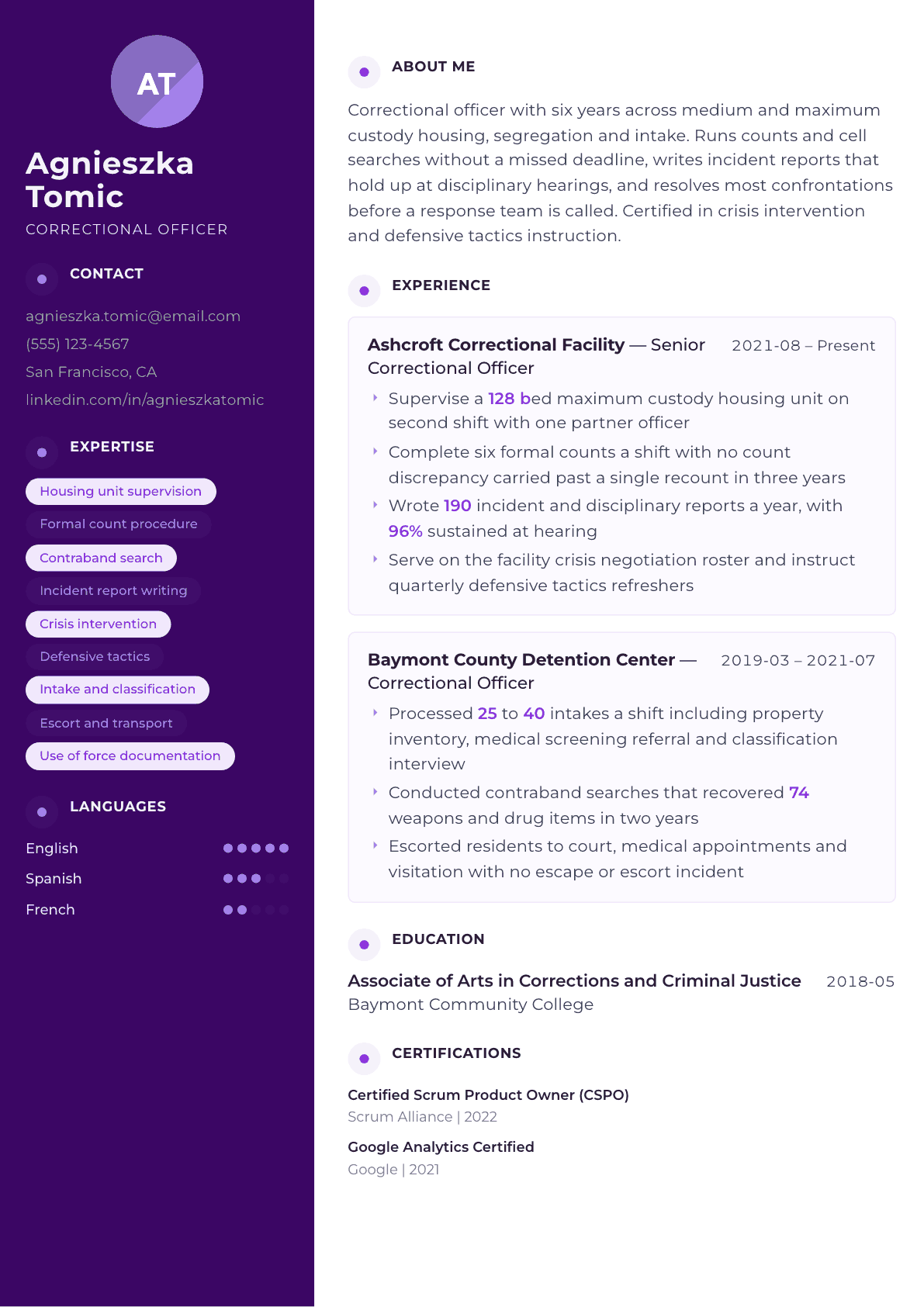
Example Correctional Officer summary
Correctional officer with six years across maximum custody housing, segregation and intake at two facilities. Runs counts and searches on schedule, writes disciplinary reports that stand up at hearing, and talks down confrontations before a response team is needed. Certified in crisis intervention and instructs defensive tactics refreshers. Looking for a sergeant track post at a larger institution.
Skills to list on a Correctional Officer resume
- Housing unit supervision
- Custody counts and accountability
- Cell and contraband searching
- Intake processing and property inventory
- Classification interviews
- Incident and disciplinary reporting
- Use of force reporting
- Crisis intervention and de-escalation
- Defensive tactics instruction
- Escort and transport procedure
- Visitation control
- Key and tool control
- Emergency response team operations
- Radio communication
- Suicide watch observation
What actually gets this resume read
- State the custody level of every unit you have worked, since maximum, medium and intake are different jobs.
- Give bed counts and officer to resident ratios so a captain can picture the post you held alone.
- Quantify your report writing and how often those reports were sustained at disciplinary hearings.
- Name your de-escalation and crisis intervention training with the body that delivered it.
- Show contraband recoveries and search routines rather than claiming a general attention to detail.
- List collateral assignments such as transport team, emergency response team, training or the negotiation roster.
How to write a correctional officer resume
The person reading a correctional officer resume is usually a shift captain with vacant posts and a training academy class already forming. What she needs to know is narrow: can you hold a housing unit with one partner, will your counts come back correct, and does your paperwork survive a disciplinary hearing. Everything else on the page is context for those three questions.
Applicants often write the job as if it were guard duty, listing supervision of inmates and maintenance of security. That language describes the post but not the officer. A captain wants the custody level, the bed count, the shift, the number of formal counts you complete, and evidence that you have handled a confrontation without it becoming a use of force incident.
This guide walks the page section by section: the format a corrections agency expects, how to write housing unit assignments, counts and incident reports, three summaries by career stage, rewritten bullets, and the questions officers ask when they transfer between facilities or move toward a sergeant post.
Format: custody levels first, clean dates, one page
Reverse chronological, one page unless you have served at several institutions across more than a decade. Corrections hiring runs a full background investigation, so dates need to be exact and any gap needs a line explaining it. Keep the layout plain, because these resumes are often scanned and forwarded as attachments through several hands before anyone opens them properly.
Under your contact block, put a short custody line: the institutions you have worked, their custody levels and the units you held. A captain reads that line and immediately knows whether to keep reading, in the same way a nurse manager reads a unit and a ratio before anything else.
- Header for corrections: name, city and state, phone, email, and your current facility and shift.
- Custody line under the summary: institution type, custody levels worked and total sworn or non-sworn years.
- Page order: summary, custody line, certifications and academy, facility experience, collateral duties, education.
- Applicants with no corrections time lead with military, security, healthcare or any role holding accountability for people.
Summary: custody level, unit size, what you are trusted with
Three lines. Name the custody levels you have worked, the unit sizes, the years, and the assignment your facility trusts you with. A correctional officer who has held segregation and intake has proven something different from one who has only worked general population day shift, and the summary is where that difference gets stated plainly.
If you are coming from the military, private security or a county jail into a state prison, say so and name the transferable half. Jail intake work, for example, builds screening and classification skill that transfers directly, while military service builds post discipline and reporting habits that a captain already understands.
Experience: the unit, the count, the incident record
Open every assignment with the facility, its custody level, the unit you held, the bed count and how many officers covered it. A single officer holding a 128 bed maximum custody unit on second shift is describing a very specific working reality, and the reader will calibrate the rest of your bullets against it.
Then bullets on the mechanics: formal counts and how often yours were clean, cell and area searches with what they recovered, intake volume, escorts and transports completed without incident, and your use of force record described honestly. Add one bullet on documentation, because reports that get overturned at hearing cost the facility more than most people outside corrections realize.
Cut the lines about maintaining a safe and secure environment or observing inmate behavior. Every applicant writes them. The bullet that earns the interview is the one showing you resolved a cell extraction standoff by talking, or that your search routine found weapons other shifts had walked past.
De-escalation, use of force and the honesty test
Corrections agencies are cautious about officers who advertise toughness. What earns trust on paper is a candidate who describes de-escalation as a technique with steps rather than a personality trait: the approach used, how often confrontations resolved without a response team, and the crisis intervention training that supports it.
Handle use of force plainly. State that your reports were complete and reviewed, and mention any role in reviewing or instructing on force policy. An applicant who omits the subject entirely reads as if there is something to hide, while one who treats it as ordinary documented work reads as an officer who has been through the process and understands it.
Skills, keywords and collateral assignments
Corrections postings reuse a narrow vocabulary: custody, count, contraband, classification, escort, segregation, disciplinary report, use of force, key control, tool control, suicide watch. Use those exact words where the work shows them, since screening systems and captains both look for them and neither will translate a paraphrase on your behalf.
Collateral assignments carry real weight at promotion time. List the emergency response team, transport team, canine support, crisis negotiation roster, training cadre or gang intelligence work you have done. Those roles show an officer who volunteers for the harder posts, which is exactly the profile a facility promotes from.
Sample resume for a corrections officer at each stage
A sample resume for a corrections officer keeps the same order at every stage and changes what fills it: custody line, counts, reports, then collateral duties. The sample on this page belongs to a senior officer with two facilities behind her. Agencies post the job as corrections officer, correction officer or correctional officer, so copy the exact title from the posting into your header and summary.
Use the lines below as the opening of the experience section for your stage, then add your own counts, unit sizes and search results underneath.
- Applicant with no corrections time: four years as a hospital security officer, patrolling a 300 bed site, writing incident reports the same shift and escorting patients under hold with clinical staff.
- Academy graduate, first year: completed the state academy and field training, now assigned to a 64 bed medium custody unit on first shift, conducting formal counts and property searches.
- County jail officer moving to a state prison: three years of booking and intake, 25 to 40 intakes a shift, classification interviews and court escorts.
- Officer applying for sergeant: shift coverage as acting sergeant, the officers you trained on the unit, the post orders you rewrote and your record on incident reports sustained at hearing.
Correctional Officer resume summary examples
New to corrections
Army veteran and security officer applying for a correctional officer academy class. Four years of access control, incident documentation and post supervision, plus crisis intervention training. Comfortable on overnight shifts and ready for a full background investigation with verifiable dates and references.
Six years in
Correctional officer with six years across maximum custody housing, segregation and county intake. Holds a 128 bed unit on second shift with one partner, completes six formal counts a shift, and wrote 190 disciplinary reports last year with the large majority sustained at hearing.
Sergeant candidate
Senior correctional officer with eleven years at two state institutions, serving on the emergency response team and crisis negotiation roster. Instructs quarterly defensive tactics refreshers, acts as shift supervisor during vacancies, and has trained fourteen officers through their probationary period.
Work experience bullets: before and after
Before: Supervised inmates in a housing unit.
After: Supervised a 128 bed maximum custody housing unit on second shift with one partner officer, covering movement, meals, showers and out of cell recreation.
Bed count, custody level and staffing tell a captain exactly what post you can fill.
Before: Performed counts and searches as required.
After: Completed six formal counts a shift with no discrepancy carried past a single recount in three years, and ran cell searches that recovered 74 weapon and drug items.
Count accuracy and recovery totals are the two numbers a facility genuinely tracks.
Before: Handled conflicts between inmates.
After: Resolved the majority of unit confrontations through verbal de-escalation, calling a response team three times in two years and completing every use of force report on shift.
It shows restraint with a number behind it instead of claiming to be good with people.
Before: Wrote incident reports.
After: Wrote 190 incident and disciplinary reports a year, with 96% sustained at hearing after review by the disciplinary officer and facility legal staff.
A sustained rate proves the writing holds up where it counts, at the hearing table.
Before: Assisted with new officer training.
After: Trained fourteen probationary officers on count procedure, search technique and report writing, and instructed quarterly defensive tactics refreshers for the full shift.
Named subjects and a trainee count turn assisting into a documented instructor role.
Hard skills
- Housing unit supervision
- Formal count and accountability procedure
- Cell and area contraband searching
- Intake processing and property inventory
- Inmate classification interviews
- Incident and disciplinary report writing
- Use of force reporting and review
- Crisis intervention and de-escalation
- Defensive tactics and restraint application
- Escort and transport procedure
- Key, tool and chemical control
- Suicide watch observation
- Emergency response team operations
Soft skills
- Consistency that residents can predict
- Composure during a unit disturbance
- Reading tension on a tier before it breaks
- Partner reliability on a two officer post
- Discretion with medical and case information
Certifications worth listing
- Certified Corrections Officer (American Correctional Association)
- Mental Health First Aid (National Council for Mental Wellbeing)
- Basic Life Support Provider (American Heart Association)
Mistakes that cost correctional officer candidates the interview
- Writing housing unit supervision with no custody level, bed count or staffing figure attached to it.
- Skipping count accuracy, which is the single number a shift captain uses to judge reliability.
- Advertising physical toughness instead of showing de-escalation as a technique with steps and outcomes.
- Avoiding use of force entirely, which reads as concealment rather than as an officer with a clean record.
- Leaving collateral assignments off the page when those are the roles facilities promote from.
- Treating a county jail resume and a state prison resume as interchangeable when intake and long term custody differ.
Correctional Officer resume questions
Do I need corrections experience to get hired?
No. Most agencies run their own academy and hire from military service, security, healthcare, education and retail supervision. What they screen for is a clean background, reliability on overnight shifts and evidence that you have held responsibility for other people without losing your temper.
Should I use the word inmate or resident on my resume?
Match the language of the agency you are applying to. Read the job posting and the department website: some systems have moved to resident or incarcerated person, others still use inmate throughout policy. Using the wrong term is minor, but matching theirs is free.
How do I write a use of force history?
State that incidents were documented, reviewed and closed, and give a rough count if it is modest. Do not describe specific incidents in detail on a resume. If a hiring panel wants the specifics they will pull the file and ask you about it in the interview.
Where can I find a sample resume for a corrections officer with no experience?
Use the stage lines above: the applicant with no corrections time leads with security, military or healthcare work where you were accountable for people, wrote reports and followed post orders. Put the academy or any certification you hold near the top, and describe every shift in custody vocabulary the posting uses.
How should I explain leaving a previous corrections job?
Briefly and factually, usually in the cover letter rather than the resume. Transfers for shift, location or family reasons are ordinary in this field. What causes trouble is a vague answer that does not match what the background investigator hears from your former facility.
Related resume examples
- Security Guard Resume example
- Police Officer Resume example
- Probation Officer Resume example
- State Trooper Resume example
- Security Officer Resume example
- Sheriff Deputy Resume example