Butcher Resume Examples: free score, then the gap list
Write a Butcher Resume That Proves Your Knife Work
By Mustafa Tarabya, founder of CVBooster · Published · Updated
Butcher resume examples with primal breakdown, yield and food safety keywords, plus a guide to proving craft and case sales on paper.
Sample resumes for a butcher
The same butcher content laid out in three CVBooster templates, so you can see what the finished document looks like before you write a word.
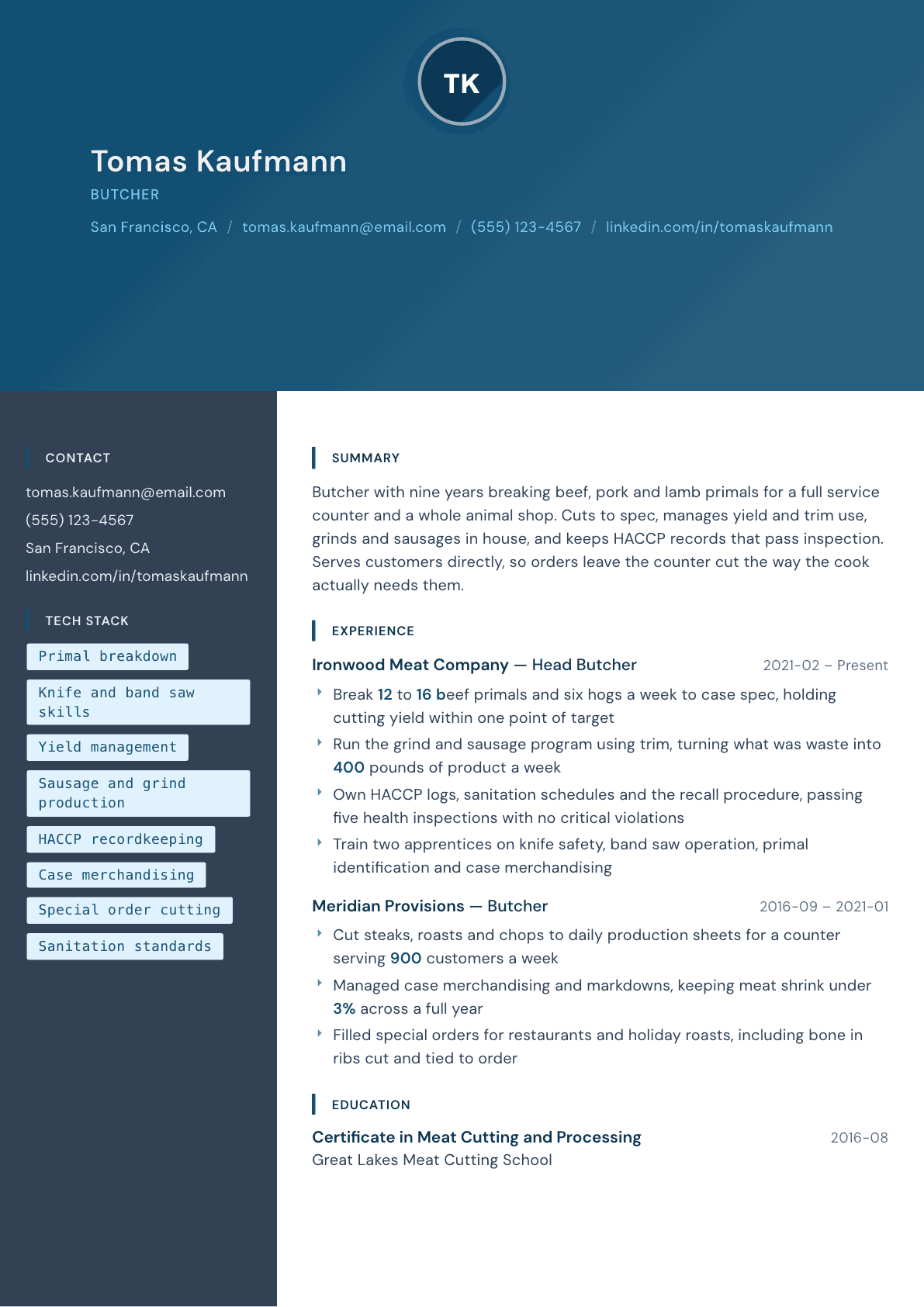
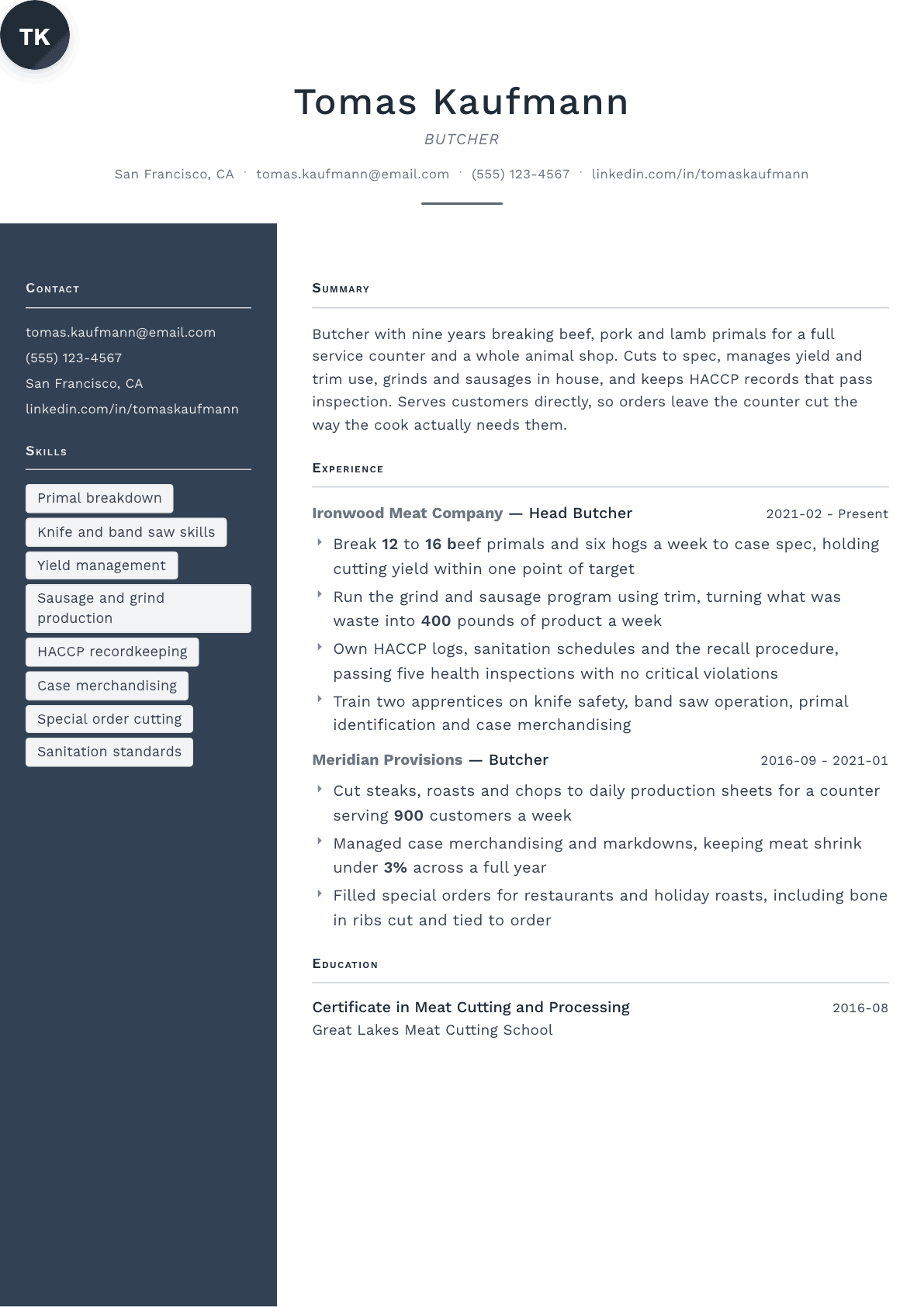
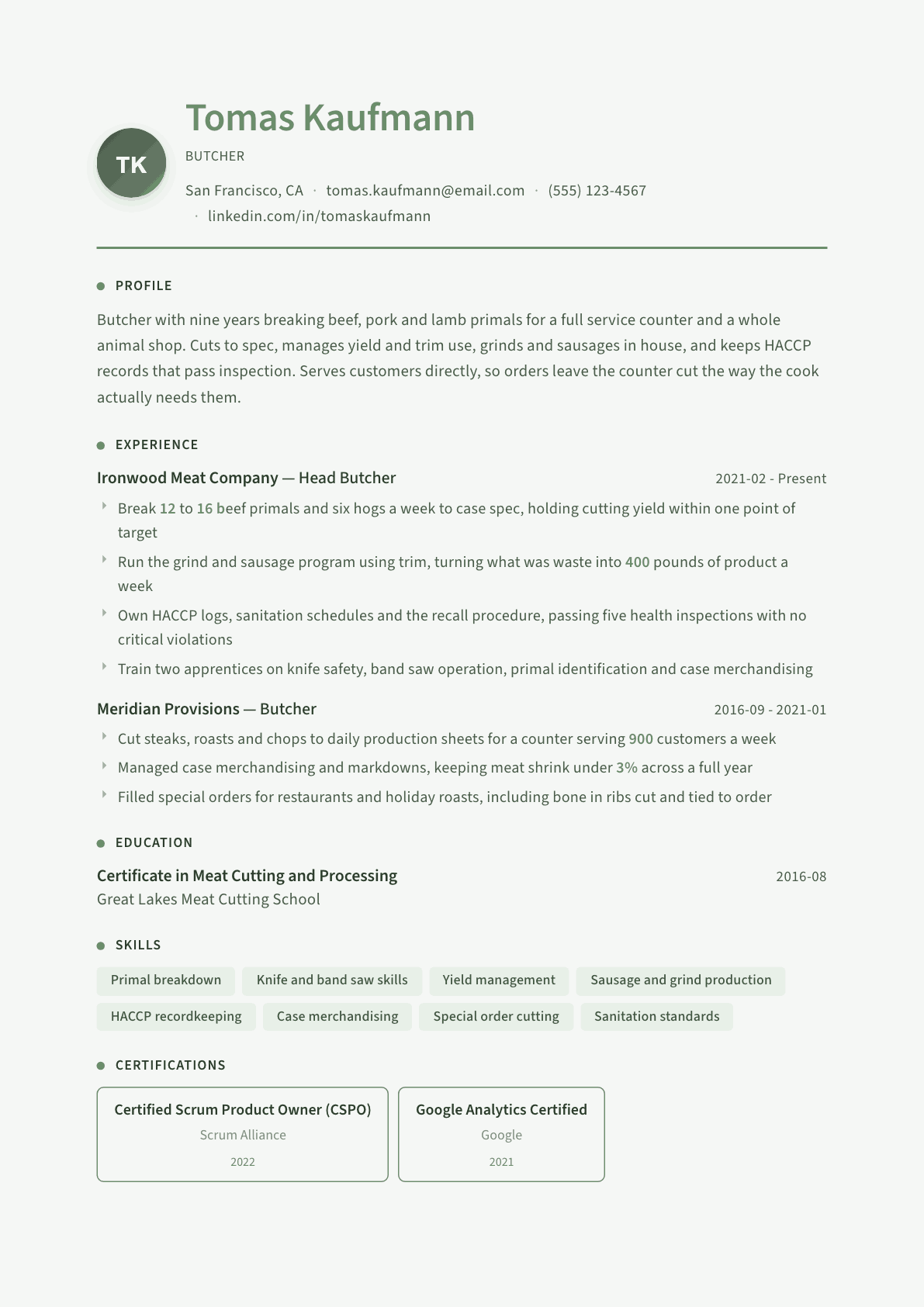
Example Butcher summary
Butcher with nine years breaking beef, pork and lamb primals for full service counters, cutting to spec and holding yield close to target. Runs an in house grind and sausage program that turns trim into sellable product, owns HACCP logs and sanitation schedules, and has trained apprentices on knife safety and primal identification. Comfortable serving customers and filling restaurant and holiday special orders.
Skills to list on a Butcher resume
- Primal and subprimal breakdown
- Knife skills and boning
- Band saw operation
- Yield and trim management
- Sausage and grind production
- HACCP and food safety records
- Case merchandising
- Special and holiday orders
- Vacuum sealing and packaging
- Sanitation and equipment cleaning
- Ordering and receiving carcasses
- Apprentice training
- Cost and shrink control
What actually gets this resume read
- Name the species and primals you break, because a shop hires for the exact cutting it needs covered.
- Give yield and shrink figures, since those two numbers decide whether a meat department makes money.
- List HACCP responsibility and inspection results, because a butcher often owns the department records.
- Show value added work such as grind, sausage, marinades and cases built from trim rather than waste.
- Include customer facing detail, since a full service counter needs someone who can talk cooks through a cut.
- Mention equipment by name: band saw, grinder, stuffer, tenderizer and vacuum sealer you have run.
How to write a butcher resume
A butcher resume is read by someone who has watched a bad hire cost real money. Poor knife work loses yield on every carcass. A weak sense of case merchandising leaves expensive cuts to mark down at nine at night. Sloppy record keeping brings a health inspection finding that lands on the department manager desk. The reader is screening for craft and for discipline at the same time.
The good news is that this trade produces measurable results. Yield against target, meat shrink, case sales, inspection outcomes and the volume of primals you break in a week are all countable, and the resumes that carry those numbers rise immediately above the ones that list cutting meat as a duty.
What follows is how to structure the page, three summaries from an apprentice through a head butcher, before and after bullets that show craft as evidence rather than claim, and the questions cutters ask when they move between a grocery counter, a whole animal shop and a processing plant.
Format: one page, or two once you have run a department
Single column, reverse chronological, plain headings. Grocery chains screen these applications through the same system as every other store role, so keep the layout simple. Independent shops often read on paper, which is another argument against columns and shading.
Add a short capability line under your contact block naming the species you break, the equipment you run and your food safety certification. A shop owner can decide in five seconds whether to keep reading, which is exactly what you want from the top of the page.
- Header: name, city and state, phone, email, food safety certification and issuing body.
- Section order: summary, capability line, experience, skills and equipment, training and certifications.
- Open each job with the setting: grocery service counter, whole animal shop, wholesale house or processing plant.
Summary: species, volume, and what you own beyond the block
Three lines. Which species and primals you break, the weekly volume, and the responsibility you hold outside cutting. Ordering, case merchandising, food safety records and training apprentices are the things that turn a cutter into a candidate for a lead position, and they belong in the first paragraph.
If you are trained but new to the trade, say so directly and name the program and hours. A meat cutting school certificate plus a stated willingness to start on the saw and grind is a clean, honest summary, and shops hire on it regularly because trained beginners are scarce.
Experience: yield, volume, value added, records
Start with volume and yield. Primals broken per week by species, and how close your cutting yield ran to target. Yield is the number that decides whether a meat department makes money, and a butcher who tracks it is telling the reader they think like an owner rather than a pair of hands.
Then value added work. Grind, sausage, marinades, kebabs and stuffed items built from trim are pure margin, and a bullet showing how much sellable product you created from what would otherwise be waste is one of the strongest things a butcher can write.
Then the department half. Case merchandising, production sheets, ordering and receiving carcasses, markdown discipline and meat shrink. Finish with records: the food safety plan, sanitation schedules, the recall procedure and inspection outcomes, which is the compliance evidence a manager needs before handing over a department.
Equipment and technique: name every machine you have run
Band saw, grinder, mixer, stuffer, tenderizer, patty machine, vacuum sealer and tumbler are all learned pieces of equipment with their own safety and cleaning routines. Listing them tells a shop how much training you will need in week one, and machine familiarity is a real hiring criterion.
Technique deserves the same precision. Boning, seam butchery, frenching, tying roasts, portion cutting to a weight tolerance and dry aging are distinct skills. A shop that dry ages will hire for that word alone, and a supermarket counter will hire for portion consistency, so name what you can genuinely do.
Customer facing work at a service counter
A full service counter needs a butcher who can talk a customer through a cut, recommend a cooking method and take a special order accurately. Say so with evidence: holiday roast volume, restaurant orders filled, or a standing arrangement with a local kitchen. It is the half of the job a plant trained cutter often lacks, and naming it makes a retail application much stronger.
Butcher resume summary examples
Trained apprentice
Meat cutting school graduate seeking an apprentice butcher position, trained across beef, pork and poultry primals with band saw, grinder and vacuum sealer experience. Food safety certified, comfortable on early starts in a cold room, and ready to build speed on portion cutting and case production.
Five years cutting
Butcher with five years on a full service counter, cutting steaks, roasts and chops to daily production sheets for a department serving 900 customers a week. Manages case merchandising and markdowns, held meat shrink under 3% across a full year, and fills restaurant and holiday special orders.
Head butcher
Head butcher breaking 12 to 16 beef primals and six hogs a week to case spec while holding cutting yield within one point of target. Runs an in house grind and sausage program producing 400 pounds a week from trim, owns the food safety plan, and trains two apprentices.
Work experience bullets: before and after
Before: Cut meat for the store every day.
After: Broke 12 to 16 beef primals and six hogs a week to case specification, holding cutting yield within one point of the department target.
Volume by species plus a yield figure is the clearest possible evidence of knife work quality.
Before: Made sausage and ground beef.
After: Ran the grind and sausage program using cutting trim, converting what had been waste into roughly 400 pounds of sellable product a week.
Framing trim as recovered margin shows commercial thinking on top of the technical skill.
Before: Followed food safety rules in the department.
After: Owned the food safety plan, sanitation schedule and recall procedure, passing five health inspections with no critical violations.
Ownership plus inspection results proves compliance rather than stating an intention to comply.
Before: Kept the meat case looking good.
After: Managed case merchandising, rotation and markdown timing across a full service counter, keeping meat shrink under 3% for a full year.
Shrink is the department scorecard, so attaching it to merchandising makes the presentation work countable.
Before: Trained new employees in the meat department.
After: Trained two apprentices on knife safety, band saw operation, primal identification and case production, both progressing to independent cutting shifts.
Naming the curriculum and the outcome shows you can build a cutter rather than just supervise one.
Hard skills
- Primal and subprimal breakdown
- Boning and seam butchery
- Band saw and grinder operation
- Yield and trim management
- Sausage and value added production
- Portion cutting to weight tolerance
- Food safety plans and records
- Case merchandising and rotation
- Vacuum sealing and packaging
- Ordering and carcass receiving
- Special and holiday order fulfillment
- Equipment sanitation and breakdown
Soft skills
- Steady hands under production pressure
- Safety awareness around blades
- Advising customers on cuts and cooking
- Training apprentices patiently
- Consistency across a long shift
Certifications worth listing
- ServSafe Food Manager (National Restaurant Association)
- Food Protection Manager Certification (National Registry of Food Safety Professionals)
- HACCP Training Certificate (International HACCP Alliance)
- Food Handler Certificate (State or County Health Department)
Mistakes that cost butcher candidates the interview
- Writing cut and prepared meat as a duty when yield and volume figures are available and far more persuasive.
- Leaving out the species and primals you break, so a shop cannot tell whether you can cover its counter.
- Omitting equipment names, which forces the owner to assume you need training on every machine in the room.
- Ignoring value added production, the fastest way a meat department turns trim into margin.
- Skipping food safety ownership and inspection outcomes when a lead role hands you those records on day one.
- Applying to a service counter with a plant resume that never mentions speaking to a customer.
Butcher resume questions
Do I need formal training to become a butcher?
Not always, since many cutters learn entirely on the job through an apprenticeship. A meat cutting program shortens the path and helps when you have no work history in the trade, because it proves you can handle a saw and identify primals safely from the start.
Should I put yield numbers on a butcher resume?
Yes, whenever your department tracked them. Yield against target is the most direct evidence of cutting skill available on paper, and pairing it with weekly volume tells a manager both how fast and how cleanly you work.
How is a grocery counter job different from a whole animal shop?
A counter runs on portion consistency, case merchandising and production sheets, while a whole animal shop runs on breaking carcasses, using every part and talking to customers about cuts. Lead with the half that matches, and mention the other as range.
What food safety credential should a butcher hold?
A recognized food safety manager certification is the strongest option, especially for a lead role that owns the department records. A basic handler card covers many counter positions, but the manager level credential is what qualifies you to sign the logs.
How do I move from a processing plant into retail butchery?
Emphasize speed, yield discipline and equipment range, then address the customer side directly. Mention any counter work, special orders or cooking advice you have given, because retail shops worry that plant cutters cannot handle a queue of questions.