Production Associate Resume Examples: what gets the call
Build a Production Associate Resume That Gets You on the Floor
By Mustafa Tarabya, founder of CVBooster · Published · Updated
Production associate resume example, keyword list and writing guide covering line work, kitting, quality checks, safety and shift attendance.
Sample resumes for a production associate
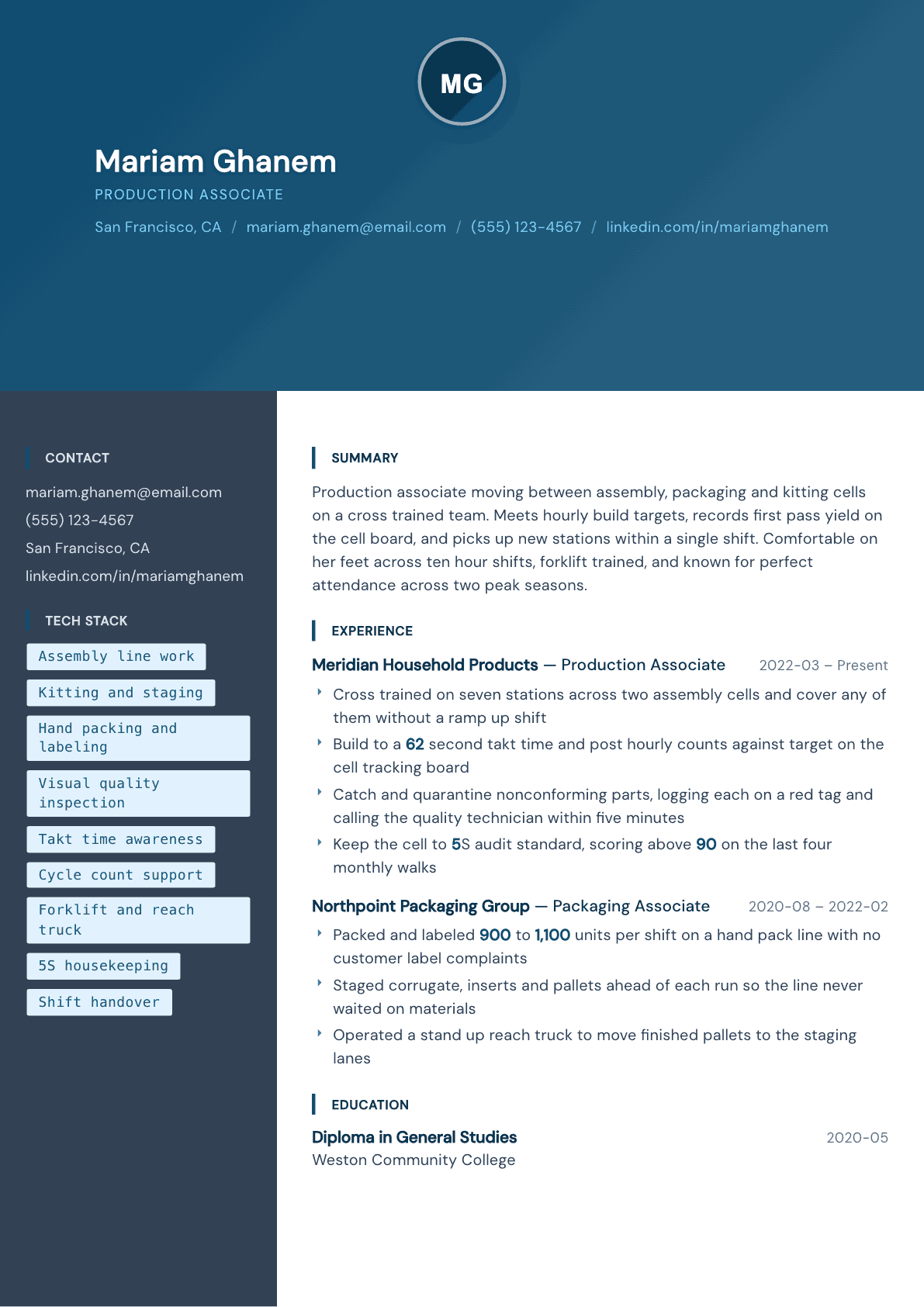
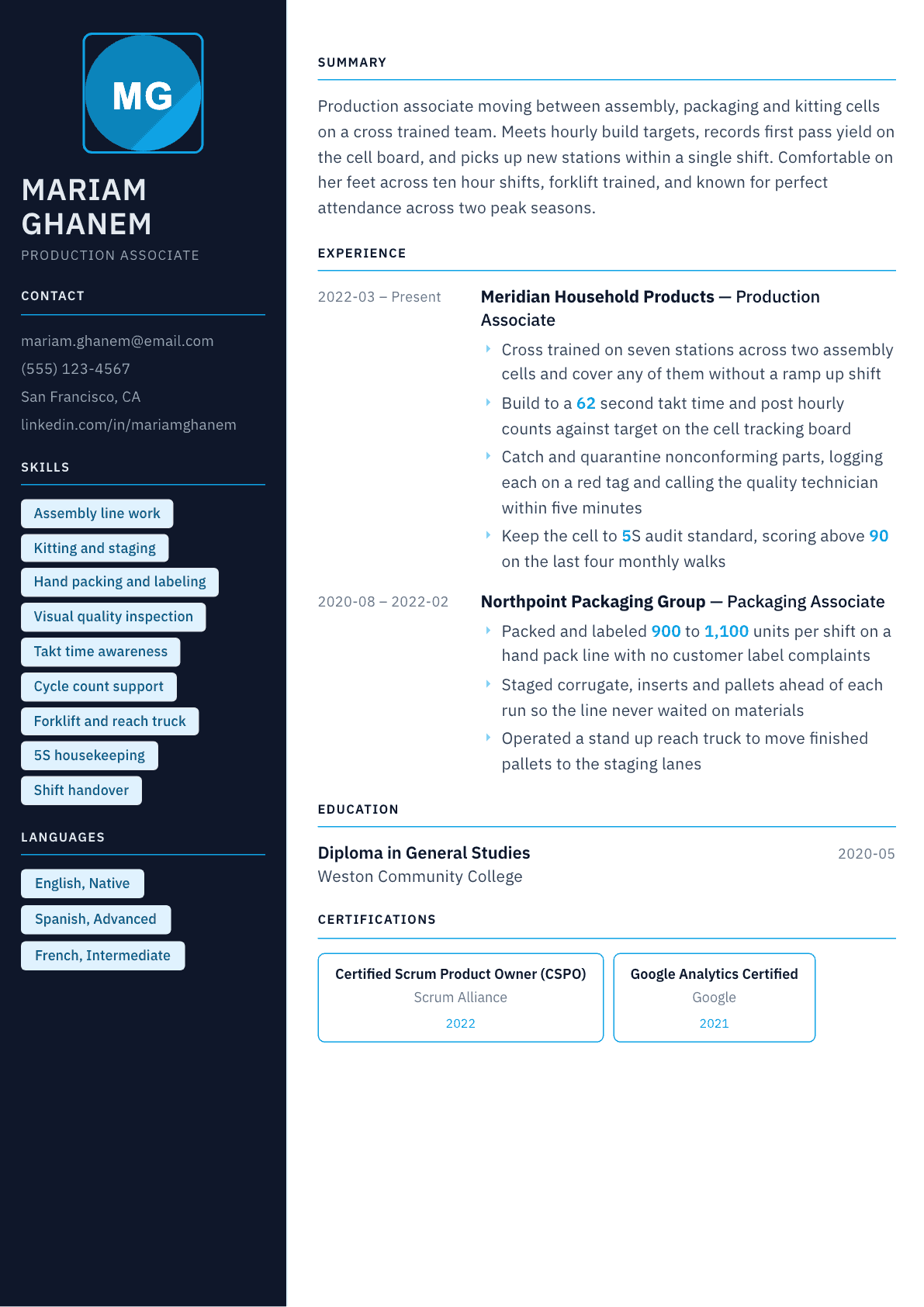
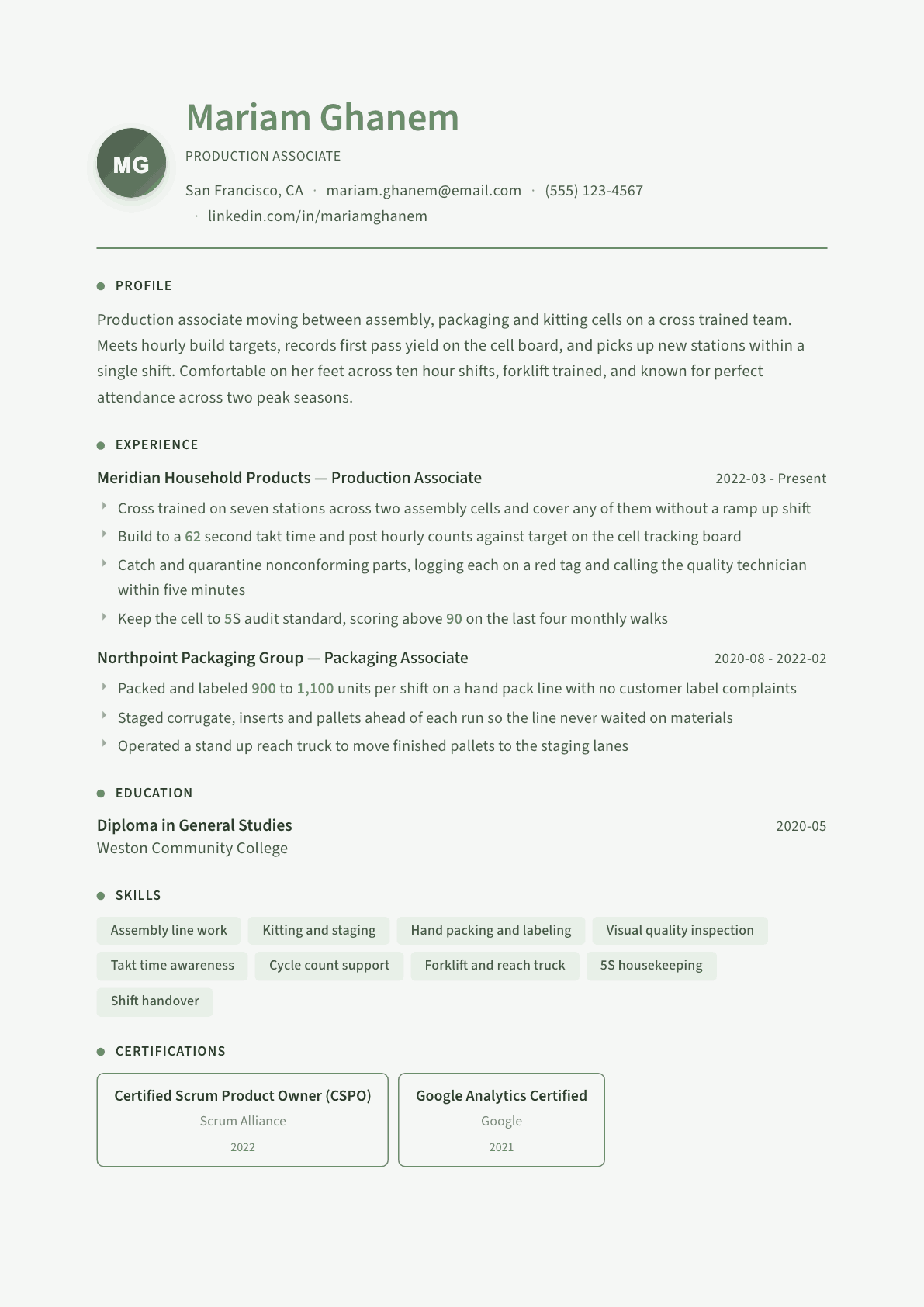
The same production associate content laid out in three CVBooster templates, so you can see what the finished document looks like before you write a word.
Example Production Associate summary
Production associate cross trained on seven stations across assembly, hand pack and kitting cells. Builds to a takt time under one minute, posts hourly counts on the cell board, and quarantines nonconforming parts the moment they appear. Reach truck cleared, strong on 5S audits, and reliable across ten hour shifts including weekend coverage during peak season.
Skills to list on a Production Associate resume
- Assembly and sub assembly
- Hand packing
- Labeling and coding
- Kitting
- Visual inspection
- Nonconforming part handling
- Takt time and hourly targets
- Material staging
- Pallet jack and reach truck
- Cycle counting
- 5S and housekeeping
- Safety reporting
- Cross training
- Team handover
What actually gets this resume read
- Lead with cross training, because a supervisor values an associate who can cover any station on the cell.
- Give the units per shift or the takt time you built to, so the reader can size your pace against theirs.
- Mention attendance and punctuality plainly if your record is strong, since staffing is the plant's daily headache.
- Name the equipment you are cleared on, such as reach truck, pallet jack, heat sealer or strapping machine.
- Show what you do when you find a bad part, because the reaction matters more than the inspection itself.
- Keep the resume to one page and put the shift you can work near the top, including nights and weekends.
How to write a production associate resume
Production associate is the widest door into a plant, which means the resume pile is deep and the screening is fast. A staffing coordinator or plant HR generalist spends well under a minute on each page, checking three things: can you work the shift, will you show up, and have you done anything resembling this work before.
That speed is exactly why vague resumes lose. Two candidates with the same background get different outcomes because one wrote that she assembled products and the other wrote that she is certified on seven stations, builds to a takt under a minute, and covers any station in the cell without a ramp up shift.
This guide shows how to build an associate resume that survives a fifty second read: what to put in the first three lines, how to describe repetitive work without sounding generic, which numbers you already have access to, and how to answer the attendance question before it is asked.
Format: one page, no ornament, shift and availability up top
One page, reverse chronological, standard headings. Production associate postings often receive hundreds of applications, and the ones that get calls are the ones a coordinator can read while standing up. Anything that costs the reader effort, such as a sidebar, a photo or a colored skill meter, works against you here.
Availability belongs near your contact details, not buried at the bottom. First, second, third, weekend, rotating twelve hour, willing to start on nights: whichever is true, say it. Plants hire against a specific open shift, and an associate who accepts the shift nobody wants moves to the front of the line immediately.
- Contact block: name, city and state, phone, email, then one line of shift and overtime availability.
- Sections in this order: summary, plant and warehouse experience, equipment and certifications, education.
- Name any equipment clearance in the header area if it is your strongest asset, such as reach truck or sit down forklift.
Summary: cross training, pace and reliability in three lines
The associate summary has one job: prove you are not a coin flip. Lead with how many stations or cells you are trained on, because breadth is the single trait that makes an associate valuable to a supervisor building a daily staffing plan. Follow it with your pace, and close with the availability and reliability line.
If this is your first plant role, replace the station count with the closest thing you have: a warehouse pick rate, a kitchen line under a ticket clock, a retail restock target. The point is to show that you have worked to a measured pace before, because that is what production work is.
Experience: the cell, the target and what you did with a bad part
Open each job with the cell or department, the product and the shift. Then write bullets that a supervisor could verify. Units per shift, takt time, pick rate, pallets moved, cases packed: pick the measure your plant actually used and give the number rather than a word like high volume.
Devote one bullet to quality. What you inspect, what a defect looks like on your product, and what you do when you find one. An associate who quarantines a bad part, red tags it and calls the technician within minutes is worth more than one who inspects nothing, and that difference is invisible unless you write it.
Devote another to the mundane reliability work that keeps a cell running: staging corrugate and components before the run so the line never waits, keeping the area to 5S standard, doing an honest count at end of shift. Supervisors notice these and rarely see them on a resume.
- Give the number of stations you are certified on and whether you cover breaks and absences.
- State your output measure with the unit your plant used: units, cases, pallets or pieces per shift.
- Show your defect response as a sequence, not as the word quality.
- Include material staging, housekeeping scores and end of shift counts where you owned them.
Equipment, clearances and the attendance question
List every piece of equipment you are cleared on by its real name: electric pallet jack, stand up reach truck, sit down counterbalance forklift, order picker, heat sealer, strapping machine, hand held scanner. Each one is a keyword a plant searches and a training cost it avoids.
Attendance is the elephant in every associate interview, because unplanned absence is what breaks a shift plan. If your record is genuinely strong, say it plainly with a period attached, such as perfect attendance across two peak seasons. If your record is not strong, leave it out and let the rest of the page carry the weight.
When you have no plant experience yet
Reframe rather than pad. Warehouse, kitchen, cleaning, landscaping, military and retail stockroom work all contain the traits a plant is buying: standing shifts, repetitive accuracy, working to a clock, following a written procedure, and lifting safely. Write those jobs with production language and the leap becomes obvious to the reader.
Add anything that closes the training gap: OSHA 10, a forklift card, a short manufacturing certificate from a community college, or a temp assignment on a packaging line. One real credential moves an entry level associate resume out of the maybe stack, because it shows you have already spent your own effort on this direction.
Production Associate resume summary examples
First production job
Warehouse picker moving into production, used to a measured rate across ten hour shifts and a 99% pick accuracy standard. Forklift and pallet jack cleared, OSHA 10 complete, available for nights and weekend coverage. Looking for an assembly or packaging cell that cross trains new associates quickly.
Two years on the cell
Production associate certified on five stations across assembly and hand pack cells, building to a 62 second takt. Posts hourly counts against target, quarantines nonconforming parts on a red tag, and holds the cell to 5S audit standard. Reach truck cleared with perfect attendance across two peak seasons.
Senior associate and relief
Senior production associate cross trained on every station of two cells and used as the standing relief for breaks and absences. Trains new hires through their first thirty days, runs line startup checks, and has covered as acting lead on nights for a fourteen person crew during vacation coverage.
Work experience bullets: before and after
Before: Worked on the assembly line building products.
After: Certified on seven stations across two assembly cells and cover any of them without a ramp up shift when someone calls out.
Station breadth is the trait a supervisor staffs around, and it turns a generic line into a reason to hire you.
Before: Met daily production goals.
After: Built to a 62 second takt time and posted hourly counts against target on the cell tracking board every shift.
The takt figure and the board make the goal concrete and show you tracked it yourself rather than hearing about it later.
Before: Checked products for quality.
After: Caught and quarantined nonconforming parts, red tagged each one and called the quality technician inside five minutes of the find.
The sequence proves you know the containment process, which is the part a plant actually cares about.
Before: Kept the work area clean.
After: Held the cell to 5S audit standard and scored above 90 on the last four monthly walks, including tool shadow boards and floor marking.
A housekeeping claim only means something once it names the audit and the score behind it.
Before: Used a forklift when needed.
After: Operated a stand up reach truck to move finished pallets to the staging lanes and restock corrugate before each run started.
Naming the truck type and the purpose shows real clearance and shows you keep the line supplied.
Hard skills
- Assembly and sub assembly work
- Hand packing and labeling
- Kitting and component staging
- Visual defect inspection
- Nonconforming material containment
- Hourly count tracking
- Electric pallet jack and reach truck
- Hand held scanner use
- Cycle counting support
- 5S housekeeping audits
- Line startup checks
- Safe lifting technique
Soft skills
- Reliability and attendance
- Repetitive accuracy
- Willingness to cross train
- Clear shift handover
- Working to a clock
Certifications worth listing
- OSHA 10-Hour General Industry (OSHA Outreach Training Program)
- Certified Production Technician 4.0 (CPT 4.0) (Manufacturing Skill Standards Council)
- Certified Logistics Associate (CLA) (Manufacturing Skill Standards Council)
Mistakes that cost production associate candidates the interview
- Describing the job as assembled products on a line, which is true of every applicant and separates you from none of them.
- Leaving shift availability off the page when the posting exists because one specific shift is short handed.
- Skipping the station count, so the supervisor cannot tell whether you cover one seat or the whole cell.
- Listing forklift without saying which truck, since a stand up reach truck and a sit down counterbalance are separate clearances.
- Writing a paragraph of duties under each job instead of bullets a coordinator can scan in seconds.
- Dropping temp assignments entirely, when they are often the only relevant plant experience on the page.
Production Associate resume questions
How do I write a production associate resume with no factory experience?
Translate what you have. Warehouse picking, kitchen line work, stockroom restocking and cleaning routes all involve a measured pace, a written procedure and physical stamina. Describe them in those terms, then add OSHA 10 or a forklift card to close the credibility gap.
Should I put my temp agency assignments on the resume?
Yes. List the agency once as the employer and name the client plants beneath it with dates and duties. That keeps the page from looking like job hopping while still showing the equipment and product lines you have actually worked on.
Is a cover letter worth writing for an associate role?
Usually not for a high volume plant posting, since the coordinator is working through a queue. Put the two things a letter would say, your shift availability and your start date, directly into the top of the resume where they will be seen.
How long should a production associate resume be?
One page, always. Even with fifteen years across several plants, the reader wants the last three roles in detail and everything older compressed to a single line each with the employer, title and dates.
What keywords do plant applicant tracking systems look for?
Equipment names, safety training and process words: pallet jack, reach truck, takt time, kitting, 5S, lockout tagout, visual inspection, nonconforming material and cycle counting. Use the exact phrasing from the posting once in your skills list and once inside a bullet.
Related resume examples
- Production Worker Resume example
- Assembler Resume example
- Warehouse Associate Resume example
- Packaging Operator Resume example
- Assembly Line Worker Resume example
- Production Coordinator Resume example