Line Supervisor Resume Examples: the lines they read
Write a Line Supervisor Resume That Proves You Hold the Shift
By Mustafa Tarabya, founder of CVBooster · Published · Updated
Line supervisor resume example with keywords and a guide to crew size, line rates, downtime response, staffing and shift handover writing.
Sample resumes for a line supervisor
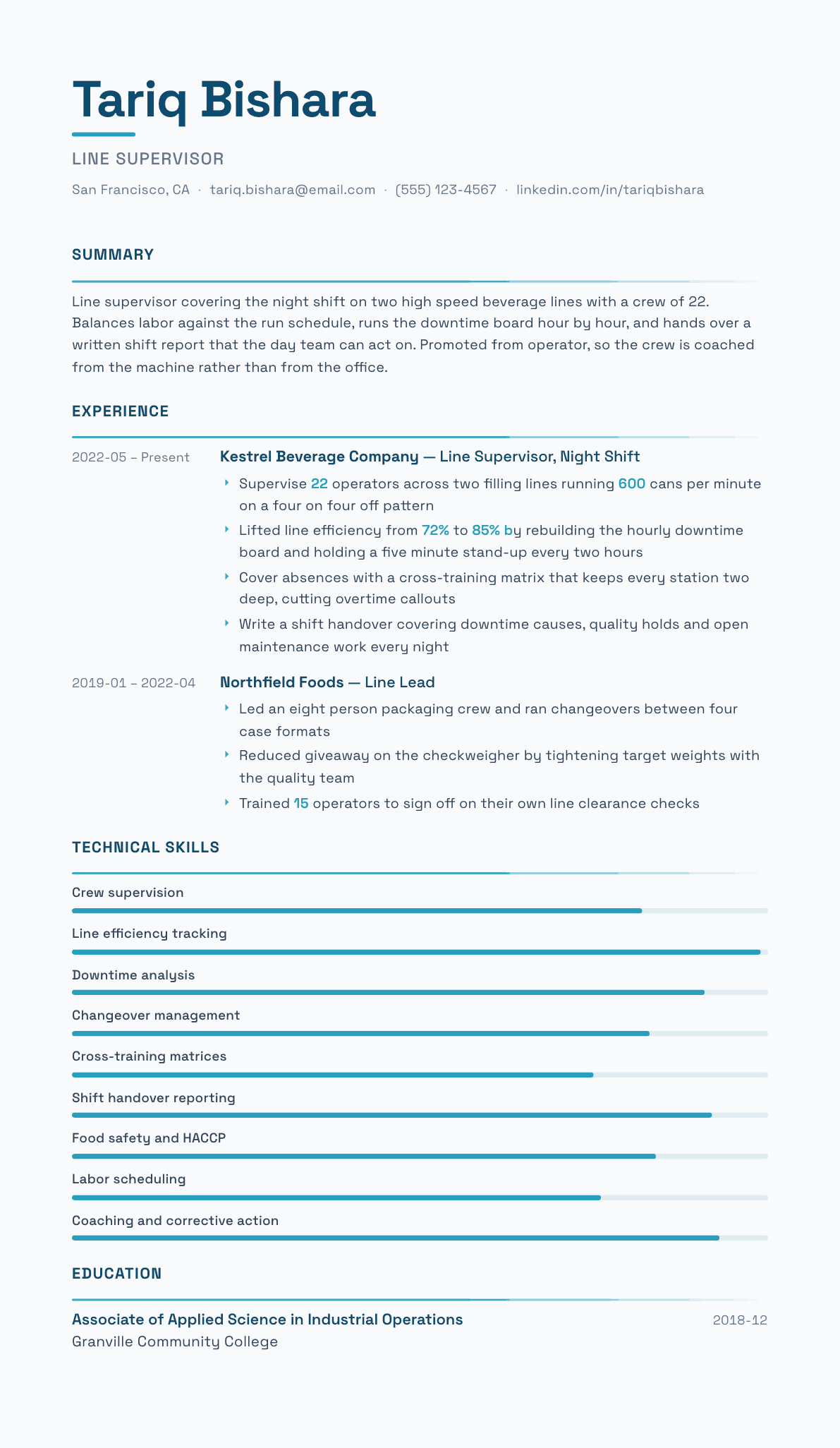
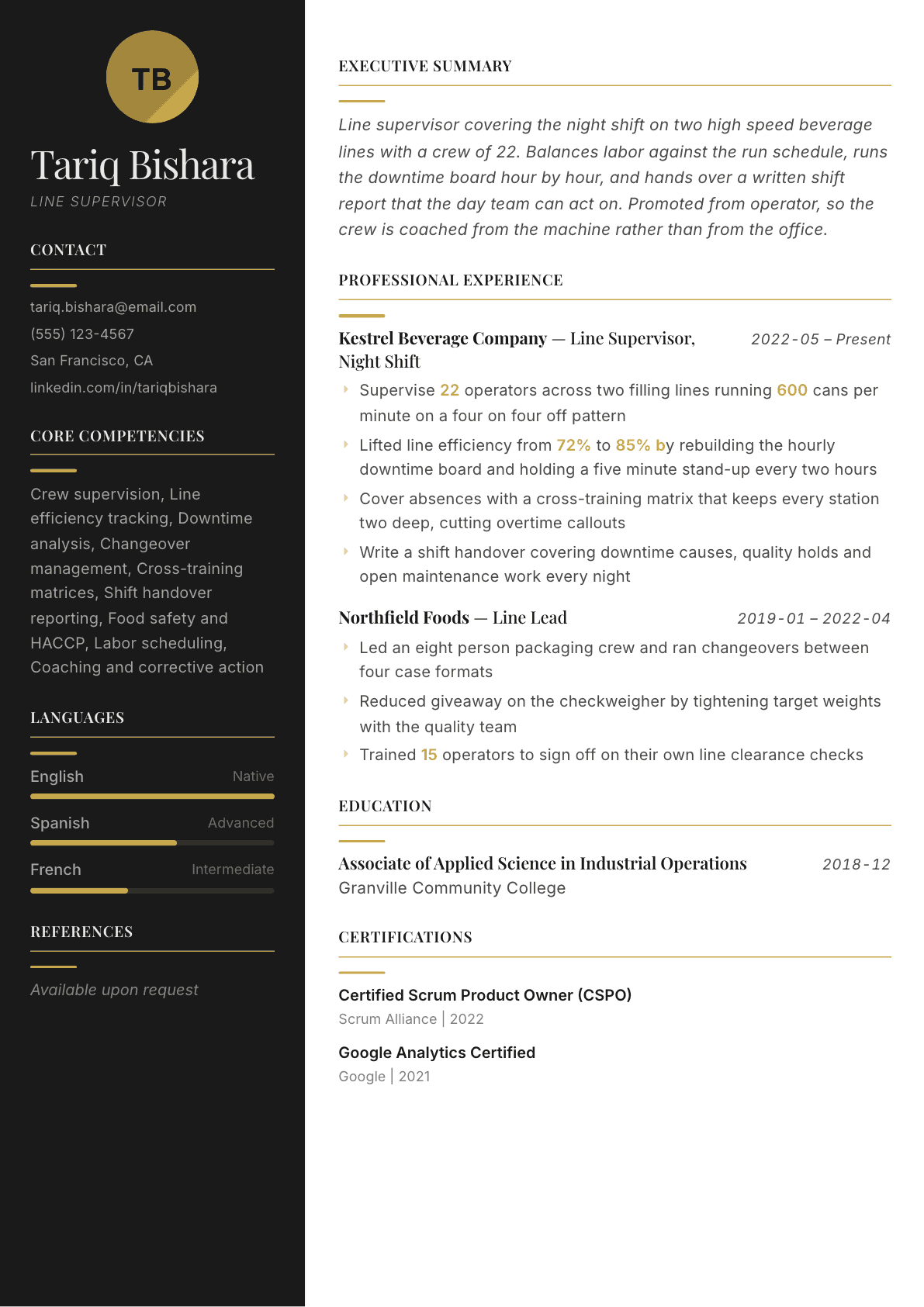
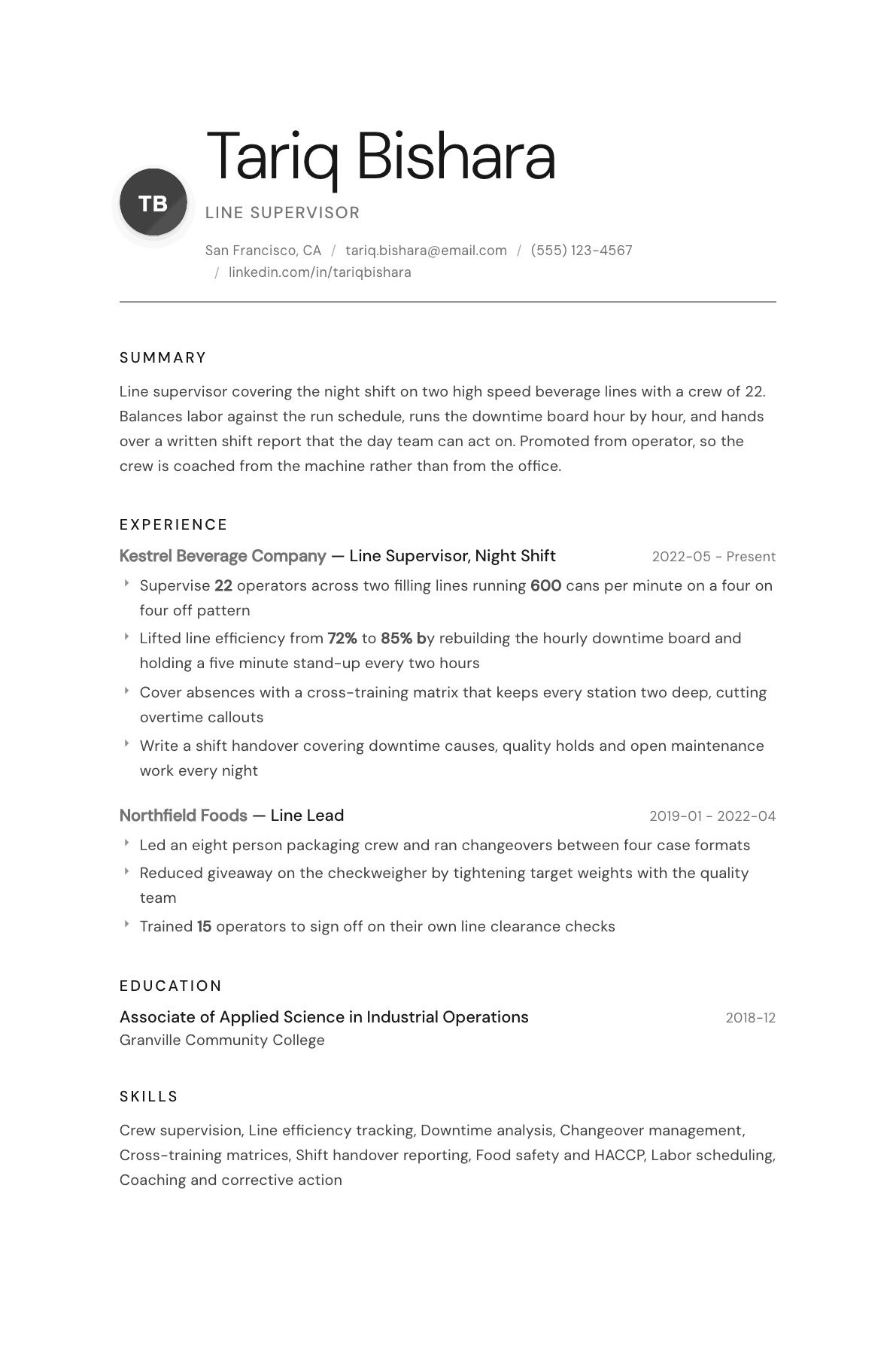
The same line supervisor content laid out in three CVBooster templates, so you can see what the finished document looks like before you write a word.
Example Line Supervisor summary
Line supervisor holding the night shift on two filling lines running 600 cans per minute with a crew of 22. Rebuilt the hourly downtime board and lifted line efficiency from 72% to 85%. Keeps every station two deep through a cross-training matrix, covers absences without overtime callouts, and writes a handover that names downtime causes, quality holds and open maintenance work. Promoted from operator.
Skills to list on a Line Supervisor resume
- Shift crew supervision
- Line efficiency and rate management
- Hourly downtime tracking
- Changeover and format change
- Labor planning and absence cover
- Cross-training matrix ownership
- Shift handover reporting
- Coaching and documented corrective action
- Line clearance and quality holds
- HACCP and food safety
- Lockout tagout enforcement
- Root cause problem solving
- Standard work auditing
- Maintenance work order escalation
What actually gets this resume read
- State your crew size, your shift pattern and the line speed you supervise in the first two lines of the resume.
- Give line efficiency or downtime as a before and after number, because that is the metric your next plant tracks hourly.
- Describe how you cover absences, since staffing a line short handed is most of what a supervisor actually does.
- Mention the handover you write and what it contains, because the incoming supervisor is your real customer.
- Include the disciplinary and coaching side plainly, from documented conversations to return to work meetings.
- Name the food safety or regulated standard your plant runs under, whether that is HACCP, SQF or a device standard.
- Say whether you were promoted from an operator seat, because plants value a supervisor who can jump on the machine.
How to write a line supervisor resume
Hiring a line supervisor is a bet that one person can keep a crew, a machine set and a build schedule pointed in the same direction for twelve hours without a manager in the building. The people reading your resume are usually the production manager and the outgoing supervisor, and both of them are picturing you standing at the end of the line at three in the morning when the filler goes down.
So the page has to answer operational questions, not personality questions. How many people did you hold? At what line speed? What did efficiency do while you held it? What happens when two operators call out an hour before start? A resume that says "supervised production staff and ensured targets were met" answers none of that and gets skipped for one that does.
This guide covers what a line supervisor resume needs: the crew and speed line at the top, downtime and efficiency written the way a plant tracks them, the staffing and coaching evidence that gets checked in the interview, and how to write the handover discipline that separates a supervisor from a promoted operator.
Format: crew, speed, shift, in the first block
One page for most supervisors, two once you have held several plants. The top block is the whole screen: crew size, number of lines, line speed or rate, shift pattern and product family. A production manager can size you against his own floor from those five facts alone, and if they are missing he has to guess, which usually means guessing low.
Group your compliance and equipment training in one place: lockout tagout authorization, food safety training, forklift, first aid, and any supervisory or coaching program the plant funded. Those items are budget line items for the plant hiring you, so surfacing them is worth more than another sentence about leadership.
- Opening block: crew size, line count, running speed in units or cases per hour, shift pattern, and the product built.
- Line technology named plainly: filler, capper, labeler, case packer, palletizer, thermoformer, oven, wrapper.
- A metrics line per job showing line efficiency, downtime hours, giveaway or scrap, and overtime as a share of hours.
- Compliance block covering lockout tagout authorized person status, food or device standards, and any safety certifications.
- A note on whether you were promoted from an operator seat, which plants read as the ability to jump on a machine.
Summary: the shift you hold and what it does
Three or four lines. What crew you supervise, on which lines and at what speed, what the efficiency number did under you, and how you handle staffing. That last point matters more than most candidates think: the supervisor who can cover an absent operator without calling in overtime saves a plant real money every week and never writes it down.
If you run nights or a rotating pattern, put it in the summary rather than hiding it in the dates. Night supervisors are hard to hire and plants know it, so a candidate who states plainly that he prefers or accepts the night rotation moves to the front of a queue for reasons that have nothing to do with the rest of the resume.
Experience: downtime, rate and the hourly board
Write the technical half of the job first. What you do when the line stops, how you decide between calling maintenance and fixing it yourself, how you sequence a changeover, and how you record downtime. A supervisor who can name the top three downtime causes on his line and what he did about each of them is demonstrating the exact skill the plant is buying.
Then the numbers. Line efficiency or overall equipment effectiveness with a before and after value, downtime hours per week, changeover time by format, giveaway or scrap, and overtime hours. Attach the mechanism to each figure, because a plant that hears "improved efficiency" assumes a favorable product mix, while a plant that hears "rebuilt the hourly downtime board and held short stand-ups" hears a method that transfers.
Strip out the filler. Ensured production targets were met, maintained a safe working environment and communicated with other departments are all things that do not distinguish you. Every line supervisor claims them, and none of them survive contact with a manager who wants to know what your line ran last quarter.
People: staffing, coaching and the difficult half
The half of the job nobody writes down is staffing an incomplete crew and handling the people who make it incomplete. Say how you build coverage, whether that is a cross-training matrix with two deep at every station, a rotation plan, or a relationship with the temp agency. Then say what your overtime and absence numbers did as a result, because that is the proof.
Coaching and corrective action belong on the page in plain language. Documented conversations, performance improvement plans, return to work discussions and attendance tracking are the reality of the role, and a manager wants to know you will do them properly rather than avoid them until the situation becomes a termination. Name any supervisory training you have completed alongside it.
Include what you did for people who wanted to move up. Operators trained and qualified, leads developed, and anyone you handed a station to permanently. A production manager reads that as a supervisor who builds bench strength rather than hoarding the competent operators on his own shift.
Handover, meetings and the words a posting uses
The written handover is a small thing that says a lot. Describe what yours contains: downtime causes with duration, quality holds and their disposition, open maintenance work orders, staffing for the next shift, and anything left mid-changeover. A supervisor who writes a handover that the next shift can act on is rare enough to be worth a bullet.
For keywords, use the vocabulary the postings use: line efficiency, downtime, changeover, format change, crew scheduling, cross-training, line clearance, sanitation, lockout tagout, corrective action, tiered daily management. Place each one where it is doing real work in a bullet rather than piling them into a block at the bottom of the page.
- Name the standard your plant runs under: HACCP, SQF, BRC, ISO 9001 or a device quality system, only where you worked to it.
- Say which meetings you run or attend: shift start up, tiered daily management, weekly downtime review, quality hold disposition.
- Include the reporting system you enter data into, from a paper downtime sheet to a plant performance platform.
- Add sanitation and line clearance responsibility if the product requires it, since food and device plants screen on it.
Line Supervisor resume summary examples
Operator moving into supervision
Line lead with 5 years on packaging lines, running changeovers across four case formats and training 15 operators on line clearance sign off. Reduced checkweigher giveaway with the quality team. Seeking a first full line supervisor seat on a rotating pattern.
Night shift supervisor
Line supervisor holding nights on two filling lines at 600 cans per minute with a crew of 22 on a four on four off pattern. Lifted line efficiency from 72% to 85% by rebuilding the hourly downtime board, and keeps every station two deep through a cross-training matrix.
Senior supervisor over multiple lines
Senior line supervisor over four packaging lines and 45 crew across two shifts, with two leads reporting in. Cut weekly downtime hours by a third through a top three loss routine, developed three operators into leads, and holds overtime under 5% of shift hours.
Work experience bullets: before and after
Before: Supervised production employees on the packaging line.
After: Supervised 22 operators across two filling lines running 600 cans per minute on a four on four off night pattern, covering filler, capper, labeler and case packer stations.
Crew size, line speed, shift pattern and station list let a manager place you on his own floor immediately.
Before: Improved line efficiency during my shift.
After: Lifted line efficiency from 72% to 85% over nine months by rebuilding the hourly downtime board and holding a five minute stand-up every two hours on the top loss of the block.
A before and after figure with a specific routine behind it reads as a transferable method rather than a good quarter.
Before: Handled scheduling and absences for the crew.
After: Built a cross-training matrix keeping every station two deep, which covered short notice absences from inside the crew and cut overtime callouts to fewer than two a month.
The staffing mechanism and the overtime outcome turn an administrative duty into a cost saving.
Before: Communicated with the incoming shift.
After: Wrote a nightly handover covering downtime causes with duration, quality holds and their disposition, open maintenance work orders and anything left mid-changeover, so the day supervisor started with decisions rather than questions.
Naming the contents proves a real discipline where "communicated" describes nothing at all.
Before: Coached team members and addressed performance issues.
After: Documented attendance and performance conversations to plant standard, ran two return to work meetings with human resources, and moved three operators onto qualified lead cover within a year.
The hard half of supervision, done properly, is what a manager actually needs to see evidence of.
Hard skills
- Shift crew supervision and scheduling
- Line efficiency and rate management
- Hourly downtime tracking and loss analysis
- Changeover and format change execution
- Cross-training matrix ownership
- Line clearance and quality hold handling
- Lockout tagout authorization and enforcement
- HACCP and food safety compliance
- Sanitation scheduling and verification
- Maintenance work order escalation
- Documented coaching and corrective action
- Shift handover reporting
- Standard work auditing
- Root cause problem solving on repeat stoppages
Soft skills
- Holding authority with people you worked beside as an operator
- Staying calm when the line goes down at the end of a run
- Reading a crew's mood before it turns into a callout wave
- Giving a correction once, clearly, without repeating it publicly
- Deciding to run or stop without waiting for a manager to answer the phone
Certifications worth listing
- HACCP Certification (International HACCP Alliance accredited course)
- OSHA 30-Hour General Industry (OSHA Outreach Training Program)
- Certified Production Technician (CPT) (Manufacturing Skill Standards Council)
- Certified Six Sigma Green Belt (CSSGB) (American Society for Quality)
Mistakes that cost line supervisor candidates the interview
- Omitting crew size and line speed, the two numbers a production manager uses to decide whether you are a fit at all.
- Describing efficiency gains without the routine behind them, which reads as a favorable product mix rather than management.
- Skipping the staffing and absence half of the job even though it consumes most of a supervisor's week.
- Avoiding corrective action on the page, which makes a manager suspect you leave discipline to human resources.
- Writing the handover as communication rather than listing what the handover actually contains.
- Hiding the night or rotating pattern in the dates when stating it plainly is what makes you attractive to hire.
Line Supervisor resume questions
How do I move from operator to line supervisor on paper?
Pull out everything you already did that was supervisory: training operators, running changeovers, covering the lead seat, holding line clearance sign off, filling in the downtime sheet. Present those as responsibilities rather than favors, and add any supervisory course you have taken.
What line efficiency number should I put on my resume?
The one your plant published, with the definition it used, because efficiency, utilization and overall equipment effectiveness are calculated differently in different plants. Give a before and after value over a stated period, and be ready to explain the calculation in the interview.
Should I mention discipline and terminations?
Mention the process, not the outcomes. Say you document conversations to plant standard, run attendance reviews and work with human resources on formal steps. A manager wants proof you handle it properly, and naming individual terminations reads as poor discretion.
How do I write about a line I supervised that never hit its target?
State the constraint honestly, whether that was equipment age, a supply problem or a chronic quality loss, then show what you did inside it: the downtime you removed, the losses you quantified, and the case you built for a fix. Managers respect a supervisor who can describe a constraint accurately.
Does food industry supervision transfer to other manufacturing?
Most of it does, because crew management, changeovers and downtime discipline are the same everywhere. Translate the parts that are industry specific: describe sanitation and line clearance as quality control routines, and lead with rate, staffing and efficiency numbers that any plant recognizes.
Related resume examples
- Production Supervisor Resume example
- Manufacturing Supervisor Resume example
- Production Lead Resume example
- Manufacturing Manager Resume example
- Production Scheduler Resume example
- Quality Auditor Resume example