Operations Coordinator Resume Examples: read this first
Write an Operations Coordinator Resume That Proves You Keep Things Running
By Mustafa Tarabya, founder of CVBooster · Published · Updated
Operations coordinator resume examples, a sample work history, ATS keywords and a writing guide that shows what hiring managers check first.
Sample resumes for a operations coordinator
The same operations coordinator content laid out in three CVBooster templates, so you can see what the finished document looks like before you write a word.
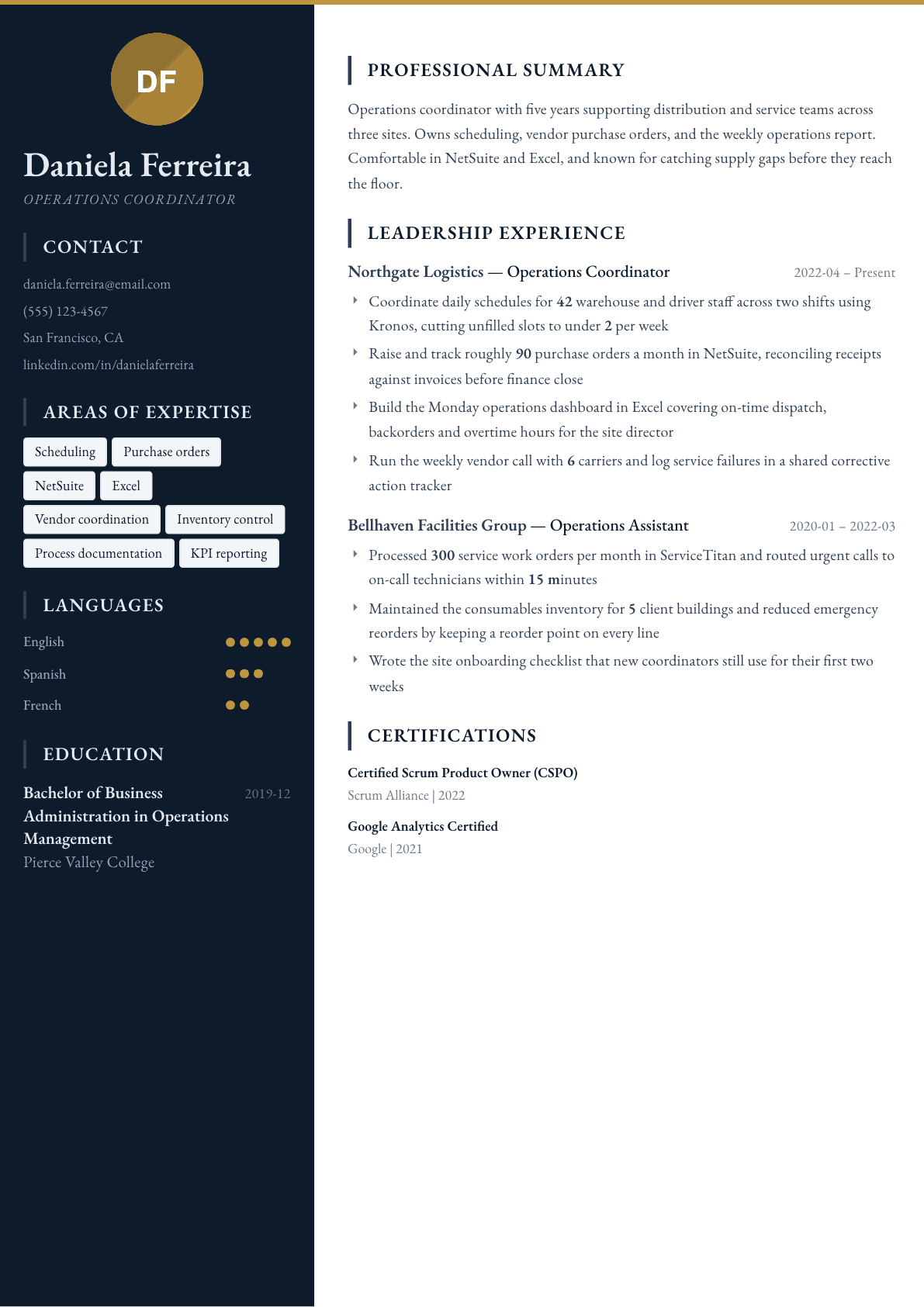
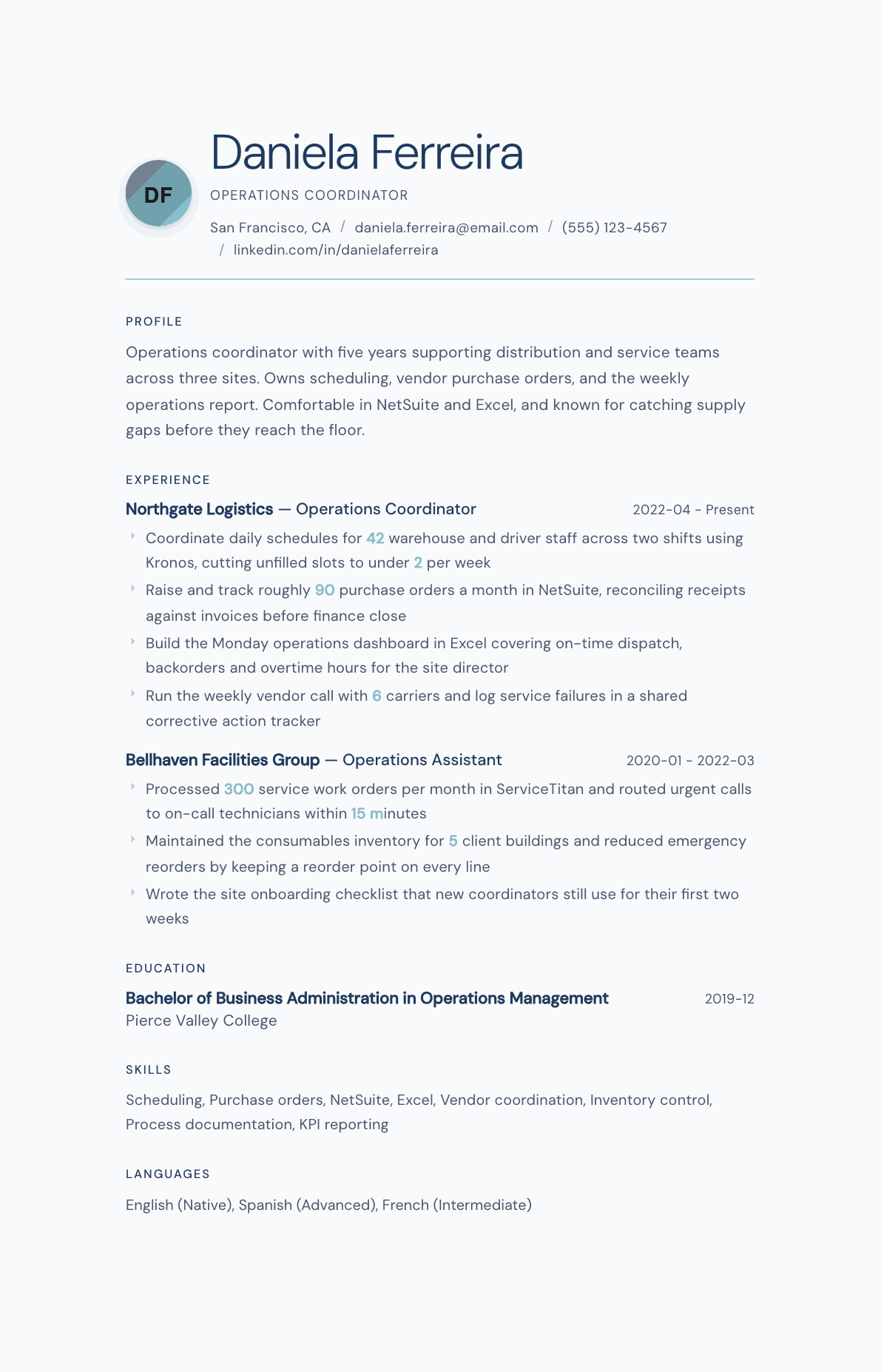
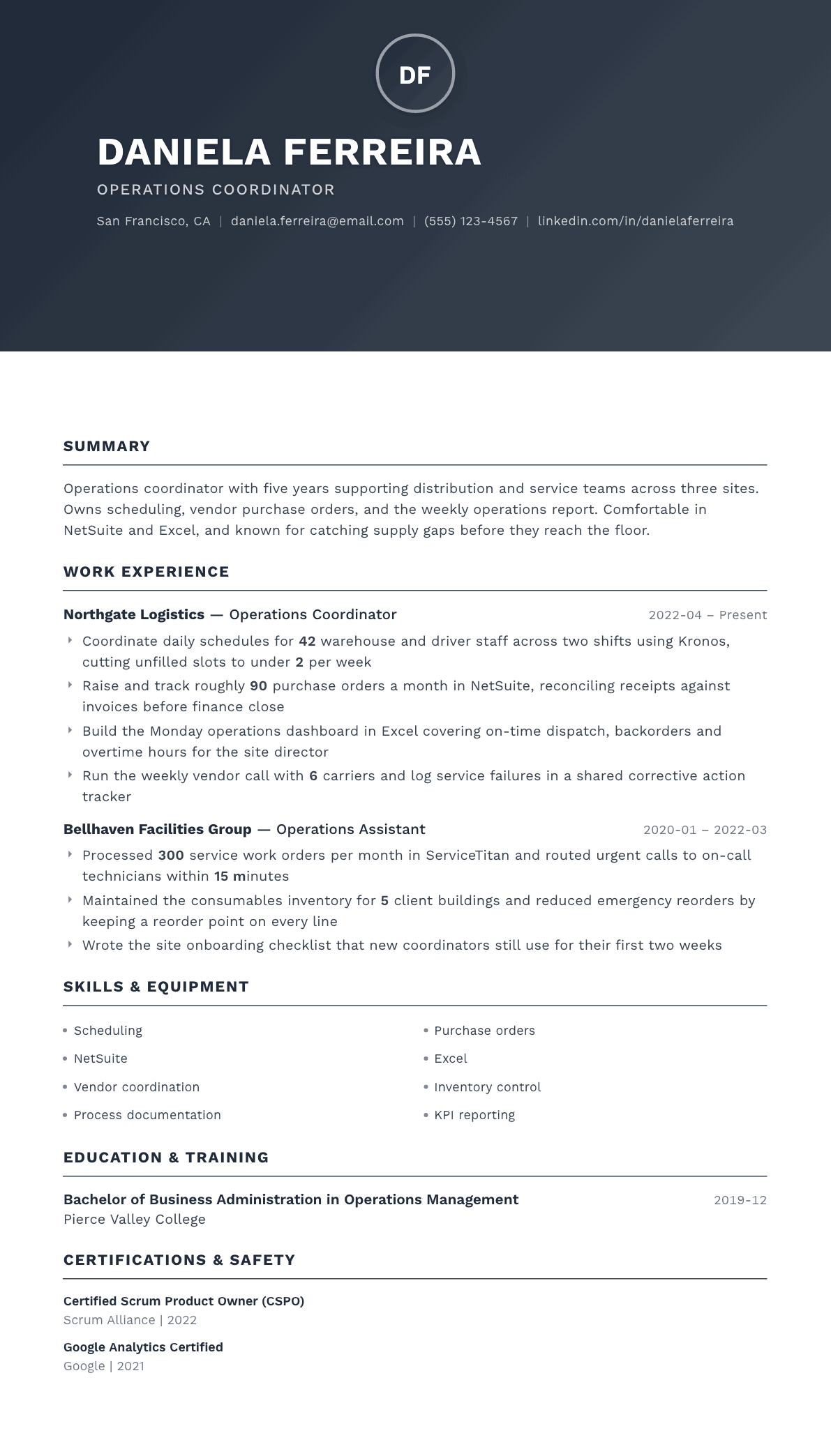
Example Operations Coordinator summary
Operations coordinator with five years keeping multi-site service and distribution teams supplied, staffed and on schedule. Owns purchase order intake, carrier performance tracking and the weekly operations report reviewed by site leadership. Strong in NetSuite, Kronos and Excel, and used to being the person other departments call when an order, a shift or a vendor goes sideways.
Skills to list on a Operations Coordinator resume
- Operations scheduling
- Purchase order processing
- Vendor coordination
- Inventory control
- ERP systems
- NetSuite
- SAP
- Excel reporting
- KPI dashboards
- Process documentation
- Cross-functional communication
- Issue escalation
- Invoice reconciliation
- Capacity planning
- Standard operating procedures
What actually gets this resume read
- Name the systems you work in daily, such as NetSuite, SAP, Kronos or Smartsheet, because coordinator postings screen on them.
- Give the scale of what you coordinate: headcount scheduled, sites supported, orders processed, vendors managed, tickets closed.
- Show the reporting you own by name, since the weekly operations report is often the reason the role exists.
- Separate coordination from administration by leading bullets with verbs like route, sequence, reconcile and escalate.
- Add one bullet per job about a process you documented or fixed, because coordinators are hired to remove recurring friction.
- Keep the resume to one page unless you have supported multiple sites for more than six years.
How to write a operations coordinator resume
An operations coordinator resume is screened for one thing before anything else: can this person hold several moving parts at once without dropping any of them. The hiring manager is usually an operations manager who is already stretched, and who needs someone to take scheduling, purchase orders, vendor chasing and the weekly report off their desk within a month.
That makes the job unusually easy to evidence and unusually easy to write badly. Most coordinator resumes read as a list of duties any office worker could claim: assisted with scheduling, supported the team, maintained records. The resumes that get calls name the systems, the volumes and the decisions. Forty-two staff scheduled across two shifts is a different job from four, and the resume has to say which one you did.
This guide covers the order to put your sections in, how to write experience bullets that show coordination rather than administration, which keywords the applicant tracking system is matching, and the questions coordinators ask most when they sit down to rewrite the file.
Format: one page, single column, systems visible near the top
Reverse-chronological, one page unless you have supported multiple sites for more than six years. Operations teams often use basic parsers built into their applicant tracking system, so avoid side-by-side columns in the experience section and put nothing important in a header or footer.
Put a short systems line directly under the summary. A screener looking for someone who can step into their environment wants to see NetSuite, SAP, Kronos, Smartsheet or ServiceTitan without scrolling. That line does more for you than a skills section buried on page two.
- Header: name, city and state, phone, email, and a one-line title such as Operations Coordinator.
- Sections in this order: summary, systems, experience, education, additional skills.
- Career changers move a short relevant projects block above older unrelated jobs.
Summary: scope, systems, and the report you own
Three lines. Say what you coordinate, at what scale, in which systems, and what recurring output you are accountable for. The recurring output matters because it tells a manager which of their own tasks they can hand over on your first Monday.
Avoid the phrase detail oriented. Every coordinator claims it and no screener has ever believed it from a claim. Replace it with an accuracy fact: purchase orders reconciled against receipts before finance close, or zero unfilled shifts across a quarter.
Experience: volumes, cadence, and what you caught
Give each job a scope line before the bullets: sites supported, headcount coordinated, orders or work orders processed per month, vendors managed. A reader who cannot picture the load will assume it was small.
Then write three to five bullets. Lead with the things that run on a cadence, because coordination is a rhythm job: the daily schedule, the weekly vendor call, the monthly reconciliation. Follow with the exceptions you handle, since that is where judgment lives. Escalating a late carrier, resequencing a route when a driver calls out, holding a purchase order because the quantity did not match the requisition.
Every coordinator has caught something before it became a problem. Write one bullet about it with the mechanism you used, not just the save. A reorder point on every consumable line is a mechanism. Being proactive is not.
- Open each job with a scope line: sites, headcount, monthly transaction volume, vendor count.
- Use verbs that show sequencing and control: route, reconcile, sequence, expedite, escalate, close out.
- Include one bullet per job on a process you wrote down or improved.
Systems and skills: name the exact platform, not the category
Writing ERP tells a screener nothing, because the posting was written against one specific ERP. Write NetSuite, SAP S/4HANA, Dynamics 365 or whatever you actually used, then add the module if you know it, such as procurement or inventory. Do the same for workforce tools: Kronos, UKG, Deputy or When I Work.
Excel deserves a specific claim rather than a bare mention. Pivot tables, XLOOKUP, Power Query and a dashboard you maintain each week are all concrete. If you have built anything in Power BI or Tableau, say so, because coordinator roles increasingly absorb the reporting the analyst used to do.
Keywords the applicant tracking system is matching
Operations postings are recycled from a small set of templates, so the same phrases recur: scheduling, purchase orders, vendor management, inventory control, standard operating procedures, cross-functional coordination, KPI reporting, work order management. Mirror the exact phrasing of the posting once in the systems or skills block and once inside a bullet where it is demonstrated.
Do not paste a keyword wall at the bottom of the page. A human reads the file within seconds of the software passing it, and a block of unattached terms reads as padding on a role that is supposed to be organized.
Operations Coordinator resume summary examples
First operations role
Business administration graduate with a year of warehouse office experience covering inbound scheduling, receiving paperwork and supplier chasing. Confident in Excel including pivot tables and lookups, trained on NetSuite receiving, and looking for an operations coordinator role in distribution or field service.
Four years in
Operations coordinator supporting two distribution sites and 42 staff across scheduling, purchase orders and vendor performance. Raises around 90 purchase orders a month in NetSuite, runs the weekly carrier call, and owns the Monday operations dashboard covering on-time dispatch, backorders and overtime.
Lead coordinator
Senior operations coordinator across three sites, mentoring two junior coordinators and owning the standard operating procedure library. Rebuilt the scheduling process against forecast volume, cut unfilled shifts to under two a week, and reports on-time dispatch and vendor service failures directly to the regional operations manager.
Work experience bullets: before and after
Before: Assisted with scheduling for the warehouse team.
After: Built the daily schedule for 42 warehouse and driver staff across two shifts in Kronos, holding unfilled slots under two a week through peak season.
Headcount, shifts, the system and the miss rate turn an assist into ownership of a measurable outcome.
Before: Responsible for purchase orders and supplier communication.
After: Raised and tracked around 90 purchase orders a month in NetSuite, reconciling every receipt against its invoice before finance close and holding short-shipped lines until credit was confirmed.
Volume, system and the control step show the reader that accuracy is a process here, not a personality trait.
Before: Created reports for management.
After: Built and issued the Monday operations dashboard in Excel covering on-time dispatch, open backorders and overtime hours, which the site director now uses to set the weekly labor plan.
Naming the metrics and the decision the report drives proves the reporting was used rather than filed.
Before: Worked with vendors to resolve issues.
After: Ran a weekly performance call with six carriers, logged every service failure in a shared corrective action tracker, and escalated two repeat offenders to contract review.
A cadence, a record and an escalation path show vendor management rather than occasional phone calls.
Before: Helped improve processes in the department.
After: Wrote the site onboarding checklist covering system access, safety induction and shift handover, cutting new coordinator ramp time from four weeks to two.
A named artifact with a before and after is verifiable; helped improve processes is not.
Hard skills
- Operations scheduling
- Purchase order processing
- Invoice and receipt reconciliation
- Vendor performance tracking
- Inventory and reorder point control
- NetSuite
- SAP
- Kronos and workforce scheduling tools
- Advanced Excel
- KPI dashboard reporting
- Standard operating procedure writing
- Work order management
- Capacity and shift planning
Soft skills
- Prioritizing competing requests
- Chasing without friction
- Escalation judgment
- Clear written handovers
- Cross-department communication
- Composure during disruption
Certifications worth listing
- Certified in Planning and Inventory Management (CPIM) (ASCM)
- Certified Supply Chain Professional (CSCP) (ASCM)
- Certified Associate in Project Management (CAPM) (Project Management Institute)
- Certified Six Sigma Yellow Belt (CSSYB) (American Society for Quality)
- Microsoft Office Specialist: Excel Expert (Microsoft)
Mistakes that cost operations coordinator candidates the interview
- Listing duties with no volume attached, so a reader cannot tell a four person office from a three site operation.
- Writing ERP or scheduling software instead of the actual platform name the posting is screening for.
- Claiming detail oriented and organized in the summary instead of showing an accuracy result underneath a job.
- Hiding the recurring reports you own, which are usually the exact tasks the manager wants to hand over.
- Using a two column template with icons, which basic parsers read out of order and often drop the dates from.
- Describing only routine work and never the exceptions, which is where a coordinator actually earns the title.
Operations Coordinator resume questions
What is the difference between an operations coordinator and an operations assistant?
An assistant executes tasks handed down each day. A coordinator owns a recurring process end to end and decides sequence, priority and escalation within it. Write your resume around the processes you own, not the tasks you were given.
How do I show impact when I do not control a budget?
Use throughput and reliability instead of money. Unfilled shifts per week, on-time dispatch rate, purchase orders processed without rework, average time to close a work order, and emergency reorders avoided all read as impact to an operations manager.
Should I list every system I have touched?
List the ones you used weekly and could still work in tomorrow. Padding the list with a platform you saw twice is risky because operations interviews often include a practical question about the system you claimed first.
Do I need a degree for an operations coordinator role?
Many postings ask for one and many accept experience instead. If you do not have a degree, lead with a strong systems line and site level volumes, and add any supply chain or project certification you hold so the education gap is not the only signal.
How do I move from operations coordinator to operations manager?
Show the two things a manager does that a coordinator usually does not: owning a budget line and directing people. Volunteer for supplier cost work and for training or scheduling ownership, then write those bullets first so the promotion reads as already underway.
Related resume examples
- Operations Manager Resume example
- Logistics Coordinator Resume example
- Operations Analyst Resume example
- Project Coordinator Resume example
- Director of Operations Resume example
- Buyer Resume example