Production Scheduler Resume Examples: what gets the call
Write a Production Scheduler Resume That Shows Real Planning Range
By Mustafa Tarabya, founder of CVBooster · Published · Updated
Production scheduler resume example, keyword list and guide covering MRP, finite capacity planning, schedule adherence and changeover sequencing.
Sample resumes for a production scheduler
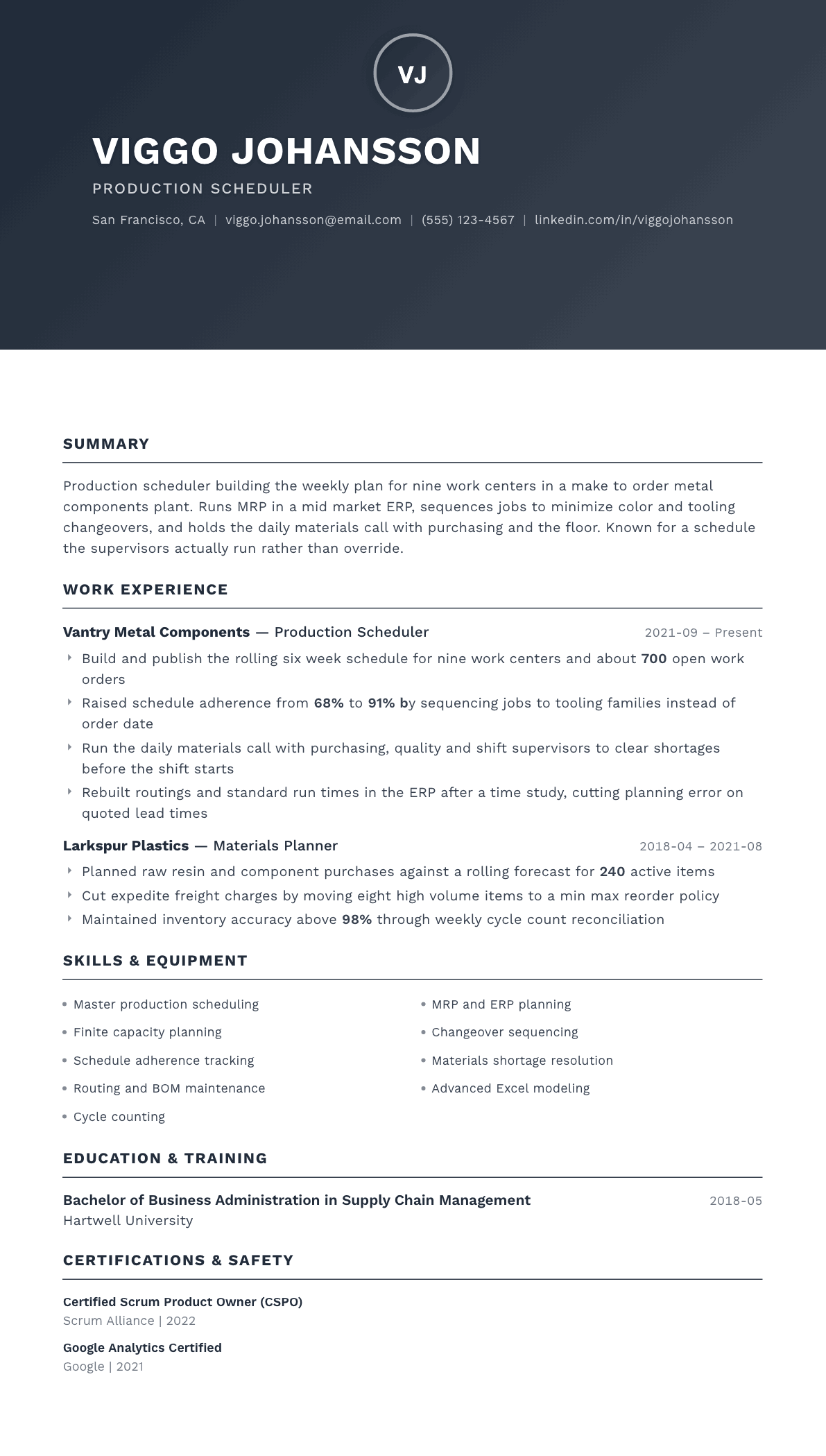
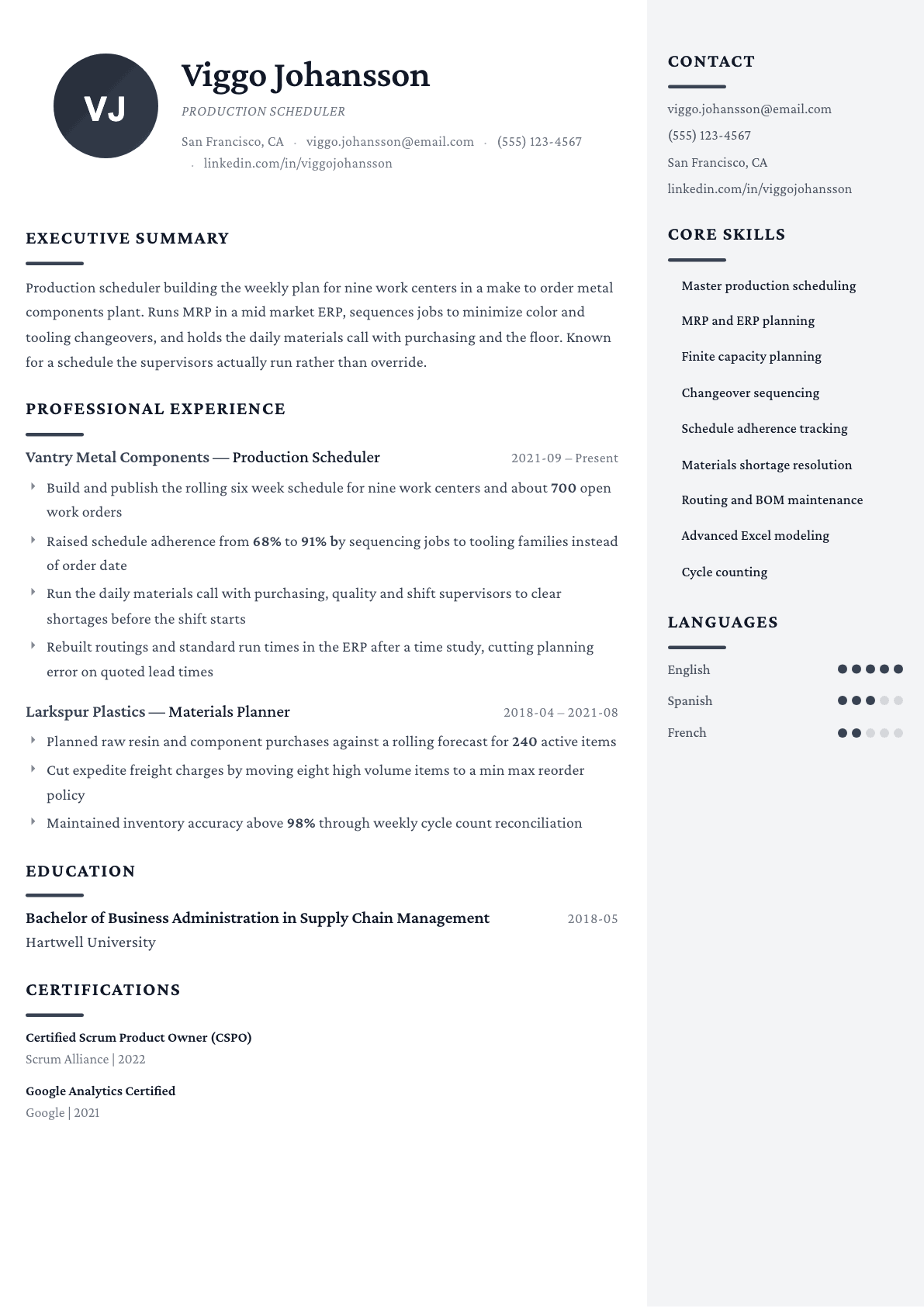
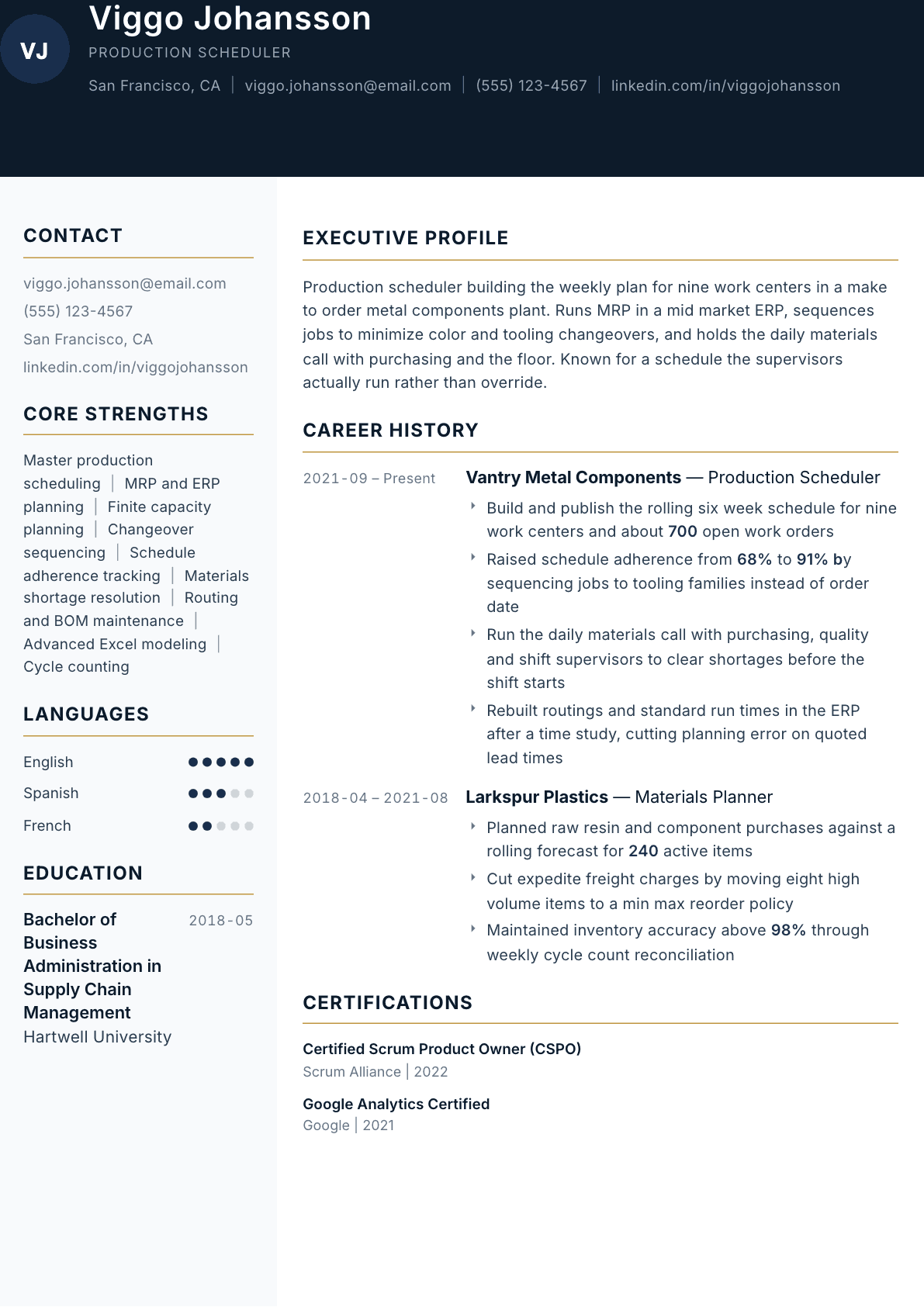
The same production scheduler content laid out in three CVBooster templates, so you can see what the finished document looks like before you write a word.
Example Production Scheduler summary
Production scheduler owning the rolling six week plan for nine work centers and roughly 700 open work orders in a make to order metal plant. Lifted schedule adherence from 68% to 91% by sequencing to tooling families rather than order date. Runs the daily materials call with purchasing and the floor, and rebuilt ERP routings after a time study so quoted lead times match what the plant can actually run.
Skills to list on a Production Scheduler resume
- Master production scheduling
- MRP and MPS execution
- Finite capacity planning
- Work order release and sequencing
- Changeover minimization
- Schedule adherence reporting
- Bill of materials maintenance
- Routing and standard time updates
- Materials shortage management
- Capacity and load leveling
- Inventory and cycle count accuracy
- Supplier delivery follow up
- Excel and pivot table modeling
- Sales and operations planning input
What actually gets this resume read
- Name the ERP by product name, because a scheduler who already knows the planning screens saves a plant weeks.
- Give the number of work centers, open work orders and active part numbers you plan, since that is your real scale.
- Report schedule adherence as a before and after figure, because it is the one number a plant manager grades you on.
- Explain your sequencing logic, whether that is tooling families, color runs, die size or cure time.
- Show how you handle shortages, from the daily materials call to the expedite decision you are allowed to make.
- Mention routing and standard time maintenance, because most planning error traces back to stale routings.
- Say whether you plan to a finite capacity model or an infinite one, since the two jobs are not the same.
How to write a production scheduler resume
A production scheduler is hired because somebody in the plant is currently building the schedule badly, usually the plant manager in a spreadsheet at seven in the morning. The person reading your resume knows exactly what that costs: expedite freight, idle work centers, missed promise dates and a floor that has stopped believing the schedule. He is looking for evidence that you have fixed that somewhere else.
Two things decide the screen. First, the planning system you know, because a scheduler who already lives inside the same enterprise platform starts producing a usable plan in weeks rather than months. Second, schedule adherence, because that single number tells a plant manager whether your last floor ran your plan or ignored it.
This guide covers what a production scheduler resume needs: the scale of what you plan, the sequencing logic that shows you understand the constraints, the data hygiene work that most schedulers never mention, and how to write the difference between planning to finite capacity and planning to a wish.
Format: system, scale, adherence, in that order
One page, or two once you have run several plants and several systems. Name the enterprise platform in the summary and again under each job, because that word is the strongest filter on the screen. Then give the scale: work centers planned, open work orders carried, active part numbers, and the planning horizon you publish.
Put schedule adherence into a visible position rather than burying it. A plant manager reads adherence as a proxy for the quality of the whole plan, since a schedule the floor overrides is not a schedule. If you also track promise date performance or forecast accuracy, put those beside it.
- Summary line naming the planning platform, the module set you use, and whether you configured or inherited it.
- Scale block: work centers, open work orders, active items, and the length of the published horizon.
- Adherence figures with the period they cover, plus on time delivery if your plan drove it.
- A production environment line: make to order, make to stock, engineer to order, or a mix with the split.
- Data maintenance line covering routings, standard times, bills of material and reorder policies you own.
Summary: what you plan and what it produced
Four sentences. What you plan and at what scale, the system it lives in, what adherence did under you, and the sequencing logic you use. That last item is what marks an experienced scheduler, because sequencing to tooling families, cure times, color runs or die sizes is judgment that no planning engine makes for you.
Say plainly whether you plan to finite or infinite capacity. A plant that loads work centers past their real capacity and calls the result a schedule is a very different job from a plant that runs a constrained model, and a scheduler who has only done one should not pretend to both.
Experience: sequencing, constraints and the daily call
Explain how you actually build the plan. Which work center you treat as the constraint, how you protect it, what you batch together and why, how far ahead you freeze, and what rule you use when a hot order arrives. Those decisions are the job, and describing them proves you were the scheduler rather than the person who printed the report.
Then show how the plan survives contact with the floor. The daily materials or production call is where most of the value sits: purchasing brings shortages, quality brings holds, supervisors bring machine problems, and you re-sequence around all three before the shift starts. A scheduler who runs that call and publishes the result is doing the part that plant managers actually need.
Include the improvement work. Adherence gains usually come from either better sequencing, better data or a better freeze rule, and naming which one you fixed tells a hiring manager whether you can do the same in his plant. Expedite freight reduction, overtime reduction and lead time reduction all belong here when your plan caused them.
- Sequencing logic: tooling family, color and material runs, die or mold size, cure and setup dependency, campaign length.
- Constraint handling: the bottleneck work center, how much buffer you keep ahead of it, and what you never let idle.
- Freeze and change rules: the frozen window, who can break it, and what an expedite costs the rest of the plan.
- The daily call: who attends, what gets decided, and what gets republished as a result.
- Exception handling: shortage lists, past due work order cleanup, and how you retire dead orders from the backlog.
Data hygiene, the part most schedulers leave off
Half of bad scheduling is bad master data. Routings with standard times nobody has checked since the machine was replaced, bills of material missing a component, reorder points set for a demand pattern that no longer exists. A scheduler who has cleaned that up has done something concrete and rare, and it belongs on the page in specifics.
Write what you fixed and how you validated it. Time studies against actual run data, routing revisions by work center, bill of material corrections found through shortage patterns, and reorder policy changes with the inventory result. A hiring manager who has been burned by a plan built on stale routings will read that section twice.
Inventory accuracy is part of the same story. Cycle counting, count reconciliation and the relationship between accuracy and material availability are all scheduler concerns even when the warehouse owns the count, because your plan fails when the on hand quantity is fiction.
Keywords, tools and the reporting you build
Postings for this role use a tight vocabulary: master production schedule, material requirements planning, capacity planning, work order release, schedule adherence, lead time, backlog, expedite, bill of material, routing, cycle count, sales and operations planning. Use the exact terms, and pair each with a place in your history where you did the work.
Say what you build outside the planning system too. Most schedulers live partly in spreadsheets, and being explicit about pivot tables, lookup driven load reports, and any query or reporting tool you use gives a hiring manager confidence that you can produce visibility his plant does not currently have.
Production Scheduler resume summary examples
Planner moving into scheduling
Materials planner with 3 years planning raw and component purchases for 240 active items against a rolling forecast, holding inventory accuracy above 98% through weekly cycle count reconciliation. Supply chain degree and heavy spreadsheet modeling. Seeking a first production scheduling seat.
Scheduling one plant
Production scheduler publishing a rolling six week plan for nine work centers and roughly 700 open work orders in a make to order metal components plant. Raised schedule adherence from 68% to 91% by sequencing to tooling families rather than order date, and runs the daily materials call.
Senior scheduler across sites
Senior production scheduler covering two plants and 20 work centers with a finite capacity model, owning routings, standard times and the frozen window policy. Rebuilt standard run times after a time study, cut expedite freight by a third, and trains the planners at both sites.
Work experience bullets: before and after
Before: Created the weekly production schedule for the plant.
After: Built and published a rolling six week schedule for nine work centers and roughly 700 open work orders, republished daily after the shortage call and frozen inside 5 working days.
Scale, horizon, republish cadence and freeze rule describe a real planning process instead of a task.
Before: Improved schedule adherence.
After: Raised schedule adherence from 68% to 91% over three quarters by sequencing work orders to tooling families instead of order date, which removed roughly two setups per machine per day.
The sequencing change and the setup count explain the number, so the improvement looks repeatable.
Before: Worked with purchasing on material shortages.
After: Ran a daily 15 minute materials call with purchasing, quality and the shift supervisors to clear the shortage list and re-sequence affected work orders before first shift started.
A named routine with attendees and a decision output beats a claim of cross-department cooperation.
Before: Maintained data in the ERP system.
After: Rebuilt routings and standard run times for 9 work centers after a time study against actual labor tickets, which brought quoted lead times in line with real capacity and cut past due orders sharply.
Data cleanup with a validation method and a business result is concrete where "maintained data" is not.
Before: Reduced expediting costs.
After: Moved 8 high volume items from order driven purchasing to a min max reorder policy, which removed most premium freight charges on those items and freed the buyer for sourcing work.
Naming the policy change and the count of items shows a structural fix rather than tighter chasing.
Hard skills
- Master production scheduling
- Material requirements planning execution
- Finite and rough cut capacity planning
- Work order release and sequencing
- Changeover minimization and campaign batching
- Schedule adherence measurement and reporting
- Bill of material and routing maintenance
- Standard time studies and updates
- Shortage management and expedite decisions
- Inventory accuracy and cycle counting
- Reorder policy and safety stock setting
- Sales and operations planning input
- Advanced spreadsheet modeling and pivot reporting
- Backlog and past due order cleanup
Soft skills
- Saying no to an expedite request with the plan cost attached
- Holding a short daily call that ends in decisions
- Explaining a capacity constraint to a salesperson without jargon
- Keeping a plan stable enough for the floor to trust it
- Chasing a shortage without turning purchasing into an enemy
Certifications worth listing
- Certified in Planning and Inventory Management (CPIM) (Association for Supply Chain Management)
- Certified Supply Chain Professional (CSCP) (Association for Supply Chain Management)
- Certified Six Sigma Green Belt (CSSGB) (American Society for Quality)
Mistakes that cost production scheduler candidates the interview
- Leaving the enterprise platform out of the summary when it is the single strongest filter a screener applies.
- Giving no schedule adherence figure, which leaves a plant manager unable to tell whether your last floor ran your plan.
- Describing the schedule as a deliverable rather than describing the sequencing judgment that produced it.
- Skipping master data work, even though stale routings and wrong bills of material cause most planning failures.
- Claiming capacity planning without saying whether the model was finite or infinite, since the two jobs differ completely.
- Listing spreadsheet skills generically instead of naming the load report or backlog model you actually built.
Production Scheduler resume questions
Which enterprise system should I highlight as a production scheduler?
All of the ones you have used, with the modules named, and the one you know deepest first. Screeners search on platform names, and a plant will interview a scheduler who knows its system even when the rest of the background is a slightly awkward fit.
What is a good schedule adherence figure to show?
Any real one, with the definition and the period attached. A move from a low number to a respectable one is more persuasive than a high number with no history, because it shows you changed something. Say how adherence was measured, since plants count it differently.
How do I show scheduling skill without an official scheduler title?
Describe the planning you did under another title: releasing work orders as a coordinator, building the daily run sequence as a lead, planning materials as a buyer. Give the same details a scheduler would give, meaning work centers, horizon, sequencing logic and adherence.
Should I mention spreadsheets when the plant has a planning system?
Yes. Almost every scheduler runs a spreadsheet alongside the system for load visibility, what if scenarios and shortage tracking. Naming the specific models you built shows you can create visibility fast in a plant whose reports do not yet answer the question.
How do I write about a plant where the schedule was constantly overridden?
Say what caused it, whether that was unreliable master data, an infinite capacity model, or a sales team promising dates outside the plan. Then show the piece you fixed and what adherence did afterward. Hiring managers know this situation well and want to hear how you approached it.
Related resume examples
- Production Planner Resume example
- Supply Chain Coordinator Resume example
- Logistics Coordinator Resume example
- Production Manager Resume example
- Production Coordinator Resume example
- Manufacturing Manager Resume example