Manufacturing Manager Resume Examples: read this first
Build a Manufacturing Manager Resume Around Plant Numbers
By Mustafa Tarabya, founder of CVBooster · Published · Updated
Manufacturing manager resume example and guide covering OEE, headcount, capital projects, cost per unit and the metrics a plant director checks.
Sample resumes for a manufacturing manager
The same manufacturing manager content laid out in three CVBooster templates, so you can see what the finished document looks like before you write a word.
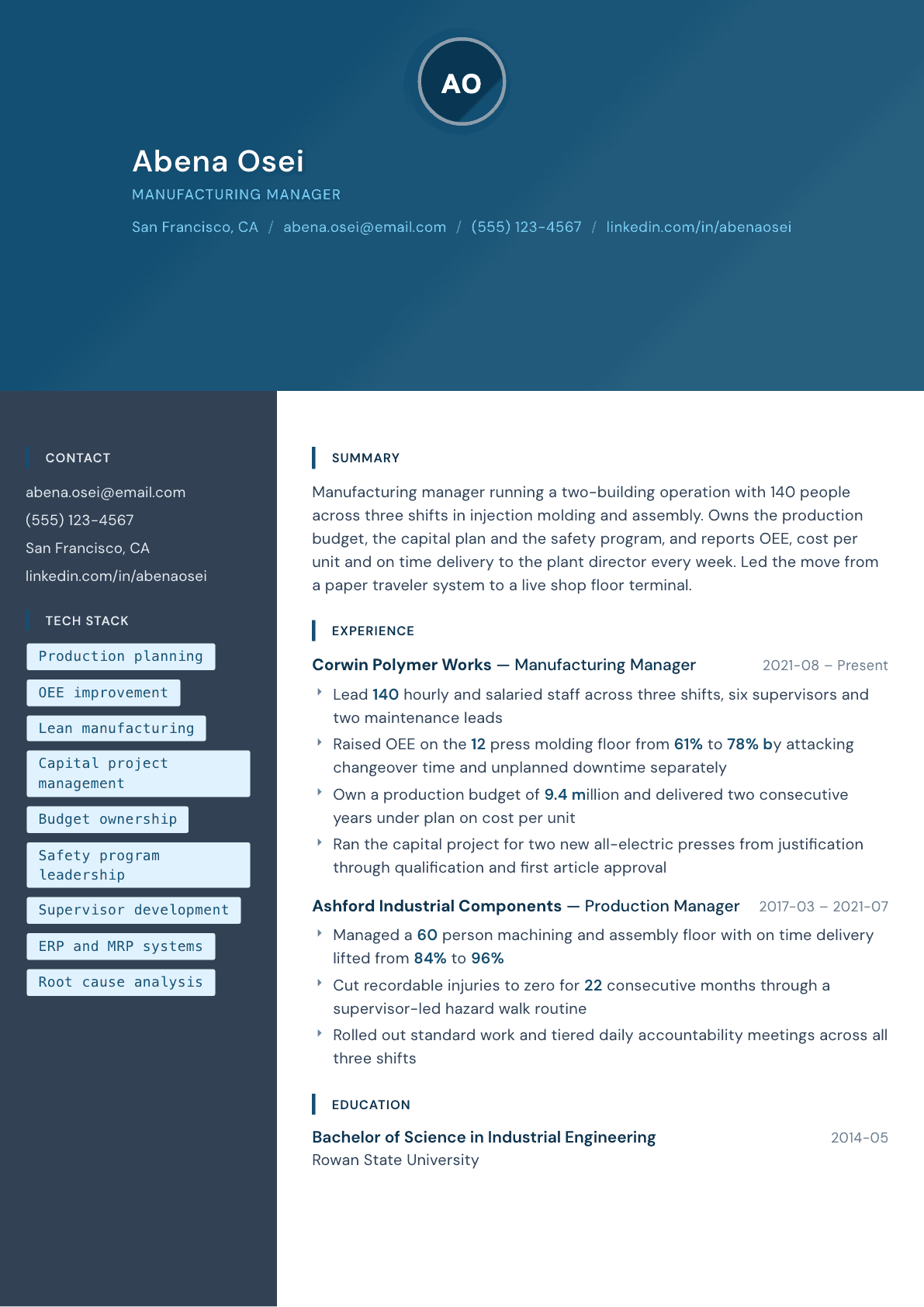
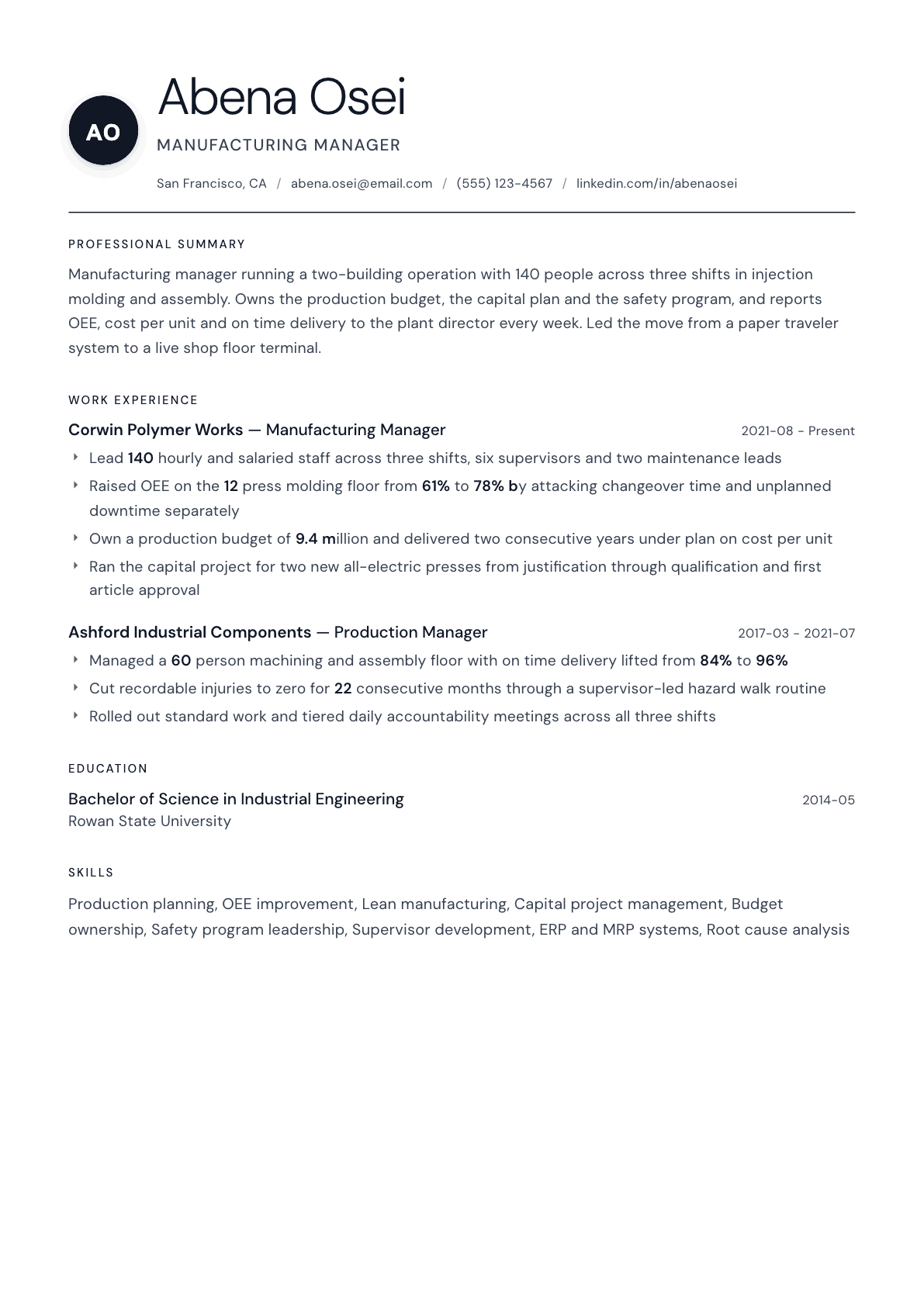
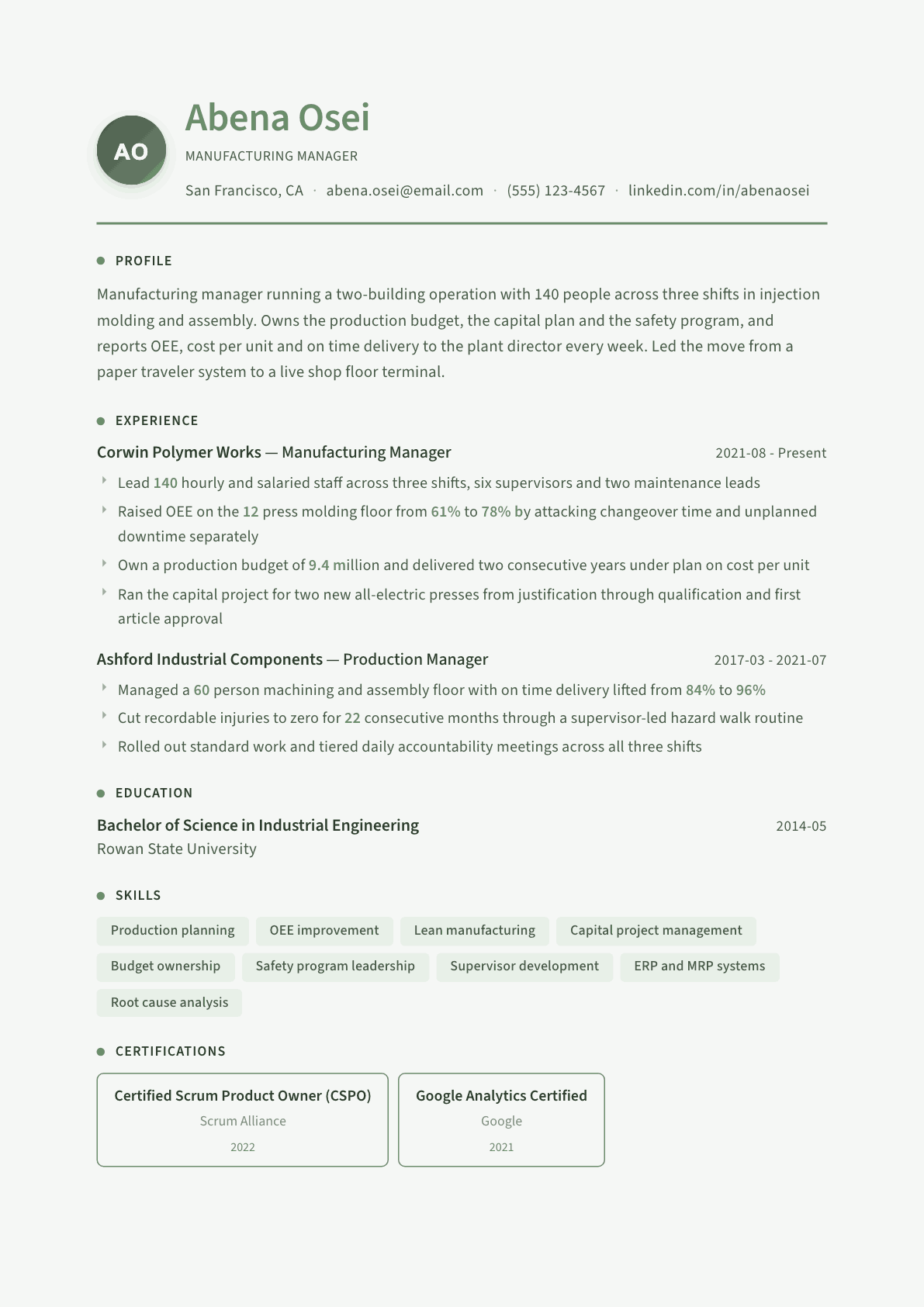
Example Manufacturing Manager summary
Manufacturing manager leading a two-building injection molding and assembly operation with 140 staff across three shifts and six supervisors. Owns the production budget, the capital plan and the safety program. Raised molding OEE from 61% to 78% by separating changeover work from downtime work, delivered two years under plan on cost per unit, and qualified two new presses from justification through first article.
Skills to list on a Manufacturing Manager resume
- Plant operations leadership
- Production planning and scheduling
- Overall equipment effectiveness
- Cost per unit management
- Capital expenditure planning
- Lean and Six Sigma deployment
- Value stream mapping
- Standard work and tiered meetings
- Supervisor coaching and development
- Labor relations and staffing
- Safety program ownership
- Quality management systems
- ERP and MRP administration
- Supplier and materials coordination
- Root cause and corrective action
- Capacity and headcount modeling
What actually gets this resume read
- Open with the size of what you run: headcount, shift count, building count and the process technology on the floor.
- Give OEE, on time delivery and cost per unit as before and after figures, since those three drive every plant review.
- Name the capital projects you have owned and how far you took them, from justification through qualification.
- Say how many supervisors report to you, because managing supervisors is a different job from managing operators.
- Show your safety record with a real measure such as recordable rate, near miss reporting or audit outcomes.
- List the ERP or MRP system by name, and whether you led an implementation or inherited one.
- Separate continuous improvement results from continuous improvement activity, because plant directors only ask about results.
How to write a manufacturing manager resume
A plant director hiring a manufacturing manager is handing over a floor, a payroll and a set of weekly numbers he currently owns himself. He wants to know the size of the operation you have run, what the numbers did while you ran it, and whether the supervisors under you got better or quit. Everything else on the page is decoration.
The resumes that fail are the ones written as a list of responsibilities: oversaw production operations, managed staff, ensured quality standards were met. Every manufacturing manager on earth did those things. The question is whether your overall equipment effectiveness moved, whether your cost per unit held through a volume swing, and whether you can point at a capital project you justified, bought, installed and qualified.
This guide sets out how a manufacturing manager resume should be built: the scale line that opens it, the metrics that carry the experience section, the leadership evidence a director quietly checks, and the way to write a plant turnaround without sounding like the previous manager was an idiot.
Format: scale first, then metrics, then the projects
Two pages is normal at this level and one page is usually a mistake, because the detail is the argument. Open with a scale line that states headcount, shift count, building or line count, and the process technology. A director reads that line and immediately knows whether you are a step up, a lateral move or a stretch.
Order the page so numbers arrive before narrative. Under each job, put a short block of plant metrics with before and after values, then the bullets that explain how the movement happened. Directors skim the metric block on the first pass and come back for the explanation only if the numbers are interesting.
- Scale line under the title: total headcount, salaried versus hourly split, shifts, lines or cells, and annual output or revenue in words.
- Metric block per role: overall equipment effectiveness, on time delivery, cost per unit, scrap, recordable injury rate, inventory turns.
- Process technology named plainly: injection molding, stamping, machining, extrusion, assembly, food processing, sterile fill.
- A capital projects line listing what you justified and installed, with the stage you owned it through.
- Systems line: the enterprise resource planning platform, the quality management system, and any manufacturing execution system.
Summary: what you run, what moved, what you are known for
Five lines. Sentence one is scale. Sentence two is the two or three metrics that moved most under you, with the mechanism attached. Sentence three is the leadership layer you manage, because managing six supervisors is a different job from managing sixty operators directly. Sentence four is your specialty, whether that is a startup, a turnaround, a transfer or steady state cost reduction.
Be honest about the plant condition you inherited. A manager who took a floor from chaos to stability and one who held a well run plant at target are both valuable, but a director hiring for a turnaround will not take a steady state manager and will not admit that in the posting. Saying which one you are gets you into the right conversations.
Experience: the metrics a plant review actually covers
Every weekly plant review touches the same short list: safety, quality, delivery, cost, and people. Build your bullets against that list and the page becomes easy for a director to read, because it is the same agenda he sits through every Monday. One or two bullets per heading is plenty.
When you claim a metric moved, separate the causes. Overall equipment effectiveness improvement that came from changeover reduction is a different capability than one that came from attacking unplanned downtime or from stabilizing quality losses, and a director who has run a plant knows which of those is hardest. Naming the split proves you were close enough to the floor to know.
On cost, avoid presenting savings without the base. A reduction in cost per unit through a volume increase is not a management achievement, so say what held constant and what changed. Managers who show that distinction are trusted with a budget conversation; managers who do not get asked uncomfortable questions in the interview.
- Safety: recordable rate direction, near miss reporting culture, machine guarding projects, audit findings closed.
- Quality: scrap and rework value, customer complaint count, corrective actions closed on time, audit outcomes.
- Delivery: on time delivery and schedule adherence, backlog direction, lead time reduction on a named product family.
- Cost: cost per unit, labor efficiency, overtime as a share of hours, energy or material yield.
- People: supervisor promotions, turnover direction, cross-training coverage, open position fill time.
Leadership evidence a director checks quietly
The part of the resume that separates candidates is people development. Directors want a manager whose supervisors got promoted, whose turnover fell, and whose floor kept running when he took a week off. Write that plainly: how many supervisors you developed, how many moved up, and what structure you built to make the plant run without you standing in it.
Include the operating rhythm you installed. Tiered daily meetings, layered process audits, a standard shift handover, a visual downtime board and a weekly problem solving session are all concrete and all checkable in an interview. A manager who names his rhythm sounds like someone with a system rather than someone who reacts to whatever the day brings.
If you have managed a represented workforce, say so and name the nature of the relationship rather than the contract terms. Grievance handling, contract administration and steward relationships are real skills, and a plant with a union will screen for them even when the posting does not mention it.
Projects, transfers and startups
Capital and transfer work is where a manufacturing manager proves range. Write each project as a short line with four facts: what it was, the value in words rather than digits, what stage you owned, and what the qualified result was. Justification, vendor selection, installation, qualification and first article approval are distinct stages, and claiming the whole chain when you owned one part is easy for a director to catch.
Product transfers and new line startups deserve their own treatment because they are the hardest thing a manager does. Name the number of part numbers moved, the ramp timeline and whether the receiving plant hit rate without a supply interruption. That last detail is what a director is really asking about.
Manufacturing Manager resume summary examples
Supervisor stepping up
Production supervisor with 7 years leading a 40 person machining and assembly shift, now completing an operations management degree. Lifted shift on time delivery from 84% to 96% and ran the standard work rollout across three shifts. Seeking a first manufacturing manager seat.
Running one plant
Manufacturing manager over a 140 person injection molding and assembly operation across three shifts and six supervisors. Raised molding overall equipment effectiveness from 61% to 78%, delivered two consecutive years under plan on cost per unit, and qualified two new all-electric presses from justification through first article.
Multi-site manager
Manufacturing manager covering two buildings and 260 staff in molding, machining and assembly, reporting to the plant director. Owns a capital plan, a safety program and the transfer of 40 part numbers from a closing site with no supply interruption. Promoted three supervisors in four years.
Work experience bullets: before and after
Before: Responsible for daily production operations and staff supervision.
After: Led 140 hourly and salaried staff across three shifts through six supervisors and two maintenance leads, running twelve molding presses and four assembly cells to a weekly build plan.
Headcount, layer structure and equipment count give a director the scale he needs before anything else.
Before: Improved equipment effectiveness through continuous improvement.
After: Raised molding floor overall equipment effectiveness from 61% to 78% by treating changeover loss and unplanned downtime as separate projects, with a die staging routine on one and a spare parts kanban on the other.
Splitting the causes and naming the fix for each proves the manager was on the floor, not reading a dashboard.
Before: Managed the department budget and reduced costs.
After: Owned a production budget of 9.4 million and finished two consecutive years under plan on cost per unit while volume fell, holding overtime under 6% of hours through a cross-training matrix.
Holding cost per unit while volume falls is the hard version, and the mechanism makes the claim believable.
Before: Led capital equipment purchases.
After: Ran the capital project for two all-electric presses from justification and vendor selection through installation, process qualification and first article approval, with the second press at full rate 5 weeks after arrival.
Naming every stage and the ramp time separates project ownership from signing a purchase order.
Before: Focused on employee safety and engagement.
After: Reached 22 consecutive months without a recordable injury by moving hazard walks from the safety coordinator to the shift supervisors, and lifted near miss reporting to a level the corporate audit called best in the group.
A duration, a structural change and an external verdict beat a statement of focus.
Hard skills
- Plant and multi-shift operations leadership
- Overall equipment effectiveness improvement
- Production budgeting and cost per unit control
- Capital expenditure justification and qualification
- Lean manufacturing and value stream mapping
- Six Sigma problem solving and root cause analysis
- Capacity modeling and headcount planning
- Enterprise resource planning and material requirements planning
- Quality management system ownership
- Product transfer and new line startup
- Safety program and regulatory compliance
- Standard work and layered process audits
- Supplier and materials escalation
- Labor relations and union administration
Soft skills
- Developing supervisors into managers
- Holding a hard conversation on the floor without an audience
- Deciding fast with partial information at shift change
- Translating plant reality upward without excuses
- Keeping composure through a customer escalation
Certifications worth listing
- Certified in Production and Inventory Management (CPIM) (Association for Supply Chain Management)
- Certified Six Sigma Black Belt (CSSBB) (American Society for Quality)
- Certified Manager of Quality/Organizational Excellence (American Society for Quality)
- OSHA 30-Hour General Industry (OSHA Outreach Training Program)
Mistakes that cost manufacturing manager candidates the interview
- Opening with responsibilities instead of the scale line that tells a director whether the move is a step up or a step down.
- Claiming improvement figures with no mechanism, which invites an interview question you will not be able to answer specifically.
- Presenting cost savings that came from volume growth as though they came from management action.
- Leaving people development off the page when supervisor promotions and turnover direction are what a director checks hardest.
- Compressing a capital project into one word when the justification, qualification and ramp stages are the interesting part.
- Writing a turnaround story as a criticism of the previous manager rather than as a description of what you built.
- Skipping the systems line, so a plant cannot tell whether you have run its enterprise platform or only heard of it.
Manufacturing Manager resume questions
How long should a manufacturing manager resume be?
Two pages. At this level the detail is the argument, and a single page forces you to cut the metric movements and project stages that a plant director is specifically looking for. Three pages only if you have run several sites with genuinely different process technologies.
What metrics belong on a manufacturing manager resume?
The ones your plant reviewed weekly: safety recordable rate, scrap and rework, on time delivery, overall equipment effectiveness, cost per unit and turnover. Give a before and after value with the mechanism attached, and skip any metric you cannot explain the causes behind.
How do I show leadership when my improvements were team efforts?
Describe what you owned rather than claiming the whole result. Say you set the target, built the team, removed the constraint or funded the fix, and name the people layer that executed. Directors trust a manager who distinguishes his contribution from his team's more than one who claims everything.
Does a degree matter for a manufacturing manager role?
It helps in corporate plants and matters less in privately held ones. If you came up through the floor, lead with the operational record and put education at the bottom. Add any professional certification, because it signals structured knowledge to a screener who cannot see your floor.
How do I write about a plant that closed or a site I could not save?
State the situation factually and then say what you delivered inside it: the transfer executed cleanly, the customers supplied through the wind down, the people placed. Directors have all lived through closures, and honest handling of one reads as maturity rather than failure.
Related resume examples
- Production Manager Resume example
- Manufacturing Supervisor Resume example
- Manufacturing Engineer Resume example
- Line Supervisor Resume example
- Production Lead Resume example
- Production Scheduler Resume example