Project Assistant Resume Examples: the lines they read
Write a Project Assistant Resume That Proves You Track Detail
By Mustafa Tarabya, founder of CVBooster · Published · Updated
Project assistant resume example with schedule, budget and minutes detail, keyword list, and a section by section guide.
Sample resumes for a project assistant
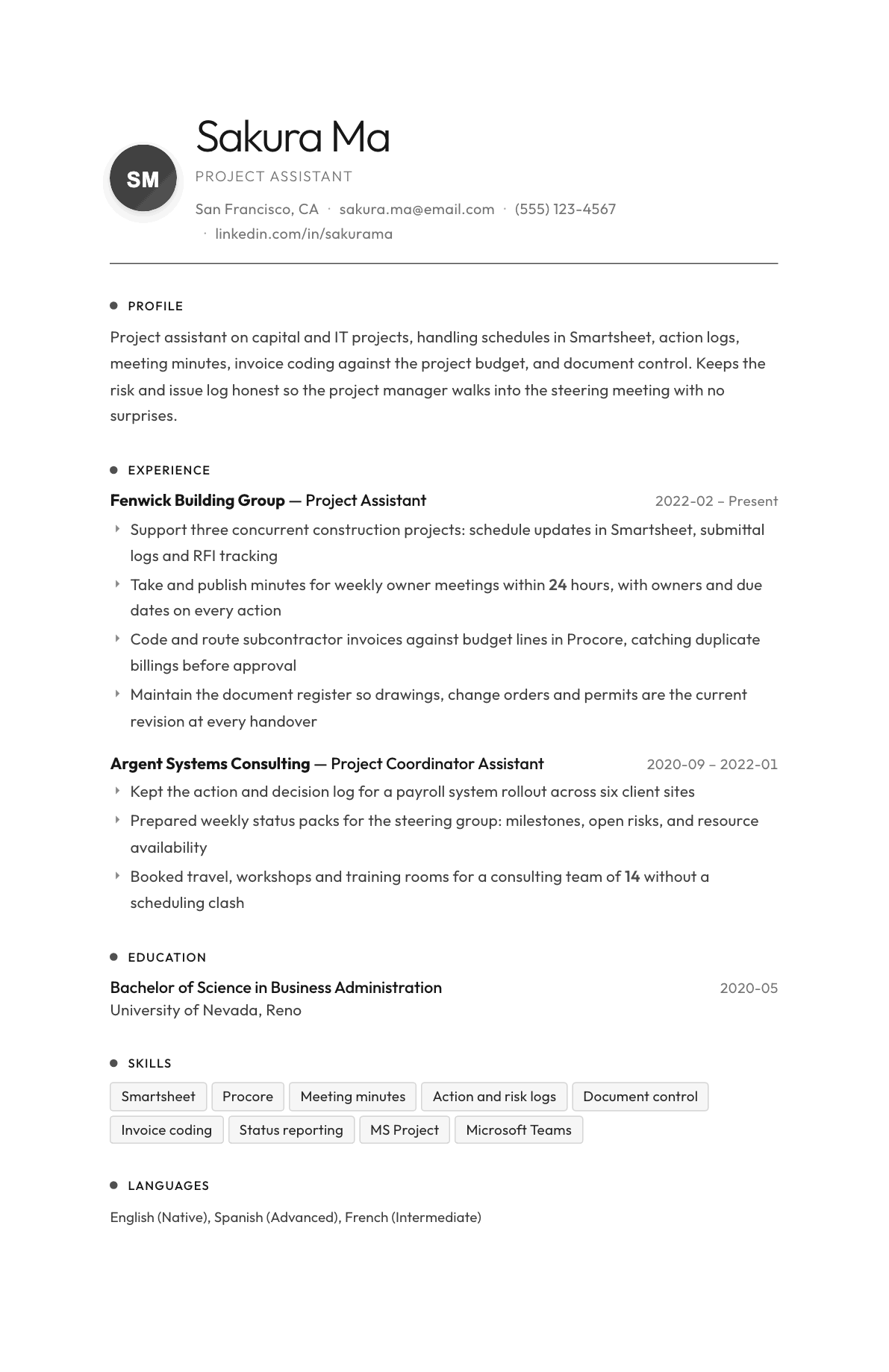
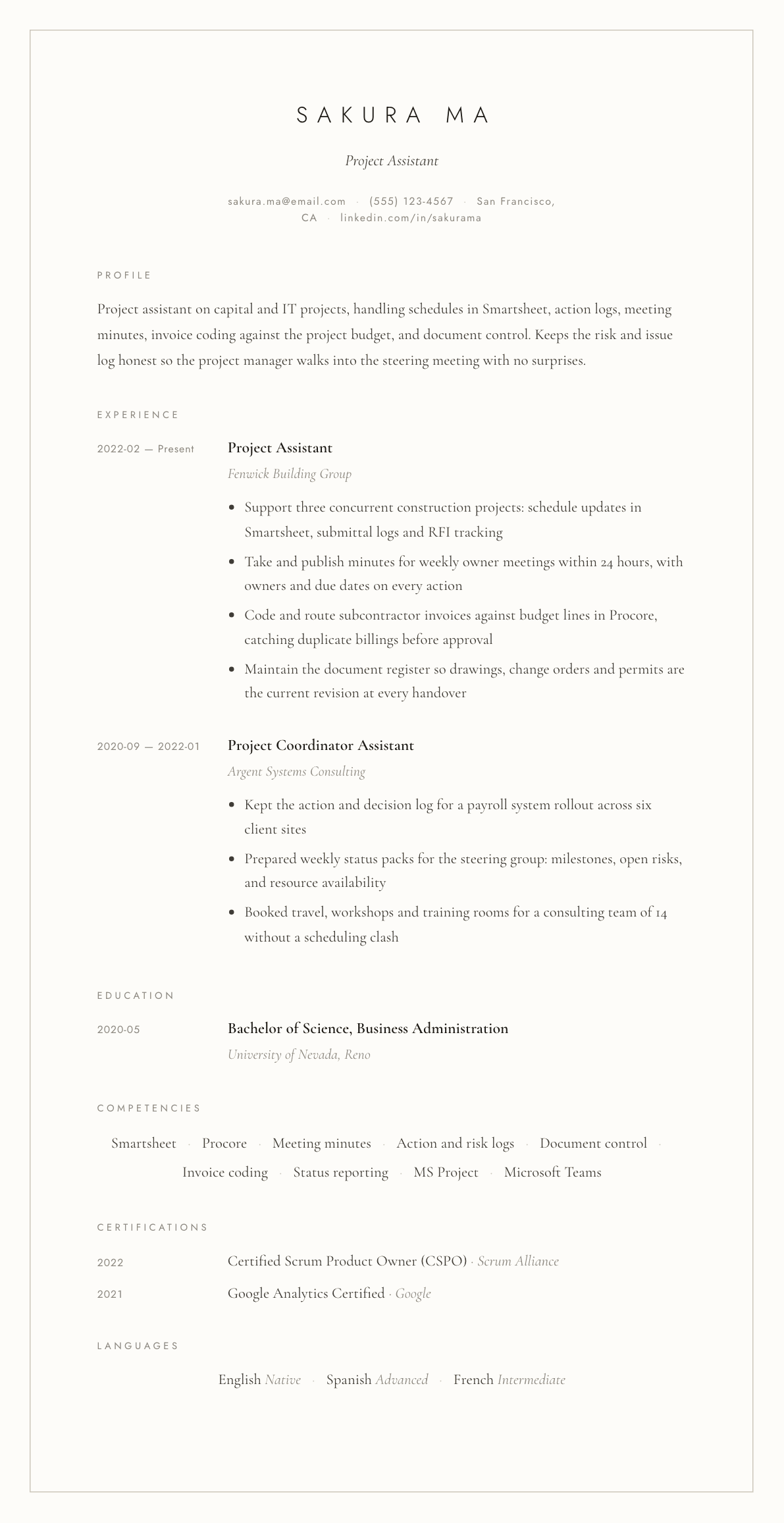
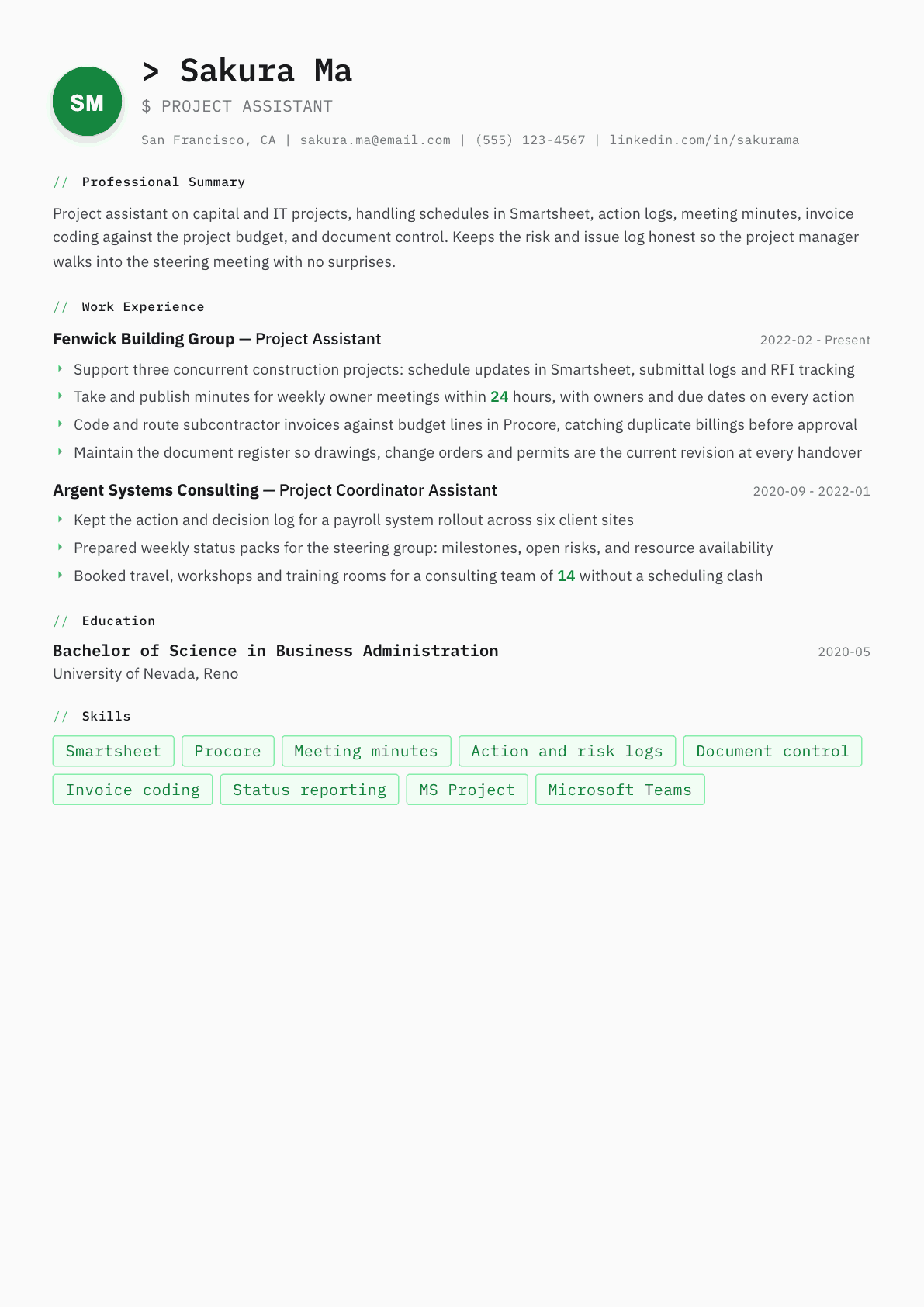
The same project assistant content laid out in three CVBooster templates, so you can see what the finished document looks like before you write a word.
Example Project Assistant summary
Project assistant with four years on construction and systems projects. Supports three concurrent jobs with schedule updates in Smartsheet, submittal and RFI logs, and owner meeting minutes published within a day. Codes subcontractor invoices against budget lines in Procore and keeps the document register at current revision. Bachelor degree in business administration.
Skills to list on a Project Assistant resume
- Meeting minutes
- Action and decision logs
- Risk and issue registers
- Schedule updates
- Smartsheet
- Microsoft Project
- Procore
- SharePoint
- Document control
- Invoice coding
- Status reporting
- Stakeholder scheduling
- Change order tracking
- Travel and workshop logistics
What actually gets this resume read
- State how many projects you supported at once and their type, because concurrent load is what a project manager checks.
- Name the tools by product: Smartsheet, Procore, MS Project, Asana, Jira or SharePoint, and where you used each.
- Show minutes and action logs as a discipline with a turnaround time, not as a soft duty buried in a list.
- Give one budget bullet, such as invoice coding, accruals or a purchase order log, to prove financial care.
- Distinguish assistant work from coordinator or manager work so the reader sees exactly what you can be handed.
- Include document control detail: revision history, transmittals or a register, since audits land on that first.
How to write a project assistant resume
A project assistant resume is judged by a project manager who has been burned by an assistant who could not keep a log current. Her screen is narrow: how many projects you carried at once, which tools you worked in, and whether minutes and actions came out of you on a predictable schedule. If those three answers are missing, she moves to the next file even if the writing is polished.
The role also sits at a confusing boundary. Project assistant, project coordinator and junior project manager are used interchangeably in job advertisements and mean very different things inside companies. A resume that is honest about which side of the line you worked on gets more interviews, not fewer, because the manager can match you to a real gap instead of guessing and then discovering the mismatch in week two.
This guide covers the section order project managers read, how to write minutes, logs, document control and budget touch points as disciplines rather than chores, three summary examples, before and after bullets, and the questions project assistants ask when they move between construction and systems work.
Format: one page, concurrent load stated in the top third
Reverse chronological, one page under six years, plain layout. The number a project manager searches for is concurrent project load, so put it in the summary and repeat it as the first line of each job block. Supported three concurrent construction projects is a harder fact than four years of project support experience, and it survives a fast scan.
Give the project type and value range in words rather than a figure if you can. Commercial fit out, a payroll system rollout across six client sites, or a plant upgrade tells the reader the shape of the work. Naming the sector matters because construction assistants live in submittals and RFIs while systems assistants live in status packs and stakeholder scheduling.
- Header: name, city and state, phone, email, then a tools strip such as Smartsheet, Procore, MS Project, SharePoint.
- Section order: summary, tools, project experience, education, certifications in progress if any.
- Each job opens with project count, type and your reporting line, for example supporting two project managers.
Summary: load, tools, cadence, and the log you keep honest
Lead with how many projects, of what type, in which tools. Then the cadence you hold: minutes published within a day, status pack out every Thursday, action log reviewed before every meeting. Cadence is the quality a project manager cannot teach quickly and cannot live without, so it deserves the second line rather than the last.
Close with the log you keep honest. Risk and issue registers rot quietly, and an assistant who chases owners for updates before the steering meeting is the difference between a manager who walks in prepared and one who is ambushed. Say that plainly in your own words.
Experience: minutes, actions, schedule, documents, money
Treat minutes as a discipline with a turnaround time and a structure. Published owner meeting minutes within 24 hours with an owner and a due date on every action is a professional standard, and it beats took meeting notes by a wide margin because it shows you know minutes exist to drive action rather than to record conversation.
For schedule work, be exact about your part. Updating percent complete and dates in Smartsheet from progress reports is assistant work; building the logic and the critical path is planner work. Say which one you did. The same care applies to risk registers: chasing owners, recording mitigations and flagging aging items is real and valuable, and it is not the same as owning the risk response.
Document control deserves its own bullet because audits land there first. Drawing revisions, transmittals, change orders, permits and a register that shows current revision at handover are the artifacts an auditor asks for. On the money side, one bullet is enough: invoice coding against budget lines, accrual tracking, or a purchase order log, ideally with a catch such as a duplicate billing you stopped before approval.
- Name the meeting types you served: owner meeting, steering group, design coordination, daily standup.
- Show submittal and RFI logs by name if you worked in construction, since those two words are screened for.
- Include logistics you owned: workshops, training rooms, travel for a team, site inductions.
Tools: name the product and the module
Project tooling is unusually specific, and a project manager will not assume transfer. Say Smartsheet for schedules and logs, Procore for submittals, RFIs and subcontractor invoices, Microsoft Project for baselines, SharePoint or a document management system for the register, and Teams or the meeting platform where the pack is distributed. Pair each tool with the thing you did in it so the claim is checkable.
If you have only ever worked in spreadsheets and a shared drive, say so honestly and describe the structure you maintained: naming conventions, revision suffixes, an index sheet. A manager will take a disciplined spreadsheet operator over a candidate who lists six platforms and cannot describe one workflow inside any of them.
Education, credentials and keyword mirroring
A business, engineering, construction management or similar degree is common but not universal. What reads well is a project management credential either held or in progress, because it signals that you intend to grow into coordination rather than stay at intake. Name the issuing body so the reader can place the credential immediately.
Postings for this role repeat a small vocabulary: meeting minutes, action log, risk register, document control, schedule updates, status reporting, invoice coding, change order tracking, and the tool names. Mirror each once inside a bullet where the work occurred and once in your tools and skills block. Keep the phrasing yours; a pasted requirement reads as a pasted requirement.
Project Assistant resume summary examples
First project support role
Business administration graduate with an internship supporting a facilities upgrade: meeting minutes, action log upkeep and supplier document collection. Confident in Excel and SharePoint, trained on Smartsheet basics. Seeking a project assistant seat where minutes, logs and document control are the core of the job.
Four years in
Project assistant supporting three concurrent construction projects with schedule updates in Smartsheet, submittal and RFI logs, and owner meeting minutes published within 24 hours. Codes subcontractor invoices against budget lines in Procore and keeps the document register at current revision through every handover.
Ready for coordinator
Senior project assistant with seven years across construction and systems rollouts, currently supporting a portfolio of five projects and two project managers. Owns the risk and issue register cadence, prepares the steering pack, tracks change orders and accruals, and trained two new assistants on document control standards.
Work experience bullets: before and after
Before: Took notes in project meetings.
After: Took and published minutes for weekly owner meetings within 24 hours, with a named owner and a due date on every action carried into the log.
A turnaround time and an action structure turn note taking into the control that keeps a project moving.
Before: Helped manage project documents.
After: Maintained the document register across three projects so drawings, change orders and permits were at current revision, and issued transmittals with a receipt record at every handover.
The document types, the revision standard and the transmittal record are exactly what an audit asks to see.
Before: Assisted with the project budget.
After: Coded and routed subcontractor invoices against budget lines in Procore, catching two duplicate billings before approval and reconciling coded spend to the monthly cost report.
A specific catch and a reconciliation step prove financial care rather than proximity to a budget.
Before: Updated the project schedule.
After: Updated task dates and percent complete in Smartsheet each week from site progress reports, then flagged tasks slipping past their float to the project manager before the client call.
It states the input, the frequency and the escalation, and it stays honest about who owned the schedule logic.
Before: Tracked risks and issues.
After: Ran the risk and issue register review before every steering meeting, chasing owners for status on aging items so the project manager walked in with no unexplained entries.
Chasing owners is the actual work, and naming it shows the reader why the register was trustworthy.
Hard skills
- Meeting minutes and action logs
- Risk and issue register upkeep
- Schedule updates and progress tracking
- Smartsheet
- Procore
- Microsoft Project
- SharePoint document management
- Submittal and RFI logs
- Change order tracking
- Invoice coding and accrual tracking
- Status pack preparation
- Stakeholder scheduling
- Transmittals and revision control
- Workshop and training logistics
Soft skills
- Chasing action owners politely
- Note taking under fast discussion
- Discretion with commercial information
- Anticipating what the manager will need
- Clear meeting communication
- Consistency week after week
Certifications worth listing
- Certified Associate in Project Management (CAPM) (Project Management Institute)
- Project Management Professional (PMP) (Project Management Institute)
- PRINCE2 Foundation (PeopleCert)
- Microsoft Office Specialist: Excel Associate (Microsoft)
- Smartsheet Product Certified User (Smartsheet)
Mistakes that cost project assistant candidates the interview
- Not stating how many projects you supported at once, which is the first number a project manager looks for.
- Listing tools with no verb attached, so the reader cannot tell a daily user from a viewer with a login.
- Blurring assistant work into coordinator or manager work, which fails immediately under interview questioning.
- Treating minutes as a soft duty in a list instead of a discipline with a turnaround time and an action structure.
- Omitting document control, the area that auditors and handovers expose first.
- Skipping any financial touch point, when nearly every project assistant posting carries invoice coding or a purchase order log.
Project Assistant resume questions
What is the difference between a project assistant and a project coordinator?
An assistant maintains the records that make a project legible: minutes, logs, documents, scheduling support. A coordinator makes calls inside the plan, chases dependencies across teams and often owns a workstream. Show which decisions you made and the reader can place you accurately.
Is a project management certification worth it for an assistant role?
An entry credential such as CAPM is worth listing because it signals direction and gives you shared vocabulary in the interview. It will not substitute for evidence of cadence, so keep your minutes turnaround, log upkeep and document control bullets as the center of the resume.
How do I move from an administrative assistant role into project support?
Rewrite the parts of your current job that already are project work: meeting minutes, action follow up, document versions, event or move logistics, invoice coding. Attach volume and tools, then name one initiative you supported from kickoff to close so the reader sees a full cycle.
Should I list the value of the projects I supported?
Only if you know the figure and can defend it. Project type, duration, site count and team size often communicate scale just as well without risking a number you cannot source. Never inflate a value, because construction and consulting interviewers check it against public information.
Do construction and IT project assistant resumes differ?
Yes. Construction screens for submittals, RFIs, drawing revisions, permits and subcontractor invoices. Systems work screens for status packs, stakeholder scheduling, testing coordination and decision logs. Keep one master file and swap the first bullet of each job to match the sector you are applying into.
Related resume examples
- Project Manager Resume example
- Administrative Assistant Resume example
- Project Coordinator Resume example
- Construction Project Manager Resume example
- Document Controller Resume example
- Administrative Coordinator Resume example