Adjectives to Describe Yourself and the Sentence for Each
By Mustafa Tarabya, founder of CVBooster · Published · Updated
7 min read
An adjective about yourself is worth nothing on its own, so every one of the thirty below arrives with the sentence that proves it. The constraint is the medium: a resume gets the proof and drops the adjective, while an interview gets the adjective and then the proof out loud. The trait definitions here are the official Work Styles wording from O*NET OnLine, with dictionary definitions from the Cambridge Dictionary, fetched in September 2026. The thirty adjectives and their sentences come first, then the three-word interview answer and the words to avoid. Written by Mustafa Tarabya, who hired for his own company, read every application himself and now writes CVBooster's guides.
30 adjectives to describe yourself, each with its sentence
Use the adjective in speech and the sentence on paper. Swap the detail for your own numbers.
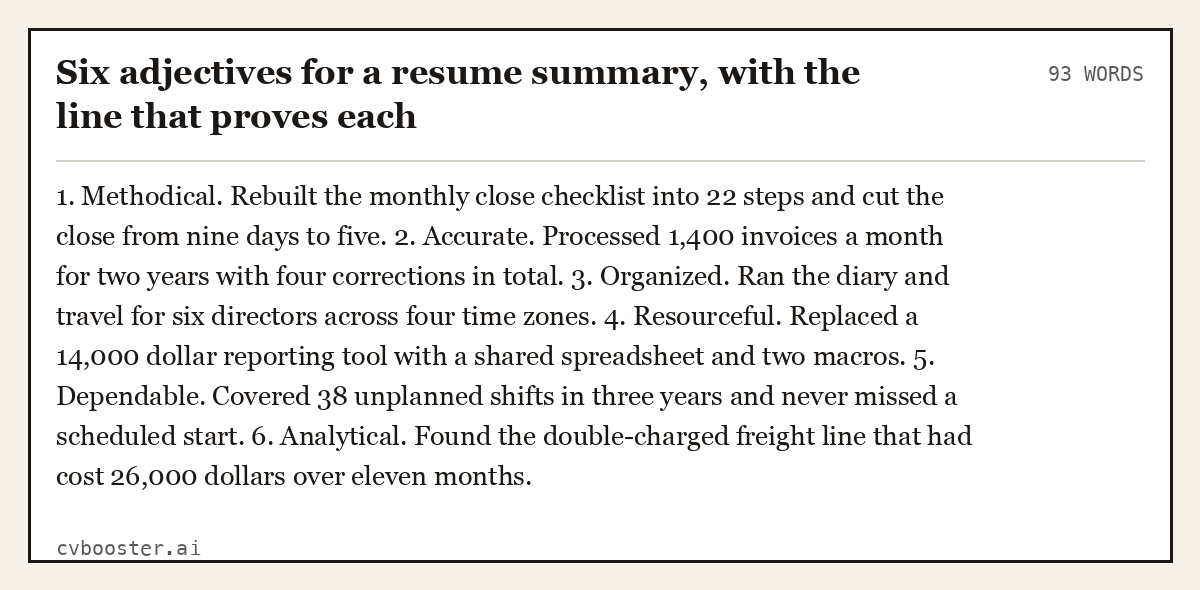
Six adjectives for a resume summary, with the line that proves each (93 words)
1. Methodical. Rebuilt the monthly close checklist into 22 steps and cut the close from nine days to five. 2. Accurate. Processed 1,400 invoices a month for two years with four corrections in total. 3. Organized. Ran the diary and travel for six directors across four time zones. 4. Resourceful. Replaced a 14,000 dollar reporting tool with a shared spreadsheet and two macros. 5. Dependable. Covered 38 unplanned shifts in three years and never missed a scheduled start. 6. Analytical. Found the double-charged freight line that had cost 26,000 dollars over eleven months.
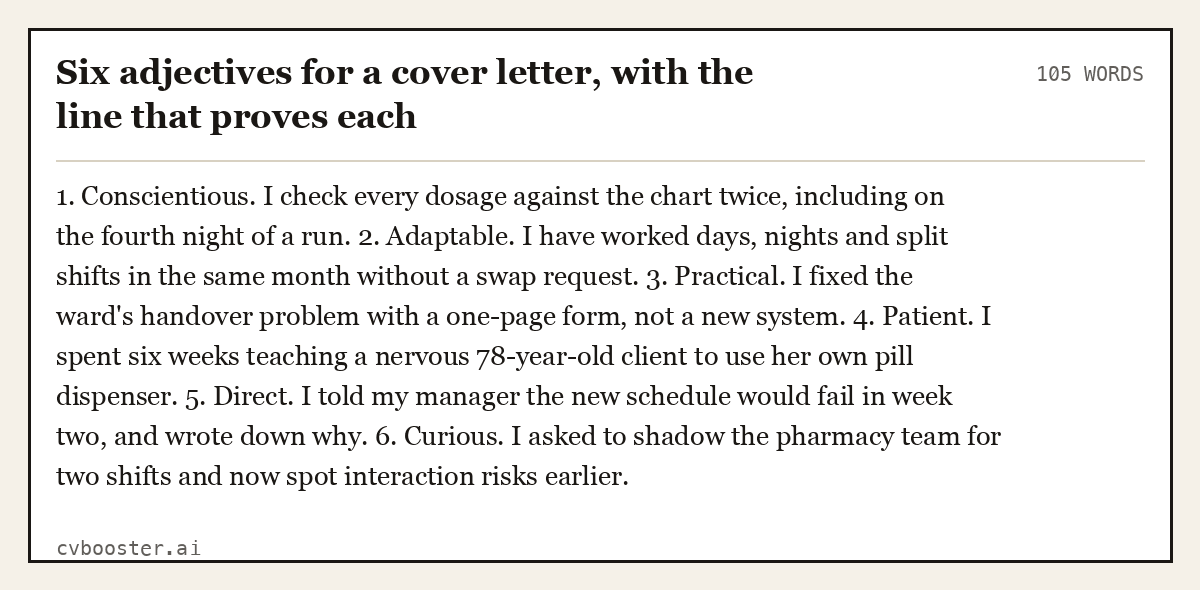
Six adjectives for a cover letter, with the line that proves each (105 words)
1. Conscientious. I check every dosage against the chart twice, including on the fourth night of a run. 2. Adaptable. I have worked days, nights and split shifts in the same month without a swap request. 3. Practical. I fixed the ward's handover problem with a one-page form, not a new system. 4. Patient. I spent six weeks teaching a nervous 78-year-old client to use her own pill dispenser. 5. Direct. I told my manager the new schedule would fail in week two, and wrote down why. 6. Curious. I asked to shadow the pharmacy team for two shifts and now spot interaction risks earlier.
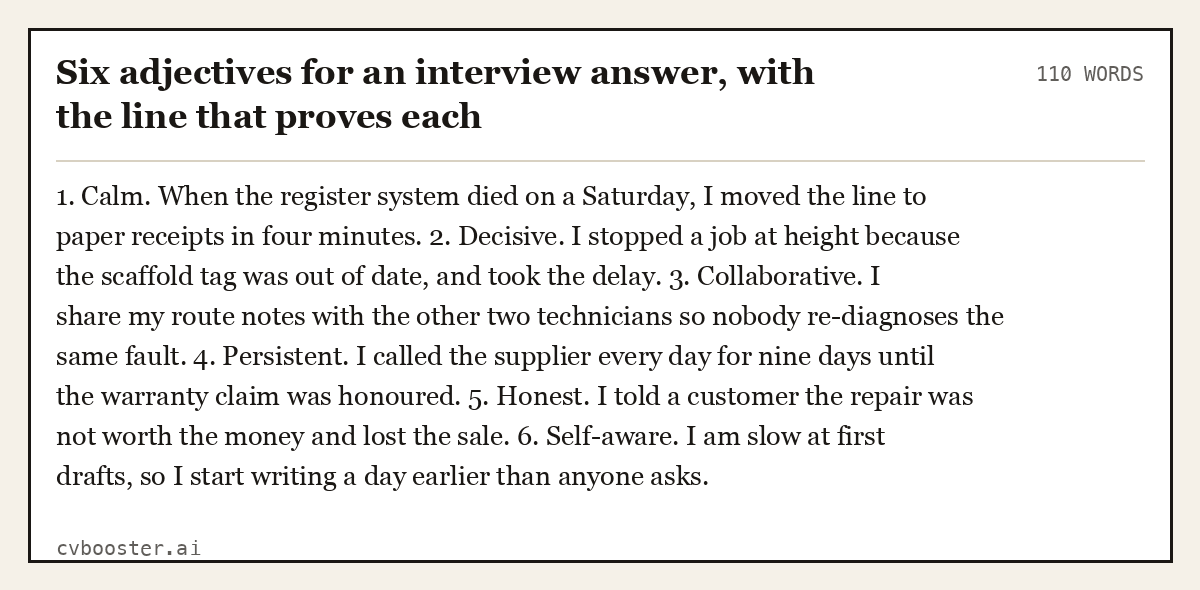
Six adjectives for an interview answer, with the line that proves each (110 words)
1. Calm. When the register system died on a Saturday, I moved the line to paper receipts in four minutes. 2. Decisive. I stopped a job at height because the scaffold tag was out of date, and took the delay. 3. Collaborative. I share my route notes with the other two technicians so nobody re-diagnoses the same fault. 4. Persistent. I called the supplier every day for nine days until the warranty claim was honoured. 5. Honest. I told a customer the repair was not worth the money and lost the sale. 6. Self-aware. I am slow at first drafts, so I start writing a day earlier than anyone asks.
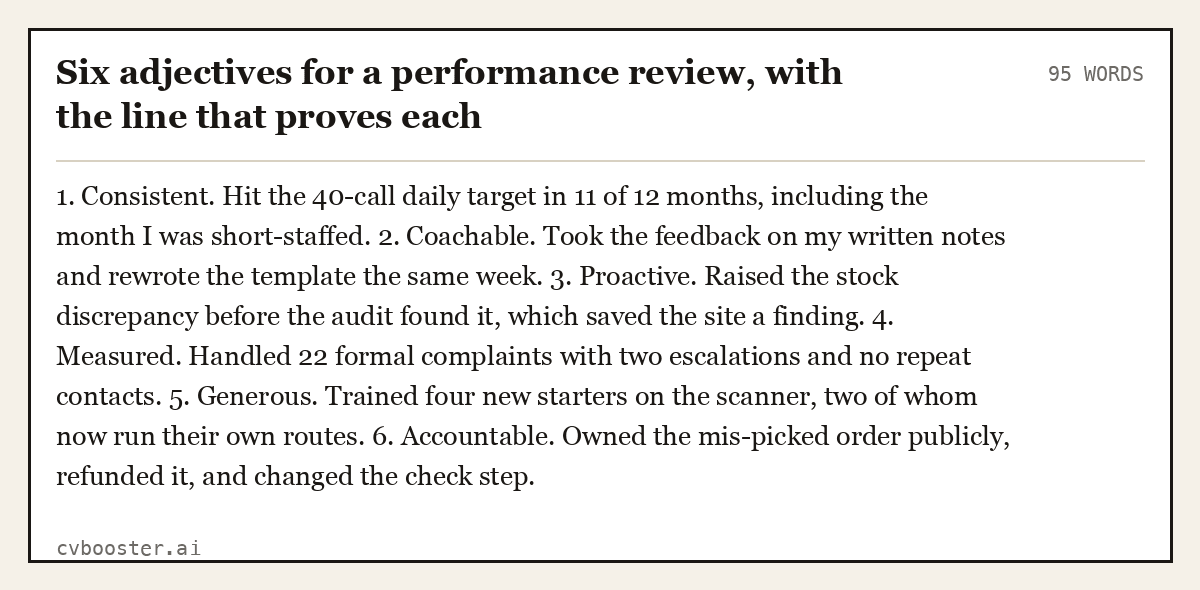
Six adjectives for a performance review, with the line that proves each (95 words)
1. Consistent. Hit the 40-call daily target in 11 of 12 months, including the month I was short-staffed. 2. Coachable. Took the feedback on my written notes and rewrote the template the same week. 3. Proactive. Raised the stock discrepancy before the audit found it, which saved the site a finding. 4. Measured. Handled 22 formal complaints with two escalations and no repeat contacts. 5. Generous. Trained four new starters on the scanner, two of whom now run their own routes. 6. Accountable. Owned the mis-picked order publicly, refunded it, and changed the check step.
Six adjectives for a LinkedIn headline or networking line, with the line that proves each (89 words)
1. Commercial. Grew a two-person care business into seven staff and 750,000 euros of annual revenue. 2. Hands-on. Wrote the job ads, read the applications and ran the interviews myself. 3. Bilingual. Work in English and Finnish daily, including clinical handovers. 4. Systematic. Built the schedule, the invoicing and the compliance file on one spreadsheet before buying software. 5. Pragmatic. Chose the boring tool that worked over the impressive one that needed training. 6. Frontline. Qualified care worker who still takes shifts, so I know what the schedule costs.
The official trait wording, quoted
Employers do not pick adjectives at random. Occupational data publishes a defined trait list, and matching your adjective to it keeps you inside language the employer already uses.
On the registered nurses summary, O*NET OnLine defines Integrity as "A tendency to be honest and ethical at work", Stress Tolerance as "A tendency to cope and function effectively in stressful situations at work", and Cautiousness as "A tendency to be careful, deliberate, and risk-avoidant when making work-related decisions or doing work".
Dictionary definitions keep you honest about what you are claiming. The Cambridge Dictionary defines conscientious as "putting a lot of effort into your work" and resourceful as "skilled at solving problems and making decisions on your own". If your proof sentence does not show that, choose a different word.
The three-word answer, written out
"How would you describe yourself" is usually asked as three words. Three words with one proof each beats five words with none.
Three words to describe yourself, full spoken answer, mid level (94 words)
Methodical, direct and calm under pressure. Methodical because I rebuilt our monthly close into a 22-step checklist and took it from nine days to five. Direct because when I could see the new schedule failing, I told my manager in week one and put the reasons in writing. Calm because the day our register system died on a Saturday I moved a 30-person line onto paper receipts in about four minutes and we lost no sales. If I had to name a fourth, it would be stubborn, and I would not apologize for it.
Where each adjective belongs
- Resume. Almost nowhere. Delete the adjective and keep the sentence, because the number is the claim.
- Cover letter. One adjective per paragraph, immediately followed by the evidence.
- Interview. Lead with the adjective, because the listener needs the label before the story.
- Performance review. Use the company's own competency wording, not a synonym of it.
- LinkedIn. Two at most, and only ones a stranger could verify from your history.
See resume action verbs for the verb side of the same problem, professional summary for a resume for where the proof sentence goes, and about me examples for the longer spoken version.
Adjectives to avoid, and what to say instead
| Avoid | Why it fails | Say instead |
|---|---|---|
| Hard-working | Unprovable and universal | The volume you carried, with the number |
| Perfectionist | Reads as a weakness in disguise | Accurate, with an error rate |
| Passionate | Describes a feeling, not a behaviour | The unpaid hours or the specific project |
| Detail-oriented | The most claimed and least proved | Methodical, with the checklist you built |
| Team player | Says nothing about what you did | Collaborative, with what you shared |
| Motivated self-starter | Two clichés joined together | The thing you started with no brief |
Plain words survive translation and paraphrase. As Plainlanguage.gov puts it, "The Plain Writing Act of 2010 established the requirement that content for the public is written for its specific audience". Your audience is one tired reader with a stack of applications.
The proof test
Cover the adjective with your thumb and read the sentence. If the sentence still makes the point, the adjective was decoration. If the sentence says nothing without it, the evidence is missing and the claim is empty.
Tip: Never use more than three self-describing adjectives in one document. The fourth one turns the first three into noise.
See weaknesses for job interviews for the mirror-image question and common interview questions and answers for what usually follows.
Frequently asked questions
How would you describe yourself?
Answer with three adjectives and one proof each, in about forty seconds. Choose words the job already rewards, name a situation with a number behind each one, and stop. Lists of five or more adjectives with no evidence are the most common way this answer is wasted.
How do you describe yourself?
Describe yourself in behaviour rather than in character: what you did, how often, and what changed. "I rebuilt our monthly close into 22 steps and cut it from nine days to five" tells a reader more than any three adjectives strung together.
How to describe yourself in a job interview?
Lead with the label, then the evidence, then stop talking. Pick the adjectives from the posting's own language, keep to three, and have one story per adjective ready. Do not use "perfectionist", "hard-working" or "passionate", which every other candidate has already used.
How would you describe yourself interview question?
It is a screening question testing self-awareness and fit, not a personality test. Panels are listening for whether your self-description matches the evidence on your resume. Any adjective you cannot back with a situation from the last two years is a risk, so drop it.
How to describe yourself for a job?
Mirror the posting. Take the two or three traits it names, write one proof sentence for each from your own history with a number in it, and use those on the cover letter. On the resume, delete the adjectives and keep only the proof sentences.
Related articles
- Fun Fact About Me: 30 Examples Sorted by What They Say
- Fun Facts About Me: 50 Examples for Work and Interviews
- Interesting Facts About Me: 6 Answers and 20 Examples
- Thank You Letter Examples: Six Templates and the Rules
More articles
- AI Cover Letters in the UK: What Employers Actually Notice
- Is an AI Resume Builder Worth It in 2026?
- AI Resume Tools Are Inventing Your Experience. Catch It First
Looking for a worked example for your job title? Browse the resume examples by job title.