Technical Writer Resume Examples: the lines they read
Technical Writer Resume and Tech Writer Resume Samples
By Mustafa Tarabya, founder of CVBooster · Published · Updated
Two tech writer resume samples written out, mid level and first job, with the portfolio, tools and audience details hiring managers check, plus bullets by level.
Sample resumes for a technical writer
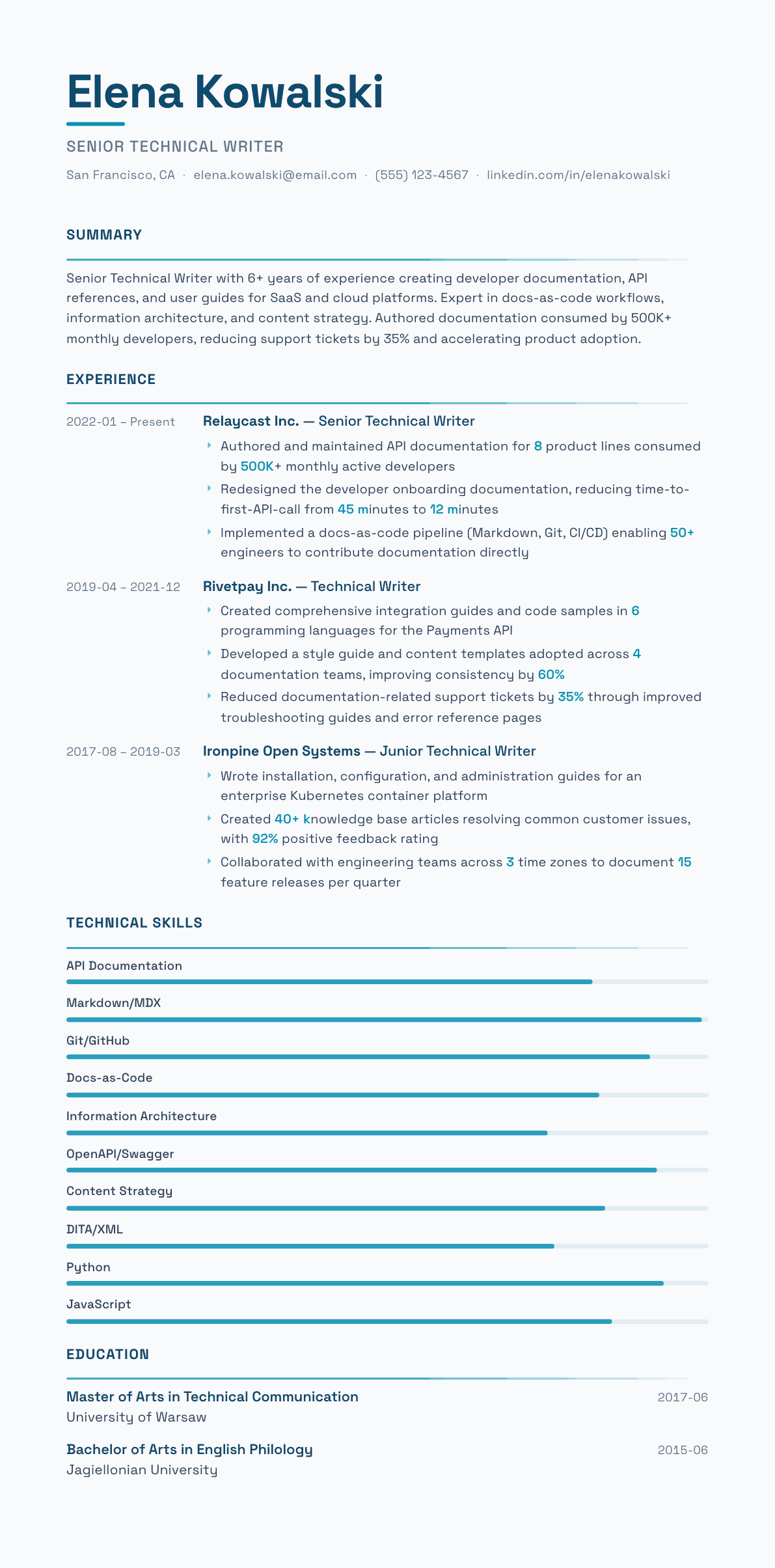
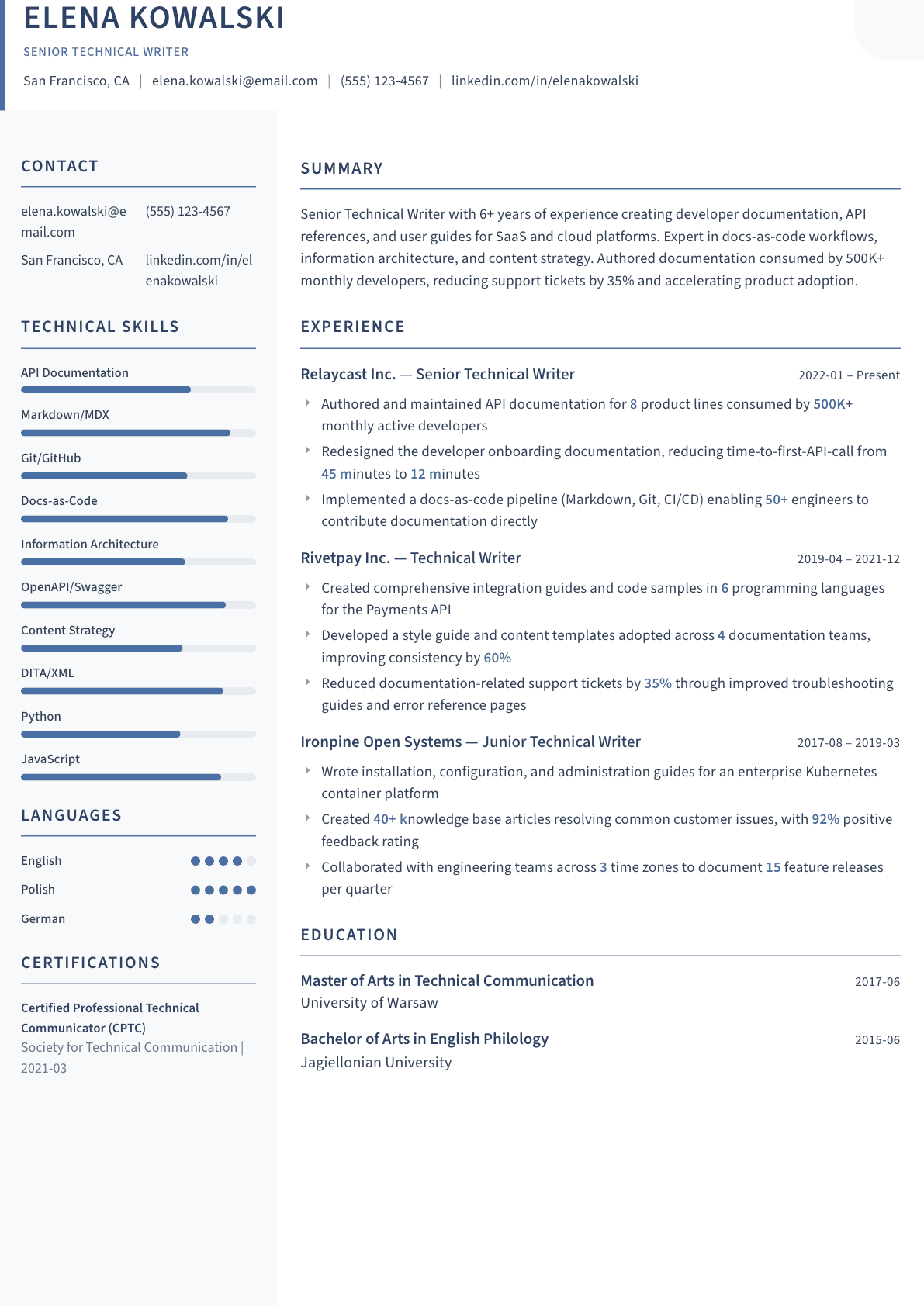
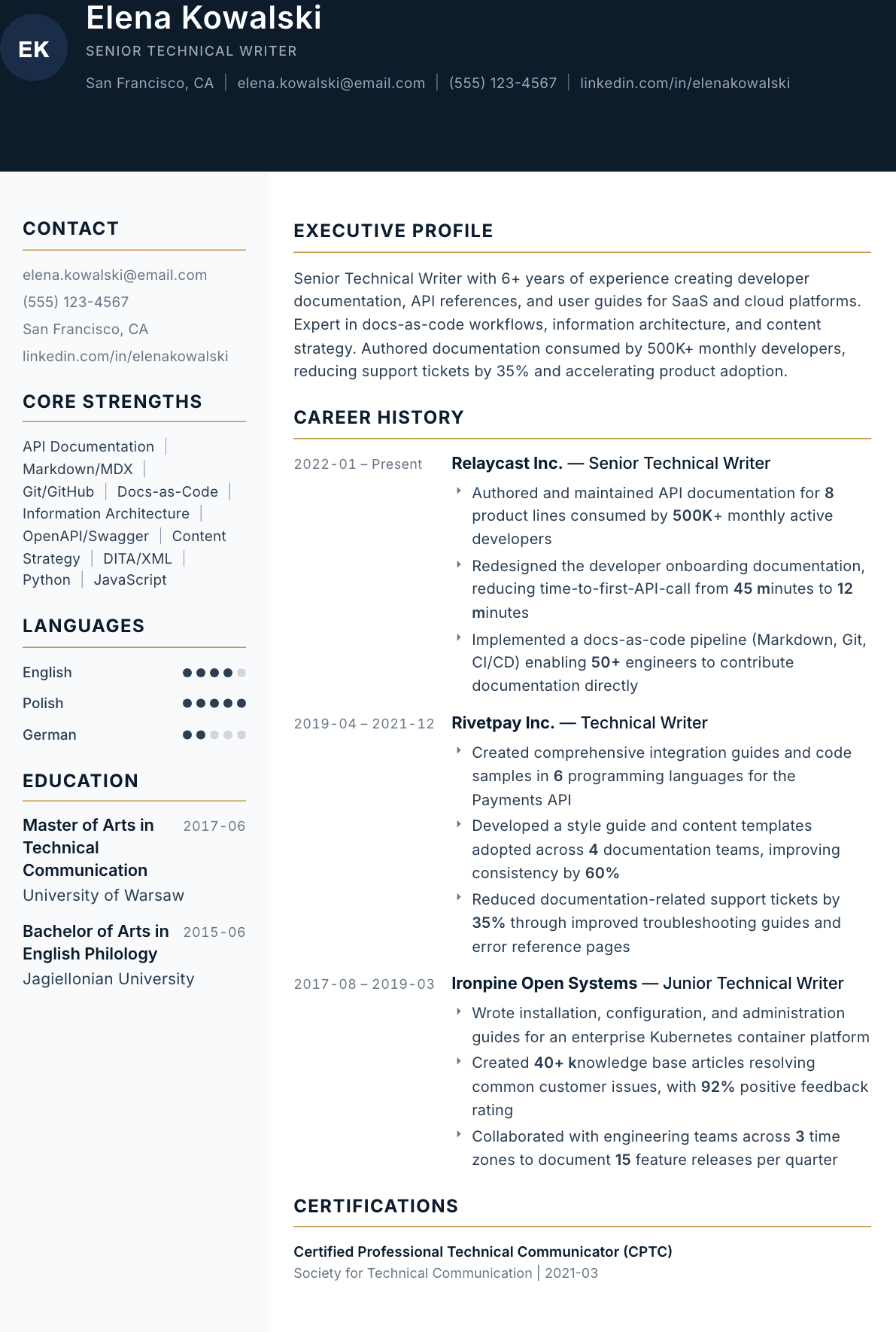
The same technical writer content laid out in three CVBooster templates, so you can see what the finished document looks like before you write a word.
Example Technical Writer summary
Senior Technical Writer with 6 years of experience creating developer documentation for SaaS and cloud platforms. Authored API references and integration guides consumed by 500K+ monthly developers, reducing support tickets by 35%. Expert in docs-as-code workflows, information architecture, and enabling engineering teams to contribute quality documentation.
Skills to list on a Technical Writer resume
- API Documentation
- Markdown/MDX
- Git/GitHub
- Docs-as-Code
- Information Architecture
- OpenAPI/Swagger
- Content Strategy
- DITA/XML
- Static Site Generators
- Python/JavaScript
- Style Guide Development
- User Research
What actually gets this resume read
- Quantify documentation impact: support ticket reduction, developer adoption rates, or time-to-first-success.
- Highlight docs-as-code experience: Markdown, Git workflows, static site generators, and CI/CD publishing.
- Include API documentation expertise: OpenAPI/Swagger, Postman collections, or interactive API explorers.
- Mention tools and platforms: Confluence, ReadMe, Docusaurus, MkDocs, or custom documentation portals.
- Show cross-functional collaboration: working with engineers, product managers, and developer advocates.
How to write a technical writer resume
A technical writer resume is a writing sample whether you intend it to be or not. Documentation managers read the page the way they read a draft: is the structure obvious, is every sentence carrying weight, is the terminology consistent, is there a typo in the first three lines. A resume with clumsy prose ends the conversation regardless of the experience it lists.
The second thing a documentation manager checks is the audience you have written for. Documentation for end users, for administrators, and for developers integrating an API are three different crafts with different tools, review paths and success measures. A resume that says produced documentation without naming the audience forces the reader to guess, and guessing usually goes badly for the candidate.
This guide covers the structure hiring managers in documentation expect, how to present a portfolio when your best work sits behind a login, three summaries at different career stages, before-and-after bullets, and the questions writers ask when they move between product areas.
Format: portfolio link in the header, tooling block near the top
One page under about six years, two pages after. Put the portfolio link in the header, immediately beside your email, because it is the first thing a documentation manager clicks. Under the summary, add a tools block covering authoring formats, publishing platforms, version control, graphics and any content management or component content system you have used.
Keep the design restrained. A technical writer who submits a resume with three fonts and a colored sidebar has told the reader something about their judgment on style guides. Consistent heading levels, parallel bullet structure and one typeface do more for you here than any layout trick.
- Header: name, title, location, email, portfolio link, and a public docs site you contributed to.
- Order: summary, tools, experience, writing samples or portfolio notes, education, certifications.
- Name the docs-as-code stack explicitly if you have one: Markdown, Git, static site generator, review pipeline.
Experience: audience, deliverable, and what changed for the reader
Open each role with the product and the audience: an infrastructure platform documented for site reliability engineers, a consumer application documented for non-technical users, a medical device documented for clinicians under regulatory review. Audience determines everything about how the writing was judged, so it belongs before the bullets.
Then write bullets around deliverables and their effect. Deliverable types are specific: API reference, quickstart, conceptual guide, tutorial, release notes, knowledge base article, administrator guide, error reference, migration guide. Naming them shows range. Vague words like content and materials show none.
Documentation effect is measurable more often than writers admit. Support ticket volume on a documented topic, time to first successful API call, search success rate in the help center, deflection rate on a knowledge base article, page feedback ratings and the number of engineers who started contributing after you set up a review workflow are all fair evidence.
The parts that separate a writer from a documentarian
Anyone can be assigned to write pages. What documentation managers hire for is the surrounding practice: information architecture, a style guide you wrote or enforced, a terminology glossary, a content audit that retired stale pages, a localization workflow, single sourcing so one topic serves three outputs, and a review process that got subject matter experts to actually respond.
Docs-as-code fluency has become a standard expectation for software documentation. Say plainly that you work in Git, open pull requests, review other people's documentation changes, and run builds in a pipeline. Writers who need an engineer to publish for them are at a real disadvantage against writers who do not.
- Name the style guide you worked to, whether an industry one or one you authored.
- Show at least one information architecture decision: a restructure, a taxonomy, a navigation redesign.
- Include the review mechanics: how you got engineering sign-off and how long it took.
Portfolio: what to do when the docs are behind a login
Public documentation is the easiest case: link directly to pages you wrote and say what you contributed. When the work sits behind a customer login or under a confidentiality agreement, build a small portfolio of sanitized excerpts, a redacted before-and-after rewrite, or a sample you wrote specifically for public use on an open source tool.
Two or three strong pieces beat a folder of twenty. Choose different types deliberately: one procedural piece, one conceptual explanation and one reference page shows range better than three tutorials. Add a short note beside each explaining the audience, the constraint and what you were asked to fix.
Keywords documentation postings reuse
The recurring vocabulary is narrow: technical documentation, API documentation, user guides, information architecture, content strategy, docs-as-code, style guide, single sourcing, DITA, structured authoring, content management, and the named toolchain. Mirror the posting phrasing once in the tools block and once inside a bullet where the practice is visible.
The tooling divide is worth reading carefully. A posting built around DITA, structured authoring and a component content management system is a different job from one built around Markdown, Git and a static site generator. Lead with whichever half of your history matches, and keep the other half present but lower.
Tech writer resume samples: two one-page resumes, written out
A sample technical writing resume is most useful when you can see the whole structure at once: header with portfolio, summary naming audience and doc type, tools, then experience bullets that show what changed for the reader. Two tech writer resume samples follow, both invented. The first is a mid level writer moving from end user help content to product and API documentation; the second is a support agent moving into a first technical writing job.
Profile: Hannah Brooks, Technical Writer. Six years writing help center articles, admin guides and release notes for business software, and the last two writing API reference and tutorials with the engineering team. Works in docs-as-code with Markdown, Git and a static site generator, and owns the style guide for a team of four writers. Portfolio: public samples linked in the header.
- Current role, Technical Writer, Fieldline Software, four years: owns the admin guide and API documentation for a scheduling product used by enterprise customers.
- Rewrote the getting started tutorial after support flagged it as the top source of onboarding tickets; tickets on that topic fell over the next two releases.
- Writes release notes every sprint from Jira tickets and engineering demos, reviewed by product and support before publishing.
- Built the documentation style guide and a review checklist now used by four writers and the support team.
- Earlier role, Help Content Writer, Brightdesk, two years: wrote and maintained help center articles in Zendesk Guide.
- Tools: Markdown, Git, Docusaurus, OpenAPI, Postman, MadCap Flare, Confluence, Jira, Snagit.
- Second sample, header: Marcus Lee, Junior Technical Writer. Three years in tier two software support, now applying for an entry level writing role; portfolio of four public samples, including a rewritten installation guide and a troubleshooting article set.
- Second sample, support role: wrote and updated 45 knowledge base articles in Zendesk Guide from repeat tickets, and the team now links them in replies instead of retyping the steps.
- Second sample, support role: reviewed release notes from engineering before each release and flagged missing upgrade steps that support would otherwise have handled by phone.
- Second sample, training: technical writing course from a university extension program; Markdown, Git basics and Snagit; one docs fix merged to an open source project.
Technical Writer resume summary examples
First documentation role
Technical writer with a year of internship and freelance work documenting a developer tool, including a quickstart, twelve reference pages and a troubleshooting guide published through a Markdown and Git workflow. Comfortable interviewing engineers and testing every procedure before publishing. Portfolio available with three sanitized samples.
Five years in
Technical writer with five years documenting cloud infrastructure products for developers and administrators. Owns the API reference and integration guides for four services, moved the team to a docs-as-code pipeline with 30 engineers contributing, and cut documentation-related support tickets by 35%.
Lead technical writer
Lead technical writer with ten years across enterprise software and hardware documentation. Runs a team of four writers, owns the style guide and terminology glossary used by 200 contributors, and restructured a help center of 900 pages down to 420 while raising search success rates.
Work experience bullets: before and after
Before: Wrote documentation for the company's products.
After: Wrote and maintained the API reference, quickstart and eight integration guides for a payments platform used by external developer teams.
Naming the deliverable types and the audience shows what kind of writing you actually do.
Before: Improved the help center and made it easier to use.
After: Ran a content audit of 900 help center articles, retired 300 outdated pages and rebuilt the navigation around six task-based categories, raising search success rates.
A content audit with counts and a stated organizing principle is information architecture, not tidying.
Before: Worked with engineers to get information for documentation.
After: Established a documentation review workflow in Git that brought 30 engineers into pull request reviews, reducing average technical sign-off time from nine days to two.
It shows the mechanism you built rather than the conversations you had, and the sign-off time proves it worked.
Before: Created a style guide for the team.
After: Authored a house style guide and terminology glossary covering 400 product terms, then aligned four writers and the localization vendor onto it before a translation cycle.
Scope and downstream use turn a document into an operating standard for a whole content pipeline.
Before: Documentation helped reduce support requests.
After: Rewrote the top ten error messages into a searchable error reference with causes and fixes, cutting tickets on those errors by 42% over two quarters.
Tying a specific rewrite to a specific ticket category makes the impact attributable instead of coincidental.
Hard skills
- API documentation
- OpenAPI and reference generation
- Markdown and reStructuredText
- Docs-as-code with Git
- Static site generators
- DITA and structured authoring
- Information architecture
- Content audits
- Style guide development
- Screenshots, diagrams and screen capture
- Localization workflows
- Release notes
- Knowledge base management
- Basic scripting for docs tooling
Soft skills
- Interviewing subject matter experts
- Editing other people's writing
- Plain language discipline
- Managing review cycles
- Advocating for the reader
- Working across engineering and support
Certifications worth listing
- Certified Professional Technical Communicator (Society for Technical Communication)
- Google Technical Writing Courses (Google)
Mistakes that cost technical writer candidates the interview
- Submitting a resume with inconsistent heading levels or a typo, which a documentation manager reads as a writing sample failure.
- Never naming the audience, leaving the reader unsure whether you write for end users, administrators or developers.
- Using vague deliverable words like content and materials instead of quickstart, reference, tutorial or release notes.
- Omitting the toolchain, when the tooling divide between structured authoring and docs-as-code decides many screens.
- Linking a portfolio that requires a login, or none at all, so the reader has nothing to evaluate.
- Listing only page counts, which measures volume rather than whether the documentation worked.
- Claiming subject expertise in every domain you have touched instead of showing how quickly you learn a new one.
Technical Writer resume questions
Do I need a portfolio to apply for technical writing jobs?
Yes, in practice every serious application is judged on samples. Two or three pieces of different types are enough. If your work is confidential, write a public sample for an open source tool and include a redacted before-and-after rewrite.
How technical does a technical writer need to be?
Enough to test what you document. For developer documentation that means reading code, calling an API and using the command line. Hiring managers care far more about whether you verify procedures yourself than about whether you could have written the product.
What should a sample technical writing resume include?
A portfolio link in the header, a summary that names your audience and document types, a tools line, and experience bullets that show what changed for readers, such as fewer support tickets or faster onboarding. Add counts of articles or guides only next to an outcome, and keep it to one or two pages.
Is docs-as-code experience necessary for a technical writer?
It is expected for most software documentation roles now, and its absence is a common screening filter. If you have never used Git, document a small open source project through pull requests before you apply. It takes days and removes the objection.
How do I move from writing user guides to writing API documentation?
Build one public API reference sample, learn to read an OpenAPI description, and get comfortable making requests from the command line. Then reframe your existing bullets around accuracy, testing procedures and working with engineers, which transfer directly.
Related resume examples
- QA Engineer Resume example
- Software Engineer Resume example
- Product Manager Resume example
- Junior Software Engineer Resume example
- Software Engineering Intern Resume example
- CTO Resume example