Quality Auditor Resume Examples: the lines they read
Build a Quality Auditor Resume That Shows Audit Days
By Mustafa Tarabya, founder of CVBooster · Published · Updated
Quality auditor resume example, keyword list and guide covering audit planning, standards, nonconformity writing, supplier audits and follow up closure.
Sample resumes for a quality auditor
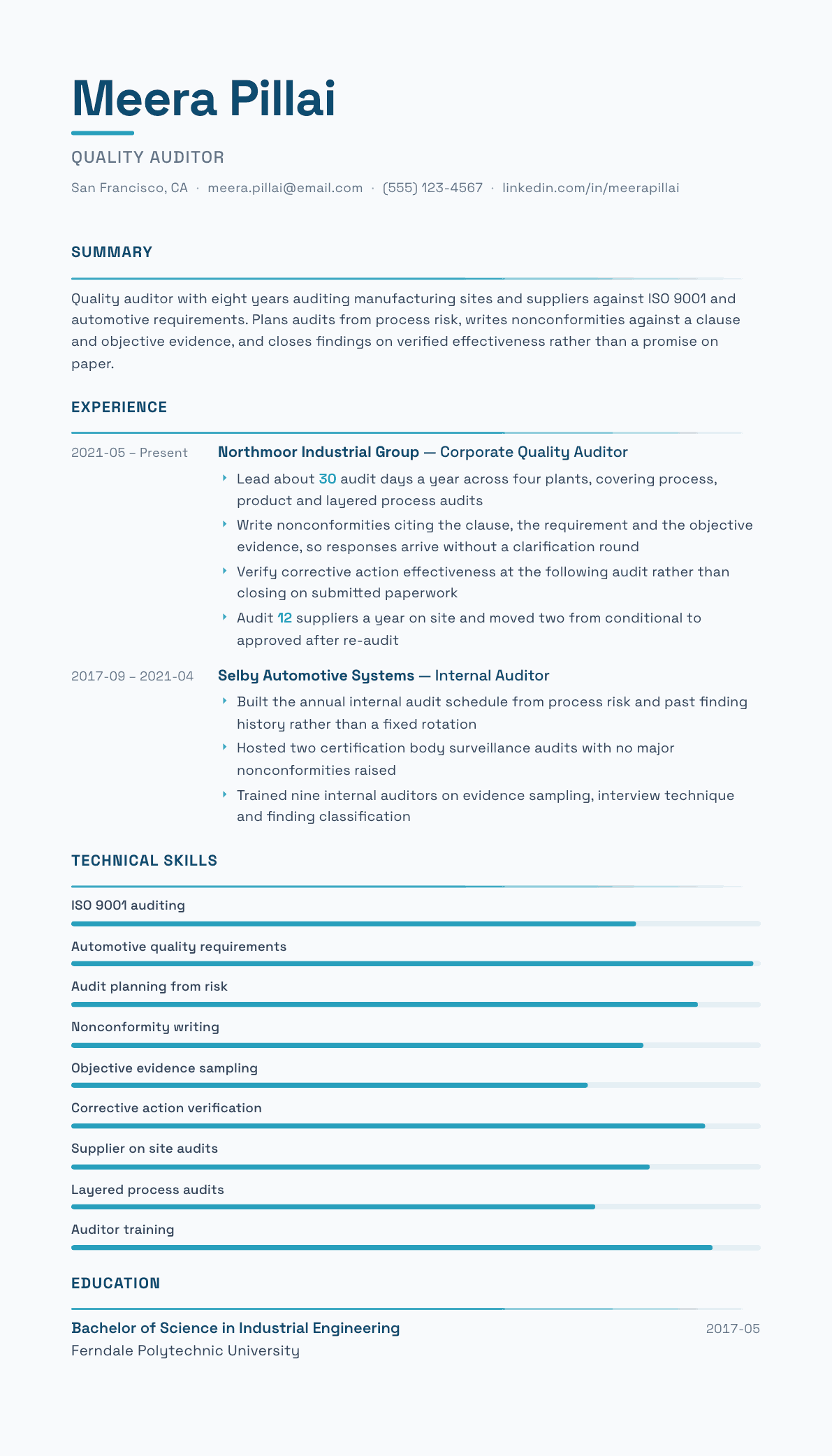
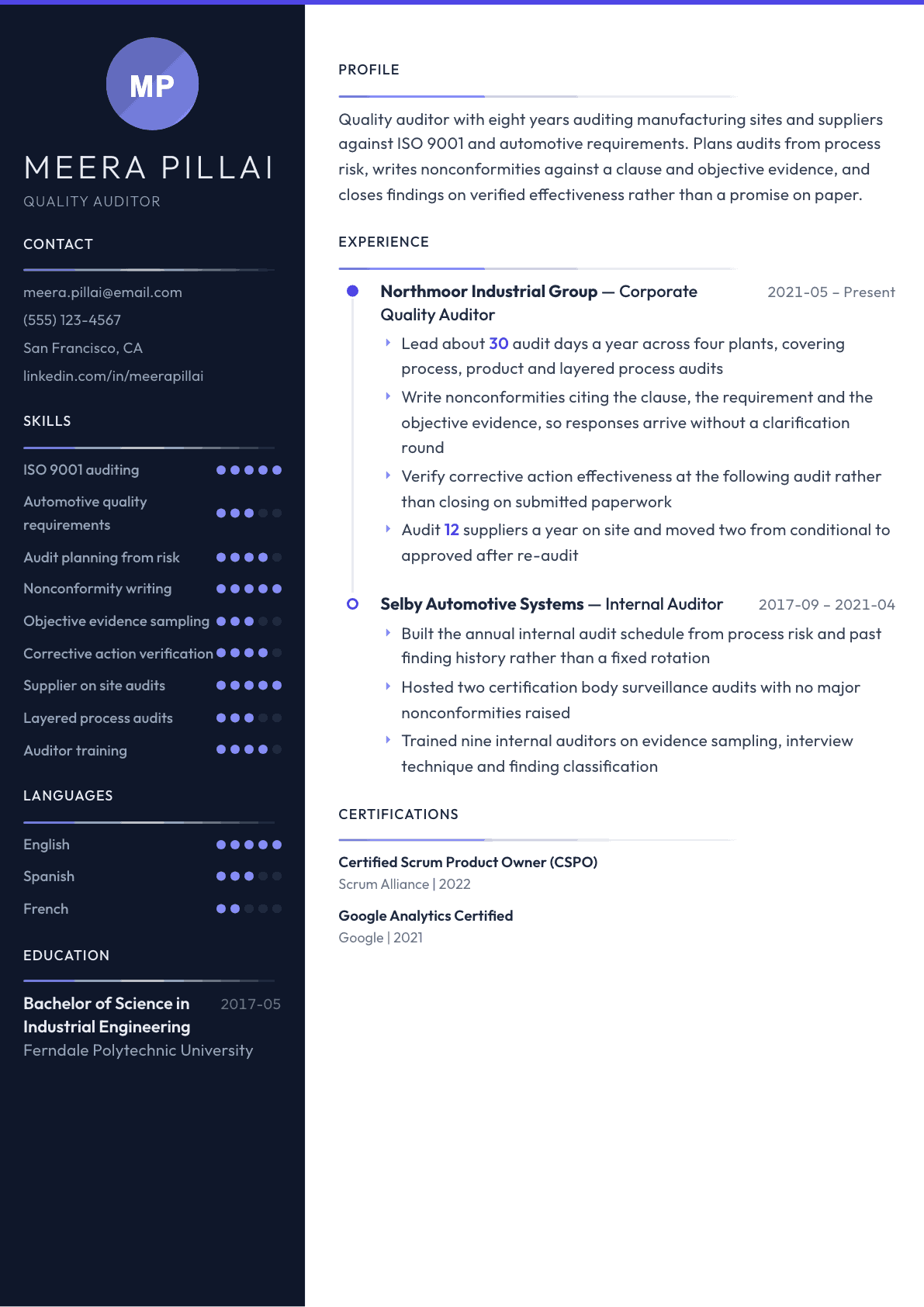
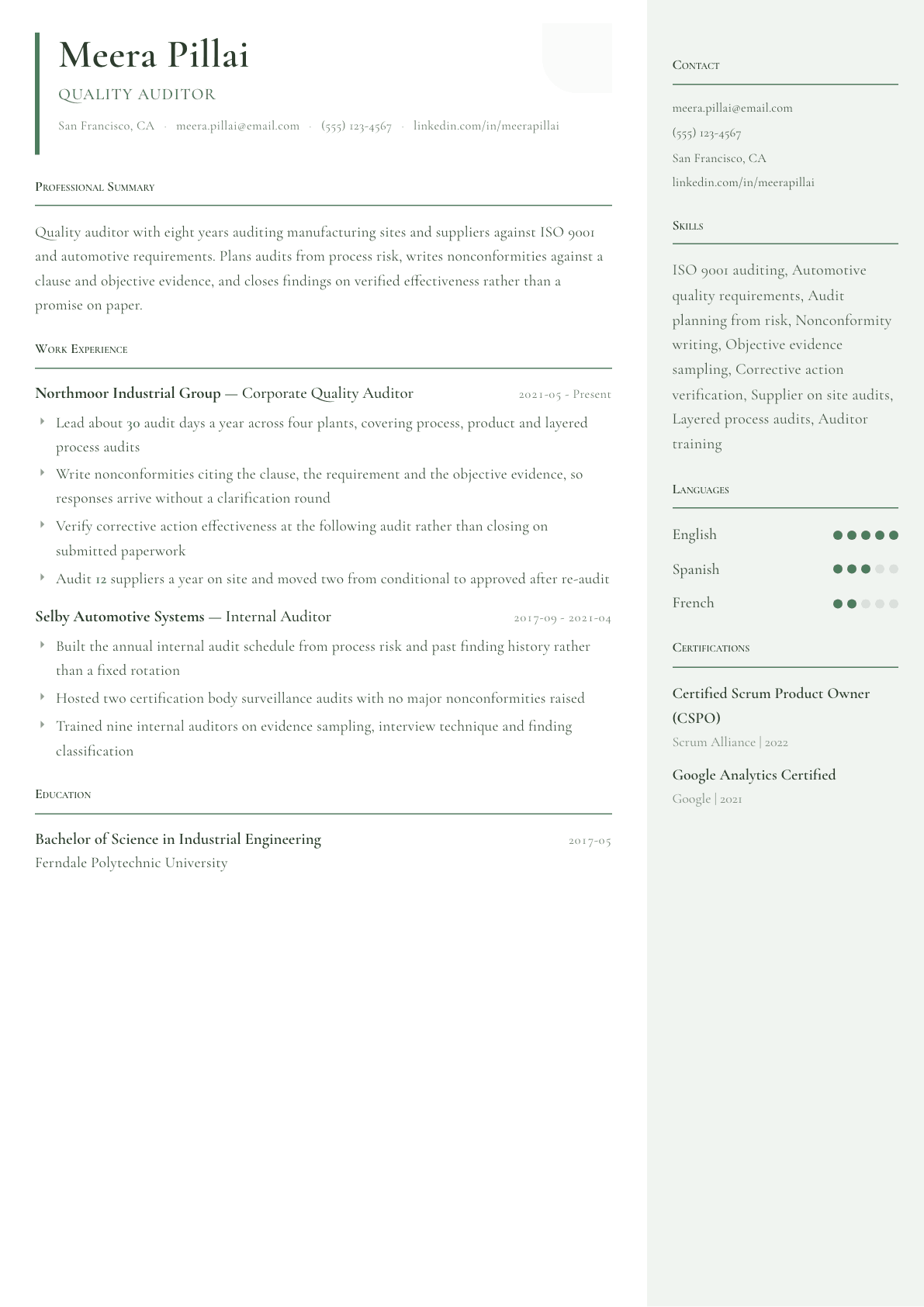
The same quality auditor content laid out in three CVBooster templates, so you can see what the finished document looks like before you write a word.
Example Quality Auditor summary
Quality auditor with eight years auditing manufacturing plants and suppliers against ISO 9001 and automotive requirements. Builds the audit schedule from process risk and finding history rather than a fixed rotation, and writes nonconformities citing the clause, the requirement and the objective evidence so responses come back usable. Verifies corrective action effectiveness at the next audit instead of closing on submitted paperwork, and hosts certification body surveillance visits.
Skills to list on a Quality Auditor resume
- ISO 9001 quality management auditing
- IATF 16949 automotive auditing
- Audit program planning
- Risk based audit scheduling
- Process and product audits
- Layered process audits
- Supplier and second party audits
- Objective evidence sampling
- Interview and floor observation technique
- Nonconformity classification and writing
- Corrective action review
- Effectiveness verification
- Certification body audit hosting
- Auditor training and calibration
- Audit reporting to management review
What actually gets this resume read
- Give audit days per year and audit type, because that is how a quality director sizes an auditor.
- Name every standard you audit against and say whether you led or supported each audit type.
- Show how you write a finding: clause, requirement and evidence beats a description of the problem.
- Say how you verify closure, since auditors who accept paperwork and auditors who re-test differ greatly.
- Include supplier audit travel and how many sites you cover, because that changes the shape of the role.
- List host experience with certification bodies and customers, which many auditors leave off the page.
How to write a quality auditor resume
Auditing is the one quality role where the product is a written finding. A quality director hiring an auditor wants somebody whose reports come back with corrective actions attached rather than arguments, who samples evidence intelligently instead of reading procedures aloud, and who can walk a floor and see the gap between what is written and what people actually do.
Resumes for this role often read like a list of standards the candidate has heard of. That is not the same as audit experience. The reader wants audit days per year, audit types, whether you led or supported, how you classify findings, and what you do at the follow up visit when the corrective action turns out to be a retrained operator and nothing else.
This guide covers the layout a quality director expects from an auditor, how to size your experience in audit days, how to describe findings and closure, before and after bullets, the credentials that carry real weight in this field, and the questions auditors ask when moving from internal to supplier or second party work.
Format: standards, audit types and volume up front
One page for internal auditors, two once you carry a supplier program across sites. Put a standards block under your name listing what you audit against, then an audit type block: system, process, product, layered process, supplier and pre-certification readiness. Those two blocks answer most of a quality director's screening questions.
Add a volume line immediately. Audit days per year, sites covered, suppliers audited and travel share tell a director whether your experience is a few internal audits a year alongside another job or a full time audit load. Both are legitimate, but she needs to know which one she is reading.
- Standards block naming each standard and whether you audit to it or only work under it.
- Audit type block separating system, process, product, layered and supplier audits.
- Volume line: audit days per year, sites, suppliers, and whether you led or supported each type.
- Host experience listed separately, since guiding a certification body is its own skill.
Summary: what you audit, how you plan it, how you close it
Three lines. The standards, the volume, how you build the schedule, and how you verify closure. Schedule construction is a quiet marker of maturity: an auditor who plans from process risk and past finding history is doing something different from one who works a fixed annual rotation, and directors notice.
Closure verification is the other marker. Say plainly that you verify effectiveness on the floor at the next audit rather than closing on submitted paperwork. That single sentence tells a director you will not hand her a system full of actions that were closed but never worked.
Experience: planning, evidence, findings, follow up
Write each job in four movements. Planning first: how the annual schedule is built, how you scope an audit, what you read before you walk in, and how you choose which processes get more attention this year than last. Then evidence: how you sample records, how many, over what period, and how you triangulate a document, an interview and an observation on the floor.
Findings third. Say how you classify major, minor and observation, and describe the structure you write to: the requirement, the evidence, the gap. A finding written that way returns a usable corrective action. A finding written as a complaint returns a defense.
Follow up last, and give it real space. Reviewing proposed actions for containment, correction and systemic fix, rejecting actions that stop at retraining, and verifying effectiveness with fresh evidence at the next visit. This is the part that most auditor resumes leave out and the part a director cares about most.
Supplier audits and the second party seat
If you audit suppliers, treat it as its own section. Number of suppliers, industries, whether you set the approval status, how you score a site, what triggers a re-audit, and any supplier you moved from conditional to approved or removed from the approved list. Those decisions carry commercial weight and they show a director you can be trusted alone at somebody else's plant.
Add the human part. Supplier audits are conducted as a guest with limited authority, so describe how you keep access to records without turning the visit adversarial, and how you report a serious finding to your own purchasing team when the commercial pressure runs the other way.
Reporting, management review and audit program health
Auditors who only produce reports stall. The ones who advance report on the program itself: finding trends by process, repeat findings, closure timeliness and the areas where the system is drifting. Say what you present at management review and what changed because of it.
Mention auditor development if you have led it. Training internal auditors, calibrating how a team classifies findings, and reviewing draft reports before issue are all program level responsibilities that separate a lead auditor from someone who fills audit days.
Quality Auditor resume summary examples
New internal auditor
Quality technician trained as an internal auditor, supporting 8 audits a year across production and document control. Writes findings with requirement, evidence and gap, tracks actions to closure, and has hosted 1 certification surveillance visit. Seeking a dedicated internal auditor position.
Six years in
Quality auditor with 6 years running about 25 audit days a year across process, product and layered process audits at 3 plants. Builds the schedule from process risk and finding history, writes findings against clause and evidence, and verifies effectiveness at the following audit.
Lead auditor
Lead quality auditor with 12 years covering internal and supplier programs against ISO 9001 and automotive requirements. Audits 12 suppliers a year on site, owns approval status decisions, trains internal auditors on evidence sampling, and reports program trends at management review.
Work experience bullets: before and after
Before: Conducted internal audits at the facility.
After: Led about 25 audit days a year across process, product and layered process audits at three plants, scoping each audit from process risk rather than a fixed rotation.
Audit days, types and a planning method size the role in a way a title never does.
Before: Wrote up audit findings and reports.
After: Wrote findings citing the clause, the requirement and the objective evidence observed, which removed the clarification round that used to delay supplier responses.
The finding structure explains why responses improved, which is the outcome a director wants.
Before: Followed up on corrective actions.
After: Rejected corrective actions that stopped at operator retraining, required a systemic fix, and verified effectiveness with fresh evidence at the following audit rather than on submitted paperwork.
Rejecting weak actions is concrete proof of standards, unlike a general follow up claim.
Before: Audited suppliers as needed.
After: Audited 12 suppliers a year on site, set approval status from the scored result, and moved 2 conditional suppliers to approved after verified corrective action at re-audit.
Supplier count plus status decisions show commercial authority, not just attendance.
Before: Reported audit results to management.
After: Presented finding trends by process, repeat finding counts and closure timeliness at quarterly management review, which redirected the next audit schedule toward two drifting processes.
Program level reporting with a consequence shows an auditor who improves the system.
Hard skills
- ISO 9001 quality management system auditing
- IATF 16949 automotive system auditing
- Audit program planning and scheduling
- Risk based audit scoping
- Process and product auditing
- Layered process auditing
- Supplier and second party auditing
- Objective evidence sampling
- Floor observation and interview technique
- Finding classification and writing
- Corrective action review and rejection
- Effectiveness verification
- Certification body audit hosting
- Internal auditor training and calibration
- Management review reporting
Soft skills
- Asking an open question and then waiting for the answer
- Holding a finding when a plant manager pushes back
- Writing so a reader who was not there understands the gap
- Being a guest at a supplier site without losing authority
- Separating what people say from what the records show
Certifications worth listing
- Certified Quality Auditor (CQA) (American Society for Quality)
- ISO 9001 Lead Auditor Certification (Exemplar Global)
Mistakes that cost quality auditor candidates the interview
- Listing standards you have read rather than standards you have audited against.
- Giving no audit days or audit count, which leaves a director guessing at your real workload.
- Describing findings without the structure that makes them answerable by the audited party.
- Treating closure as receiving paperwork instead of verifying the fix on the floor.
- Leaving supplier audit decisions off the page when approval status carries commercial weight.
- Ignoring program level reporting, which is what separates a lead auditor from an audit participant.
Quality Auditor resume questions
How many audits should I list on an auditor resume?
Give totals rather than a list of every audit. Audit days per year, audit types and site counts communicate scale, and a director can ask about individual audits in the interview once the volume has established what kind of auditor you are.
Do I need a lead auditor certificate to apply?
For internal roles, often not, since many companies train their own auditors. For supplier programs and consultancy work a recognized lead auditor qualification carries real weight, so list yours with the issuing body and the standard it covers.
How do I move from internal auditing to supplier auditing?
Emphasize independence, evidence sampling and reporting to people with no obligation to cooperate. Add any supplier visits, incoming quality investigations or customer audits you hosted, since all three demonstrate working outside your own authority.
What if my audits found very little?
A quiet audit history is not automatically a weakness, but it invites the question of whether you were sampling deeply. Describe your evidence approach and the areas you targeted, and include the findings you did raise with their systemic outcomes.
Should I name the companies I audited as a supplier auditor?
Name industries and site types rather than companies, since audit results are usually confidential. Saying you audited casting, plating and electronics assembly suppliers across several countries gives the reader scope without breaching anything you signed.
Related resume examples
- Quality Assurance Technician Resume example
- Quality Manager Resume example
- Quality Engineer Resume example
- Supplier Quality Engineer Resume example
- Line Supervisor Resume example
- Manufacturing Manager Resume example