Quality Assurance Technician Resume Examples: free score
Write a Quality Assurance Technician Resume for the System
By Mustafa Tarabya, founder of CVBooster · Published · Updated
Quality assurance technician resume example, keywords and guide covering batch record review, deviations, corrective actions, document control and audits.
Sample resumes for a quality assurance technician
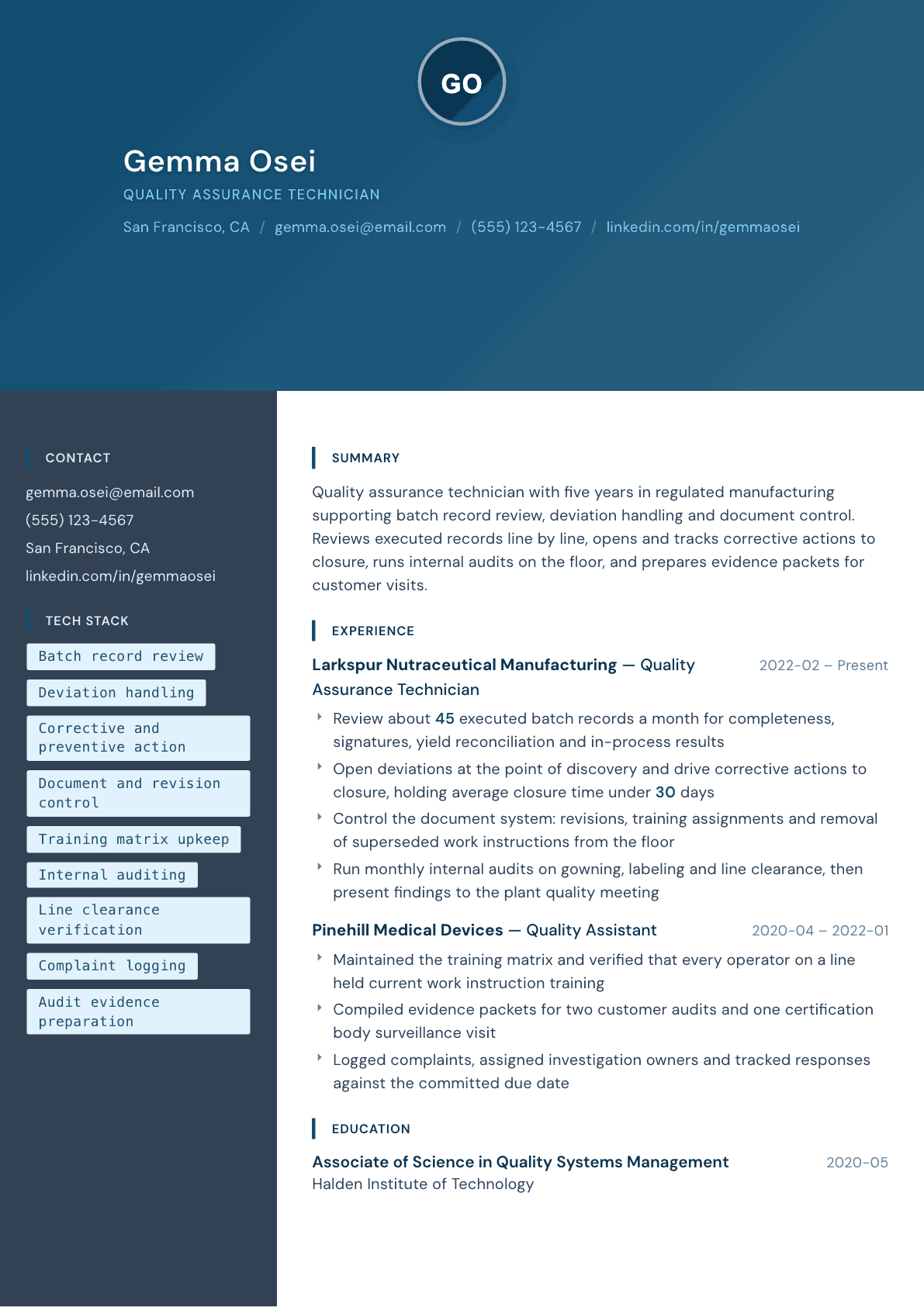
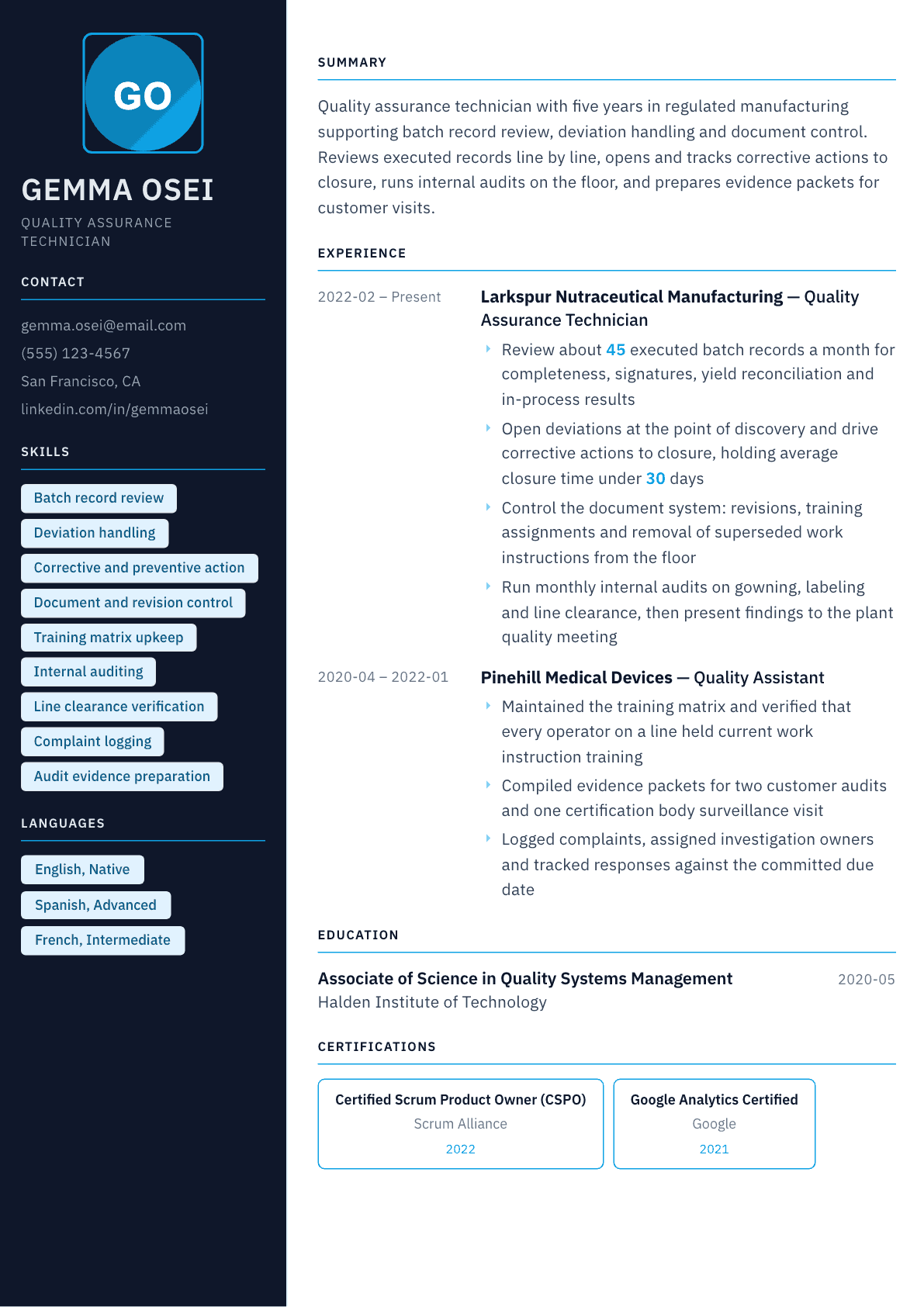
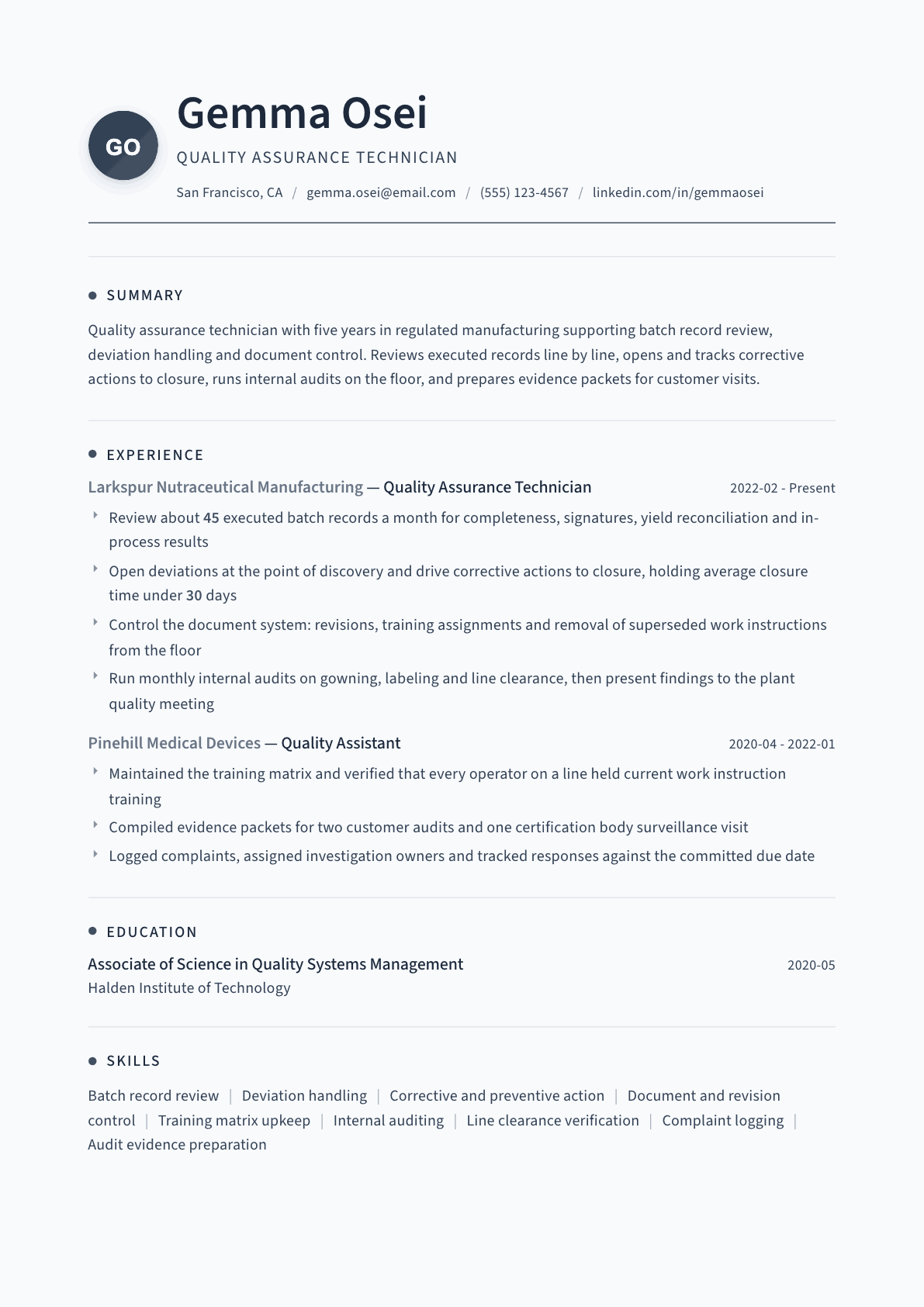
The same quality assurance technician content laid out in three CVBooster templates, so you can see what the finished document looks like before you write a word.
Example Quality Assurance Technician summary
Quality assurance technician with five years in regulated manufacturing covering batch record review, deviations and document control. Reviews executed records for signatures, yield reconciliation and in-process results, opens deviations at the point of discovery, and drives corrective actions to closure inside the committed window. Owns revision control and the training matrix, runs monthly internal audits on gowning and line clearance, and builds the evidence packets customer auditors ask for.
Skills to list on a Quality Assurance Technician resume
- Executed batch record review
- Yield reconciliation checks
- Deviation and nonconformance handling
- Corrective and preventive action tracking
- Root cause investigation support
- Document and revision control
- Standard operating procedure drafting
- Training matrix administration
- Internal audit execution
- Line clearance and labeling verification
- Change control participation
- Complaint intake and tracking
- Supplier certificate review
- Audit evidence packet preparation
- Quality management system software
What actually gets this resume read
- Separate your systems work from inspection work, because a quality assurance technician is judged on records.
- Give the number of batch records you review a month and what you catch when you review them.
- Name the standard your plant is certified to, since the documentation habits it demands differ sharply.
- Put corrective action closure time on the page, because open actions are what fail a surveillance audit.
- Show your document control work: revision releases, training assignment and pulling superseded copies.
- Mention audits you prepared for and whether your evidence packets drew observations or passed clean.
How to write a quality assurance technician resume
Quality assurance is the system half of quality. Where an inspector checks product and a laboratory technician tests it, a quality assurance technician makes sure the plant did what its procedures say it does, and that the paper proves it. The manager hiring you is defending a certification, a customer approval or a regulatory registration, and she reads your resume with that at stake.
That means the resume needs a different center of gravity from an inspection page. Batch record review, deviations, corrective actions, change control, document revisions, training records, internal audits and line clearance are the daily work. A page that leads with calipers and gages will be read as an inspector resume and passed over for this seat.
This guide covers the section order a quality assurance department expects, how to write a summary that signals system fluency, what belongs in each experience block, before and after bullets, the credentials worth listing, and the questions technicians ask when they move between regulated industries.
Format: system experience before product experience
One page, reverse chronological, with a systems block under your name rather than an equipment list. Name the quality system elements you have worked: document control, deviation handling, corrective and preventive action, change control, training records, internal audit, complaint handling and supplier approval.
Then a standards line naming what your plants were certified or registered to, because the documentation habits demanded by a food safety scheme, an automotive standard and a medical device system are different disciplines. A hiring manager sorts candidates by that line before she reads a single bullet.
- Systems block covering the elements you personally worked rather than those your department owned.
- Standards line naming the certifications or registrations your sites held while you were there.
- Volume figures: records reviewed, deviations opened, actions closed, audits run.
- Software named: the electronic quality system, document repository or training platform you used daily.
Summary: records, deviations, closure and audits
Three lines built on four facts: how many executed records you review, whether you open deviations yourself, whether you drive corrective actions to closure, and whether you run internal audits. Those four cover the daily job almost completely, and each one is a number or a yes.
Closure discipline is the strongest claim available to a quality assurance technician. Overdue actions are what a certification body writes up, so a candidate who can state an average closure time against a committed window arrives already speaking to the manager's worst monthly report.
Experience: review, deviation, action, audit
Structure each job around the four verbs. Review comes first: executed batch or work records checked for signature, sequence, yield reconciliation and in-process results, with the volume per month and the kinds of error you catch. Missing signatures, uncalculated yields, out of sequence entries and unrecorded in-process checks are the usual four, and naming them proves you have really done it.
Deviation and action come next: opening a deviation at the point of discovery rather than at month end, assessing product impact, supporting the root cause work, writing the action and verifying it happened. Say who owns closure and what your part is, because that boundary differs by plant and the reader will want to know.
Audit and document control fill the rest. Internal audits run per year and the areas covered, findings raised and how you present them, plus revision releases, superseded copy removal from the floor, training assignment on new revisions and the training matrix upkeep that makes the whole thing defensible.
Audit readiness, the part that gets you hired
Every quality assurance manager has lived through a customer audit going badly. Describing your part in preparing for one is the most persuasive material you have: the evidence packets you assemble, how you rehearse the room, the records you pull in advance and how you handle a request for a document that does not exist.
Give outcomes where you can. Surveillance visits held without a major finding, customer audits passed, observations closed inside the response window. Never claim a result your department earned as your own personal work, because that story falls apart the moment an interviewer asks what you specifically did.
Vocabulary that separates assurance from control
Use the assurance words: deviation, nonconformance, corrective and preventive action, root cause, effectiveness check, change control, document revision, line clearance, training matrix, complaint, hold and release. Each has a precise meaning, and a candidate who mixes them with inspection language signals they have not worked inside a real system.
Where you have both control and assurance experience, keep them separated on the page. Show inspection or laboratory work as background, then build the visible half of the resume around the system work, so the reader is never confused about which job you are applying for.
Quality Assurance Technician resume summary examples
Moving into quality assurance
Production operator with 3 years on a regulated line moving into quality assurance after covering line clearance and record checks. Trained in good manufacturing practice, document revisions and deviation reporting. Seeking a quality assurance technician role supporting batch record review and internal audits.
Five years in
Quality assurance technician with 5 years in regulated manufacturing reviewing about 45 executed batch records a month for signatures, yield reconciliation and in-process results. Opens deviations at discovery, holds corrective action closure under 30 days, and runs monthly internal audits on gowning and line clearance.
Senior technician
Senior quality assurance technician with 10 years across nutraceutical and device manufacturing, owning document control, the training matrix and the internal audit schedule. Prepares evidence packets for customer and certification visits, and has closed every observation inside the committed response window for 4 years.
Work experience bullets: before and after
Before: Reviewed paperwork for production batches.
After: Reviewed about 45 executed batch records a month for signature completeness, entry sequence, yield reconciliation and in-process results, returning records to the floor before release rather than after.
Volume plus the four things you check makes the review real instead of nominal.
Before: Handled deviations and corrective actions.
After: Opened deviations at the point of discovery, assessed product impact with production, and drove corrective actions to closure with an average under 30 days against a 45 day commitment.
Closure time against a commitment is the number a certification body actually examines.
Before: Managed controlled documents.
After: Released document revisions, assigned the matching training, and pulled superseded work instructions from every point of use so no operator could follow an out of date version.
Removing superseded copies is the step that fails audits, and naming it shows real ownership.
Before: Performed internal audits.
After: Ran monthly internal audits on gowning, labeling and line clearance, raised findings with objective evidence, and presented them at the plant quality meeting with owners and due dates attached.
Evidence, owners and dates turn an audit from an exercise into a closed loop.
Before: Helped prepare for customer audits.
After: Compiled evidence packets for 2 customer audits and 1 certification surveillance visit, pulling records, training files and calibration history in advance so no request went unanswered on the day.
Describing the preparation shows what you did rather than borrowing the department result.
Hard skills
- Executed batch and work record review
- Yield reconciliation checking
- Deviation and nonconformance handling
- Corrective and preventive action tracking
- Root cause investigation support
- Change control participation
- Document and revision control
- Standard operating procedure drafting
- Training matrix administration
- Internal audit execution and reporting
- Line clearance and labeling verification
- Complaint intake and response tracking
- Supplier documentation review
- Audit evidence packet preparation
- Electronic quality management systems
Soft skills
- Raising a finding without turning production against you
- Reading a record carefully at the end of a long day
- Explaining why a procedure step exists rather than quoting it
- Chasing an overdue action politely and repeatedly
- Staying calm in the room when an auditor asks for a document
Certifications worth listing
- Certified Quality Improvement Associate (CQIA) (American Society for Quality)
- Certified Quality Process Analyst (CQPA) (American Society for Quality)
Mistakes that cost quality assurance technician candidates the interview
- Leading with gages and measurement, which makes the page read as an inspection resume by mistake.
- Naming the quality system elements your department owned rather than the ones you personally worked.
- Omitting record volumes, leaving a manager unable to judge whether you can carry her review load.
- Claiming department audit results as personal achievements, which collapses under one interview question.
- Skipping document control detail, when superseded copies on the floor are a classic audit finding.
- Writing deviation and nonconformance loosely, which signals unfamiliarity with the system to a trained reader.
Quality Assurance Technician resume questions
Is a quality assurance technician the same as a quality control inspector?
No. Control checks the product against a specification, assurance checks that the process and its records did what the system requires. Some plants blur the titles, so read the posting duties carefully and lead with the half that matches.
How do I move into quality assurance from production?
Use the system work you already do: line clearance, record completion, deviation reporting and training sign offs. Then add the standard your plant runs under and any internal audit you supported. Production knowledge is a genuine advantage in this seat, so do not hide it.
Which industries value this experience most?
Pharmaceuticals, medical devices, food, nutraceuticals, cosmetics and automotive all run formal systems and hire for this work. Name the standard your sites held, since the transfer between industries depends far more on system fluency than on product familiarity.
Do I need software experience on the resume?
Name whatever electronic quality system, document repository or training platform you used, and say what you did in it. Managers do not expect a specific product, but they do want evidence you can work in a controlled system rather than a shared folder.
How do I describe corrective action work honestly?
Separate what you owned from what you tracked. Writing that you opened deviations, coordinated investigations and verified completion is accurate for most technician roles, while claiming to have led root cause analysis overstates the seat and will be tested in an interview.
Related resume examples
- Quality Auditor Resume example
- Quality Control Technician Resume example
- Quality Assurance Resume example
- Quality Manager Resume example
- Line Supervisor Resume example
- Clean Room Technician Resume example