Quality Control Technician Resume Examples: free score
Build a Quality Control Technician Resume Around Test Methods
By Mustafa Tarabya, founder of CVBooster · Published · Updated
Quality control technician resume example, keywords and guide covering test methods, instrument calibration, control charts, retains and out of spec handling.
Sample resumes for a quality control technician
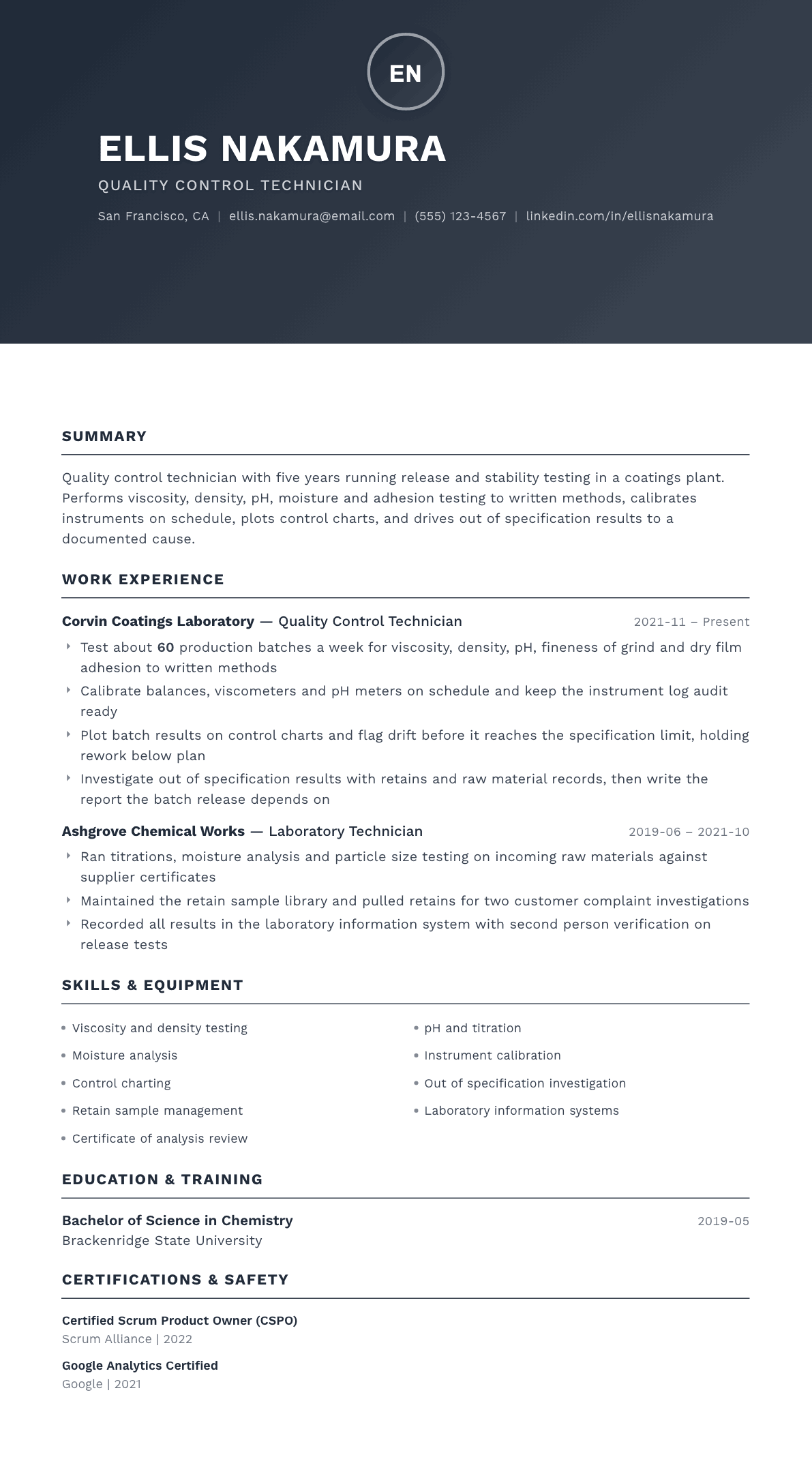
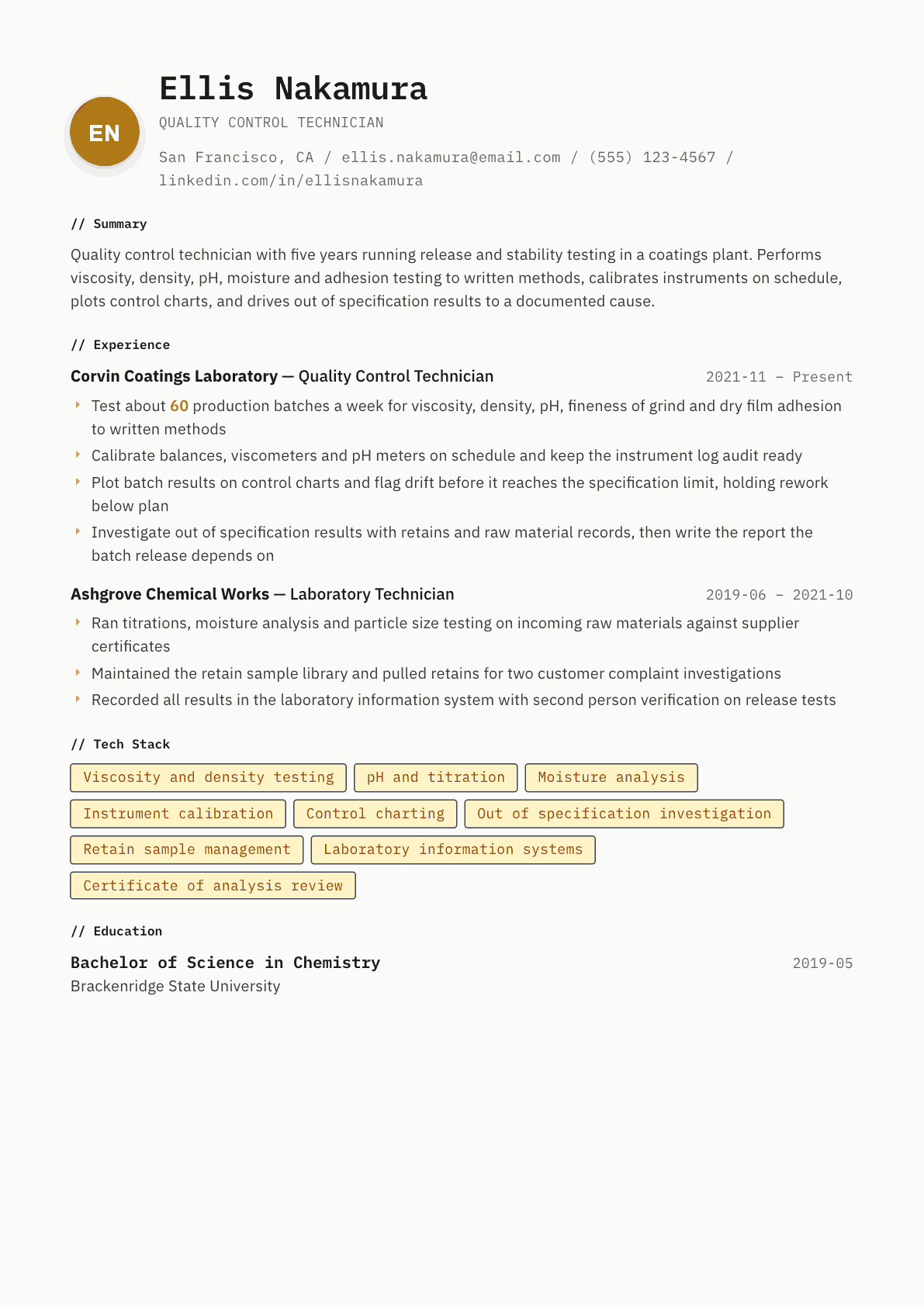
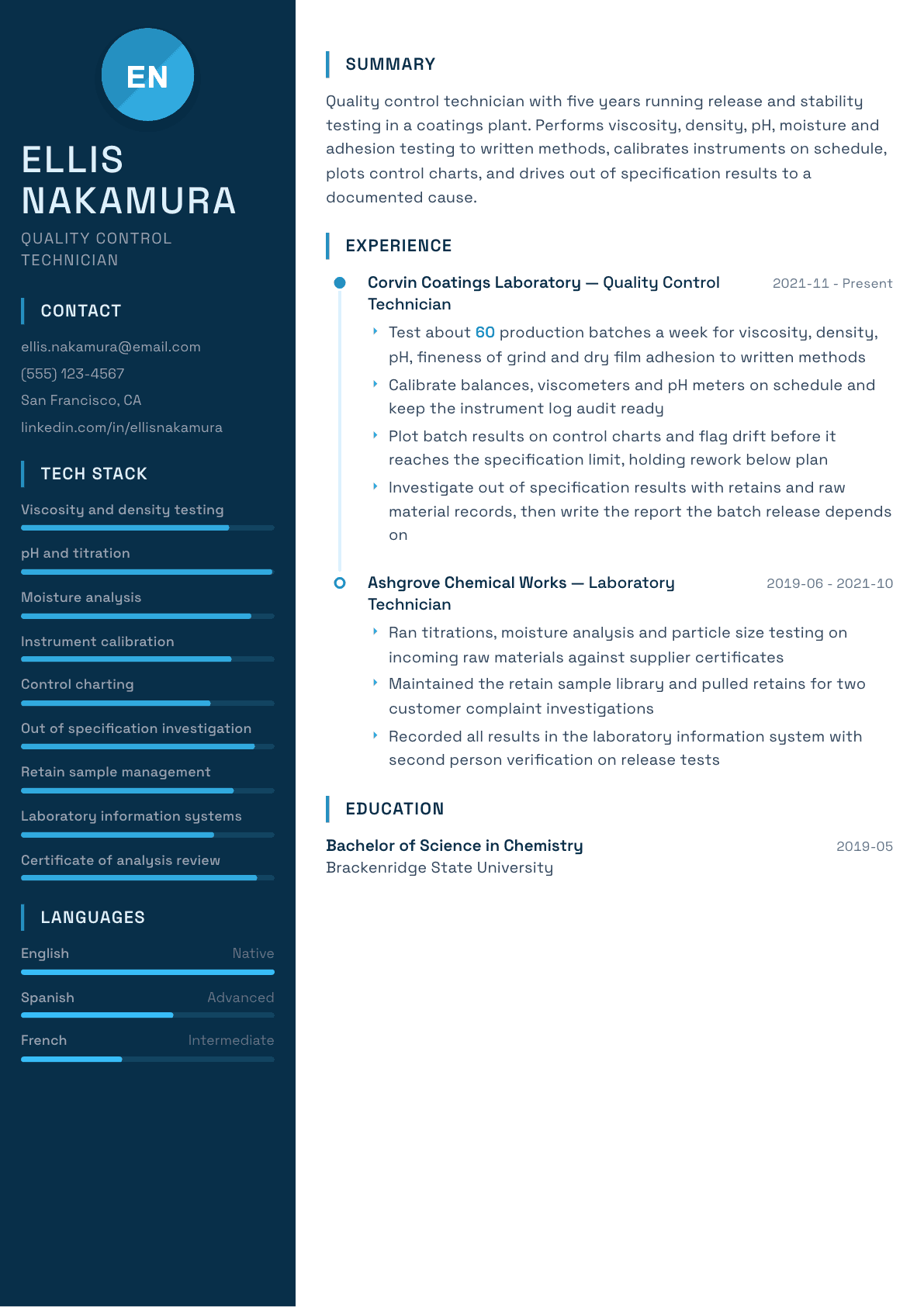
The same quality control technician content laid out in three CVBooster templates, so you can see what the finished document looks like before you write a word.
Example Quality Control Technician summary
Quality control technician with five years of release and stability testing in a coatings plant. Runs viscosity, density, pH, fineness of grind and adhesion tests to written methods, calibrates balances, viscometers and pH meters on schedule, and keeps the instrument log audit ready. Plots batch results on control charts to catch drift before it hits the specification limit, and closes out of specification investigations with retains and raw material records.
Skills to list on a Quality Control Technician resume
- Written test method execution
- Viscosity and rheology testing
- Density and specific gravity
- pH measurement and titration
- Moisture and loss on drying
- Particle size and fineness of grind
- Tensile and adhesion testing
- Instrument calibration and verification
- Statistical process control charting
- Out of specification investigation
- Retain sample library management
- Certificate of analysis review
- Laboratory information systems
- Laboratory safety and chemical handling
- Batch release documentation
What actually gets this resume read
- List your test methods by name, because a hiring lab wants to know what it can hand you on day one.
- Name the instruments you calibrate and verify, not just the ones you operate under someone else.
- Say how many batches or samples you clear in a week, since throughput is the number a lab lead plans on.
- Show your out of specification work: retains pulled, records reviewed and the conclusion you documented.
- Include the quality system you worked under so a reader knows the documentation discipline you carry.
- Explain your control charting habit, because catching drift early is worth more than catching failure late.
How to write a quality control technician resume
A laboratory supervisor reading quality control technician resumes has a bench that must clear a fixed number of samples a day and a release decision waiting at the end of each one. She is looking for someone who runs a written method exactly as written, keeps instruments in calibration, and investigates a failing result instead of quietly rerunning it until it passes.
This role sits between the inspector and the chemist. The inspector measures parts, the quality control technician runs tests: viscosity, titration, moisture, particle size, tensile strength, microbiology plating, whatever the product demands. So the resume should be built around methods and instruments rather than around parts and gages.
This guide covers how to lay out a laboratory focused resume, what makes a summary credible to a lab lead, how to describe throughput and calibration, before and after bullets, the credential list that helps, and the questions technicians ask about moving into quality engineering or method development.
Format: methods and instruments block, then jobs
One page, reverse chronological, with a methods and instruments block directly under the header. List the tests you run and the equipment you operate. A lab lead is mentally assigning you to a bench while she reads that block, so it should read like a capability list rather than a paragraph.
Separate what you operate from what you calibrate and verify. Running an instrument is a training task. Calibrating it, checking it against a standard and taking it out of service when it drifts is a responsibility, and hiring labs pay attention to which one you have held.
- Methods block: the tests by name, with the property each one measures.
- Instrument block: balances, viscometers, meters, analyzers and testers, marked operate or calibrate.
- Sample throughput per day or per week, because a lab schedules by volume.
- Quality system context: the standard your lab worked under and the documentation it required.
Summary: product, tests, throughput, investigations
Four facts, three lines. What product you tested, which methods you run unsupervised, how many samples or batches you clear in a week, and whether you lead out of specification investigations. That last item is the one that separates a technician who works a bench from one who can be left with it.
Name the industry, because coatings, food, pharmaceuticals, plastics and metals labs use different methods and different documentation. A lab lead reading your summary should know within one line whether your instrument list will transfer to her bench.
Experience: methods run, data recorded, decisions supported
Open each job with the lab type, the product and the testing scope. Then bullets in three groups. Routine testing first: the methods, the volume, the turnaround you held and the release decisions your results supported. Give sample numbers so the reader can size the bench you carried.
Instrument work second: calibration schedules, verification against reference standards, preventive maintenance, and the actions you take when an instrument fails a check, including the review of results already reported using it. That review is the part auditors ask about and the part most resumes forget.
Investigation work third. Out of specification handling, retest justification, retain sample pulls, raw material record review and the written conclusion. Describe one investigation in a bullet with its outcome, because it shows judgment far better than a claim about problem solving skills.
Data, charts and the trend nobody else spotted
A strong quality control technician does not only report results, she watches them move. Say whether you plot control charts, calculate capability, review trends between batches and raise a signal before a result crosses the specification limit. That is the difference between a lab that prevents rework and one that documents it.
Mention the systems you record in: a laboratory information system, a statistical package, a spreadsheet workbook you built, or a paper notebook with second person verification. Data integrity habits belong here too: recording as you go, no back dating, corrections made by single line with initials.
Keywords a laboratory posting screens for
Lab postings repeat a defined vocabulary: test method, specification, out of specification, retain, calibration, verification, control chart, capability, certificate of analysis, batch release and good laboratory practice. Use them where they belong, and pair each one with the specific test or product it applied to.
Add the safety and handling side in a short line: chemical handling, safety data sheets, fume hood work, waste segregation and personal protective equipment. Labs will not hire a technician who treats those as an afterthought, and one accurate sentence carries the point.
Quality Control Technician resume summary examples
New to the bench
Chemistry graduate with 6 months of laboratory placement running pH, moisture and viscosity testing on raw materials. Trained in balance calibration, safety data sheet handling and result recording with second person verification. Seeking a quality control technician role in a manufacturing laboratory.
Five years in
Quality control technician with 5 years in a coatings laboratory clearing about 60 batches a week for viscosity, density, pH, fineness of grind and adhesion. Calibrates balances, viscometers and meters on schedule, plots control charts, and closes out of specification investigations with retains.
Senior technician
Senior quality control technician with 11 years across chemical and food laboratories, owning method transfer, instrument qualification and the retain library. Trains new technicians, leads out of specification investigations to documented cause, and has supported 4 certification audits with no laboratory findings.
Work experience bullets: before and after
Before: Performed quality tests on production samples.
After: Cleared about 60 production batches a week for viscosity, density, pH, fineness of grind and dry film adhesion, each to a written method with results recorded at the bench.
Volume and named methods let a lab lead assign you to a bench without a trial week.
Before: Calibrated laboratory equipment.
After: Calibrated balances, viscometers and pH meters to schedule, verified against reference standards before release testing, and removed one drifting meter from service pending review of results reported with it.
The review of already reported results is exactly what an auditor checks for.
Before: Investigated failed test results.
After: Led out of specification investigations using retains, raw material certificates and batch records, and traced a recurring viscosity failure to a supplier resin lot rather than to the test method.
A traced root cause proves investigation, where investigated failures proves only activity.
Before: Used control charts to monitor quality.
After: Plotted batch results on control charts and raised a drift signal three batches before the specification limit, which let production correct the addition sequence without rework.
Catching drift early with a stated lead time shows the chart doing real work.
Before: Kept accurate records of testing.
After: Recorded results into the laboratory information system as tests completed, with single line corrections and initials, and kept the retain library indexed for complaint investigations.
Data integrity practice described concretely is worth more than a claim of accuracy.
Hard skills
- Written test method execution
- Viscosity and rheology measurement
- Density and specific gravity testing
- pH measurement and titration
- Moisture and loss on drying analysis
- Particle size and fineness of grind
- Tensile, hardness and adhesion testing
- Instrument calibration and verification
- Preventive maintenance on lab equipment
- Control charting and capability review
- Out of specification investigation
- Retain sample library management
- Certificate of analysis preparation
- Laboratory information system entry
- Chemical handling and waste segregation
Soft skills
- Running a method the same way on a busy day as on a quiet one
- Reporting a failing result without softening it
- Explaining a laboratory number to a production supervisor
- Keeping a bench orderly enough for someone else to finish
- Asking for a repeat sample instead of assuming an error
Certifications worth listing
- Certified Quality Technician (CQT) (American Society for Quality)
- Certified Calibration Technician (CCT) (American Society for Quality)
Mistakes that cost quality control technician candidates the interview
- Listing instruments without saying which ones you calibrate rather than only operate.
- Giving no sample or batch volume, which leaves a lab lead unable to plan around you.
- Describing testing without a single release decision your results supported.
- Writing problem solving instead of one out of specification investigation with a traced cause.
- Ignoring data integrity habits, which regulated laboratories treat as a hiring requirement.
- Blending inspection and laboratory work together so neither reads as your actual profession.
Quality Control Technician resume questions
How technical should a quality control technician resume get?
Technical enough to name methods and instruments, plain enough that a hiring manager who is not a chemist still follows it. Give the test name and the property it measures in the same phrase, and the page stays readable to both audiences.
What if my lab used method names that other companies do not?
Translate to the property being measured and add the standard where one exists. Naming an internal method alone tells a reader nothing, while saying you measured viscosity by rotational viscometer to a written internal method is universally understood.
Do I need a degree for this role?
Many laboratories accept a technical diploma plus hands on method experience, particularly in coatings, plastics and food. Where a degree is required it is usually chemistry or a related science, so list relevant coursework and instrument time if your degree is in progress.
How do I move from technician to quality engineer?
Build evidence of analysis rather than execution: capability studies, gage repeatability work, trend investigations that changed a process, and any method validation you supported. Engineers are hired on the ability to draw a conclusion from data and defend it.
Should microbiology testing go on the same resume as chemical testing?
Yes, but keep them in separate blocks because the disciplines and the hygiene requirements differ. A lab hiring for a micro bench wants to see plating, incubation, enumeration and aseptic technique named explicitly rather than folded into a general testing list.
Related resume examples
- Quality Control Inspector Resume example
- Lab Technician Resume example
- Quality Assurance Technician Resume example
- Quality Engineer Resume example
- Chemical Plant Operator Resume example
- Water Treatment Operator Resume example