Chemical Plant Operator Resume Examples: free ATS score
Write a Chemical Plant Operator Resume That Reads as Safe Hands
By Mustafa Tarabya, founder of CVBooster · Published · Updated
Chemical plant operator resume example with unit, DCS, batch and safety keywords, plus a guide to proving process control and turnaround work.
Sample resumes for a chemical plant operator
The same chemical plant operator content laid out in three CVBooster templates, so you can see what the finished document looks like before you write a word.
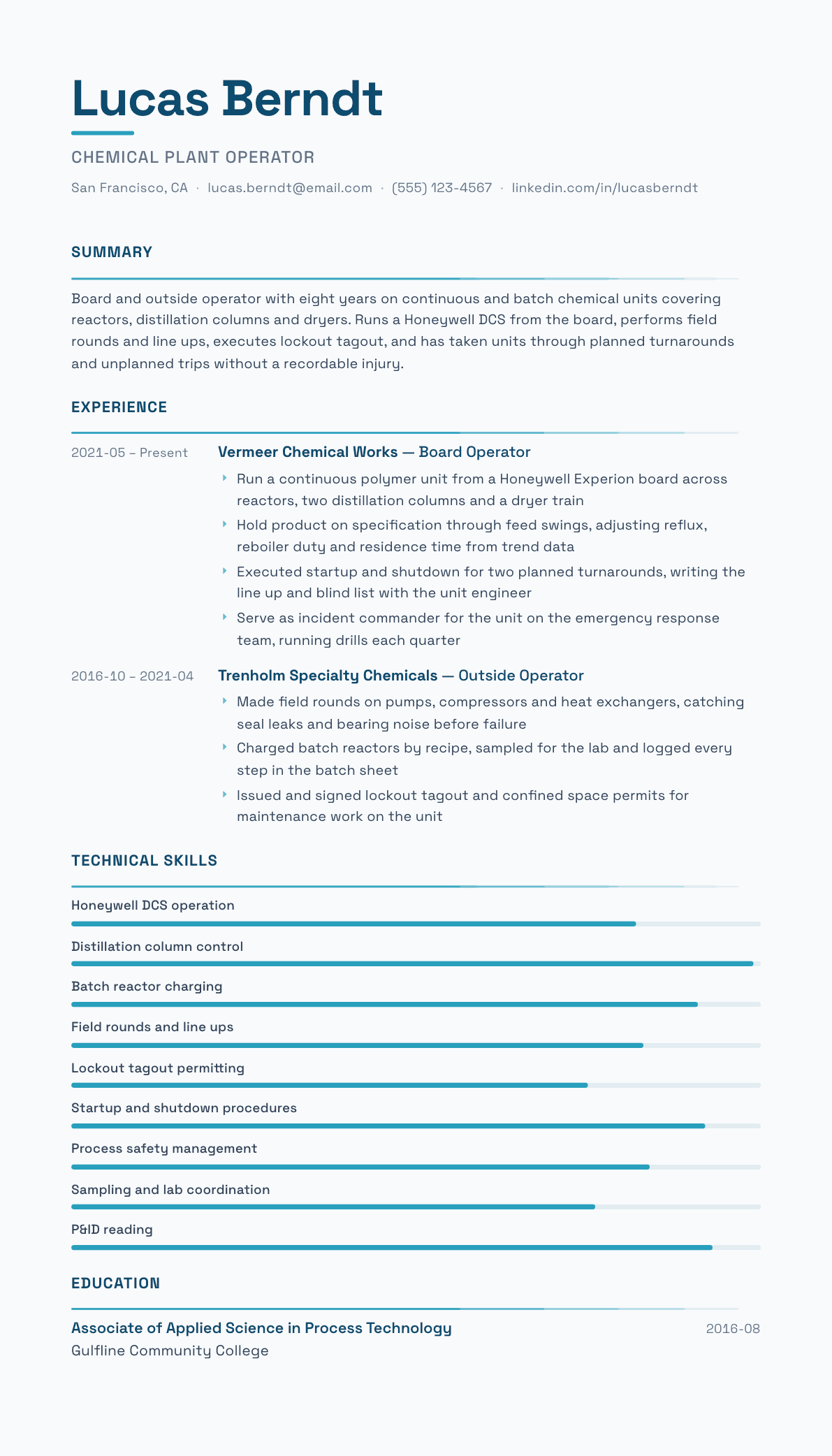
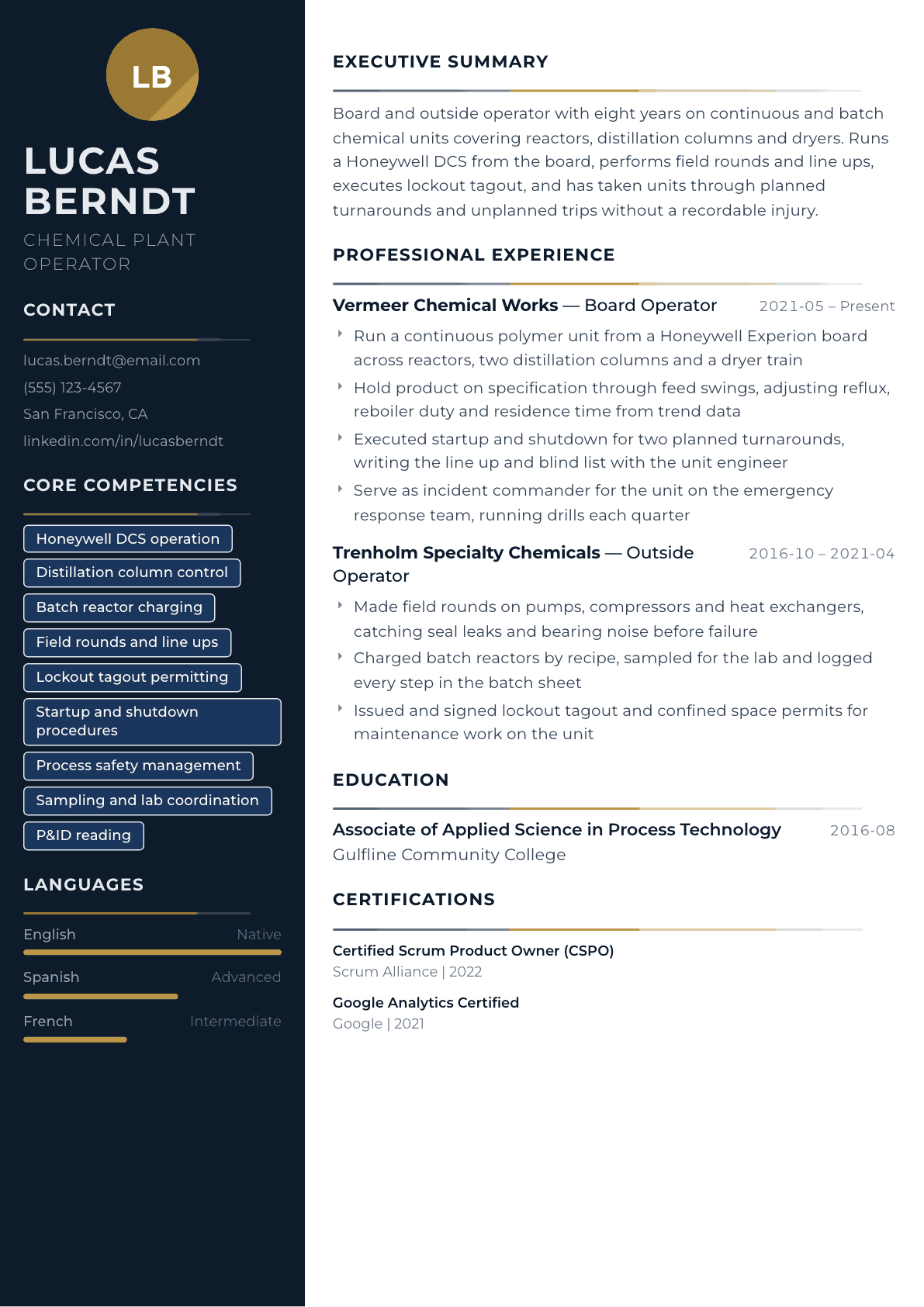
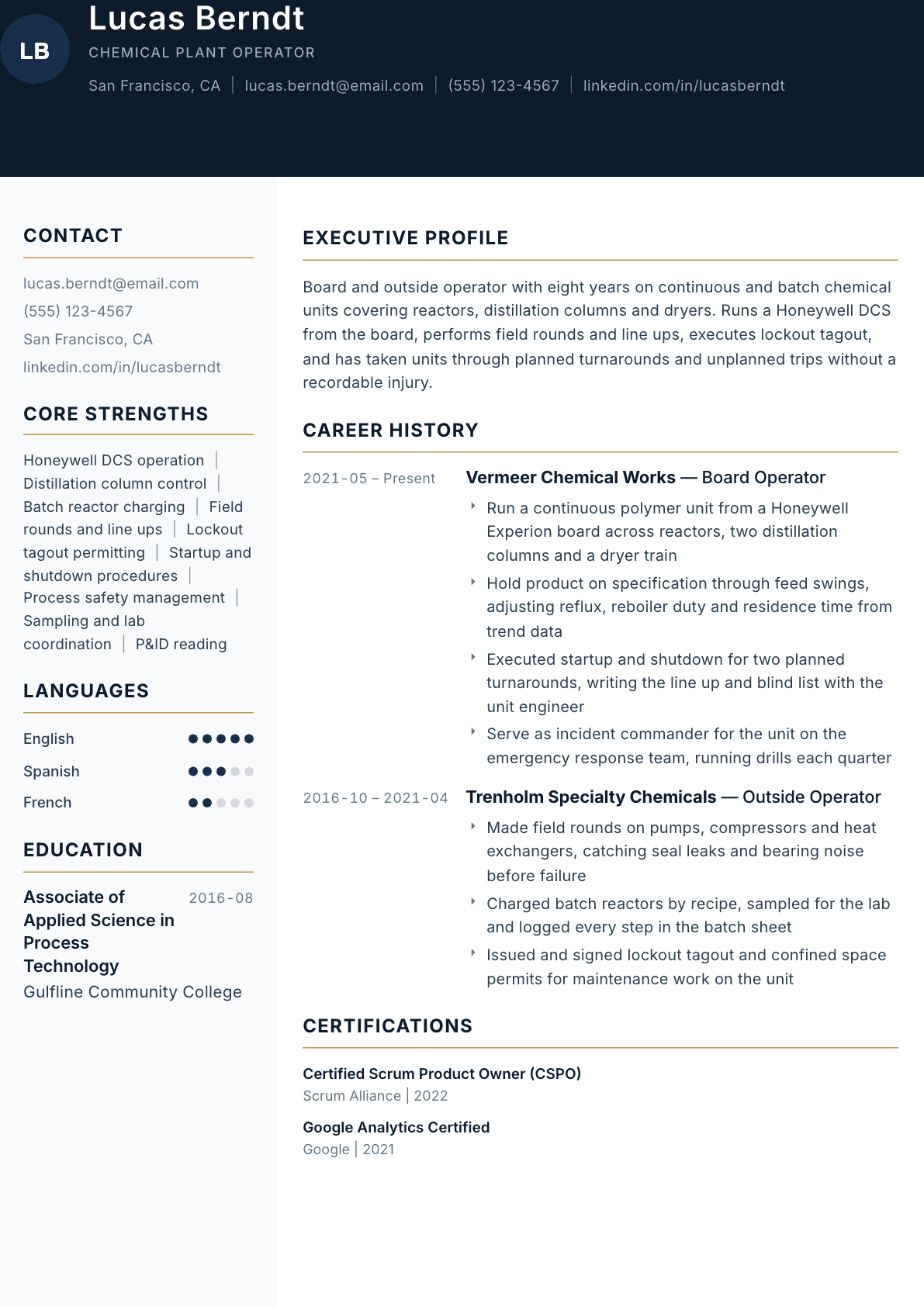
Example Chemical Plant Operator summary
Chemical plant operator with eight years across continuous and batch units, working both the board on a Honeywell Experion system and the field on rounds, line ups and permitting. Holds polymer product on specification through feed swings by trending reflux, reboiler duty and residence time. Took two units through planned turnarounds including the line up and blind list, and serves as unit incident commander on the emergency response team.
Skills to list on a Chemical Plant Operator resume
- Distributed control system operation
- Distillation and separation control
- Reactor operation and charging
- Batch recipe execution
- Heat exchanger and pump monitoring
- Compressor operation
- Startup and shutdown procedures
- Turnaround and outage support
- Lockout tagout and permit to work
- Confined space entry
- Process safety management
- P&ID and PFD interpretation
- Field sampling and lab liaison
- Emergency response and drills
- Shift logs and turnover notes
- Root cause investigation support
What actually gets this resume read
- Say whether you ran the board, worked outside, or both, because those are two distinct operator jobs.
- Name the control system by vendor and version family, since a plant does not want to retrain you on the board.
- List the unit operations you have run: reactors, columns, dryers, compressors, and the products they made.
- Show turnaround and startup work, which is where a plant learns whether an operator can think under pressure.
- Put your process safety and permitting work on the page, including lockout tagout and confined space entry.
- Give shift pattern experience, because a plant on twelve hour rotating shifts needs to know you have done it.
How to write a chemical plant operator resume
The person hiring a chemical plant operator is thinking about the worst night of the year. Not the routine shift, but the one where a feed pump trips at three in the morning, the column starts flooding and somebody has to decide in ninety seconds whether to cut rates or take the unit down. Your resume is being read as evidence about how you behave on that night.
What that reader needs is the unit vocabulary, and it has to be yours rather than borrowed. Reactors, columns, dryers, evaporators, centrifuges, compressors, heat exchangers, tank farms and loading racks. The control system by name. Whether you sat on the board, walked the field, or did both. What you did in the last turnaround and what you did the last time a unit tripped.
This guide covers how to structure a page around units rather than titles, how to write about process safety without sounding like a poster, how to present turnaround work, and how to make a shift record and a training background readable to a plant that has never met you.
Format: unit qualifications before employment history
One to two pages, reverse chronological. The block that goes first is your unit qualification list, because in a plant that is what an operator is: a person qualified on named positions. List each unit you have been signed off on, the position within it, and whether the qualification is current.
Below that, structure each employer around the process rather than around a job description. Say what the plant made, roughly what scale it ran at, and which units you covered. Continuous and batch operation are different disciplines and a hiring manager reads them differently, so make clear which you have and in what proportion.
- Contact line: name, phone, email, city, plus the shift pattern you have worked and are willing to work.
- Qualification block: unit, position, board or field, and the date you were last signed off.
- Control system line: vendor and system family, plus any advanced control applications you monitor.
- Process type line: continuous, batch or both, with the products and the unit operations involved.
- Safety and permit block: process safety training, permit issuing authority, emergency response role.
Board and field: two different arguments for hiring you
A board operator sits with the process trends and makes the calls. A field operator has hands on the valves, catches the seal leak, lines up the equipment and makes the entry safe for maintenance. Plants hire for both and the strongest candidates are qualified on both, but they are read as different capabilities and your page should keep them apart.
If you run the board, describe the control decisions in terms a process engineer would recognize: holding product on specification through a feed composition swing by adjusting reflux ratio and reboiler duty, managing a column that is close to flooding, balancing a compressor with recycle. Those sentences say you understand the unit rather than the buttons.
If you work the field, describe the rounds and what they caught. Bearing noise, seal weep, a hot spot on a pump casing, a relief valve chattering, a level glass reading against the transmitter. Field operators earn their reputation by finding problems before instruments do, and a page that shows two or three real catches is more convincing than any adjective.
Process safety, permits and lockout: state your authority
Process safety management is the spine of the job. Say which elements you have worked inside: standard operating procedures you helped write or revise, management of change reviews you participated in, pre startup safety reviews you walked, process hazard analysis sessions you sat in as the operator voice. Operators are usually the only people in the room who know what the unit actually does, and hiring managers value operators who have taken that seat.
Permitting is the practical daily half of it. Say whether you issue permits or only receive them, and which types: hot work, confined space entry, line break, excavation, energized electrical. Add lockout tagout and whether you have been a permit authorizing authority. Those distinctions matter because a plant is deciding how much responsibility you can be handed on day one.
- Permit types you issue and whether you walk the job down before signing.
- Lockout tagout role: applying, verifying, or authorizing on behalf of the unit.
- Confined space duties: entrant, attendant, entry supervisor, or gas tester.
- Emergency response role: fire brigade, hazmat, rescue, or unit incident command.
- Process safety elements you have taken part in, named plainly and without exaggeration.
Turnarounds, startups and the trips you have handled
Startups and shutdowns are where an operator's value is most visible, because they are the least routine and the least forgiving. Describe your part: writing or checking the line up and blind list, draining and steaming out, nitrogen purging, catalyst loading or unloading, hydrotesting support, box up verification, and the sequenced restart with the engineer.
Unplanned events belong here too, handled carefully. Describe a trip or an upset factually: what happened, what you did, what the outcome was. No dramatics and no blame. Plants read that kind of bullet as a sign of an operator who reflects rather than reacts, and it gives an interviewer something specific to explore.
If you have been part of commissioning a new unit, say so prominently. Operators who have taken a unit from water batching through to on specification production carry knowledge that a plant expanding or building cannot buy easily.
Shift work, logs and the words plants search
Say which shift pattern you have worked and for how long. Twelve hour rotating shifts are a physical commitment, and a plant that runs them wants operators who have already proven they can. Add anything about turnover discipline: a written shift log that the next crew can act on, a handover walk of the unit, the outstanding items list you keep.
Plants search on the plain vocabulary of the work: DCS, P&ID, line up, blind list, lockout tagout, permit to work, startup, shutdown, turnaround, upset, trip, interlock, relief system, sampling, batch sheet, standard operating procedure. Use them inside real sentences where the work happened. Also name any process technology degree or operator training program you completed, since plants hiring in volume screen on it.
Chemical Plant Operator resume summary examples
Fresh from process technology
Process technology graduate with an associate degree covering unit operations, instrumentation, safety and troubleshooting, plus a plant internship on a batch reactor area. Made field rounds, charged reactors to recipe under supervision, logged batch sheets and completed confined space and lockout tagout training.
Eight years, board qualified
Chemical plant operator with eight years across continuous and batch units, qualified on both board and field positions. Runs a polymer unit from a Honeywell console, holds product on specification through feed swings by trending reflux and reboiler duty, and issues confined space and line break permits.
Lead operator
Lead operator with seventeen years, responsible for a four unit area and the shift crew that runs it. Writes and revises operating procedures, sits as the operator voice in process hazard analysis, leads startups after turnarounds, and serves as unit incident commander on the emergency response team.
Work experience bullets: before and after
Before: Operated chemical processing equipment.
After: Ran a continuous polymer unit from a Honeywell Experion console covering two reactors, two distillation columns and a dryer train on a twelve hour rotating shift.
The control system, the specific unit operations and the shift pattern let a plant picture you at its own console.
Before: Kept the process running within specification.
After: Held product on specification through feed composition swings by adjusting reflux ratio, reboiler duty and residence time from trend data rather than waiting for the lab result.
Naming the variables adjusted and the reasoning shows process understanding instead of alarm response.
Before: Performed rounds and checked equipment.
After: Walked field rounds on pumps, compressors and heat exchangers each shift, catching seal weep and bearing noise early enough for planned repair rather than an unplanned unit rate cut.
A specific catch with its consequence proves the value of rounds, which a generic checking statement never does.
Before: Helped with plant turnarounds.
After: Executed startup and shutdown for two planned turnarounds, writing the line up and blind list with the unit engineer and verifying box up before the restart sequence began.
The specific deliverables and the verification step show ownership of the riskiest hours in the plant year.
Before: Responsible for safety permits.
After: Issued and signed lockout tagout, confined space and line break permits for maintenance work on the unit, walking every job down with the crew before authorizing entry.
Permit types plus the walkdown habit describe real authority and the discipline that goes with holding it.
Hard skills
- Distributed control system operation
- Distillation and separation control
- Reactor operation and batch charging
- Dryer, evaporator and centrifuge operation
- Pump, compressor and exchanger monitoring
- Startup, shutdown and emergency procedures
- Turnaround line ups and blind lists
- Lockout tagout and permit to work issuing
- Confined space entry and gas testing
- Process safety management participation
- P&ID and process flow diagram interpretation
- Field sampling and laboratory coordination
- Standard operating procedure writing and revision
- Shift log and turnover documentation
Soft skills
- Making a rate decision quickly without panicking
- Handing over a shift so the next crew knows exactly where the unit stands
- Trusting an instrument reading only as far as it deserves
- Working closely with maintenance without giving away control of the unit
- Speaking honestly in an incident review
Certifications worth listing
- HAZWOPER 40-Hour (OSHA Training Institute)
- Certified Production Technician (Manufacturing Skill Standards Council)
- OSHA 30-Hour General Industry (OSHA Training Institute)
- Transportation Worker Identification Credential (Transportation Security Administration)
Mistakes that cost chemical plant operator candidates the interview
- Describing the job as operating equipment without naming a single unit operation, product or control system.
- Failing to say whether you are board qualified, field qualified or both, which is the first thing a plant needs to know.
- Writing about safety in slogans instead of naming permits, lockout roles, gas testing and the hazard reviews you sat in.
- Leaving turnaround work off the page, which removes the clearest evidence of how you perform outside routine operation.
- Treating batch and continuous experience as interchangeable when plants read them as different skill sets.
- Giving no shift pattern history, so a plant on twelve hour rotations cannot tell whether you have lived that schedule.
Chemical Plant Operator resume questions
How do I get hired as an operator with no plant experience?
Lead with a process technology degree or a military or maritime engineering background, then show mechanical aptitude and shift work history from any industry. Plants hire trainable people constantly, and reliability plus a clean safety record often outweighs the absence of unit time.
Should I list the specific chemicals my unit produced?
Give the product family and the hazard class rather than proprietary details. A hiring manager needs to know whether you have worked with flammables, toxics, acids or high pressure gas, because the handling discipline transfers even when the chemistry does not.
How do I describe a unit upset without it looking like my fault?
State the event, your actions and the outcome in neutral language, and focus on what the response required rather than who caused it. Interviewers use those stories to test judgment, so a calm factual account reads as strength and an evasive one raises questions.
Does board experience on one control system transfer to another?
Most of it does, because the process knowledge is the hard part and the graphics are learned quickly. Say which system you ran and add that you are comfortable learning another, since plants know the transition takes weeks rather than years for a qualified operator.
What should I say about overtime and callouts?
State your availability plainly, including whether you have covered callouts and held over for a missing operator. Plants rely on that flexibility to keep units staffed, and candidates who address it directly stand out from those who leave it to be discovered later.
Related resume examples
- Process Operator Resume example
- Plant Operator Resume example
- Refinery Operator Resume example
- Chemical Engineer Resume example
- Wastewater Treatment Operator Resume example
- Quality Control Technician Resume example