Water Treatment Operator Resume Examples: free ATS score
Write a Water Treatment Operator Resume That Proves Compliance
By Mustafa Tarabya, founder of CVBooster · Published · Updated
Water treatment operator resume example, keyword list and writing guide covering license grades, filtration, disinfection and sampling records.
Sample resumes for a water treatment operator
The same water treatment operator content laid out in three CVBooster templates, so you can see what the finished document looks like before you write a word.
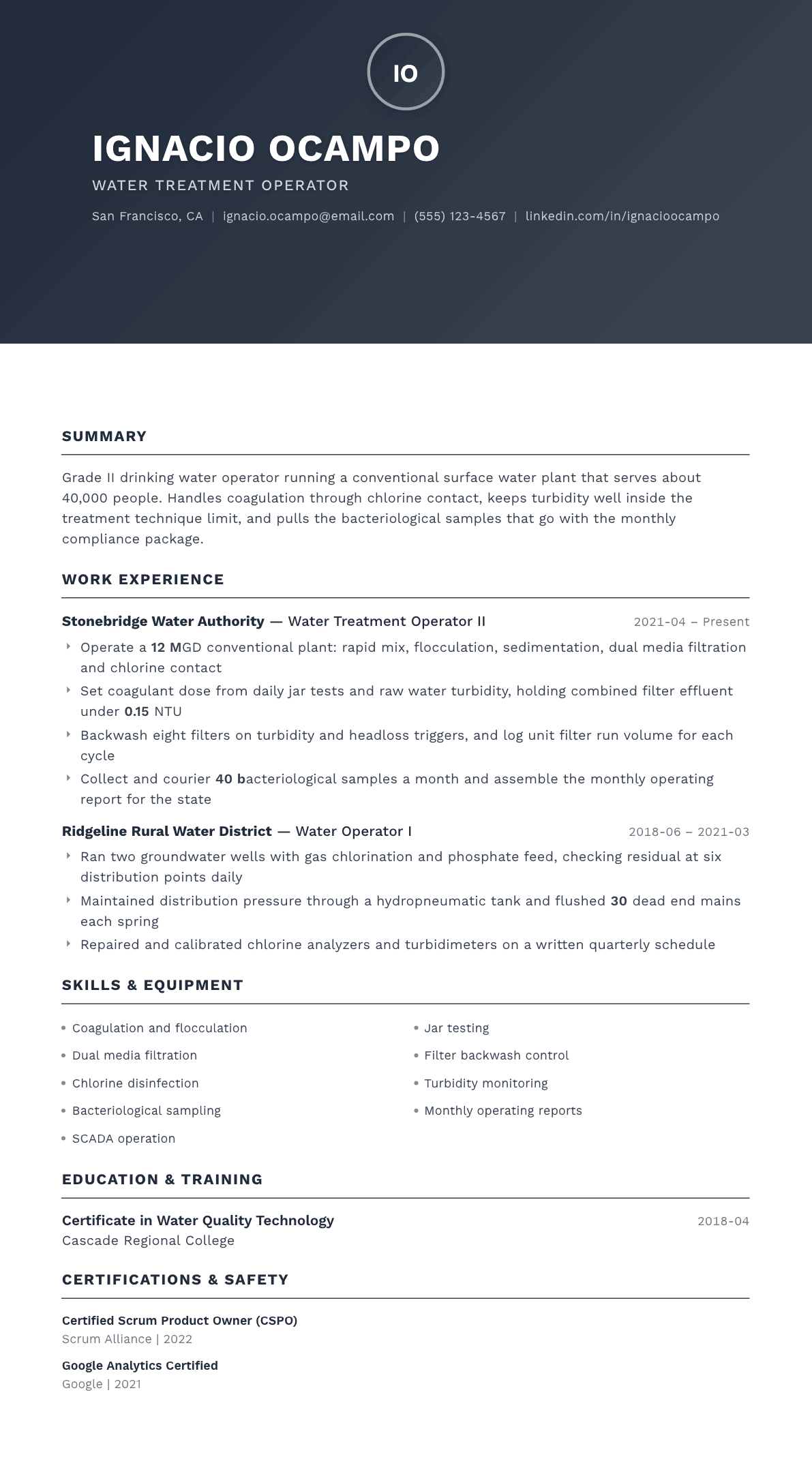
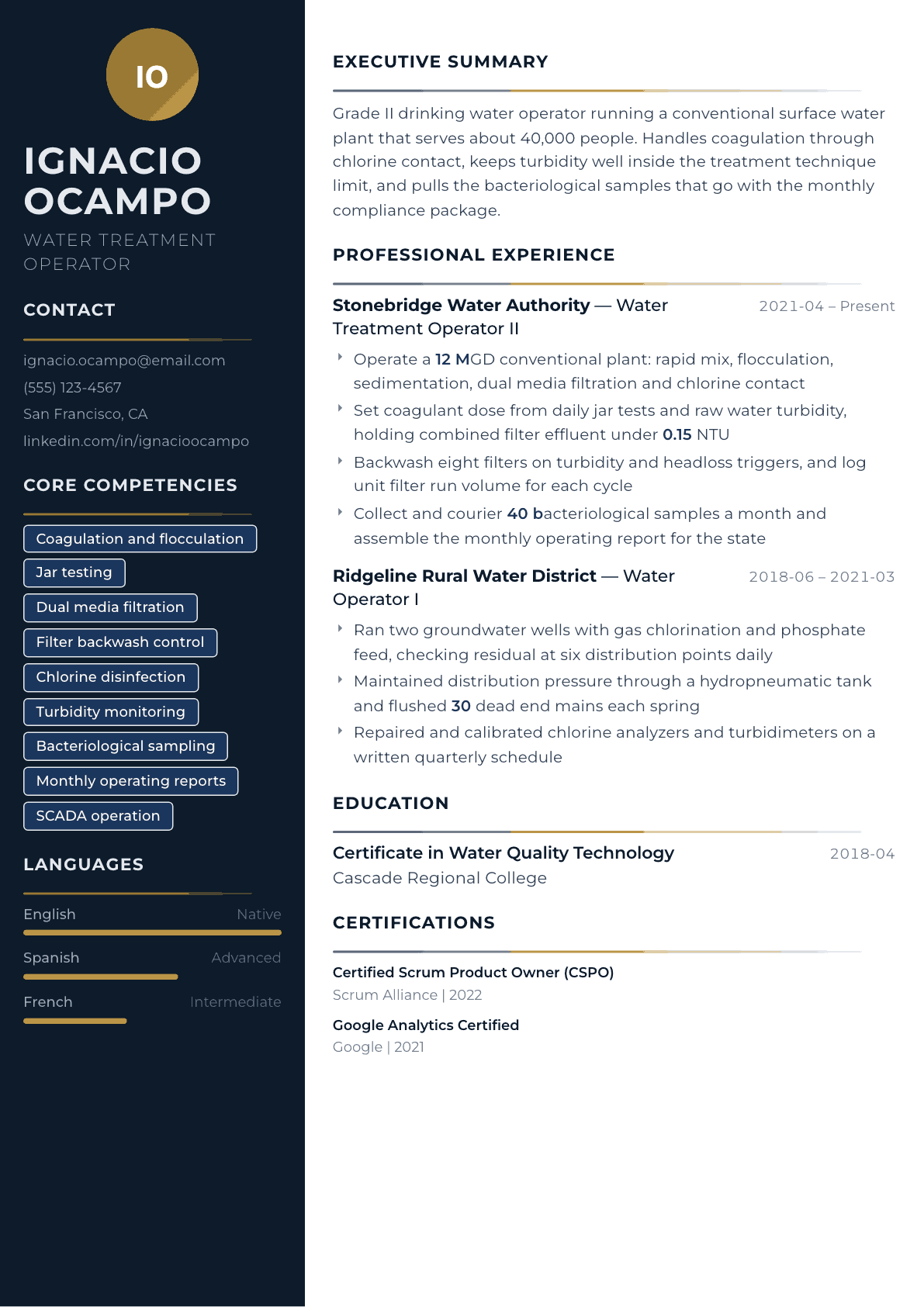
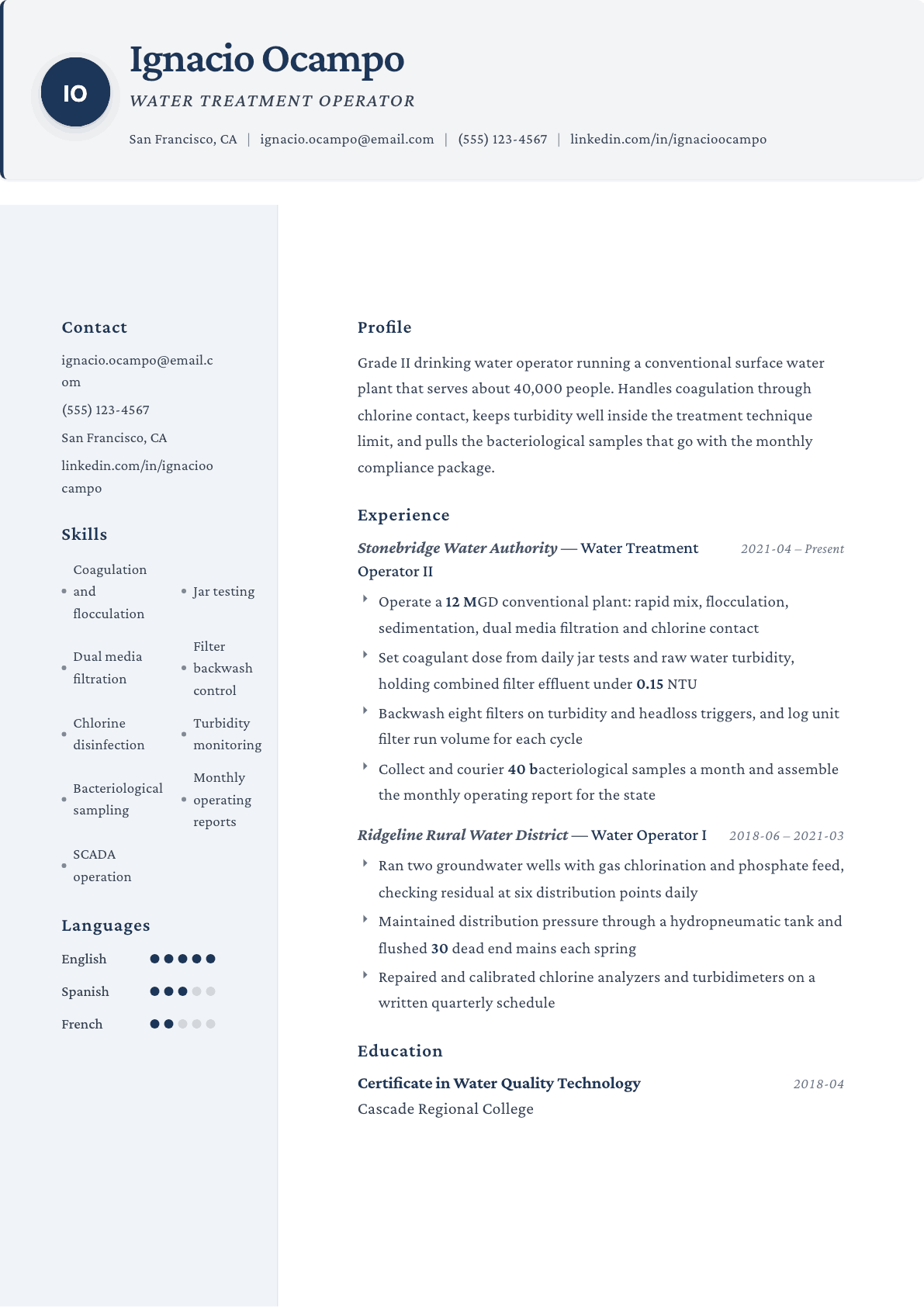
Example Water Treatment Operator summary
Grade II water treatment operator running a conventional surface water plant for a system serving about 40,000 people. Sets coagulant dose from jar tests, holds combined filter effluent well inside the turbidity limit, and manages the sampling and monthly operating report the state reviews. Also holds distribution experience across wells, storage and flushing, and is working toward the next license grade.
Skills to list on a Water Treatment Operator resume
- Surface water treatment
- Groundwater treatment
- Coagulation and jar testing
- Sedimentation basin operation
- Filtration and backwash control
- Chlorine and chloramine disinfection
- Turbidity and residual monitoring
- Fluoride and corrosion control
- Membrane and reverse osmosis systems
- Bacteriological sampling
- Monthly operating reports
- SCADA and telemetry
- Pump station operation
- Instrument calibration
- Distribution flushing and valve exercising
What actually gets this resume read
- Lead with your drinking water license grade and state, then note distribution or treatment endorsements separately.
- Say whether the source is surface water or groundwater, because the treatment train and the rules differ.
- Give the plant capacity and the population served so a utility can place your experience against its own system.
- Name the compliance reports you build, from monthly operating reports to consumer confidence report data.
- Show your instrument work: turbidimeter calibration, chlorine analyzer checks and the schedule you keep them on.
- Add distribution duties like flushing, hydrant testing and backflow work if you cover them, since small utilities need both.
How to write a water treatment operator resume
Drinking water is the one product where a bad day makes the news. A utility hiring a water treatment operator is choosing who stands between a raw source and the tap, and the person reading your resume is either a plant superintendent or a public works director who has to defend the hire if something goes wrong.
That shapes what they read for. Certification grade and state come first, because staffing rules attach operator grades to plant classifications. Then source type and treatment train, because a conventional surface plant and a chlorinated well field ask for different hands. Then whether you handle the compliance sampling and the reporting yourself.
This guide lays out the page in that order, with summary examples for a trainee, a settled Grade II operator and someone heading for chief operator, plus rewritten bullets and the questions operators ask when they change utilities or add a distribution endorsement.
Format: certification, source type, plant size, in that order
Keep it to one page unless you hold several certificates across states. The header carries your name and then your water treatment certification with grade, state and expiry, plus any distribution certificate, because those two lines are what a human resources screen matches against the posting.
Directly under the summary, describe each plant by source and process rather than by the utility name alone. Surface water with rapid mix, flocculation, sedimentation and filtration is a different job from a groundwater system with gas chlorination and sequestration, and the reader should not have to infer which one you have run.
- Header pair for a water operator: treatment certification grade and state, then distribution certification if you hold one.
- Sequence on the page: summary, certifications, plants operated by source and process, experience bullets, compliance work, then schooling.
- Each plant entry states rated capacity, the population or connection count served, and whether the site is attended around the clock.
- Where you have worked more than one source, keep surface and groundwater experience visibly separate rather than merged.
Summary: grade, source, capacity and what you sign for
Three lines that answer the screen. Grade and years, source type and plant capacity, then the piece you personally own. Ownership normally means the coagulant dose, the backwash decisions, the sampling schedule or the monthly operating report.
If you have held a chief operator or operator in responsible charge designation, put it in the first line. A utility filling a lead vacancy scans for that phrase, and mentioning it later on the page is close to not mentioning it at all.
Experience: dose decisions, filter performance and the compliance record
Water operator resumes fail when they read as a checklist of duties. What a superintendent wants is evidence that you make treatment decisions and that the numbers behind them stayed inside the rules. Coagulant dose from jar testing, filter run length, unit filter run volume, backwash triggers, disinfectant residual and contact time are the currency here.
Write bullets that pair a decision with a result. A coagulant change during spring runoff that held finished turbidity steady, a filter media inspection that explained early breakthrough, a residual problem in a far end of the distribution system that you traced to storage turnover. These read as an operator who understands the plant rather than one who watches it.
Include the maintenance you do yourself: chemical feed pump calibration, turbidimeter and chlorine analyzer verification, valve exercising, well pump checks and generator testing. Small utilities in particular hire the operator who can also keep the instruments honest.
- One bullet on coagulation or disinfection dosing with the input you used and the finished water result.
- One bullet on filter performance: run length, backwash trigger and any media or underdrain work.
- One bullet on compliance sampling and reporting, naming the report and the review outcome.
- One bullet on instrument calibration and preventive maintenance you personally perform.
Compliance, sampling and the paperwork that protects the utility
Say exactly which regulatory work you do. Bacteriological sampling under a written site plan, disinfection byproduct sampling, lead and copper sampling rounds, consumer confidence report data, and the monthly operating report all belong on the page by name. A director hiring you is buying calm at the next sanitary survey.
If you have been through a sanitary survey, a boil water advisory or a permit amendment, describe your part in it without drama. Operators who can talk plainly about a bad event and what changed afterward are more trusted than operators whose pages imply nothing has ever gone wrong.
Skills, keywords and the distribution side
Postings repeat a compact vocabulary: coagulation, flocculation, sedimentation, filtration, backwash, turbidity, chlorine residual, contact time, corrosion control, fluoridation, membrane, reverse osmosis, SCADA, storage tank and flushing. Mirror the posting language once in the skills block and once in a bullet that shows the work.
Distribution work belongs on the resume even when the job is plant only. Hydrant flushing, valve exercising, main repair support, backflow testing and pressure zone management make you useful on days when the plant is quiet, and many utilities require both certificates within a couple of years anyway.
Water Treatment Operator resume summary examples
Operator in training
Water quality technology graduate with an operator in training certificate and 15 months on a groundwater system with gas chlorination. Checks residuals at six distribution points daily, maintains a hydropneumatic tank, and pulls bacteriological samples. Preparing for the Grade I treatment exam.
Grade II, five years
Grade II water treatment operator on a 12 MGD conventional surface plant serving about 40K residents. Sets coagulant dose from daily jar tests, holds combined filter effluent turbidity well inside the treatment technique limit, and assembles the monthly operating report and bacteriological sampling package for the state.
Chief operator
Grade IV operator with seventeen years across surface and membrane plants, currently chief operator on a 25 MGD facility with a staff of seven. Owns the compliance program, led a filter media replacement and a corrosion control study, and has closed three sanitary surveys with no significant deficiencies.
Work experience bullets: before and after
Before: Operated the water treatment plant on assigned shifts.
After: Operated a 12 MGD conventional plant through rapid mix, flocculation, sedimentation, dual media filtration and chlorine contact on rotating shifts.
Naming the full treatment train tells the reader what kind of plant you can actually walk into.
Before: Adjusted chemicals as needed.
After: Set coagulant dose from daily jar tests against raw turbidity and temperature, holding combined filter effluent below 0.15 NTU through spring runoff.
It shows the input, the method and the finished water number the state measures you on.
Before: Backwashed filters when required.
After: Backwashed eight filters on turbidity and headloss triggers rather than a clock, extending average filter run length by four hours and cutting backwash water use.
The trigger logic and the run length result show real filter management, not a scheduled chore.
Before: Took water samples for testing.
After: Collected and couriered 40 bacteriological samples a month under a written sampling plan and assembled the monthly operating report with no state corrections in three years.
Volume, a written plan and a clean review record make the compliance claim verifiable.
Before: Fixed equipment problems around the plant.
After: Calibrated turbidimeters and chlorine analyzers on a written quarterly schedule and rebuilt two chemical feed pumps, keeping the plant off contract service calls for a full year.
Instrument work with a schedule and a cost consequence is exactly what a small utility is buying.
Hard skills
- Conventional surface water treatment
- Groundwater and well field operation
- Jar testing and coagulant dosing
- Flocculation and sedimentation control
- Dual media filtration and backwash
- Chlorine and chloramine disinfection
- Contact time calculations
- Turbidity and residual monitoring
- Corrosion control and sequestration
- Fluoridation systems
- Membrane and reverse osmosis operation
- Bacteriological and chemical sampling
- Monthly operating and compliance reports
- SCADA, telemetry and pump station control
- Instrument calibration and chemical feed maintenance
Soft skills
- Composure during a source water event
- Plain explanation of water quality to the public
- Care with sampling technique and holding times
- Reliability on call at night and on holidays
- Working openly with state inspectors
Certifications worth listing
- Water Treatment Operator Certification (Association of Boards of Certification)
- Water Distribution Operator Certification (Association of Boards of Certification)
- Backflow Prevention Assembly Tester (American Water Works Association)
Mistakes that cost water treatment operator candidates the interview
- Writing "water plant operator" with no source type, so a surface water utility cannot tell whether you fit.
- Leaving the certification grade, state and expiry out of the top of the page.
- Describing chemical work as adjusting chemicals rather than naming the dose, the input and the finished result.
- Skipping filter performance entirely, which is the heart of the job at a conventional plant.
- Omitting compliance sampling and reporting, the tasks that carry the most legal weight.
- Ignoring distribution duties, even though most utilities want both certificates in one person.
Water Treatment Operator resume questions
Which certification should I get first?
Whichever your current utility needs from you. Many operators take a distribution certificate early because it is achievable with less plant time, then add treatment grades as the required operating experience accumulates. List both once you have them, with grades and states.
How do I show experience if my plant is very small?
Show breadth instead of flow. Operators at small systems usually handle treatment, distribution, sampling, reporting, instrument work and customer calls in one week. Spell out that range, because it is genuinely harder to find than experience on one shift of a large plant.
Does membrane plant experience transfer to a conventional plant?
Partly. Instrumentation, disinfection, compliance sampling and SCADA transfer directly, while coagulation practice and filter management do not. Be explicit about which parts you have run so the superintendent can plan your training rather than discover the gap later.
Should I mention a boil water advisory I worked through?
Yes, if you can describe your role and what changed afterward. Utilities value an operator who has been through an event and understands notification steps, sampling clearance and public communication. Present it as a lesson learned rather than as a story about blame.
How long should a water treatment operator resume be?
One page for most operators, two only if you hold multiple state certifications and have run several plant types. Superintendents scan for grade, source, capacity and compliance history, so a long page tends to bury exactly the facts you need read first.
Related resume examples
- Wastewater Treatment Operator Resume example
- Water Treatment Engineer Resume example
- Plant Operator Resume example
- Environmental Engineer Resume example
- Lab Technician Resume example
- Process Operator Resume example