Quantity Surveyor Resume Examples: the lines they read
Craft a Quantity Surveyor Resume Around Cost Control Evidence
By Mustafa Tarabya, founder of CVBooster · Published · Updated
Quantity surveyor resume example with measurement, valuation and variation bullets, plus keywords and a guide to contracts and final accounts.
Sample resumes for a quantity surveyor
The same quantity surveyor content laid out in three CVBooster templates, so you can see what the finished document looks like before you write a word.
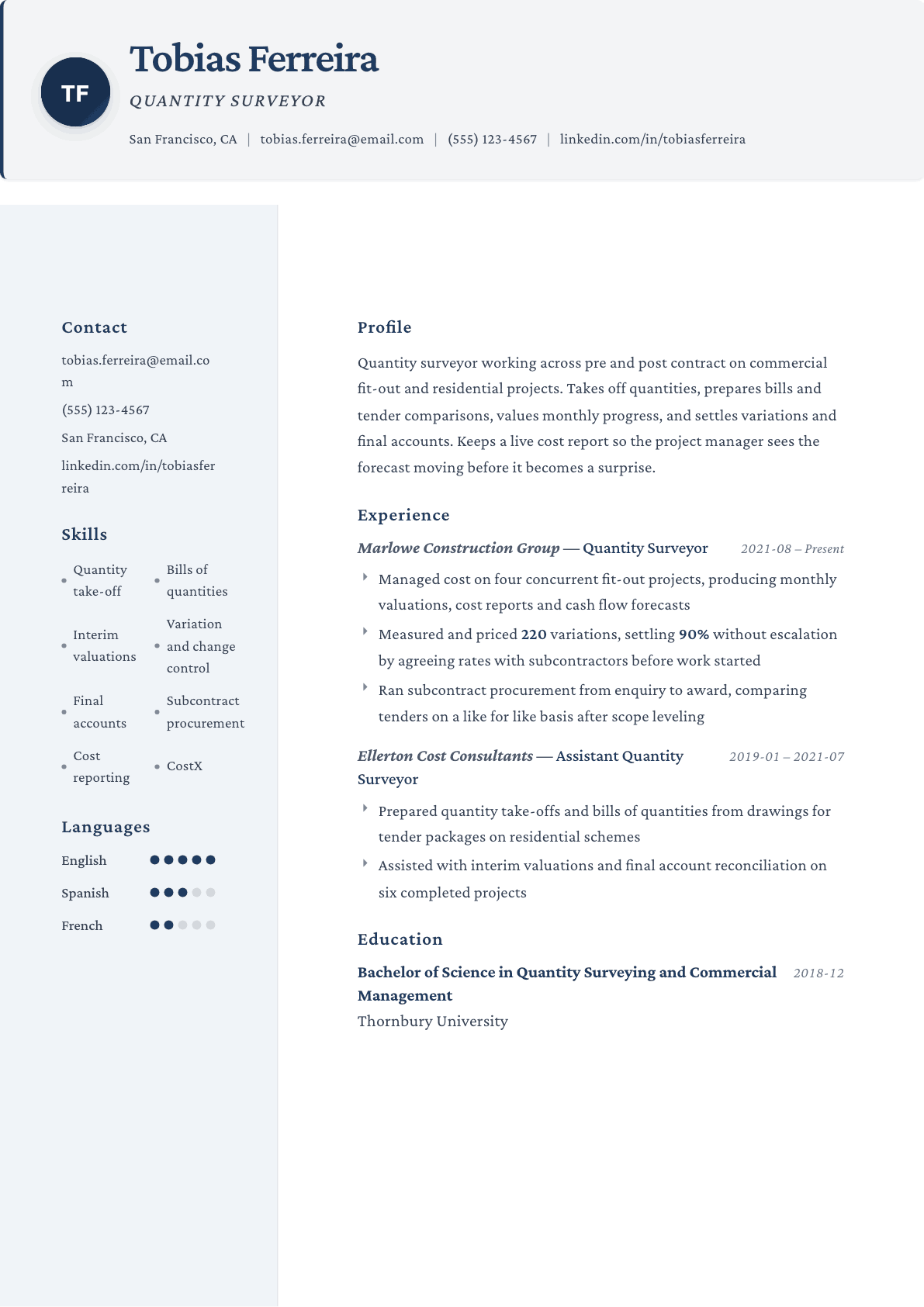
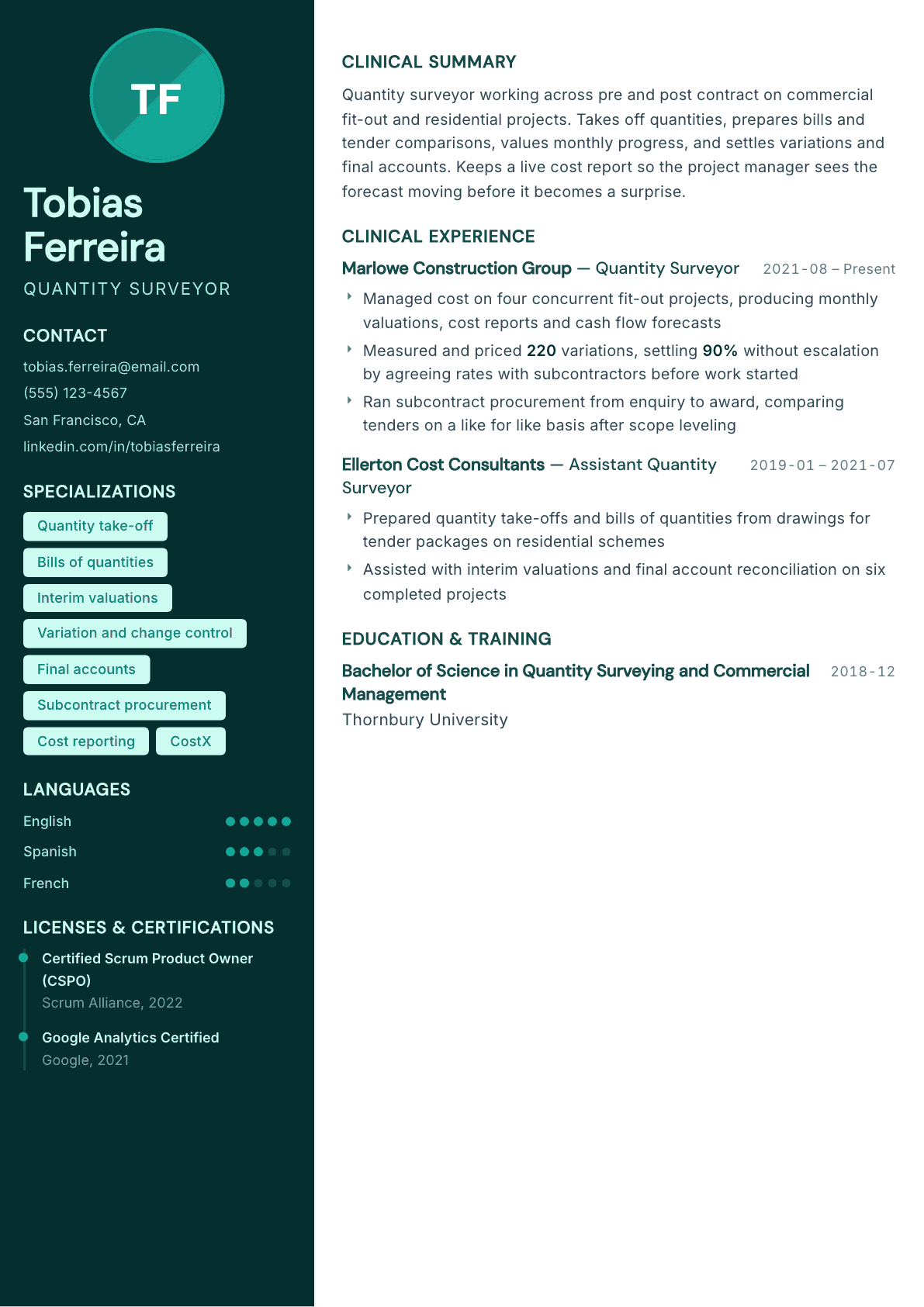
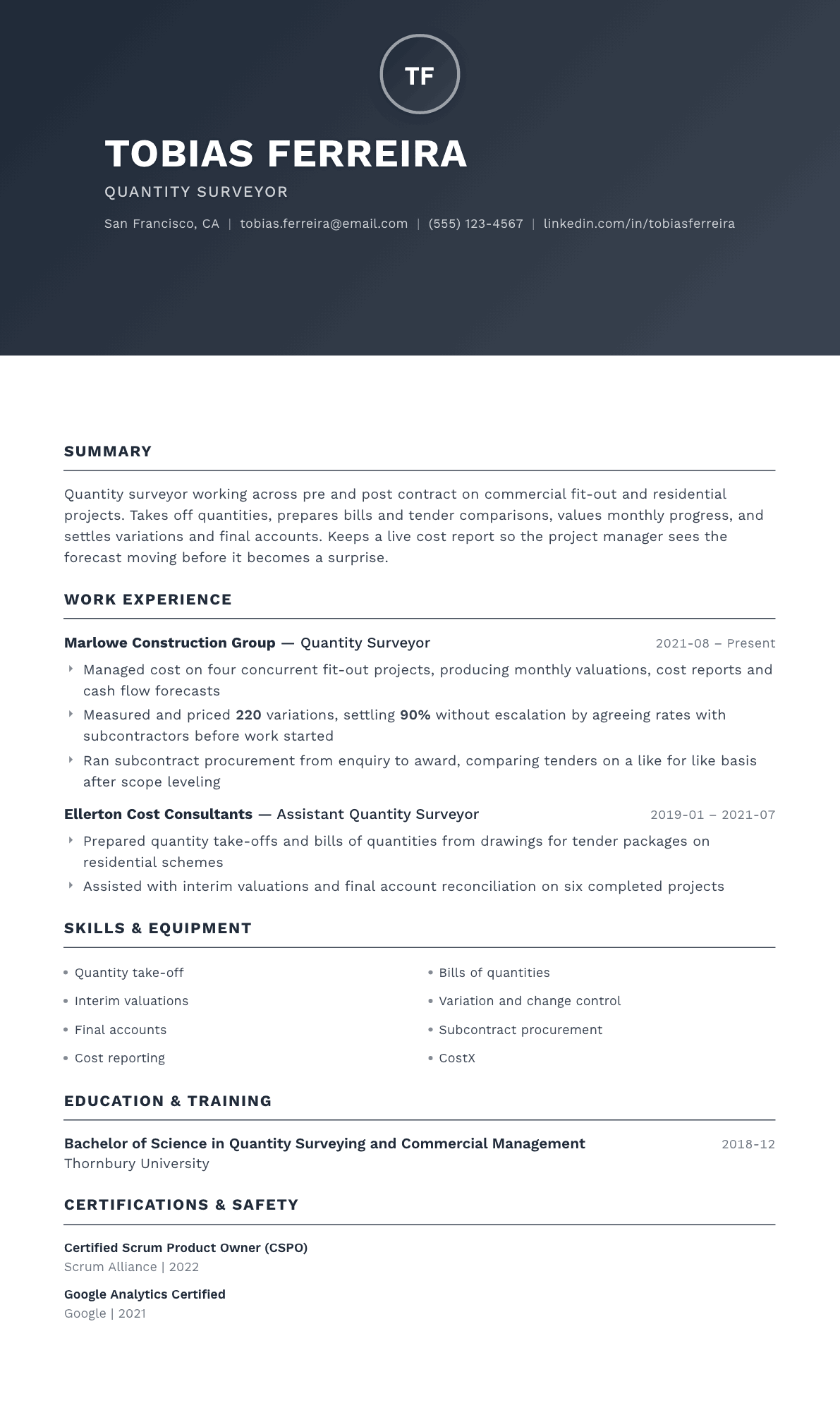
Example Quantity Surveyor summary
Quantity surveyor with six years across pre and post contract work on commercial fit-out and residential projects. Prepares take-offs and bills, runs subcontract procurement, values monthly progress and settles variations and final accounts. Measured and agreed 220 variations without escalation on a four project portfolio. Seeking a senior quantity surveyor role with a main contractor.
Skills to list on a Quantity Surveyor resume
- Quantity take-off
- Bills of quantities
- Standard method of measurement
- Tender analysis
- Subcontract procurement
- Interim valuations
- Variation management
- Change control
- Final account settlement
- Cost value reconciliation
- Cash flow forecasting
- Contract administration
- CostX
- Bluebeam
- Risk and contingency tracking
What actually gets this resume read
- Split your bullets into pre contract and post contract work, because employers hire for one side or both.
- Give the value band and type of the projects you handled rather than a general claim about large projects.
- Name the contract forms you have worked under, since claims and valuation practice change entirely with the form.
- Show variation and claim outcomes: how many were measured, agreed, and how disputes were closed out.
- List your measurement software and the standard method of measurement you used on take-offs.
- Mention chartered status or progress toward it, including the assessment route you are following.
How to write a quantity surveyor resume
A quantity surveyor resume is read as a commercial risk assessment. The commercial manager screening it wants to know whether you can measure accurately, price honestly, value monthly without giving away money, and settle a final account without the job ending in a dispute. Everything on the page should point at one of those four capabilities.
The first split a reader looks for is pre contract against post contract. Take-offs, bills of quantities, tender analysis and procurement sit on one side. Valuations, variations, change control, cost value reconciliation and final accounts sit on the other. Firms hire for one side, the other, or both, and a resume that mixes them into an undifferentiated list makes the reader do work he will not do.
This guide covers the structure a commercial team expects, three summary examples across career stages, before and after bullets from measurement and settlement work, the chartered routes worth naming, and the questions quantity surveyors ask when they move between contractor and consultancy work.
Format: two pages is normal, and projects need their own block
Reverse chronological, one column, two pages once you have several projects to describe. Commercial roles are one of the few where two pages is expected early, because project context carries real information: sector, procurement route, contract form and duration.
Consider a short project list under each employer rather than inside the bullets. Sector, value band, contract form and your role on each project reads faster than the same facts scattered through prose, and it lets a commercial manager match your background to his live jobs at a glance.
- Header: name, city, phone, email, and chartered status or progress toward it.
- Order: summary, chartered status, pre contract and post contract skills, experience with projects, education.
- Say whether you worked contractor side, consultancy side or client side in each role.
Summary: which side of the contract, which sectors
Open with the sectors and the contract stage. A quantity surveyor working across pre and post contract on commercial fit-out and residential projects has answered the two questions a commercial manager asks before any other. Then the deliverables you own: take-offs and bills, valuations, variations, final accounts, cost reports.
Close with a commercial outcome rather than a personal quality. Agreeing rates with subcontractors before work starts so that variations settle without escalation is a claim only someone who has done the job would think to make, and it lands harder than any statement about being commercially aware.
Experience: measurement, valuation and settlement
For each role give the employer type and its work, then the projects, then the commercial duties. On the pre contract side, describe what you measured and to what method: quantity take-off from drawings, bills prepared to a standard method of measurement, tender packages issued and enquiries chased, and tenders leveled so comparison is like for like. Scope leveling is the step amateurs skip and it belongs in a bullet.
On the post contract side the currency is control. Monthly valuations and applications, cost reports, cash flow forecasts, cost value reconciliation, and the variation register. Say how many variations you measured and agreed, and how they closed. Variations settled by agreeing rates before the work is done, rather than argued after, is the single most persuasive commercial habit you can describe.
Then final accounts. Accounts settled, the gap between forecast and outturn, and any claim or dispute you helped close. Employers are buying the ability to finish a job cleanly, and a surveyor who has taken accounts to agreement is worth more than one who has only ever valued interim work.
Contracts and procurement: name the forms
The contract form changes everything about valuation, notice periods, change control and claims. Name the standard forms you have worked under and the procurement routes you know, whether that is a traditional lump sum with bills, design and build, a two stage process, or a measured term arrangement. A commercial manager reads that and knows which of his jobs you can be put on.
Procurement work deserves separate bullets. Enquiry preparation, tender comparison after scope leveling, subcontract award and the terms you flowed down. A surveyor who has run a package from enquiry to award has done the part where money is actually saved or lost, and it should not be hidden inside a general procurement mention.
- Measurement: take-offs, bills of quantities, standard method of measurement, remeasurement.
- Valuation: interim applications, payment notices, retention, materials on site.
- Change: variation instructions, dayworks, loss and expense, extension of time support.
- Reporting: cost value reconciliation, forecast at completion, cash flow, risk and contingency.
Software, chartered status and screening keywords
Name the measurement software you take off in and the tools you produce cost reports with, plus any document markup package used for drawing based measurement. Fluency in a measurement tool is a genuine filter for consultancies working at volume.
Chartered status is a real screening line. If you hold it, put it after your name and name the institution. If you are working toward it, say which route and where you are in the assessment, because employers who support candidates through professional assessment look for that sentence specifically.
Quantity Surveyor resume summary examples
Assistant quantity surveyor
Quantity surveying graduate with two years preparing take-offs and bills of quantities from drawings for residential tender packages. Supported interim valuations and final account reconciliation on six completed projects, and is now working toward professional assessment through a structured training agreement.
Six years in
Quantity surveyor working across pre and post contract on commercial fit-out and residential projects. Produces monthly valuations, cost reports and cash flow forecasts on four concurrent jobs, and measured and priced 220 variations, settling 90% without escalation by agreeing rates before work started.
Senior quantity surveyor
Senior quantity surveyor with eleven years contractor side, running commercial delivery on fit-out and refurbishment projects from tender through final account. Owns procurement, valuation and change control, settles accounts to agreement, and mentors two assistants through their professional assessment.
Work experience bullets: before and after
Before: Prepared bills of quantities from drawings.
After: Prepared quantity take-offs and bills of quantities to the standard method of measurement for residential tender packages, and issued the enquiries and drawing revisions to each bidder.
Naming the measurement standard and the package issue shows the full pre contract process rather than a single task.
Before: Managed variations on site.
After: Measured and priced 220 variations across four fit-out projects and settled 90% without escalation by agreeing rates with subcontractors before the work was carried out.
The variation count, the settlement rate and the reason for it turn change management into evidence of commercial control.
Before: Did monthly valuations and cost reports.
After: Produced monthly valuations, cost value reconciliation and cash flow forecasts on four concurrent projects, so the project manager saw the forecast move before it became a surprise.
The reporting cycle and its purpose show cost control as a live discipline rather than a monthly form.
Before: Handled subcontractor procurement.
After: Ran subcontract procurement from enquiry to award, leveled scope across bidders so tenders compared like for like, and flowed main contract terms down into each subcontract.
Scope leveling and terms flow down are the steps where money is protected, and naming them proves real procurement work.
Before: Assisted with final accounts.
After: Reconciled and settled final accounts on six completed projects, closing the outstanding variation register and agreeing the outturn with the client team without recourse to formal dispute.
Settlement to agreement, with the register closed, is the outcome that commercial managers actually buy.
Hard skills
- Quantity take-off
- Bills of quantities
- Standard method of measurement
- Tender analysis and scope leveling
- Subcontract procurement
- Interim valuations and payment notices
- Variation measurement and change control
- Final account settlement
- Cost value reconciliation
- Cash flow forecasting
- Contract administration
- Risk and contingency tracking
- CostX
- Bluebeam
Soft skills
- Negotiating rates without souring a relationship
- Clear commercial reporting
- Holding a position under pressure
- Working with site teams daily
- Recording decisions in writing
- Reading a contract carefully
Certifications worth listing
- Chartered Surveyor (MRICS) (Royal Institution of Chartered Surveyors)
- Chartered Member (MCIOB) (Chartered Institute of Building)
- Certified Cost Professional (CCP) (AACE International)
- Certified Cost Technician (CCT) (AACE International)
- Certified Professional Estimator (CPE) (American Society of Professional Estimators)
Mistakes that cost quantity surveyor candidates the interview
- Mixing pre contract and post contract work into one list, so the reader cannot tell which side you are strong on.
- Describing projects as large or complex instead of giving the sector, the value band and the contract form.
- Leaving out the contract forms you have worked under, which decides how your valuation and claims experience transfers.
- Reporting duties rather than settlements, so nothing shows that you can close an account.
- Skipping the measurement standard used on take-offs, which is a direct filter for consultancy roles.
- Claiming commercial awareness with no example of a rate agreed, a claim closed or a forecast corrected early.
Quantity Surveyor resume questions
Should a quantity surveyor resume list project values?
Give a value band rather than exact figures, and pair it with the sector and contract form. Bands let a commercial manager judge scale without exposing confidential tender information, and they read as more professional than precise numbers.
How do I show the difference between contractor and consultancy experience?
Label each role by side. Contractor side work emphasizes subcontract procurement, cost value reconciliation and final accounts, while consultancy work emphasizes measurement, tender documentation and client cost reporting. Employers screen for the side they need.
Do I need chartered status to get a senior role?
Not always, but it opens client facing and consultancy positions that expect it. If you are working toward assessment, name the route and your stage, because firms that support candidates through it look for that line specifically.
How do I quantify quantity surveying work?
Count variations measured and agreed, valuations produced, packages procured, accounts settled and projects run concurrently. Those five numbers describe both workload and commercial control, which is what a hiring manager is weighing.
What if my experience is mostly assisting a senior surveyor?
Say what you personally produced. Take-offs completed, applications drafted, variation registers maintained and reconciliations prepared are real outputs even under supervision, and describing them honestly reads better than implying independent ownership.
Related resume examples
- Construction Manager Resume example
- Civil Engineer Resume example
- Construction Estimator Resume example
- Construction Project Manager Resume example
- Product Engineer Resume example
- Mining Engineer Resume example