Mining Engineer Resume Examples: the lines they read
Unearth a Mining Engineer Resume That Digs Deep Into Results
By Mustafa Tarabya, founder of CVBooster · Published · Updated
Build a mining engineer resume showcasing mine planning, geotechnical analysis, and resource estimation expertise with production metrics that impress.
Sample resumes for a mining engineer
The same mining engineer content laid out in three CVBooster templates, so you can see what the finished document looks like before you write a word.
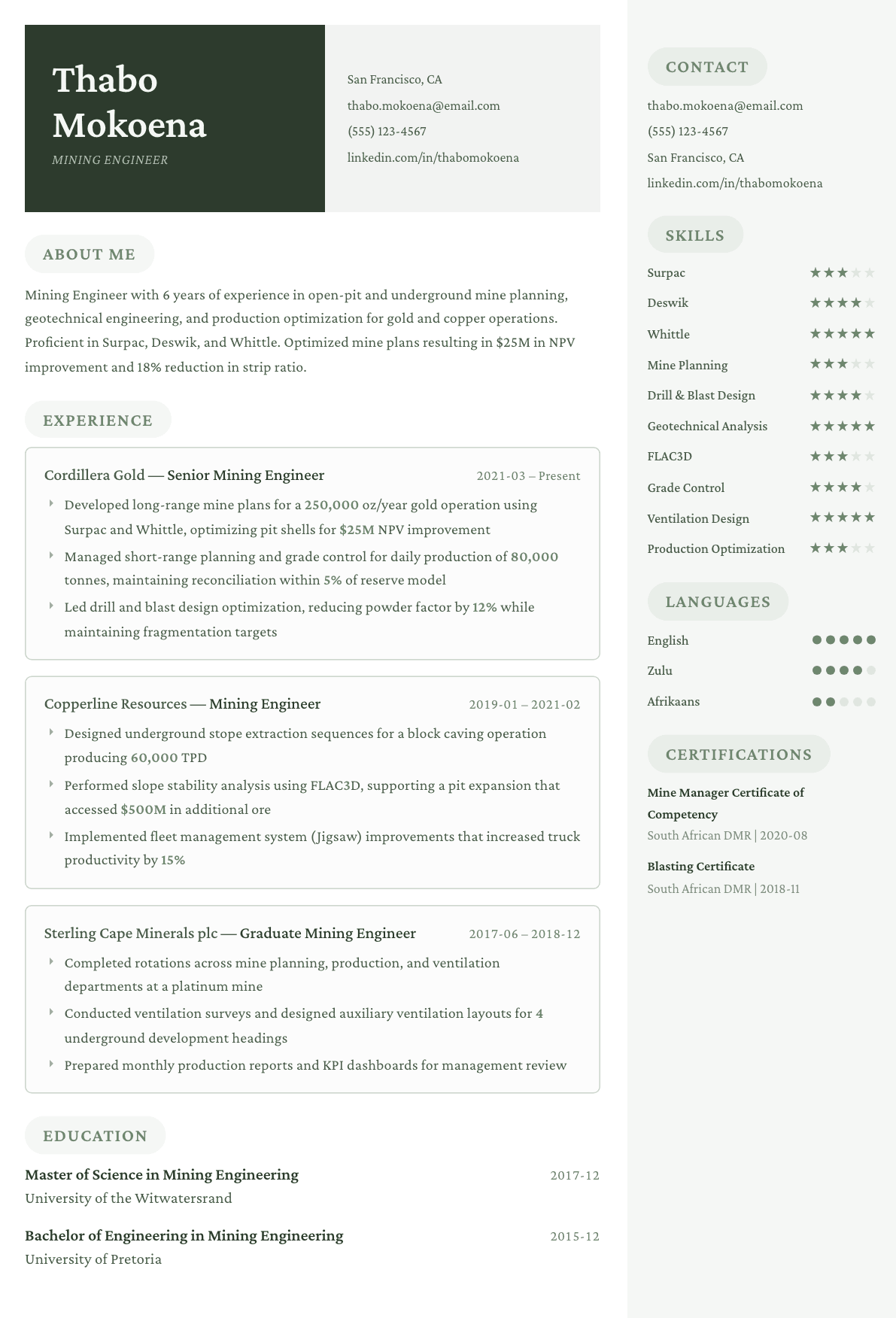
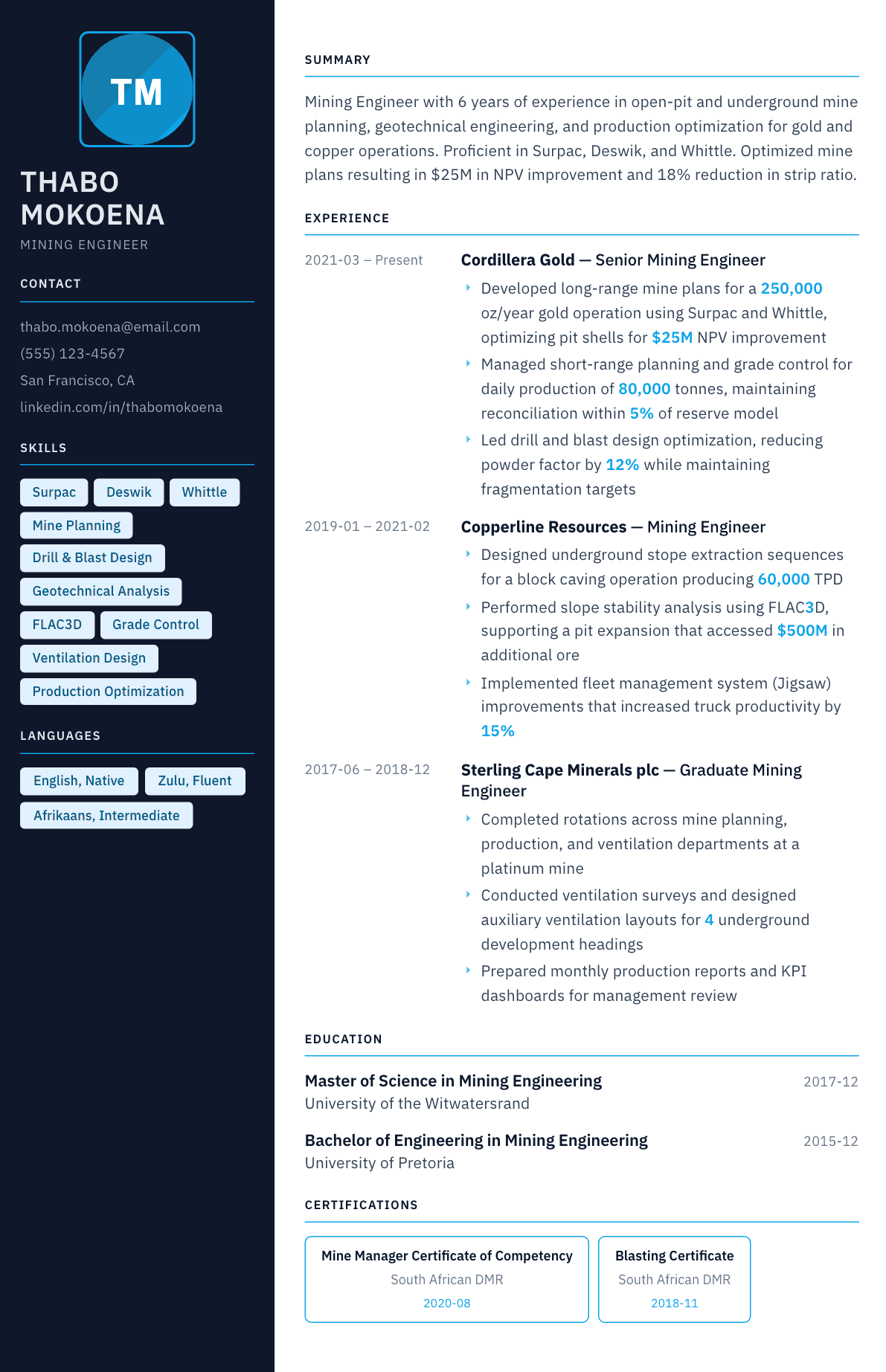
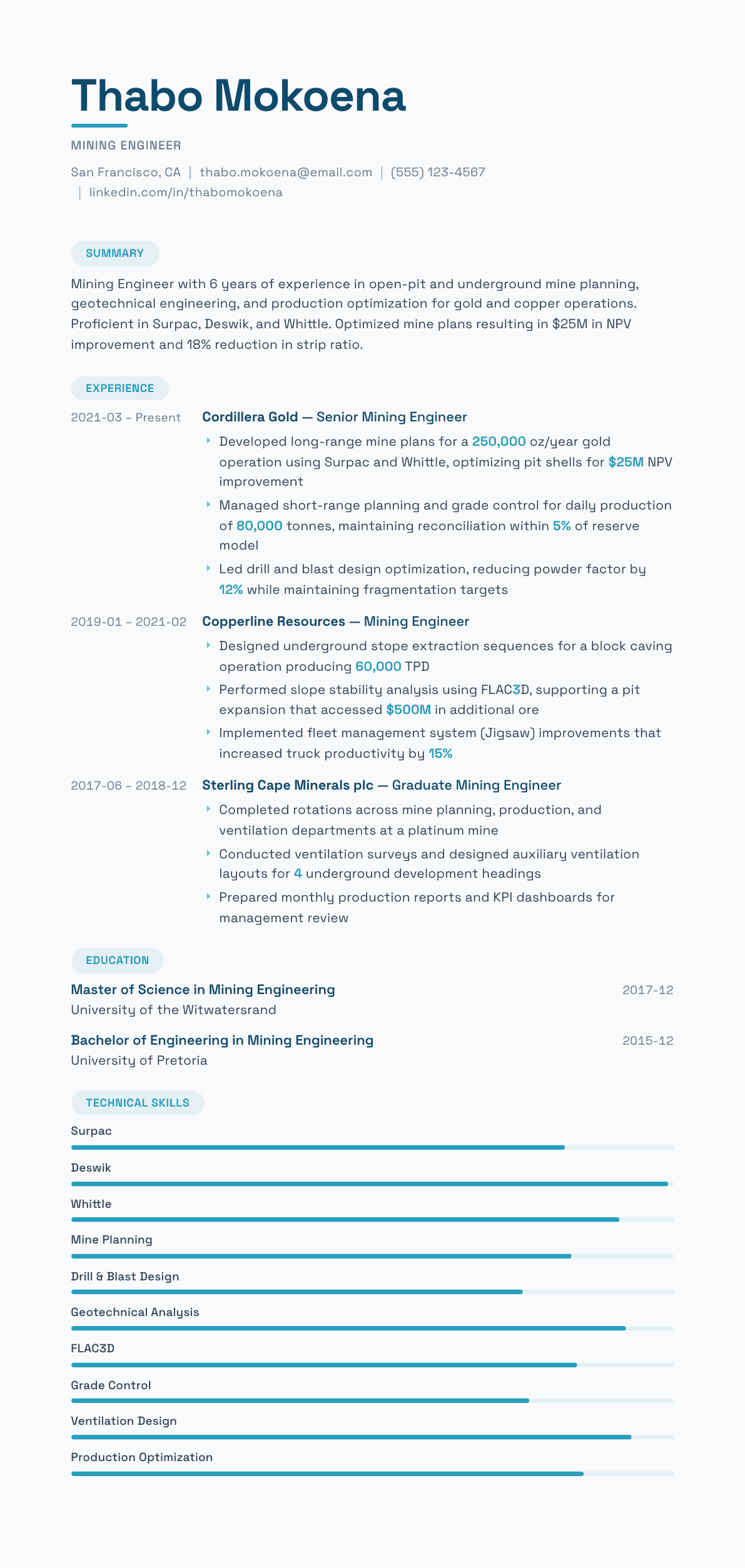
Example Mining Engineer summary
Mining Engineer with 6 years of experience in open-pit and underground mine planning for gold and copper operations. Expert in Surpac, Deswik, and Whittle with geotechnical proficiency in FLAC3D. Optimized mine plans delivering $25M in NPV improvement and 18% strip ratio reduction.
Skills to list on a Mining Engineer resume
- Surpac
- Deswik
- Whittle
- Vulcan
- Mine Planning
- Drill & Blast Design
- Geotechnical Analysis
- FLAC3D
- Grade Control
- Ventilation Design
- Production Optimization
- Resource Estimation
- Fleet Management
- Slope Stability
- Cost Estimation
What actually gets this resume read
- Highlight mine planning software: Surpac, Deswik, Whittle, Vulcan, MineSched, Datamine.
- Specify mining methods: open-pit, block caving, sublevel stoping, room-and-pillar, longwall.
- Quantify production metrics: tonnes per day, ounces per year, strip ratio, recovery rates.
- Include geotechnical tools: FLAC3D, SLOPE/W, Phase2, RocScience suite.
- Reference regulatory compliance: MSHA, DMR, JORC, NI 43-101.
- Mention commodity experience: gold, copper, coal, iron ore, platinum, lithium.
How to write a mining engineer resume
Mining engineering resumes are screened on three facts that appear in the first two lines or not at all: surface or underground, the commodity, and the mining method. A reader who plans a block cave will not shortlist an engineer whose experience is entirely open pit truck and shovel, no matter how strong the rest of the page is. Method is the profession, not a detail.
After that, the chief engineer is reading for planning horizon and software. Short range grade control, medium range scheduling and long range life of mine work are different jobs with different pressures, and each mine runs its own package for design and scheduling. Then come the operational realities: production rate, dilution and recovery, ground conditions, ventilation, and the safety and regulatory record you carry.
This guide sets out the section order mining employers expect, how to write planning and production bullets that a mine manager trusts, summaries for a graduate through a superintendent, and the questions engineers ask when moving between commodities, jurisdictions or from operations into technical services and consulting.
Format: method and commodity in the first line, software visible
Single column, reverse chronological, two pages once you have several operations behind you. Mining is a small industry where names carry weight, so state the operations by type and scale even where you cannot name the owner. Production rate in tonnes per day, mining method and commodity together give a reader an instant frame.
Keep a short software block near the top. Mining software is expensive and site specific, and an engineer already fluent in the package a site runs saves months of ramp up, which is exactly what the hiring engineer is calculating.
- Header: name, city and country, phone, email, professional registration, and mobility or rotation availability.
- Order: summary, technical software and methods, operations experience, education, registrations and safety training.
- For every operation give commodity, method, production rate and your planning horizon.
Summary: pit or underground, commodity, horizon, software
Write the summary so a technical services manager can place you in one reading. Open pit gold with truck and shovel haulage, underground copper with long hole open stoping, coal continuous miner sections, or a caving operation each imply a different toolkit and a different set of daily problems.
Name your planning horizon and your strongest area. Resource and reserve work, pit optimization and design, stope design and sequencing, drill and blast, ventilation, ground control, mine scheduling, or cost and capital studies. Then list two or three packages you use rather than every logo you have seen.
Experience: the plan, the compliance, the production result
Open each role with the operation profile, then write bullets around the planning and production cycle. A strong planning bullet says what you designed, the constraint you worked against, and how the plan performed. Plan compliance, reconciliation against the resource model, dilution and ore loss, and grade delivered to the mill are the numbers a mine manager quotes in the morning meeting, so use them.
Drill and blast work should carry the design parameters and the outcome: pattern and burden and spacing changes, powder factor, fragmentation, wall control results and vibration compliance near sensitive structures. Ground control work should carry the support standard, the instrumentation and the conditions you were managing. Ventilation work should carry airflow quantity, fan duty, and the network model you built.
Production and cost bullets are what separate an operations engineer from a study engineer. Say what you did about truck cycle times, loading efficiency, development advance rates, stope turnaround, or unit cost per tonne. If you delivered a study, name the study level and what it supported, since scoping, prefeasibility and feasibility work carry different rigor and are recognized as such.
Safety belongs in a bullet, not just in a claim. Hazard identification systems, trigger action response plans, ground control management plans, critical control verification and incident investigation are the mechanisms a mine runs on, and having led one of them is meaningful.
Skills: design and scheduling software, geotechnics, and the field work
Name design and scheduling packages specifically, alongside optimization tools, geotechnical analysis software, ventilation network modeling, and the fleet management or dispatch system you have worked with. Add block model handling and the query and reporting tools you use, since most technical services teams now expect an engineer to interrogate the database themselves.
Field competence deserves its own line and is often underclaimed by younger engineers. Survey pickup and mark up, face and bench mapping, grade control sampling, backfill placement, shotcrete and support installation supervision, and blast supervision all show that you can work in the production environment rather than only in an office.
Registration, reporting codes and safety training
Professional registration matters more in mining than in many engineering fields because public reporting of resources and reserves requires a qualified or competent person under the relevant code. If you contribute to public disclosure, state your registration and any sign off responsibility clearly.
List statutory and safety training with the jurisdiction it applies to: the mandatory new miner and refresher training, first aid and mine rescue, blasting or shot firer authority, gas testing and ventilation officer qualifications, and any statutory certificate of competency such as a mine manager or mine foreman ticket. These are hard gates in many jurisdictions and belong on the page rather than in a cover letter.
Mining Engineer resume summary examples
Graduate engineer
Mining engineering graduate with two vacation placements on an open pit gold operation and an underground platinum mine. Completed pit design and short-term scheduling exercises in mine planning software, ran ventilation surveys on 4 development headings, and holds statutory new miner and first aid training.
Five years in planning
Mining engineer on a truck and shovel copper operation moving about 90 thousand tonnes per day. Owns short range planning, grade control and drill and blast design, holds plan compliance above 92%, and cut powder factor by 11% while keeping fragmentation within mill feed targets.
Technical services superintendent
Technical services superintendent with 14 years across underground long hole stoping and open pit gold. Leads a team of 7 engineers and surveyors, owns life of mine planning and reserve reporting, and delivered a prefeasibility study that added 6 years of mine life through a pushback redesign.
Work experience bullets: before and after
Before: Prepared mine plans and schedules.
After: Built the rolling three-month schedule for a truck and shovel operation, balanced mill feed grade against stripping requirements, and held plan compliance above 90% for eight consecutive months.
A named horizon, the constraint being balanced and a compliance figure show planning that survived contact with production.
Before: Did drill and blast design for production blasts.
After: Redesigned the production blast pattern for a hard basalt bench, trialed a wider burden with an emulsion change, and held fragmentation within mill targets while dropping powder factor by 11%.
Rock type, the specific design change and a two-sided result prove the optimization did not simply degrade fragmentation.
Before: Worked on ground support and geotechnical issues.
After: Revised the ground support standard for a deteriorating decline: added fibrecrete and cable bolting through 180 metres, installed extensometers, and reopened the heading with a documented trigger action response plan.
Support elements, instrumentation and a formal response plan turn a vague statement into managed geotechnical risk.
Before: Improved productivity of the mining fleet.
After: Analyzed dispatch data to find queueing at a single crusher tip, resequenced haul assignments and added a second tip point, lifting truck effective utilization by 8% without adding units.
The data source, the diagnosis and a capital-free fix are exactly what an operations manager wants to read.
Before: Assisted with resource and reserve estimation.
After: Converted the measured and indicated resource into a reserve for the annual statement, applied dilution and recovery factors from reconciliation history, and documented the modifying factors for the qualified person review.
Naming the modifying factors and the review path shows you understand what public reporting actually requires.
Hard skills
- Open pit design and pit optimization
- Underground stope design and sequencing
- Short and long range mine scheduling
- Drill and blast design
- Grade control and reconciliation
- Resource and reserve modifying factors
- Geotechnical analysis and ground support design
- Ventilation network modeling
- Mine surveying and mark up
- Haulage and fleet productivity analysis
- Backfill design and placement
- Cost estimation and capital studies
- Mine planning software
- Block model interrogation and query tools
Soft skills
- Working with crews underground
- Decisions under production pressure
- Safety leadership
- Rotation and remote site resilience
- Communication with geology and processing
- Contractor supervision
Certifications worth listing
- Professional Engineer, Mining (State or provincial licensing board)
- Registered Member (Society for Mining, Metallurgy and Exploration)
- Chartered Professional (Australasian Institute of Mining and Metallurgy)
- Part 46 or Part 48 New Miner and Refresher Training (Mine Safety and Health Administration)
- Mine Manager or Mine Foreman Certificate of Competency (State or national mining regulator)
Mistakes that cost mining engineer candidates the interview
- Leaving out the mining method, which is the first filter every mining employer applies and cannot be inferred from a commodity alone.
- Listing software without saying what you built in it. Naming a package proves access, not the ability to produce a defensible design.
- Quoting production improvements with no baseline, no period and no mention of what else changed on site at the same time.
- Skipping statutory training and registrations, which are hard requirements in most jurisdictions and slow down every application without them.
- Writing only office work when the posting is operational. Face time, blast supervision and shift coverage are what an operations manager is hiring for.
- Ignoring reconciliation. Plans that were never checked against actual tonnes and grade are not evidence of planning skill.
Mining Engineer resume questions
How do I move from open pit to underground mining?
Emphasize what transfers directly: scheduling logic, drill and blast fundamentals, reconciliation, cost work and safety systems. Then be explicit about what you are learning, such as ground support and ventilation, and add any underground exposure, site visit or coursework so the reader sees deliberate intent.
Which mining software should I list on my resume?
List the design, scheduling and optimization packages you have produced real deliverables in, plus any geotechnical or ventilation modeling tools and the dispatch system from your site. Two packages used deeply read far better than six listed without any output attached.
Do mining engineers need professional registration?
It becomes important once you contribute to public resource and reserve reporting, since those statements must be signed by a qualified or competent person under the applicable code. Many operational roles do not require it, but it opens consulting and technical leadership paths.
How do I show safety leadership on a mining resume?
Describe the system you ran rather than repeating a commitment to safety. Leading incident investigations, owning a ground control management plan, verifying critical controls or building a trigger action response plan are all concrete and are recognized immediately by mining readers.
How should I handle rotation and remote site work on my resume?
State the roster you worked, since a two week on and one week off rotation at a remote camp is a real qualification in this industry. Mentioning availability for fly in and fly out work removes an early screening question and often moves your file forward faster.
Related resume examples
- Civil Engineer Resume example
- Petroleum Engineer Resume example
- Environmental Engineer Resume example
- Drilling Engineer Resume example
- Quantity Surveyor Resume example
- Geotechnical Engineer Resume example